
Cape CanaveralSection 1 |
USA |
 Cape Canaveral Map of Cape Canaveral Credit: © Mark Wade |
AKA: Cape Kennedy;Kennedy Space Center;KSC;Patrick AFB;Spaceport Florida. First Launch: 1950-07-24. Last Launch: 2014-08-05. Number: 5044 . Location: Florida. Longitude: -80.56 deg. Latitude: 28.47 deg. Apogee: 3.00 km (1.80 mi).
Spaceport Florida consisted of one launch complex, including a pad and a remote control center; a small payload preparation facility; and an RLV support facility. The Florida Space Authority invested over $500 million to upgrade launch sites, build an RLV support complex adjacent to the Shuttle Landing Facility, develop a new space operations support complex, and build a state-of-the-art research facility at Kennedy Space Center.
Major planned additions to the Cape Canaveral complexes that were never completed included:
- Four Nova-class booster pads north of the Saturn complex, with the Nova Vertical Assembly Building and its port located at the northernmost tip of the strip of land next to the so-called 'Mosquito Lagoon' (now a national seashore and wildlife refuge). South of the Nova VAB on this strip of land there were also plans for a Solid Rocket Booster check-out / storage building.
- The unbuilt LC-42, which was intended to be used by Titan 3 and 4 rockets. Its would have branched to the north of the Titan causeway., symmetrical to LC-40. It is doubtful that LC-42 will ever be built because it would pose a safety problem to operations from LC-39A.
- A third Saturn 5 pad. LC-39C was the original designation for the pad closest to the Vertical Assembly Building, and LC-39A for the farthest of the three planned pads. When it was decided not to build the third launch pad LC-39C was renamed LC-39A.
Minimum Inclination: 28.0 degrees. Maximum Inclination: 57.0 degrees.
In October 1946, the Armed Forces Joint Research and Development Board created a committee to select an over-water test range for long-range missiles. The Committee on Long Range Proving Grounds initially selected California s El Centro Marine Corps Base but abandoned the site after a breakdown in talks with the Mexican Government regarding sovereignty rights for needed tracking stations. Next, the committee looked at the recently deactivated Banana River Naval Air Station located on Florida's east coast. Featuring a climate allowing year-round operations, isolation, government-owned property, an existing infrastructure associated with a naval air station, and islands down-range that would allow for tracking facilities, the area near Cape Canaveral became the committee's final selection for what would become America's spaceport.
In May 1949, President Truman authorized the establishment of a joint long-range proving ground at the eastern Florida site and a month later the Banana River Naval Air Station was reactivated. In August 1950, the facility became Patrick AFB, home to the Air Force Missile Test Center (AFMTC).
Initial responsibility for construction at the Cape and Patrick AFB fell to the Jacksonville District of the Corps of Engineers. Tasked in May 1950 with building the pad for the first missile launch at the Cape, the District succeeded in having the facility ready in time for the July 24 lift-off of a V-2 with a WAC Corporal upper stage (missile test number Bumper No. 8).
Throughout the 1950s, the Jacksonville District supervised the construction of missile service gantries, control bunkers, assembly and research buildings, and other support structures. These facilities supported research, development, testing, and evaluation for such air-breathing weapons as Matador, Snark, Mace, and BOMARC.3 In addition, the Corps built a deep-water port to allow the delivery of large components.
The Matador, first launched from the Cape on June 20, 1951, became the first Cape-tested weapon to enter the Air Force operational inventory. From 1951 to 1962, 286 Matadors lifted off into the Atlantic sky from Complexes 1-3. Another air-breathing missile to undergo extensive testing at AFTMC was the Snark. From August 29, 1951, to December 5, 1960, 97 Snarks were tested. As a follow-on to the Matador, the Martin Company produced the Mace, which underwent testing at the Cape between 1959 and
a Snark and BOMARC are discussed in Part I. Mace and Matador were built by the Martin Company as intermediate-range cruise missiles for overseas deployment. The two missiles resembled swept-wing fighter planes without cockpits.
Florida Sites
1962. Testing for the BOMARC area defense weapon began at the Cape and later continued at Eglin AFB, Florida. One AFMTC-tested long-range missile that never deployed, the Navaho, pioneered inertial guidance and large rocket engine technology that would find its way into IRBMs and ICBMs.
On August 30, 1953, the Army's Redstone became the first ballistic missile to lift off from the Cape. Two years later, the Army began testing to support development of its Jupiter IRBM. In May 1957, a Jupiter prototype launched from the Cape recorded a flight of 1,050 miles. Meanwhile, the Air Force began testing its Thor IRBM at the Florida facility in January 1957. The first successful Thor launch occurred the following October.
Cape Canaveral played a critical role in ICBM development. Atlas models A through F underwent constant testing in the late 1950s as did the Titan I. Later, the Air Force also tested its Titan II and Minuteman ICBMs at the Cape. In addition, the Navy constructed and used Cape facilities to test its sea-launched ballistic missiles. Of course Cape Canaveral became best known for its role in America's manned space program.
Because of the growth of the space program, on May 1, 1963, the Corps of Engineers created a new Canaveral District to supervise Cape construction. Eight years later, this District was disestablished with functions being assumed by a newly created Florida office of the Mobile District.
| Cape Canaveral LC3 X-17, V-2, Polaris, Bomarc launch complex. This complex was built to support the Bomarc interceptor missile program, but also supported Bumper, Jason, Redstone, X-17 and Polaris ballistic missile operations. The Air Force accepted Complex 3 in November 1951. The location had already supported the Cape's first major launch - Bumper 8 - on 24 July 1950. Following the last Bomarc launch in April 1960, some Bomarc support facilities were converted into a medical support area for Project Mercury. Later the complex supported tethered aerostat programs from 1983 through 1989. |
| Cape Canaveral LA Snark, Matador, Lark launch area. |
| Cape Canaveral LC4 Redstone, Matador, Bomarc launch complex. This complex was built to support the Bomarc interceptor missile program, but also supported Bumper, Jason, Redstone, X-17 and Polaris ballistic missile operations. The Air Force accepted Complex 4 in 1952. Following the last Bomarc launch in April 1960, some Bomarc support facilities were converted into a medical support area for Project Mercury. Later the complex supported tethered aerostat programs from 1983 through 1989. |
| Cape Canaveral LC2 Snark launch complex. This complex was constructed for the Snark winged missile program, and may have supported some Matador combat training launches in the 1950s. The Air Force accepted the sites in 1953, and the complexes continued to support Snark launches through 5 December 1960. The pad served as a helicopter pad for the Mercury manned program in the early 1960s, and supported tethered aerostat (balloon) programs from 1983 through 1989. |
| Cape Canaveral LC6 Redstone, Jupiter launch complex. Pad 6 supported its first Redstone launch on 20 April 1955, three months before the complex was finally accepted by the U.S. Government. In addition to Redstone and Jupiter launches, the complex supported Explorer and Pioneer missions and all six Redstone /Mercury suborbital flights. On 31 January 1964, Complexes 5 and 6 were reassigned to become part of the USAF Space Museum. |
| Cape Canaveral RW30/12 Navaho, Matador launch complex. Skid Strip, Cape Canaveral Air Station |
| Cape Canaveral LC5 Redstone, Jupiter launch complex. Pad 5 supported its first Jupiter A launch on 19 July 1956. In addition to Redstone and Jupiter launches, the complex supported Explorer and Pioneer missions and all six Redstone /Mercury suborbital flights. On 31 January 1964, Complexes 5 and 6 were reassigned to become part of the USAF Space Museum. |
| Cape Canaveral LC9 Navaho launch complex. The complex was built to support the Navaho winged intercontinental missile program. The Air Force accepted both sites 9 and 10 on 29 June 1956. Both complexes were demolished in 1959 to make room for Minuteman complexes 31 and 32. |
| Cape Canaveral LC18A Viking, Vanguard, Scout launch complex. The LC18 complex included two launch pads 18A and 18B. Pad 18A was used to launch 14 Vanguard space vehicles for NASA and the U.S. Navy between 8 December 1956 and 19 September 1959. Following termination of the Vanguard program, Pad 18A supported ten Blue Scout Junior launches for the Air Force between 21 September 1960 and 10 June 1965. Complex 18 was deactivated on 1 February 1967. |
| Cape Canaveral LC17B Delta launch complex. Part of a dual launch pad complex built for the Thor ballistic missile program in 1956. Upgraded over the decades for use with Thor, Delta, Delta II, and Delta III launch vehicles, it remained in use for over half a century. |
| Cape Canaveral LC14 Atlas launch complex. The complex was built for the Atlas ballistic missile program. Launch sites 11 to 14 were accepted between August 1957 and mid-April 1958. After its final Atlas missile launch, Complex 14 was converted into an Atlas /Agena launch complex, and later turned over to NASA. Complex 14 supported 32 Atlas and Atlas/Agena missions, including four manned Mercury missions and seven unmanned Gemini target vehicle launches. Complexes 11, 12 and 14 were deactivated in 1967. Complex 14 and the gantry on Complex 13 were declared national historic landmarks in April 1984. |
| Cape Canaveral LC1 Snark launch complex. This complex was constructed for the Snark winged missile program, and may have supported some Matador combat training launches in the 1950s. The Air Force accepted the sites in 1953, and the complexes continued to support Snark launches through 5 December 1960. The pad served as a helicopter pad for the Mercury manned program in the early 1960s, and supported tethered aerostat (balloon) programs from 1983 through 1989. |
| Cape Canaveral LC26A Redstone, Jupiter launch complex. The LC-26 dual launch pad complex was constructed for the U.S. Army's Redstone and Jupiter missile programs in 1956-1957. At least 36 Redstone, Jupiter, Jupiter C and Juno II launches were conducted 1957-1964. |
| Cape Canaveral LC17A Delta launch complex. Part of a dual launch pad complex built for the Thor ballistic missile program in 1956. Pad 17A supported Thor, Delta, and Delta II launches into the 21st Century. |
| Cape Canaveral LC26B Jupiter launch complex. The LC-26 dual launch pad complex was constructed for the U.S. Army's Redstone and Jupiter missile programs in 1956-1957. At least 36 Redstone, Jupiter, Jupiter C and Juno II launches were conducted 1957-1964. |
| Cape Canaveral LC12 Atlas launch complex. The complex was built for the Atlas ballistic missile program. Launch sites 11 to 14 were accepted between August 1957 and mid-April 1958. Complex 12 supported its first Atlas launch on 10 January 1958, and it supported nine Ranger missions and four Mariner missions between 12 August 1961 and 15 June 1967. Complexes 11, 12 and 14 were deactivated in 1967, and Complex 13 was deactivated in April 1978. |
| Cape Canaveral LC25A X-17, Polaris launch complex. Complex 25 was built to support the U.S. Navy's Polaris submarine ballistic missile program. The Navy occupied pad 25A in December 1957. Complex 25 supported 68 Polaris missile launches between 18 April 1958 and 6 March 1965. Pads 25A and 25B were dismantled in September 1969. |
| Cape Canaveral LC18B Scout, Delta launch complex. The LC18 complex included two launch pads 18A and 18B. Pad 18B supported 17 Thor missile launches between 4 June 1958 and 1 March 1960. Pad 18B supported half a dozen Blue Scout I, Blue Scout II and Scout missions between 7 January 1961 and 13 April 1962. Complex 18 was deactivated on 1 February 1967. |
| Cape Canaveral LC11 Atlas launch complex. The complex was built for the Atlas ballistic missile program. Launch sites 11 to 14 were accepted between August 1957 and mid-April 1958. Complex 11 supported 28 Atlas launches and five Atlas Advanced Ballistic Reentry System flights between 19 July 1958 and 2 April 1964. Complexes 11, 12 and 14 were deactivated in 1967. |
| Cape Canaveral LC13 Atlas launch complex. Originally built in 1958 for the Atlas ballistic missile program. |
| Cape Canaveral LC10 Navaho, Jason, Draco launch complex. The complex was built to support the Navaho winged intercontinental missile program. The Air Force accepted both sites 9 and 10 on 29 June 1956. Both complexes were demolished in 1959 to make room for Minuteman complexes 31 and 32. |
| Cape Canaveral LC4A Bomarc launch complex. This complex was built to support the Bomarc interceptor missile program, but also supported Bumper, Jason, Redstone, X-17 and Polaris ballistic missile operations. The Air Force accepted Complex 4 in 1952. Following the last Bomarc launch in April 1960, some Bomarc support facilities were converted into a medical support area for Project Mercury. Later the complex supported tethered aerostat programs from 1983 through 1989. |
| Cape Canaveral AMR DZ Launch point used for drop of air-launched missiles down the Atlantic Missile Range. |
| Cape Canaveral LC22 Mace launch complex. Cruise missile launch complex. Supported 20 Bull Goose and Goose missile launches 1957-1958. Rebuilt to support 44 Mace missile launches 1959-1963. |
| Cape Canaveral LC43 Viper, Loki, Hopi, Arcas, Rocketsonde launch complex. |
| Cape Canaveral LC15 Titan launch complex. Complexes 15, 16, 19, and 20 were built for the Titan ballistic missile program. The sites were accepted by the U.S. Government between February and mid-September 1959. All four sites supported Titan I launches in 1959 and the early 1960s, and complexes 15 and 16 supported Titan II launches between 16 March 1962 and 10 April 1964. Complex 15 was deactivated in March 1967, and it was dismantled three months later. |
| Cape Canaveral LC19 Titan launch complex. Complexes 15, 16, 19, and 20 were built for the Titan ballistic missile program. The sites were accepted by the U.S. Government between February and mid-September 1959. All four sites supported Titan I launches in 1959 and the early 1960s. In 1962 and 1963, Complex 19 was converted into the space program's only manned Titan II/Gemini launch complex. It supported two unmanned and ten manned Gemini missions between 8 April 1964 and 16 November 1966. Complex 19 was deactivated on 10 April 1967, and it was declared a national historic landmark in April 1984. |
| Cape Canaveral LC25B Polaris launch complex. Complex 25 was built to support the U.S. Navy's Polaris submarine ballistic missile program. The Navy occupied pad 25B in January 1958. Pads 25A and 25B were dismantled in September 1969. |
| Cape Canaveral LC29A Polaris launch complex. Complex 29 was built to support the U.S. Navy's Polaris submarine ballistic missile program. Construction began in August 1958. The Navy occupied the site in July 1959, and Pad 29A supported 47 Polaris launches between 21 September 1959 and 2 November 1967. The complex was placed on standby status in 1968, and it was upgraded to support the British Chevaline submarine ballistic missile program in the mid 1970s. Complex 29 supported ten Chevaline launches between 12 September 1977 and 20 May 1980. The site was deactivated in 1980. |
| Cape Canaveral LC16 Titan, Pershing launch complex. Originally built for the Titan ballistic missile program in 1959. Supported Titan I and II launches from 1959 to 1964. Reassigned to NASA in 1965 for static firings of the Apollo service module propulsion engine. Deactivated in 1969, later reassigned to the U.S. Army, supported 128 Pershing ballistic missile launches 1974 -1988. Deactivated in accordance with the Intermediate Nuclear Forces (INF) Treaty. |
| Cape Canaveral LC32A Complexes 31 and 32 were built between July 1959 and July 1960 to support the Air Force's Minuteman missile program. Each complex had one blockhouse and two launch pads. The two "A" pads were constructed as conventional flat pads, and the two "B" pads were built as ballistic missile silos. The sites were modified subsequently to support later versions of the Minuteman missile. In all, 92 Minuteman I, II and III missiles were launched from the complexes between 1 February 1961 and 15 December 1970. |
| Cape Canaveral LC20 Titan, Super Chief, Loki, Prospector, Aries launch complex. Complexes 15, 16, 19, and 20 were built for the Titan ballistic missile program. The sites were accepted by the U.S. Government between February and mid-September 1959. All four sites supported Titan I launches in 1959 and the early 1960s. Complex 20 was modified to support four Titan IIIA flights which took place between 1 September 1964 and 7 May 1965. The site was deactivated in April 1967, but it got a new lease on life toward the end of the 1980s. Complex 20 was selected for the Starbird program in 1987, and it supported a Starbird launch on 18 December 1990. Between 18 June 1991 and 29 May 1993, the complex supported the commercial Joust-1 launch and four Red Tigress and Red Tigress II missions sponsored by the Strategic Defense Initiative Organization. Much of Complex 20's electronic equipment and both of its rail launchers were removed in 1995, rendering the site inactive for a time. |
| Cape Canaveral LC42 Complexes 40 and 41 were constructed as part of a $39 million project to build an Integrate-Transfer-Launch (ITL) facility at the north end of Cape Canaveral in the early 1960s. An additional LC-42 was planned at the ITL to support ambitious military space projects that never materialized. It was intended to be used by Titan 3 rockets, and would have branched to the north of the Titan causeway, symmetrical to LC-40. It is doubtful that LC-42 would actually have been built because it would pose a safety problem to operations from LC-39A. |
| Cape Canaveral LC30 Pershing launch complex. This complex was built as a dual launch pad facility to support the U.S. Army's Pershing missile program in the early 1960s. The complex was occupied by the Army on 8 January 1960. Following completion of the Pershing test flight program, the mobile gantry on Complex 26 was dismantled in February 1968. Pershing 1A follow-on tests began at Complex 31 on 21 February 1973. |
| Cape Canaveral LC31A Pershing, Minuteman, M55E1 launch complex. Built 1959-1960 to support the Air Force's Minuteman missile program. In 1973 used briefly for the Army's Pershing 1A follow-on testing program. |
| Cape Canaveral LC32B Minuteman launch silo. Complexes 31 and 32 were built between July 1959 and July 1960 to support the Air Force's Minuteman missile program. Each complex had one blockhouse and two launch pads. The two "A" pads were constructed as conventional flat pads, and the two "B" pads were built as ballistic missile silos. The sites were modified subsequently to support later versions of the Minuteman missile. Pad 32B supported the first Minuteman II and III launches on 24 September 1964 and 16 August 1968 respectively. In all, 92 Minuteman I, II and III missiles were launched from the complexes between 1 February 1961 and 15 December 1970. |
| Cape Canaveral LC34 Saturn I launch complex. Saturn I and IB program launch complex, built 1959-1961. Four Saturn I and three Saturn IB vehicles were launched from Complex 34 between 27 October 1961 and 12 October 1968. |
| Cape Canaveral LC31B Minuteman launch silo. Complexes 31 and 32 were built between July 1959 and July 1960 to support the Air Force's Minuteman missile program. Each complex had one blockhouse and two launch pads. The two "A" pads were constructed as conventional flat pads, and the two "B" pads were built as ballistic missile silos. The sites were modified subsequently to support later versions of the Minuteman missile. In all, 92 Minuteman I, II and III missiles were launched from the complexes between 1 February 1961 and 15 December 1970. |
| Cape Canaveral LC36A Atlas launch complex. Launch site built in 1960 for NASA's Atlas/Centaur development program, and used for launches of that launch vehicle until its retirement. |
| Cape Canaveral LC21/1 Mace launch complex. Launcher 1. In the mid-1950s, a launch area near the Cape Lighthouse was set aside for complexes 21 and 22 to support the Air Force's winged Bull Goose decoy missile project. Construction started in 1956, and the Air Force accepted both complexes on 26 February 1957. In 1959 and 1960, the sites were rebuilt to support Mace winged cruise missile launches. The last Mace was launched in 1963, and the complexes remained dormant pending reassignment to another program. Both complexes were finally deactivated in the early 1970s. |
| Cape Canaveral LC21/2 Mace launch complex. Launcher 2. In the mid-1950s, a launch area near the Cape Lighthouse was set aside for complexes 21 and 22 to support the Air Force's winged Bull Goose decoy missile project. Construction started in 1956, and the Air Force accepted both complexes on 26 February 1957. In 1959 and 1960, the sites were rebuilt to support Mace winged cruise missile launches. The last Mace was launched in 1963, and the complexes remained dormant pending reassignment to another program. Both complexes were finally deactivated in the early 1970s. |
| Cape Canaveral LC37A Complex 37 was built in 1962 for Saturn I launches, and it was occupied by NASA in January 1963. Complex 37A was never used for a launch. Complexes 34 and 37 were mothballed in November 1971, and their service structures were scrapped in April 1972. NASA retained control of both complexes, and both sites became NASA tour stops. |
| Cape Canaveral LC37B Saturn I, Delta IV launch complex. Complexes 34 and 37 were designed to support NASA's Saturn I and Saturn IB program. Complex 37 was built in 1962, and it was occupied by NASA in January 1963. Complex 37 supported eight Saturn I and Saturn IB missions, including the first flight of an unmanned Apollo lunar module, between 29 January 1964 and 23 January 1968. Complexes 34 and 37 were mothballed in November 1971, and their service structures were scrapped in April 1972. NASA retained control of both complexes, and both sites became NASA tour stops. LC37B was rebuilt in 2001 for the Delta IV booster and designated SLC37. |
| Cape Canaveral LC40 Titan launch complex. Constructed as part of the Titan Integrate-Transfer-Launch (ITL) facility at the north end of Cape Canaveral in the early 1960s. Supported a wide variety of military space missions involving Titan IIIC, Titan 34D and Titan IV vehicles. |
| Cape Canaveral LC36B Atlas V, Atlas launch complex. Atlas Centaur launch pad, in service from 1964 until the retirement of the launch vehicle. |
| Cape Canaveral LC41 Titan, Atlas V launch complex. Complexes 40 and 41 were constructed as part of the Integrate-Transfer-Launch (ITL) Titan launch facility at the north end of Cape Canaveral in the early 1960s. Over the next three decades, the complexes supported a wide variety of military space missions involving Titan IIIC, Titan 34D and Titan IV. Complex 41 was deactivated at the end of 1977, then upgraded for the Titan IV program in the 1986-88 period. In October 1999, Complex 41 was demolished with high explosives in order for a new pad for launch of the Atlas 5 rocket to be erected. |
| Cape Canaveral LC39A Shuttle, Saturn V launch complex. LC39A and LC39B, part of the Kennedy Space Center, were built on Merritt Island (north/northwest of the Cape) to support the Saturn V/Apollo lunar landing program. The sites were modified in the last half of the 1970s to support the manned Space Shuttle program. Construction began in December 1963. Complex 39A was completed on 4 October 1965. Complex 39A supported two unmanned and nine manned Saturn V/Apollo missions between 9 November 1967 and 8 December 1972. The site also supported the launch of the Skylab space station on 14 May 1973. Both complexes were modified to support Space Shuttle missions later on. Complex 39A supported the first Space Shuttle launch on 12 April 1981. |
| Cape Canaveral LC25C Trident, Poseidon launch complex. Complex 25 supported the U.S. Navy's submarine ballistic missile programs. Pads 25C and 25D were built in 1967 to support the Navy's Poseidon ballistic missile program. Seventeen Poseidons were launched from pads 25C and 25D between 16 August 1968 and 30 June 1970. Pad 25C supported the Cape's first Trident I ballistic missile launch on 18 January 1977. Seventeen more Trident I missiles were launched from Pad 25C between 15 February 1977 and 24 January 1979. Complex 25 was inactivated and dismantled in 1979. |
| Cape Canaveral LC39B Shuttle, Saturn V, Saturn I launch complex. LC39A and LC39B, part of the Kennedy Space Center, were built on Merritt Island (north/northwest of the Cape) to support the Saturn V/Apollo lunar landing program in 1963-1966. The sites were modified in the last half of the 1970s to support the manned Space Shuttle program. |
| Cape Canaveral LC25D Poseidon launch complex. Complex 25 supported the U.S. Navy's submarine ballistic missile programs. Pads 25C and 25D were built in 1967 to support the Navy's Poseidon ballistic missile program. Complex 25 was inactivated and dismantled in 1979. |
| Cape Canaveral LC39D If NASA had received funding for its schemes for manned Mars expeditions and enormous space stations in the 1970's, two additional pads would have been built at LC39 for advanced versions of the Saturn V. LC39D would have been west of the also-unbuilt LC39C. |
| Cape Canaveral LC39E If NASA had received funding for its schemes for manned Mars expeditions and enormous space stations in the 1970's, two additional pads would have been built at LC39 for advanced versions of the Saturn V. LC39E would have been northwest of the also-unbuilt LC39C. |
| Cape Canaveral LC29B Polaris launch complex. Complex 29 was built to support the U.S. Navy's Polaris submarine ballistic missile program. Construction began in August 1958. The Navy occupied the site in July 1959. The complex was placed on standby status in 1968, and it was upgraded to support the British Chevaline submarine ballistic missile program in the mid 1970s. The site was deactivated in 1980. |
| Cape Canaveral LC47 Loki, Rocketsonde launch complex. Complex 47 was used to support weather rocket launches at the Cape. In March 1984, weather rocket operations were relocated from Complex 43 to Complex 47 to make room for the construction of Complex 46. In addition to weather rocket launches, Complex 47 was designated part of Spaceport Florida and supported the commercial launch of a single-stage solid rocket (LOFT-1) in November 1988. The site also supported a student suborbital launch of a Super Loki weather rocket in October 1992. |
| Cape Canaveral LC46 Trident, Athena launch complex. This complex was built as part of the U.S. Navy's Trident II ballistic missile effort at the Cape. Construction was underway in February 1984, and the complex was ordnance-certified in November 1986. Complex 46 supported the Cape's first Trident II test missile launch on 15 January 1987. Eighteen more Trident IIs were launched from the site between 17 March 1987 and 27 January 1989. As Trident launch operations moved out to sea later in 1989, the complex was placed on standby status awaiting special Trident II test requirements. No new requirements surfaced in the 1990s, but the Spaceport Florida Authority (SFA) won $4,890,000 in Air Force grants to redesign Complex 46 to handle small commercial space launch operations (e.g., Lockheed Martin's new LMLV-2 space launch vehicle). |
| Cape Canaveral RW15/33 Shuttle Landing Facility, NASA Kennedy Space Center |
| Mayport DZ Air-launched rocket drop zone. Mayport, Florida, Warning Area, North Atlantic Ocean. |
| Cape Canaveral SLC41 Cape Canaveral SLC41 |
| Cape Canaveral RW31/13 Cape Canaveral skid strip. |
| Cape Canaveral SLC17 Cape Canaveral SLC17 |
| Cape Canaveral LC39 Cape Canaveral LC39 |
| Cape Canaveral LC39C This complex would have been part of the Kennedy Space Center, on Merritt Island (north/northwest of the Cape), and supported the Saturn V/Apollo lunar landing program. However this third Saturn V pad was never built. LC-39C was the original designation for the pad closest to the Vertical Assembly Building, and LC-39A for the farthest of the three planned pads. When it was decided not to build the third launch pad, LC-39C was renamed LC-39A. |
| Cape Canaveral ETR Launch area for submarine-launched ballistic missiles down the Eastern Test Range. |
Family: Orbital Launch Site, Tomahawk Sandia. Country: USA. Spacecraft: Comstar, UHF, AEHF, Apollo Lunar Landing, Vanguard 1, Explorer A, Vanguard 2, Explorer B, Pioneer 0-1-2, Explorer C, Beacon 1, Pioneer 3-4, Score, Vanguard 3, Mercury, S-1, S-2, Transit, Pioneer P 3, Apollo LM, Midas, Pioneer 5, S-46, TIROS, GRAB, Echo, Apollo CSM, Courier, S-30, Lofti, P-14, Gemini, S-15, Injun, EPE, Ranger 1-2, Radio Test Spacecraft, TRAAC, Oscar, Lofti 2, SECOR, SURCAL, Ranger 3-4-5, OSO, Ariel, Anna, Telstar, Mariner 1-2, ERS, Relay, Syncom, SSF, AE, TRS, Vela, IMP, Surveyor, Jupiter nose cone, Ranger 6-7-8-9, BE, OGO, Mariner 3-4, OV1, LES, Pegasus satellite, Intelsat 1, LCS, OV2, Gemini Agena Target Vehicle, GEOS, Pioneer 6-7-8-9-E, OAO, Atlas Target Docking Adapter, GGTS, IDCSP, Lunar Orbiter, TOS, Intelsat 2, MOL, OV4, ATS-1, Biosatellite, ATS-2, Advanced Vela, OV5, Mariner 5, DODGE, ATS-3, TTS, Solrad, RAE, Canyon, ATS-4, Intelsat 3, HEOS, TACSAT, Mariner 6-7, PAC, ATS-5, TETR, NATO 1, Rhyolite, DSP, Intelsat 4, Mariner 8-9, PFS, DSCS II, Pioneer 10-11, HS 333, Skylab, Mariner 10, Skynet, Sphinx, Viking, SMS, ATS-6, Helios, Symphonie, Apollo ASTP Docking Module, Spacebus 100, Intelsat 4A, GOES, AS 1000, CTS, Marisat, NATO 3, LAGEOS, ESA-Geos, Himawari, HEAO, Voyager, Sirio, ECS/OTS, ISEE, Meteosat, CS-1, IUE, FLTSATCOM, Yuri, Pioneer 12, Chalet, Pioneer 13, Anik satellite, SCATHA, SMM, HS 376, Intelsat 5, Columbia, Insat 1, AS 3000, DSCS III, Challenger, TDRS, SPAS, Spacelab, IRT, LDEF, AMPTE, Discovery, HS 381, ERBS, Magnum, ISS, Intelsat 5A, NUSAT, Spartan, PDP, ASC, Atlantis, GLOMR, AS 4000, OEX Target, Mir, SDI, Eurostar 2000, Lacrosse (satellite), GPS Block 2 and 2A, HS 393, Magellan, FS-1300, SDS-2, Galileo orbiter, Galileo probe, HS 601, LACE, RME, Misty, HST, ROSAT, NOSS-2, NOSS-2 subsatellite, CRRES, Ulysses, Eurostar 1000, AS 5000, GRO, AFP-675, CRO, IBSS, MPEC, Losat, UARS, Endeavour, EUVE, DUVE, Geotail, Eureca, Mars Observer, CTA, SEDS, Spacehab, PMG, ACTS, AS 7000, BremSat, ODERACS, Milstar, GOES-Next, Trumpet, Mercury ELINT, Wind, Advanced Orion, MicroSat-100, WSF, Mir-Shuttle Docking Module, SOHO, XTE, OAST-Flyer, NEAR, TSS, SAX, IAE satellite, PAMS, Spacebus 3000, AS 2100, Mars Global Surveyor, ORFEUS, Mars Pathfinder, GPS Block 2R, LM 700, ACE, Cassini, Huygens, Falcon Gold, AERCam, Lunar Prospector, CAPRICORN, Globalstar, Deep Space 1, SEDSAT, SAC-A, ISS Unity, MightySat 1, MCO, Mars Polar Lander, ROCSAT, Stardust, Starshine, FUSE, Chandra, HS 702, FalconSat, SDS-3, Mars Odyssey, GeoLITE, MAP, Genesis, Simplesat, NOSS-3, Contour, MEPSI, XSS, MER, Cubesat, SIRTF, Messenger, Swift, 3CSat, Deep Impact, Eurostar 3000, Mars Reconnaissance Orbiter, New Horizons, Mitex, Stereo, Themis, Midstar, Orbital Express Astro, RS-300, STPSat, Phoenix, Dawn, C/NOFS, GLAST, SDO, Orion. Flights: Mercury MA-6, Mercury MA-7, Mercury MA-8, Mercury MA-9, Gemini 3, Gemini 4, Gemini 5, Gemini 7, Gemini 6, Gemini 8, Gemini 9, Gemini 10, Gemini 11, Gemini 12, Apollo 7, Apollo 8, Apollo 9, Apollo 10, Apollo 11, Apollo 12, Apollo 13, Apollo 14, Apollo 15, Apollo 16, Apollo 17, Skylab 2, Skylab 3, Skylab 4, Apollo (ASTP), STS-1, STS-2, STS-3, STS-4, STS-5, STS-6, STS-7, STS-8, STS-9, STS-41-B, STS-41-C, STS-41-D, STS-41-G, STS-51-A, STS-51-C, STS-51-D, STS-51-B, STS-51-G, STS-51-F, STS-51-I, STS-51-J, STS-61-A, STS-61-B, STS-61-C, STS-51-L, STS-26, STS-27, STS-29, STS-30, STS-28, STS-34, STS-33, STS-32, STS-36, STS-31, STS-41, STS-38, STS-35, STS-37, STS-39, STS-40, STS-43, STS-48, STS-44, STS-42, STS-45, STS-49, STS-50, STS-46, STS-47, STS-52, STS-53, STS-54, STS-56, STS-55, STS-57, STS-51, STS-58, STS-61, STS-60, STS-62, STS-59, STS-65, STS-64, STS-68, STS-66, STS-63, STS-67, STS-71, STS-70, STS-69, STS-73, STS-74, STS-72, STS-75, STS-76, STS-77, STS-78, STS-79, STS-80, STS-81, STS-82, STS-83, STS-84, STS-94, STS-85, STS-86, STS-87, STS-89, STS-90, STS-91, STS-95, STS-88, STS-96, STS-93, STS-103, STS-99, STS-101, STS-106, STS-92, STS-97, STS-98, STS-102, STS-100, STS-104, STS-105, STS-108, STS-109, STS-110, STS-111, STS-112, STS-113, STS-107, STS-114, STS-121, STS-115, STS-116, STS-117, STS-118, STS-120, STS-122, STS-123, STS-124, STS-126, STS-119, STS-125, STS-127, STS-128, STS-129, STS-130, STS-131, STS-132, STS-133, STS-134. Launch Vehicles: V-2, Navaho, Bumper-WAC, Matador, Nike, Navaho X-10, Navaho G-26, Lark, MX-775, Viking Type 9, Bomarc, Hermes A-2, Snark, Redstone, Jupiter C, Titan I, X-17 QTV, X-17 HTV, Jupiter IRBM, X-17, Jupiter A, Asp, Loki Dart, Atlas Able, Polaris A1, Thor DM-18, Atlas B, Nike Asp, Atlas A, Vanguard, Atlas C, Polaris TV, Nike Apache, Thor Able, Bold Orion 1, Titan II, Jason sounding rocket, Thor Able I, Polaris AX, Arcas, Thor DM-18A, Atlas D, Juno II, Bold Orion 2, Redstone MRLV, Thor Able II, Draco, Atlas E, Thor Delta A, Thor Able III, Minuteman 1A, Titan IIIC, Atlas C Able, Loki, Mace, Thor DM-18C, Pershing 1, Atlas Agena A, Thor Able IV, Thor Ablestar, Thor Delta, Blue Scout Jr, Polaris A2, Blue Scout I, Blue Scout II, Atlas SLV-3 Agena B, Atlas Agena B, Atlas F, Saturn C-1, Thor DSV-2D, Atlas SLV-3 Agena D, Atlas Centaur, Polaris A3, Minuteman 1B, Thor Delta B, Hopi Dart, Saturn I, Nike Javelin, Nike Tomahawk, Atlas Agena D, Thor DSV-2F, Saturn IB, Thor Delta C, Judi-Dart, Thor DSV-2G, Titan II GLV, Cajun Dart, Thor Delta D, Titan IIIA, Minuteman 2, Polaris A2E, Atlas Centaur D, Thor Delta E, Thor Delta C1, Atlas SLV-3, Thor Delta E1, Uprated Saturn I, Space Shuttle, Thor Delta G, Viper-Dart, Atlas SLV-3C Centaur, Saturn V, Atlas SLV-3A Agena D, Pershing 1A, Super Loki, Minuteman 3, Poseidon C3, Thor Delta N, Thor Delta M, Rocketsonde, Thor Delta L, M55E1, Thor Delta M6, Delta 1604, Delta 1914, Atlas SLV-3D Centaur, Delta 1913, Aries, Delta 2313, Titan IIIE, Delta 2914, Delta 2910, Delta 1910, Delta 3914, Trident C-4, Delta 3910, Delta 3910/PAM, Delta 3920, Pershing 2, Delta 3920/PAM, Delta 3924, Titan 34D/IUS, Titan 34D/Transtage, Atlas G Centaur, Trident D-5, Delta 6925, Delta 3920-8, Titan 402A/IUS, Delta 4925-8, Commercial Titan 3, Delta 6920-8, Delta 6925-8, Delta 6920-10, Titan 405A, Atlas I, Delta 7925, Starbird, LCLV, Prospector sounding rocket, Atlas II, Atlas IIA, Atlas IIAS, Titan 401A/Centaur, Delta 7925-8, Pegasus XL, Delta 7925-10, Athena-1, Delta 7920-10, Titan 402B/IUS, Delta 7920-8, Titan 401B/Centaur, Athena-2, Delta 7925-9.5, Delta 7420-10C, Delta 8930, Delta 7326-9.5, Delta 7425-9.5, Delta 7426-9.5, Delta 7320-10, Atlas 3A, Titan 403B, Delta 7425-10, Atlas 3B DEC, Delta 7920-10L, Atlas V 401, Delta 4M+(4,2), Delta 4M, Atlas V 521, Delta 7920H, Delta 7320-10C, Delta 4H, Atlas V 431, Atlas V 551, Atlas V 411, Delta 7925-10L, Delta 7925H, Atlas V 421, Delta 4M+(5,4), Atlas V 501. Projects: Americom, Anik, Apollo, ASTP, Astra, ATS, BONUM, BS, BSB, CS, DFS, DirecTV, Discovery series, DSCS, Eutelsat, Explorer, Galaxy, GTE, Hispasat, Insat, Intelsat, JCSAT, Koreasat, Leasat, Mariner, Mars Surveyor, Morelos, Navstar, Pioneer series, Palapa, Ranger, SAC, Satcom, SBS, STS, Superbird, Telstar series, Tempo, Thor Comsat, Westar. Launch Sites: Cape Canaveral LC3, Cape Canaveral LA, Cape Canaveral LC4, Cape Canaveral LC2, Cape Canaveral LC6, Cape Canaveral RW30/12, Cape Canaveral LC5, Cape Canaveral LC9, Cape Canaveral LC18A, Cape Canaveral LC17B, Cape Canaveral LC14, Cape Canaveral LC1, Cape Canaveral LC26A, Cape Canaveral LC17A, Cape Canaveral LC26B, Cape Canaveral LC12, Cape Canaveral LC25A, Cape Canaveral LC18B, Cape Canaveral LC11, Cape Canaveral LC13, Cape Canaveral LC10, Cape Canaveral LC4A, Cape Canaveral LC22, Cape Canaveral LC43, Cape Canaveral LC15, Cape Canaveral LC19, Cape Canaveral LC25B, Cape Canaveral LC29A, Cape Canaveral LC16, Cape Canaveral LC32A, Cape Canaveral LC20, Cape Canaveral LC42, Cape Canaveral LC30, Cape Canaveral LC31A, Cape Canaveral LC32B, Cape Canaveral LC34, Cape Canaveral LC31B, Cape Canaveral LC36A, Cape Canaveral LC21/1, Cape Canaveral LC21/2, Cape Canaveral LC37A, Cape Canaveral LC37B, Cape Canaveral LC40, Cape Canaveral LC36B, Cape Canaveral LC41, Cape Canaveral LC39A, Cape Canaveral LC25C, Cape Canaveral LC39B, Cape Canaveral LC25D, Cape Canaveral LC39D, Cape Canaveral LC39E, Cape Canaveral LC29B, Cape Canaveral LC47, Cape Canaveral LC46, Cape Canaveral RW15/33, Cape Canaveral SLC41, Cape Canaveral SLC17, Cape Canaveral LC39, Cape Canaveral LC39C, Cape Canaveral ETR. Agency: USAF, NATO, Arabsat, Aussat, SES, Inmarsat, Echostar. Bibliography: 2, 9336, 13403.
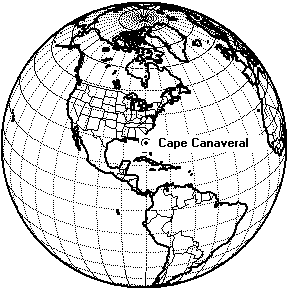 | Cape Canaveral Location of Cape Canaveral Credit: © Mark Wade |
1949 May 11 - . Launch Site: Cape Canaveral. Launch Complex: Cape Canaveral.
- Cape Canaveral selected for rocket launches. - .
Nation: USA.
Recognizing that rocket test ranges will exceed White Sands capability, Cape Canaveral selected for future long range flights. President Truman signed a bill providing a 5,000-mile guided-missile test range, which was subsequently established at Cape Canaveral, Fla. Negotiations with British government begin for installation of string of tracking stations in Bahamas Islands.
1949 October 1 - . Launch Site: Cape Canaveral. Launch Complex: Cape Canaveral.
- Cape Canaveral activated. - . Nation: USA. Long-Range Proving Ground at Cape Canaveral was activated..
1950 June 13 - . Launch Site: Cape Canaveral. Launch Complex: Cape Canaveral.
- Air Force given responsibility for Cape Canaveral. - .
Nation: USA.
Department of Defense assigned range responsibilities to the armed services: Army: White Sands, N. Mex., Proving Ground and nearby Holloman Air Force Base at Alamogordo; Navy: Point Mugu, Calif.: Air Force: Long-Range Proving Groud at Banana River, Fla. (now called Cape Canaveral).
1950 July 19 - . Launch Site: Cape Canaveral. Launch Complex: Cape Canaveral. Launch Vehicle: V-2.
- First attempted launch from Cape Canaveral. - . Payload: WAC-Corporal. Nation: USA. Related Persons: von Braun. Program: Bumper. Class: Technology. Type: Navigation technology satellite. Pad abort on 19 July of Bumper No. 8, a German V-2 with a 320 kg Army-JPL Wac Corporal. Launch scrubbed first due to emergency landing of aircraft in the range; second attempt, no lift, main chamber did not ignite..
1950 July 24 - . 14:29 GMT - . Launch Site: Cape Canaveral. Launch Complex: Cape Canaveral LC3. LV Family: V-2. Launch Vehicle: Bumper-WAC. FAILURE: Failure.
- Test mission - .
Nation: USA.
Agency: GE,
US Army.
Apogee: 20 km (12 mi).
Bumper No. 8, a German V-2 with a 320 kg Army-JPL Wac Corporal, was fired from the Long-Range Proving Ground at Cape Canaveral at a very low angle of attack. The first-stage V-2 climbed 16 km before it exploded. The second-stage Corporal separated successfully, however, and traveled another 24 km. This was the first missile launch from Cape Canaveral.
1950 July 29 - . 11:25 GMT - . Launch Site: Cape Canaveral. Launch Complex: Cape Canaveral LC3. LV Family: V-2. Launch Vehicle: Bumper-WAC.
- Test mission - .
Nation: USA.
Agency: GE,
US Army.
Apogee: 50 km (31 mi).
Bumper No. 7 was the second missile launch from Cape Canaveral. This was to be a maximum range test of a two-stage vehicle, to study the problems in staging. The launch was delayed because of moisture in the vehicle. But when finally launched, the WAC achieved the highest sustained speed in the atmosphere to that date (Mach 9/2500 m/s) and 35.2 km altitude before impacting 305 km downrange.
1950 August 1 - . Launch Site: Cape Canaveral. Launch Complex: Cape Canaveral.
- Patrick AFB named. - . Nation: USA. Patrick Air Force Base, administrative headquarters of the AFMTC at Cape Canaveral, offiically named after Gen. Mason M. Patrick..
1950 October 25 - . Launch Site: Cape Canaveral. Launch Complex: Cape Canaveral LA. Launch Vehicle: Lark.
- Nation: USA. Agency: USAF. Apogee: 8.00 km (4.90 mi). The first Lark missile launched by Air Force from Cape Canaveral, the last of the three missiles launched in 1950 at the LRPG..
1950 October 26 - . Launch Site: Cape Canaveral. Launch Complex: Cape Canaveral LA. Launch Vehicle: Lark. FAILURE: Failure.
1950 November 21 - . Launch Site: Cape Canaveral. Launch Complex: Cape Canaveral LA. Launch Vehicle: Lark.
1951 April 11 - . Launch Site: Cape Canaveral. Launch Complex: Cape Canaveral LA. Launch Vehicle: Lark. FAILURE: Failure.
1951 April 17 - . Launch Site: Cape Canaveral. Launch Complex: Cape Canaveral LA. Launch Vehicle: Lark.
1951 May 3 - . Launch Site: Cape Canaveral. Launch Complex: Cape Canaveral LA. Launch Vehicle: Lark.
1951 May 11 - . Launch Site: Cape Canaveral. Launch Complex: Cape Canaveral LA. Launch Vehicle: Lark.
1951 May 29 - . Launch Site: Cape Canaveral. Launch Complex: Cape Canaveral LA. Launch Vehicle: Lark. FAILURE: Failure.
1951 June 7 - . Launch Site: Cape Canaveral. Launch Complex: Cape Canaveral LA. Launch Vehicle: Lark.
1951 June 7 - . Launch Site: Cape Canaveral. Launch Complex: Cape Canaveral LA. Launch Vehicle: Lark. FAILURE: Failure.
1951 June 20 - . Launch Site: Cape Canaveral. Launch Complex: Cape Canaveral LA. Launch Vehicle: Matador.
1951 June 29 - . Launch Site: Cape Canaveral. Launch Complex: Cape Canaveral LA. Launch Pad: LA?. Launch Vehicle: Matador.
1951 July 3 - . Launch Site: Cape Canaveral. Launch Complex: Cape Canaveral LA. Launch Vehicle: Lark.
1951 July 18 - . Launch Site: Cape Canaveral. Launch Complex: Cape Canaveral LA. Launch Pad: LA?. Launch Vehicle: Matador.
1951 July 20 - . Launch Site: Cape Canaveral. Launch Complex: Cape Canaveral LA. Launch Vehicle: Lark. FAILURE: Failure.
1951 August 10 - . Launch Site: Cape Canaveral. Launch Complex: Cape Canaveral LA. Launch Pad: LA?. Launch Vehicle: Matador.
1951 August 31 - . Launch Site: Cape Canaveral. Launch Complex: Cape Canaveral LA. Launch Pad: LA?. Launch Vehicle: Matador.
1951 September 6 - . Launch Site: Cape Canaveral. Launch Complex: Cape Canaveral LA. Launch Pad: LA?. Launch Vehicle: Matador. FAILURE: Failure.
1951 September 13 - . Launch Site: Cape Canaveral. Launch Complex: Cape Canaveral LA. Launch Vehicle: Lark. FAILURE: Failure.
1951 September 19 - . Launch Site: Cape Canaveral. Launch Complex: Cape Canaveral LA. Launch Vehicle: Lark.
1951 October 4 - . Launch Site: Cape Canaveral. Launch Complex: Cape Canaveral LA. Launch Vehicle: Lark. FAILURE: Failure.
1951 October 26 - . Launch Site: Cape Canaveral. Launch Complex: Cape Canaveral LA. Launch Pad: LA?. Launch Vehicle: Matador.
1951 December 7 - . Launch Site: Cape Canaveral. Launch Complex: Cape Canaveral LA. Launch Pad: LA?. Launch Vehicle: Matador.
1951 December 11 - . Launch Site: Cape Canaveral. Launch Complex: Cape Canaveral LA. Launch Vehicle: Lark.
1951 December 13 - . Launch Site: Cape Canaveral. Launch Complex: Cape Canaveral LA. Launch Pad: LA?. Launch Vehicle: Matador.
1952 January 15 - . Launch Site: Cape Canaveral. Launch Complex: Cape Canaveral LA. Launch Pad: LA?. Launch Vehicle: Matador.
1952 January 28 - . Launch Site: Cape Canaveral. Launch Complex: Cape Canaveral LA. Launch Vehicle: Lark.
1952 February 12 - . Launch Site: Cape Canaveral. Launch Complex: Cape Canaveral LA. Launch Vehicle: Lark. FAILURE: Failure.
1952 February 13 - . Launch Site: Cape Canaveral. Launch Complex: Cape Canaveral LA. Launch Pad: LA?. Launch Vehicle: Matador.
1952 February 28 - . Launch Site: Cape Canaveral. Launch Complex: Cape Canaveral LA. Launch Vehicle: Lark. FAILURE: Failure.
1952 March 10 - . Launch Site: Cape Canaveral. Launch Complex: Cape Canaveral LA. Launch Pad: LA?. Launch Vehicle: Matador.
1952 March 20 - . Launch Site: Cape Canaveral. Launch Complex: Cape Canaveral LA. Launch Pad: LA?. Launch Vehicle: Matador.
1952 March 21 - . Launch Site: Cape Canaveral. Launch Complex: Cape Canaveral LA. Launch Vehicle: Lark. FAILURE: Failure.
1952 April 4 - . Launch Site: Cape Canaveral. Launch Complex: Cape Canaveral LA. Launch Pad: LA?. Launch Vehicle: Matador.
1952 April 9 - . Launch Site: Cape Canaveral. Launch Complex: Cape Canaveral LA. Launch Pad: LA?. Launch Vehicle: Matador.
1952 April 10 - . Launch Site: Cape Canaveral. Launch Complex: Cape Canaveral LA. Launch Vehicle: Lark. FAILURE: Failure.
1952 April 17 - . Launch Site: Cape Canaveral. Launch Complex: Cape Canaveral LA. Launch Vehicle: Lark. FAILURE: Failure.
1952 May 2 - . Launch Site: Cape Canaveral. Launch Complex: Cape Canaveral LA. Launch Pad: LA?. Launch Vehicle: Matador.
1952 May 15 - . Launch Site: Cape Canaveral. Launch Complex: Cape Canaveral LA. Launch Pad: LA?. Launch Vehicle: Matador. FAILURE: Failure.
1952 May 16 - . Launch Site: Cape Canaveral. Launch Complex: Cape Canaveral LA. Launch Vehicle: Lark.
1952 May 22 - . Launch Site: Cape Canaveral. Launch Complex: Cape Canaveral LA. Launch Pad: LA?. Launch Vehicle: Matador.
1952 June 24 - . Launch Site: Cape Canaveral. Launch Complex: Cape Canaveral LA. Launch Vehicle: Lark.
1952 July 7 - . Launch Site: Cape Canaveral. Launch Complex: Cape Canaveral LA. Launch Vehicle: Lark.
1952 July 9 - . Launch Site: Cape Canaveral. Launch Complex: Cape Canaveral LA. Launch Pad: LA?. Launch Vehicle: Matador.
1952 July 15 - . Launch Site: Cape Canaveral. Launch Complex: Cape Canaveral LA. Launch Vehicle: Lark. FAILURE: Failure.
1952 July 19 - . Launch Site: Cape Canaveral. Launch Complex: Cape Canaveral LA. Launch Pad: LA?. Launch Vehicle: Matador.
1952 August 29 - . Launch Site: Cape Canaveral. Launch Complex: Cape Canaveral LA. Launch Pad: LA?. LV Family: Snark. Launch Vehicle: MX-775.
1952 September 10 - . Launch Site: Cape Canaveral. Launch Complex: Cape Canaveral LA. Launch Pad: LA?. Launch Vehicle: Matador.
1952 September 10 - . Launch Site: Cape Canaveral. Launch Complex: Cape Canaveral LC4. Launch Vehicle: Bomarc. FAILURE: Failure.
1952 September 16 - . Launch Site: Cape Canaveral. Launch Complex: Cape Canaveral LA. Launch Pad: LA?. Launch Vehicle: Matador.
1952 September 17 - . Launch Site: Cape Canaveral. Launch Complex: Cape Canaveral LA. Launch Vehicle: Lark.
1952 October 1 - . Launch Site: Cape Canaveral. Launch Complex: Cape Canaveral LA. Launch Pad: LA?. LV Family: Snark. Launch Vehicle: MX-775.
1952 October 9 - . Launch Site: Cape Canaveral. Launch Complex: Cape Canaveral LA. Launch Pad: LA?. Launch Vehicle: Matador.
1952 October 30 - . Launch Site: Cape Canaveral. Launch Complex: Cape Canaveral LA. Launch Pad: LA?. LV Family: Snark. Launch Vehicle: MX-775.
1952 November 4 - . Launch Site: Cape Canaveral. Launch Complex: Cape Canaveral LA. Launch Pad: LA?. Launch Vehicle: Matador.
1952 November 7 - . Launch Site: Cape Canaveral. Launch Complex: Cape Canaveral LA. Launch Pad: LA?. Launch Vehicle: Matador.
1952 November 17 - . Launch Site: Cape Canaveral. Launch Complex: Cape Canaveral LA. Launch Pad: LA?. Launch Vehicle: Matador.
1952 November 17 - . Launch Site: Cape Canaveral. Launch Complex: Cape Canaveral LA. Launch Pad: LA?. Launch Vehicle: Matador.
1952 November 26 - . Launch Site: Cape Canaveral. Launch Complex: Cape Canaveral LA. Launch Pad: LA?. LV Family: Snark. Launch Vehicle: MX-775.
1952 November 28 - . Launch Site: Cape Canaveral. Launch Complex: Cape Canaveral LA. Launch Vehicle: Lark.
1952 December 4 - . Launch Site: Cape Canaveral. Launch Complex: Cape Canaveral LA. Launch Vehicle: Lark.
1952 December 4 - . Launch Site: Cape Canaveral. Launch Complex: Cape Canaveral LA. Launch Pad: LA?. Launch Vehicle: Matador.
1952 December 15 - . Launch Site: Cape Canaveral. Launch Complex: Cape Canaveral LA. Launch Pad: LA?. Launch Vehicle: Matador.
1952 December 16 - . Launch Site: Cape Canaveral. Launch Complex: Cape Canaveral LA. Launch Vehicle: Lark. FAILURE: Failure.
1952 December 19 - . Launch Site: Cape Canaveral. Launch Complex: Cape Canaveral LA. Launch Pad: LA?. Launch Vehicle: Matador.
1952 December 19 - . Launch Site: Cape Canaveral. Launch Complex: Cape Canaveral LA. Launch Pad: LA?. LV Family: Snark. Launch Vehicle: MX-775.
1953 January 12 - . Launch Site: Cape Canaveral. Launch Complex: Cape Canaveral LA. Launch Pad: LA?. Launch Vehicle: Matador. FAILURE: Failure.
1953 January 14 - . Launch Site: Cape Canaveral. Launch Complex: Cape Canaveral LA. Launch Pad: LA?. Launch Vehicle: Matador. FAILURE: Failure.
1953 January 23 - . Launch Site: Cape Canaveral. Launch Complex: Cape Canaveral LC3. Launch Pad: LC3/4?. Launch Vehicle: Bomarc. FAILURE: Failure.
1953 January 30 - . Launch Site: Cape Canaveral. Launch Complex: Cape Canaveral LA. Launch Pad: LA?. Launch Vehicle: Matador.
1953 February 5 - . Launch Site: Cape Canaveral. Launch Complex: Cape Canaveral LA. Launch Pad: LA?. Launch Vehicle: Matador.
1953 February 6 - . Launch Site: Cape Canaveral. Launch Complex: Cape Canaveral LA. Launch Pad: LA?. LV Family: Snark. Launch Vehicle: MX-775.
1953 February 11 - . Launch Site: Cape Canaveral. LV Family: Wasserfall. Launch Vehicle: Hermes A-2.
1953 February 12 - . Launch Site: Cape Canaveral. Launch Complex: Cape Canaveral LA. Launch Vehicle: Lark.
1953 February 17 - . Launch Site: Cape Canaveral. Launch Complex: Cape Canaveral LA. Launch Pad: LA?. Launch Vehicle: Matador.
1953 February 24 - . Launch Site: Cape Canaveral. Launch Complex: Cape Canaveral LA. Launch Vehicle: Lark.
1953 March 3 - . Launch Site: Cape Canaveral. Launch Complex: Cape Canaveral LA. Launch Vehicle: Lark.
1953 March 4 - . Launch Site: Cape Canaveral. LV Family: Wasserfall. Launch Vehicle: Hermes A-2.
1953 March 4 - . Launch Site: Cape Canaveral. Launch Complex: Cape Canaveral LA. Launch Pad: LA?. Launch Vehicle: Matador.
1953 March 10 - . Launch Site: Cape Canaveral. Launch Complex: Cape Canaveral LA. Launch Pad: LA?. LV Family: Snark. Launch Vehicle: MX-775.
1953 March 16 - . Launch Site: Cape Canaveral. Launch Complex: Cape Canaveral LA. Launch Vehicle: Lark.
1953 March 18 - . Launch Site: Cape Canaveral. Launch Complex: Cape Canaveral LA. Launch Pad: LA?. Launch Vehicle: Matador.
1953 March 25 - . Launch Site: Cape Canaveral. LV Family: Wasserfall. Launch Vehicle: Hermes A-2.
1953 March 25 - . Launch Site: Cape Canaveral. LV Family: Wasserfall. Launch Vehicle: Hermes A-2.
1953 March 31 - . Launch Site: Cape Canaveral. Launch Complex: Cape Canaveral LA. Launch Pad: LA?. Launch Vehicle: Matador.
1953 April 1 - . Launch Site: Cape Canaveral. Launch Complex: Cape Canaveral LA. Launch Pad: LA?. Launch Vehicle: Matador.
1953 April 8 - . Launch Site: Cape Canaveral. Launch Complex: Cape Canaveral LA. Launch Vehicle: Lark.
1953 April 22 - . Launch Site: Cape Canaveral. Launch Complex: Cape Canaveral LA. Launch Vehicle: Lark. FAILURE: Failure.
1953 April 24 - . Launch Site: Cape Canaveral. Launch Complex: Cape Canaveral LA. Launch Pad: LA?. Launch Vehicle: Matador.
1953 April 28 - . Launch Site: Cape Canaveral. Launch Complex: Cape Canaveral LA. Launch Vehicle: Lark.
1953 April 29 - . Launch Site: Cape Canaveral. Launch Complex: Cape Canaveral LA. Launch Pad: LA?. Launch Vehicle: Matador.
1953 May 4 - . Launch Site: Cape Canaveral. Launch Complex: Cape Canaveral LA. Launch Pad: LA?. Launch Vehicle: Matador.
1953 May 12 - . Launch Site: Cape Canaveral. Launch Complex: Cape Canaveral LA. Launch Vehicle: Lark.
1953 May 14 - . Launch Site: Cape Canaveral. Launch Complex: Cape Canaveral LA. Launch Vehicle: Lark.
1953 June 10 - . Launch Site: Cape Canaveral. Launch Complex: Cape Canaveral LC3. Launch Pad: LC3/4?. Launch Vehicle: Bomarc. FAILURE: Failure.
1953 June 12 - . Launch Site: Cape Canaveral. Launch Complex: Cape Canaveral LA. Launch Pad: LA?. Launch Vehicle: Matador.
1953 July 2 - . Launch Site: Cape Canaveral. Launch Complex: Cape Canaveral LA. Launch Pad: LA?. Launch Vehicle: Matador.
1953 July 8 - . Launch Site: Cape Canaveral. Launch Complex: Cape Canaveral LA. Launch Vehicle: Lark.
1953 July 9 - . Launch Site: Cape Canaveral. Launch Complex: Cape Canaveral LA. Launch Pad: LA?. Launch Vehicle: Matador.
1953 July 27 - . Launch Site: Cape Canaveral. Launch Complex: Cape Canaveral LC3. Launch Pad: LC3/4?. Launch Vehicle: Bomarc. FAILURE: Failure.
1953 August 4 - . Launch Site: Cape Canaveral. Launch Complex: Cape Canaveral LA. Launch Pad: LA?. Launch Vehicle: Matador.
1953 August 6 - . Launch Site: Cape Canaveral. Launch Complex: Cape Canaveral LA. Launch Pad: LA?. Launch Vehicle: Snark.
- Test mission - . Nation: USA. Agency: USAF. Apogee: 10 km (6 mi). First test flight N-69A version of Snark..
1953 August 20 - . 14:37 GMT - . Launch Site: Cape Canaveral. Launch Complex: Cape Canaveral LC4. Launch Vehicle: Redstone. FAILURE: Control System malfunction followed by Power Plant malfunction at approximately 80 sec. Ground cut-off command given... Failed Stage: G.
- Nation: USA. Agency: US Army. Apogee: 6.00 km (3.70 mi). Redstone missile No. 1 was fired by Army Redstone Arsenal personnel at AFMTC, Cape Canaveral. Missile test failure. Missed aimpoint by 240,000 m..
1953 August 24 - . Launch Site: Cape Canaveral. Launch Complex: Cape Canaveral LA. Launch Pad: LA?. Launch Vehicle: Matador.
1953 September 4 - . Launch Site: Cape Canaveral. Launch Complex: Cape Canaveral LC3. Launch Pad: LC3/4?. Launch Vehicle: Bomarc. FAILURE: Failure.
1953 September 23 - . Launch Site: Cape Canaveral. Launch Complex: Cape Canaveral LA. Launch Pad: LA?. Launch Vehicle: Matador.
1953 October 15 - . Launch Site: Cape Canaveral. Launch Complex: Cape Canaveral LA. Launch Pad: LA?. Launch Vehicle: Snark.
1953 October 21 - . Launch Site: Cape Canaveral. Launch Complex: Cape Canaveral LA. Launch Pad: LA?. Launch Vehicle: Matador.
1953 October 22 - . Launch Site: Cape Canaveral. Launch Complex: Cape Canaveral LA. Launch Pad: LA?. Launch Vehicle: Matador.
1953 November 2 - . Launch Site: Cape Canaveral. Launch Complex: Cape Canaveral LA. Launch Pad: LA?. Launch Vehicle: Matador.
1953 November 17 - . Launch Site: Cape Canaveral. Launch Complex: Cape Canaveral LA. Launch Pad: LA?. Launch Vehicle: Matador.
1953 November 18 - . Launch Site: Cape Canaveral. Launch Complex: Cape Canaveral LA. Launch Pad: LA?. Launch Vehicle: Matador.
1953 November 18 - . Launch Site: Cape Canaveral. Launch Complex: Cape Canaveral LA. Launch Pad: LA?. Launch Vehicle: Matador.
1953 November 19 - . Launch Site: Cape Canaveral. Launch Complex: Cape Canaveral LA. Launch Pad: LA?. Launch Vehicle: Matador.
1953 November 19 - . Launch Site: Cape Canaveral. Launch Complex: Cape Canaveral LA. Launch Pad: LA?. Launch Vehicle: Matador.
1953 November 27 - . Launch Site: Cape Canaveral. Launch Complex: Cape Canaveral LA. Launch Pad: LA?. Launch Vehicle: Matador.
1953 December 2 - . Launch Site: Cape Canaveral. Launch Complex: Cape Canaveral LA. Launch Pad: LA?. Launch Vehicle: Matador.
1953 December 11 - . Launch Site: Cape Canaveral. Launch Complex: Cape Canaveral LA. Launch Pad: LA?. Launch Vehicle: Matador.
1953 December 15 - . Launch Site: Cape Canaveral. Launch Complex: Cape Canaveral LA. Launch Pad: LA?. Launch Vehicle: Matador.
1953 December 15 - . Launch Site: Cape Canaveral. Launch Complex: Cape Canaveral LA. Launch Pad: LA?. Launch Vehicle: Matador.
1953 December 15 - . Launch Site: Cape Canaveral. Launch Complex: Cape Canaveral LA. Launch Pad: LA?. Launch Vehicle: Matador.
1953 December 15 - . Launch Site: Cape Canaveral. Launch Complex: Cape Canaveral LA. Launch Pad: LA?. Launch Vehicle: Matador.
1953 December 16 - . Launch Site: Cape Canaveral. Launch Complex: Cape Canaveral LA. Launch Pad: LA?. Launch Vehicle: Matador.
1953 December 16 - . Launch Site: Cape Canaveral. Launch Complex: Cape Canaveral LA. Launch Pad: LA?. Launch Vehicle: Matador.
1953 December 17 - . Launch Site: Cape Canaveral. Launch Complex: Cape Canaveral LA. Launch Pad: LA?. Launch Vehicle: Matador.
1954 January 7 - . Launch Site: Cape Canaveral. Launch Complex: Cape Canaveral LA. Launch Pad: LA?. Launch Vehicle: Matador.
1954 January 8 - . Launch Site: Cape Canaveral. Launch Complex: Cape Canaveral LA. Launch Pad: LA?. Launch Vehicle: Matador.
1954 January 8 - . Launch Site: Cape Canaveral. Launch Complex: Cape Canaveral LA. Launch Pad: LA?. Launch Vehicle: Matador.
1954 January 8 - . Launch Site: Cape Canaveral. Launch Complex: Cape Canaveral LA. Launch Pad: LA?. Launch Vehicle: Matador.
1954 January 21 - . Launch Site: Cape Canaveral. Launch Complex: Cape Canaveral LA. Launch Pad: LA?. Launch Vehicle: Matador.
1954 January 27 - . 15:20 GMT - . Launch Site: Cape Canaveral. Launch Complex: Cape Canaveral LC4. Launch Vehicle: Redstone.
- Nation: USA. Agency: US Army. Apogee: 90 km (55 mi). Successful missile test. Missed aimpoint by 8,400 m..
1954 January 29 - . Launch Site: Cape Canaveral. Launch Complex: Cape Canaveral LA. Launch Pad: LA?. Launch Vehicle: Matador.
1954 February 2 - . Launch Site: Cape Canaveral. Launch Complex: Cape Canaveral LA. Launch Pad: LA?. Launch Vehicle: Snark.
1954 February 4 - . Launch Site: Cape Canaveral. Launch Complex: Cape Canaveral LA. Launch Pad: LA?. Launch Vehicle: Matador.
1954 February 18 - . Launch Site: Cape Canaveral. Launch Complex: Cape Canaveral LC2. Launch Vehicle: Snark.
1954 February 19 - . Launch Site: Cape Canaveral. Launch Complex: Cape Canaveral LA. Launch Pad: LA?. Launch Vehicle: Matador.
1954 February 25 - . Launch Site: Cape Canaveral. Launch Complex: Cape Canaveral LA. Launch Pad: LA?. Launch Vehicle: Matador.
1954 March 5 - . Launch Site: Cape Canaveral. Launch Complex: Cape Canaveral LA. Launch Pad: LA?. Launch Vehicle: Matador.
1954 March 5 - . Launch Site: Cape Canaveral. Launch Complex: Cape Canaveral LA. Launch Pad: LA?. Launch Vehicle: Matador.
1954 March 23 - . Launch Site: Cape Canaveral. Launch Complex: Cape Canaveral LA. Launch Pad: LA?. Launch Vehicle: Matador.
1954 March 23 - . Launch Site: Cape Canaveral. Launch Complex: Cape Canaveral LA. Launch Pad: LA?. Launch Vehicle: Matador.
1954 March 26 - . Launch Site: Cape Canaveral. Launch Complex: Cape Canaveral LA. Launch Pad: LA?. Launch Vehicle: Matador.
1954 March 30 - . Launch Site: Cape Canaveral. Launch Complex: Cape Canaveral LA. Launch Pad: LA?. Launch Vehicle: Matador.
1954 March 30 - . Launch Site: Cape Canaveral. Launch Complex: Cape Canaveral LA. Launch Pad: LA?. Launch Vehicle: Matador.
1954 April 9 - . Launch Site: Cape Canaveral. Launch Complex: Cape Canaveral LA. Launch Pad: LA?. Launch Vehicle: Matador.
1954 April 9 - . Launch Site: Cape Canaveral. Launch Complex: Cape Canaveral LA. Launch Pad: LA?. Launch Vehicle: Matador.
1954 April 9 - . Launch Site: Cape Canaveral. Launch Complex: Cape Canaveral LA. Launch Pad: LA?. Launch Vehicle: Matador.
1954 April 9 - . Launch Site: Cape Canaveral. Launch Complex: Cape Canaveral LA. Launch Pad: LA?. Launch Vehicle: Matador.
1954 April 9 - . Launch Site: Cape Canaveral. Launch Complex: Cape Canaveral LA. Launch Pad: LA?. Launch Vehicle: Matador.
1954 April 13 - . Launch Site: Cape Canaveral. Launch Complex: Cape Canaveral LA. Launch Pad: LA?. Launch Vehicle: Matador.
1954 April 13 - . Launch Site: Cape Canaveral. Launch Complex: Cape Canaveral LA. Launch Pad: LA?. Launch Vehicle: Matador.
1954 April 15 - . Launch Site: Cape Canaveral. Launch Complex: Cape Canaveral LA. Launch Pad: LA?. Launch Vehicle: Matador.
1954 April 23 - . Launch Site: Cape Canaveral. Launch Complex: Cape Canaveral LA. Launch Pad: LA?. Launch Vehicle: Matador.
1954 April 23 - . Launch Site: Cape Canaveral. Launch Complex: Cape Canaveral LA. Launch Pad: LA?. Launch Vehicle: Matador.
1954 April 23 - . Launch Site: Cape Canaveral. Launch Complex: Cape Canaveral LA. Launch Pad: LA?. Launch Vehicle: Matador.
1954 April 23 - . Launch Site: Cape Canaveral. Launch Complex: Cape Canaveral LA. Launch Pad: LA?. Launch Vehicle: Matador.
1954 April 26 - . Launch Site: Cape Canaveral. Launch Complex: Cape Canaveral LC2. Launch Vehicle: Snark.
1954 April 27 - . Launch Site: Cape Canaveral. Launch Complex: Cape Canaveral LA. Launch Pad: LA?. Launch Vehicle: Matador.
1954 April 30 - . Launch Site: Cape Canaveral. Launch Complex: Cape Canaveral LA. Launch Pad: LA?. Launch Vehicle: Matador.
1954 April 30 - . Launch Site: Cape Canaveral. Launch Complex: Cape Canaveral LA. Launch Pad: LA?. Launch Vehicle: Matador. FAILURE: Failure.
1954 April 30 - . Launch Site: Cape Canaveral. Launch Complex: Cape Canaveral LA. Launch Pad: LA?. Launch Vehicle: Matador.
1954 April 30 - . Launch Site: Cape Canaveral. Launch Complex: Cape Canaveral LA. Launch Pad: LA?. Launch Vehicle: Matador. FAILURE: Failure.
1954 May 5 - . 17:28 GMT - . Launch Site: Cape Canaveral. Launch Complex: Cape Canaveral LC4. Launch Vehicle: Redstone. FAILURE: Ejector burnout immediately following lift-off.. Failed Stage: 1.
- Nation: USA. Agency: US Army. Apogee: 0 km (0 mi). Missile test failure. Missed aimpoint by 277,000 m..
1954 May 14 - . Launch Site: Cape Canaveral. Launch Complex: Cape Canaveral LA. Launch Pad: LA?. Launch Vehicle: Matador.
1954 May 14 - . Launch Site: Cape Canaveral. Launch Complex: Cape Canaveral LA. Launch Pad: LA?. Launch Vehicle: Matador.
1954 May 14 - . Launch Site: Cape Canaveral. Launch Complex: Cape Canaveral LA. Launch Pad: LA?. Launch Vehicle: Matador.
1954 May 18 - . Launch Site: Cape Canaveral. Launch Complex: Cape Canaveral LA. Launch Pad: LA?. Launch Vehicle: Matador.
1954 May 19 - . Launch Site: Cape Canaveral. Launch Complex: Cape Canaveral LA. Launch Pad: LA?. Launch Vehicle: Matador.
1954 May 19 - . Launch Site: Cape Canaveral. Launch Complex: Cape Canaveral LA. Launch Pad: LA?. Launch Vehicle: Matador.
1954 May 20 - . Launch Site: Cape Canaveral. Launch Complex: Cape Canaveral LA. Launch Pad: LA?. Launch Vehicle: Matador.
1954 June 3 - . Launch Site: Cape Canaveral. Launch Complex: Cape Canaveral LA. Launch Pad: LA?. Launch Vehicle: Snark.
1954 June 3 - . Launch Site: Cape Canaveral. Launch Complex: Cape Canaveral LA. Launch Pad: LA?. Launch Vehicle: Matador. FAILURE: Failure.
1954 June 4 - . Launch Site: Cape Canaveral. Launch Complex: Cape Canaveral LA. Launch Pad: LA?. Launch Vehicle: Matador.
1954 June 4 - . Launch Site: Cape Canaveral. Launch Complex: Cape Canaveral LA. Launch Pad: LA?. Launch Vehicle: Matador. FAILURE: Failure.
1954 June 9 - . Launch Site: Cape Canaveral. Launch Complex: Cape Canaveral LA. Launch Pad: LA?. Launch Vehicle: Matador.
1954 June 10 - . Launch Site: Cape Canaveral. Launch Complex: Cape Canaveral LA. Launch Pad: LA?. Launch Vehicle: Matador.
1954 June 10 - . Launch Site: Cape Canaveral. Launch Complex: Cape Canaveral LA. Launch Pad: LA?. Launch Vehicle: Matador.
1954 June 18 - . Launch Site: Cape Canaveral. Launch Complex: Cape Canaveral LA. Launch Pad: LA?. Launch Vehicle: Matador.
1954 June 24 - . Launch Site: Cape Canaveral. Launch Complex: Cape Canaveral LA. Launch Pad: LA?. Launch Vehicle: Matador.
1954 June 29 - . Launch Site: Cape Canaveral. Launch Complex: Cape Canaveral LA. Launch Pad: LA?. Launch Vehicle: Matador.
1954 June 30 - . Launch Site: Cape Canaveral. Launch Complex: Cape Canaveral LA. Launch Pad: LA?. Launch Vehicle: Matador.
1954 July 7 - . Launch Site: Cape Canaveral. Launch Complex: Cape Canaveral LA. Launch Pad: LA?. Launch Vehicle: Matador.
1954 July 20 - . Launch Site: Cape Canaveral. Launch Complex: Cape Canaveral LA. Launch Pad: LA?. Launch Vehicle: Matador.
1954 July 21 - . Launch Site: Cape Canaveral. Launch Complex: Cape Canaveral LA. Launch Pad: LA?. Launch Vehicle: Snark.
1954 July 22 - . Launch Site: Cape Canaveral. Launch Complex: Cape Canaveral LA. Launch Pad: LA?. Launch Vehicle: Matador.
1954 August 5 - . Launch Site: Cape Canaveral. Launch Complex: Cape Canaveral LC3. Launch Vehicle: Bomarc. FAILURE: Failure.
1954 August 18 - . 14:04 GMT - . Launch Site: Cape Canaveral. Launch Complex: Cape Canaveral LC4. Launch Vehicle: Redstone. FAILURE: Steam generator regulator malfunction caused drop in combustion pressure..
- Nation: USA. Agency: US Army. Apogee: 90 km (55 mi). Missile test failure. Missed aimpoint by 19,200 m..
1954 September 10 - . Launch Site: Cape Canaveral. Launch Complex: Cape Canaveral LA. Launch Pad: LA?. Launch Vehicle: Matador.
1954 September 21 - . Launch Site: Cape Canaveral. Launch Complex: Cape Canaveral LA. Launch Pad: LA?. Launch Vehicle: Snark.
- Test mission - . Nation: USA. Agency: USAF. Apogee: 10 km (6 mi). First test flight N-69B version of Snark..
1954 September 29 - . Launch Site: Cape Canaveral. Launch Complex: Cape Canaveral LA. Launch Pad: LA?. Launch Vehicle: Matador.
1954 October 12 - . Launch Site: Cape Canaveral. Launch Complex: Cape Canaveral LA. Launch Pad: LA?. Launch Vehicle: Snark.
1954 October 20 - . Launch Site: Cape Canaveral. Launch Complex: Cape Canaveral LA. Launch Pad: LA?. Launch Vehicle: Matador.
1954 October 20 - . Launch Site: Cape Canaveral. Launch Complex: Cape Canaveral LA. Launch Pad: LA?. Launch Vehicle: Matador.
1954 October 20 - . Launch Site: Cape Canaveral. Launch Complex: Cape Canaveral LA. Launch Pad: LA?. Launch Vehicle: Matador.
1954 October 25 - . Launch Site: Cape Canaveral. Launch Complex: Cape Canaveral LC3. Launch Vehicle: Bomarc.
1954 November 12 - . Launch Site: Cape Canaveral. Launch Complex: Cape Canaveral LA. Launch Pad: LA?. Launch Vehicle: Snark.
1954 November 17 - . 18:12 GMT - . Launch Site: Cape Canaveral. Launch Complex: Cape Canaveral LC4. Launch Vehicle: Redstone. FAILURE: Ground programmed yaw maneuver caused missile control loss at 80 sec causing power plant erratic behavior. Human error in selection of yaw maneuver impulse.. Failed Stage: G.
- Nation: USA. Agency: US Army. Apogee: 0 km (0 mi). Missile test failure. Missed aimpoint by 166,300 m..
1954 November 24 - . Launch Site: Cape Canaveral. Launch Complex: Cape Canaveral LC3. Launch Vehicle: Bomarc.
1954 December 10 - . Launch Site: Cape Canaveral. Launch Complex: Cape Canaveral LA. Launch Pad: LA?. Launch Vehicle: Snark.
1954 December 16 - . Launch Site: Cape Canaveral. Launch Complex: Cape Canaveral LA. Launch Pad: LA?. Launch Vehicle: Matador.
1955 January 13 - . Launch Site: Cape Canaveral. Launch Complex: Cape Canaveral LC1. Launch Pad: LC1/2?. Launch Vehicle: Snark.
1955 January 14 - . Launch Site: Cape Canaveral. Launch Complex: Cape Canaveral LA. Launch Pad: LA?. Launch Vehicle: Matador.
1955 January 18 - . Launch Site: Cape Canaveral. Launch Complex: Cape Canaveral LA. Launch Pad: LA?. Launch Vehicle: Matador.
1955 January 18 - . Launch Site: Cape Canaveral. Launch Complex: Cape Canaveral LA. Launch Pad: LA?. Launch Vehicle: Matador.
1955 January 19 - . Launch Site: Cape Canaveral. Launch Complex: Cape Canaveral LC3. Launch Vehicle: Bomarc.
1955 February 9 - . 20:15 GMT - . Launch Site: Cape Canaveral. Launch Complex: Cape Canaveral LC4. Launch Vehicle: Redstone. FAILURE: Separation bolt No. 3 failure. Inverter frequency shift.. Failed Stage: 1.
- Nation: USA. Agency: US Army. Apogee: 0 km (0 mi). Missile test failure. Missed aimpoint by 23,400 m..
1955 February 10 - . Launch Site: Cape Canaveral. Launch Complex: Cape Canaveral LC2. Launch Vehicle: Snark.
- Test mission - . Nation: USA. Agency: USAF. Apogee: 10 km (6 mi). First test flight N-69C version of Snark..
1955 February 16 - . Launch Site: Cape Canaveral. Launch Complex: Cape Canaveral LA. Launch Pad: LA?. Launch Vehicle: Matador.
1955 February 21 - . Launch Site: Cape Canaveral. Launch Complex: Cape Canaveral LA. Launch Pad: LA?. Launch Vehicle: Matador.
1955 February 24 - . Launch Site: Cape Canaveral. Launch Complex: Cape Canaveral LC3. Launch Vehicle: Bomarc.
1955 February 24 - . Launch Site: Cape Canaveral. Launch Complex: Cape Canaveral LA. Launch Pad: LA?. Launch Vehicle: Matador.
1955 March 2 - . Launch Site: Cape Canaveral. Launch Complex: Cape Canaveral LA. Launch Pad: LA?. Launch Vehicle: Matador.
1955 March 2 - . Launch Site: Cape Canaveral. Launch Complex: Cape Canaveral LA. Launch Pad: LA?. Launch Vehicle: Matador.
1955 March 3 - . Launch Site: Cape Canaveral. Launch Complex: Cape Canaveral LC3. Launch Vehicle: Bomarc.
1955 March 9 - . Launch Site: Cape Canaveral. Launch Complex: Cape Canaveral LA. Launch Pad: LA?. Launch Vehicle: Matador.
1955 March 17 - . Launch Site: Cape Canaveral. Launch Complex: Cape Canaveral LA. Launch Pad: LA?. Launch Vehicle: Matador.
1955 March 17 - . Launch Site: Cape Canaveral. Launch Complex: Cape Canaveral LA. Launch Pad: LA?. Launch Vehicle: Matador.
1955 April 1 - . Launch Site: Cape Canaveral. Launch Complex: Cape Canaveral LA. Launch Pad: LA?. Launch Vehicle: Matador.
1955 April 6 - . Launch Site: Cape Canaveral. Launch Complex: Cape Canaveral LC1. Launch Pad: LC1/2?. Launch Vehicle: Snark.
1955 April 20 - . Launch Site: Cape Canaveral. Launch Complex: Cape Canaveral LA. Launch Pad: LA?. Launch Vehicle: Matador.
1955 April 20 - . 06:51 GMT - . Launch Site: Cape Canaveral. Launch Complex: Cape Canaveral LC6. Launch Vehicle: Redstone. FAILURE: Guidance system malfunction at 310 sec due to air pressure loss. ST-80 lateral guidance only..
- Nation: USA. Agency: US Army. Apogee: 90 km (55 mi). Missile test failure. Missed aimpoint by 7,000 m..
1955 April 21 - . Launch Site: Cape Canaveral. Launch Complex: Cape Canaveral LA. Launch Pad: LA?. Launch Vehicle: Matador.
1955 April 26 - . Launch Site: Cape Canaveral. Launch Complex: Cape Canaveral LC2. Launch Vehicle: Snark.
1955 April 28 - . Launch Site: Cape Canaveral. Launch Complex: Cape Canaveral LA. Launch Pad: LA?. Launch Vehicle: Matador.
1955 April 29 - . Launch Site: Cape Canaveral. Launch Complex: Cape Canaveral LA. Launch Pad: LA?. Launch Vehicle: Matador.
1955 May 5 - . Launch Site: Cape Canaveral. Launch Complex: Cape Canaveral LC3. Launch Vehicle: Bomarc. FAILURE: Failure.
1955 May 6 - . Launch Site: Cape Canaveral. Launch Complex: Cape Canaveral LC4. Launch Vehicle: Matador.
1955 May 10 - . Launch Site: Cape Canaveral. Launch Complex: Cape Canaveral LA. Launch Pad: LA?. Launch Vehicle: Matador.
1955 May 13 - . Launch Site: Cape Canaveral. Launch Complex: Cape Canaveral LC1. Launch Pad: LC1/2?. Launch Vehicle: Snark.
1955 May 17 - . Launch Site: Cape Canaveral. Launch Complex: Cape Canaveral LA. Launch Pad: LA?. Launch Vehicle: Matador.
1955 May 19 - . Launch Site: Cape Canaveral. Launch Complex: Cape Canaveral LA. Launch Pad: LA?. Launch Vehicle: Matador.
1955 May 23 - . Launch Site: Cape Canaveral. Launch Complex: Cape Canaveral. Launch Vehicle: Redstone.
- Project Orbiter plans. - . Nation: USA. Project Orbiter Conference was held at Redstone Arsenal and at Cape Canaveral..
1955 May 23 - . Launch Site: Cape Canaveral. Launch Complex: Cape Canaveral LC3. LV Family: X-17. Launch Vehicle: X-17 QTV.
1955 May 23 - . Launch Site: Cape Canaveral. Launch Complex: Cape Canaveral LC3. LV Family: X-17. Launch Vehicle: X-17 QTV.
1955 May 25 - . 04:24 GMT - . Launch Site: Cape Canaveral. Launch Complex: Cape Canaveral LC6. Launch Vehicle: Redstone. FAILURE: Guidance system malfunction at 155, sec due to wiring error..
- Nation: USA. Agency: US Army. Apogee: 90 km (55 mi). Missile test failure. Missed aimpoint by 17,200 m..
1955 June 1 - . Launch Site: Cape Canaveral. Launch Complex: Cape Canaveral LA. Launch Pad: LA?. Launch Vehicle: Matador.
1955 June 1 - . Launch Site: Cape Canaveral. Launch Complex: Cape Canaveral LA. Launch Pad: LA?. Launch Vehicle: Matador.
1955 June 9 - . Launch Site: Cape Canaveral. Launch Complex: Cape Canaveral LA. Launch Pad: LA?. Launch Vehicle: Matador.
1955 June 10 - . Launch Site: Cape Canaveral. Launch Complex: Cape Canaveral LA. Launch Pad: LA?. Launch Vehicle: Matador.
1955 June 10 - . Launch Site: Cape Canaveral. Launch Complex: Cape Canaveral LA. Launch Pad: LA?. Launch Vehicle: Matador.
1955 June 13 - . Launch Site: Cape Canaveral. Launch Complex: Cape Canaveral LC3. LV Family: X-17. Launch Vehicle: X-17 HTV. FAILURE: Failure.
1955 June 23 - . Launch Site: Cape Canaveral. Launch Complex: Cape Canaveral LC3. LV Family: X-17. Launch Vehicle: X-17 HTV.
1955 June 30 - . Launch Site: Cape Canaveral. Launch Complex: Cape Canaveral LC3. LV Family: X-17. Launch Vehicle: X-17 HTV.
1955 July 8 - . Launch Site: Cape Canaveral. Launch Complex: Cape Canaveral LA. Launch Pad: LA?. Launch Vehicle: Matador.
1955 July 8 - . Launch Site: Cape Canaveral. Launch Complex: Cape Canaveral LA. Launch Pad: LA?. Launch Vehicle: Matador.
1955 July 13 - . Launch Site: Cape Canaveral. Launch Complex: Cape Canaveral LC2. Launch Vehicle: Snark.
1955 July 14 - . Launch Site: Cape Canaveral. Launch Complex: Cape Canaveral LC3. LV Family: X-17. Launch Vehicle: X-17 HTV.
1955 July 18 - . Launch Site: Cape Canaveral. Launch Complex: Cape Canaveral LA. Launch Pad: LA?. Launch Vehicle: Matador.
1955 July 18 - . Launch Site: Cape Canaveral. Launch Complex: Cape Canaveral LA. Launch Pad: LA?. Launch Vehicle: Matador.
1955 July 22 - . Launch Site: Cape Canaveral. Launch Complex: Cape Canaveral LA. Launch Pad: LA?. Launch Vehicle: Matador.
1955 July 27 - . Launch Site: Cape Canaveral. Launch Complex: Cape Canaveral LC3. Launch Vehicle: Bomarc. FAILURE: Failure.
1955 July 29 - . Launch Site: Cape Canaveral. Launch Complex: Cape Canaveral LA. Launch Pad: LA?. Launch Vehicle: Matador.
1955 July 29 - . Launch Site: Cape Canaveral. Launch Complex: Cape Canaveral LA. Launch Pad: LA?. Launch Vehicle: Matador.
1955 Aug - . Launch Site: Cape Canaveral. LV Family: X-17. Launch Vehicle: X-17.
- First attempt to launch X-17 reentry test vehicle - . Lockheed's first attempt to launch its X-17 reentry test vehicle (RTV) at Cape Canaveral, Florida, was unsuccessful..
1955 August 9 - . Launch Site: Cape Canaveral. Launch Complex: Cape Canaveral LC1. Launch Pad: LC1/2?. Launch Vehicle: Snark.
1955 August 19 - . Launch Site: Cape Canaveral. Launch Complex: Cape Canaveral RW30/12. LV Family: Navaho. Launch Vehicle: Navaho X-10.
- Navaho X-10 flight 16 - . Nation: USA. Agency: USAF. Program: Navaho. Demonstrated planned automated landing, but drag chute did not deploy after landing. The vehicle overran the skid strip, the nosewheel collapsed in the sand in the overrun, the tanks ruptured, and the vehicle burned..
1955 August 25 - . Launch Site: Cape Canaveral. Launch Complex: Cape Canaveral LC3. Launch Pad: LC3/4?. Launch Vehicle: Bomarc.
1955 August 26 - . Launch Site: Cape Canaveral. Launch Complex: Cape Canaveral LC3. Launch Vehicle: X-17.
1955 August 31 - . 00:11 GMT - . Launch Site: Cape Canaveral. Launch Complex: Cape Canaveral LC6. Launch Vehicle: Redstone. FAILURE: Excessive temperature in tail section caused malfunction of jet vane control..
- Nation: USA. Agency: US Army. Apogee: 90 km (55 mi). Missile test failure. Missed aimpoint by 540 m..
1955 September 1 - . Launch Site: Cape Canaveral. Launch Complex: Cape Canaveral LA. Launch Pad: LA?. Launch Vehicle: Matador.
1955 September 22 - . 05:51 GMT - . Launch Site: Cape Canaveral. Launch Complex: Cape Canaveral LC6. LV Family: Redstone. Launch Vehicle: Jupiter A. FAILURE: Excessive temperature in tail section caused malfunction of control.. Failed Stage: 1.
- Nation: USA.
Agency: US Army.
Apogee: 10 km (6 mi).
RS-11 was launched at 0051 hours EST from AMR after a three-hour hold. The flight was unsuccessful. The LOX container pressure and the combustion chamber decreased 50 seconds after lift-off. The temperature of Fin Number 1 went out of measuring range 72 seconds after lift-off. The servo battery current dropped to zero and the stabilised platform lost its reference. The range safety officer gave the emergency cut-off signal at 79 seconds. Impact occurred approximately 21,000 yards from the launch pad. The RS-11 was the first flight with the complete guidance system. Missed aimpoint by 118,800 m.
1955 September 23 - . Launch Site: Cape Canaveral. Launch Complex: Cape Canaveral LC3. Launch Vehicle: X-17. FAILURE: Failure.
1955 September 29 - . Launch Site: Cape Canaveral. Launch Complex: Cape Canaveral LC3. Launch Pad: LC3/4?. Launch Vehicle: Bomarc.
1955 October 24 - . Launch Site: Cape Canaveral. Launch Complex: Cape Canaveral RW30/12. LV Family: Navaho. Launch Vehicle: Navaho X-10.
- Navaho X-10 flight 17 - . Nation: USA. Agency: USAF. Program: Navaho. An engine problem resulted in a mission abort. After autolanding the nose wheel developed a shimmy, the vehicle ran off the skid strip, caught fire, and was destroyed..
1955 October 26 - . Launch Site: Cape Canaveral. Launch Complex: Cape Canaveral LC1. Launch Pad: LC1/2?. Launch Vehicle: Snark.
1955 October 27 - . Launch Site: Cape Canaveral. Launch Complex: Cape Canaveral LA. Launch Pad: LA?. Launch Vehicle: Matador.
1955 November 10 - . Launch Site: Cape Canaveral. Launch Complex: Cape Canaveral LA. Launch Pad: LA?. Launch Vehicle: Matador.
1955 November 17 - . Launch Site: Cape Canaveral. Launch Complex: Cape Canaveral LC3. Launch Pad: LC3/4?. Launch Vehicle: Bomarc.
1955 November 26 - . Launch Site: Cape Canaveral. Launch Complex: Cape Canaveral LC1. Launch Pad: LC1/2?. Launch Vehicle: Snark.
1955 November 30 - . Launch Site: Cape Canaveral. Launch Complex: Cape Canaveral LC3. Launch Pad: LC3/4?. Launch Vehicle: Bomarc.
1955 December 1 - . Launch Site: Cape Canaveral. Launch Complex: Cape Canaveral LC3. Launch Vehicle: X-17.
1955 December 6 - . 00:46 GMT - . Launch Site: Cape Canaveral. Launch Complex: Cape Canaveral LC6. LV Family: Redstone. Launch Vehicle: Jupiter A.
- Nation: USA.
Agency: US Army.
Apogee: 90 km (55 mi).
RS-12 was launched from AMR at 1946 hours EST. The flight was successful. The actual range was 144.79 nm; .31 nm over; and 200 meters right of the intended impact point, The primary test objective was to test the complete guidance system. This was the first successful flight with the inertial guidance system. Missed aimpoint by 228,800 m.
1955 December 9 - . Launch Site: Cape Canaveral. Launch Complex: Cape Canaveral LC1. Launch Pad: LC1/2?. Launch Vehicle: Snark.
1955 December 16 - . Launch Site: Cape Canaveral. Launch Complex: Cape Canaveral LC1. Launch Pad: LC1/2?. Launch Vehicle: Snark.
- Test mission - . Nation: USA. Agency: USAF. Apogee: 10 km (6 mi). USAF Northrop Snark launched from Cape Canaveral on 2,000-mile flight..
1956 January 19 - . Launch Site: Cape Canaveral. Launch Complex: Cape Canaveral LA. Launch Pad: LA?. Launch Vehicle: Matador.
1956 January 20 - . Launch Site: Cape Canaveral. Launch Complex: Cape Canaveral LC3. Launch Vehicle: X-17.
1956 January 25 - . Launch Site: Cape Canaveral. Launch Complex: Cape Canaveral LA. Launch Pad: LA?. Launch Vehicle: Matador.
1956 January 27 - . Launch Site: Cape Canaveral. Launch Complex: Cape Canaveral LA. Launch Pad: LA?. Launch Vehicle: Matador.
1956 January 27 - . Launch Site: Cape Canaveral. Launch Complex: Cape Canaveral LC1. Launch Pad: LC1/2?. Launch Vehicle: Snark.
1956 February 2 - . Launch Site: Cape Canaveral. Launch Complex: Cape Canaveral LC4. Launch Vehicle: Bomarc.
1956 February 3 - . Launch Site: Cape Canaveral. Launch Complex: Cape Canaveral RW30/12. LV Family: Navaho. Launch Vehicle: Navaho X-10.
- Navaho X-10 flight 18 - . Nation: USA. Agency: USAF. Program: Navaho. The vehicle reached Mach 1.9 on a 51-minute long-range flight. It landed successfully..
1956 February 6 - . Launch Site: Cape Canaveral. Launch Complex: Cape Canaveral LA. Launch Pad: LA?. Launch Vehicle: Matador.
1956 February 6 - . Launch Site: Cape Canaveral. Launch Complex: Cape Canaveral LA. Launch Pad: LA?. Launch Vehicle: Matador.
1956 February 8 - . Launch Site: Cape Canaveral. Launch Complex: Cape Canaveral LC1. Launch Pad: LC1/2?. Launch Vehicle: Snark.
1956 February 17 - . Launch Site: Cape Canaveral. Launch Complex: Cape Canaveral LC1. Launch Pad: LC1/2?. Launch Vehicle: Snark.
1956 February 29 - . Launch Site: Cape Canaveral. Launch Complex: Cape Canaveral RW30/12. LV Family: Navaho. Launch Vehicle: Navaho X-10.
- Navaho X-10 flight 19 - . Nation: USA. Agency: USAF. Program: Navaho. The vehicle reached a record Mach 2.1 speed and autolanded safely on the skid strip after a 62 minute flight..
1956 March 5 - . Launch Site: Cape Canaveral. Launch Complex: Cape Canaveral LC3. Launch Vehicle: X-17.
1956 March 15 - . Launch Site: Cape Canaveral. Launch Complex: Cape Canaveral LC3. Launch Pad: LC3/4?. Launch Vehicle: Bomarc.
1956 March 15 - . 00:36 GMT - . Launch Site: Cape Canaveral. Launch Complex: Cape Canaveral LC6. LV Family: Redstone. Launch Vehicle: Jupiter A. FAILURE: Early cut-off caused by Incorrect guidance cut-off equation pre-setting. ST-80 gyro spilled at 310 sec..
- Jupiter A - .
Nation: USA.
Agency: US Army.
Apogee: 90 km (55 mi).
The first Jupiter A launching, by ABMA at Cape Canaveral. RS-18 was launched at 1936 hours EST from AMR. The flight was successful. The scheduled launching date of this missile was 13 March. Three holds were called because of LOX difficulties, telemetry difficulties, and replacement of a gate valve. The actual range was 133.58 nm; 10.3 nm under; and 5.66 nm right of the intended impact point. Separation occurred before the missile gained its correct velocity. Improper assumption of propellant flow for the trajectory calculation was primarily responsible for the incorrect cut-off. The primary test objectives were to test the complete guidance and control system to establish the performance qualities of the complete missile system. Missed aimpoint by 19,100 m.
1956 March 20 - . Launch Site: Cape Canaveral. Launch Complex: Cape Canaveral RW30/12. LV Family: Navaho. Launch Vehicle: Navaho X-10.
- Navaho X-10 flight 20 - . Nation: USA. Agency: USAF. Program: Navaho. Test of high angle-of-attack approach and recovery system. Flawless autolanding on the skid strip with precision short landing (1080 m landing roll)..
1956 March 23 - . Launch Site: Cape Canaveral. Launch Complex: Cape Canaveral LA. Launch Pad: LA?. Launch Vehicle: Matador.
1956 March 23 - . Launch Site: Cape Canaveral. Launch Complex: Cape Canaveral LA. Launch Pad: LA?. Launch Vehicle: Matador.
1956 March 26 - . Launch Site: Cape Canaveral. Launch Complex: Cape Canaveral LA. Launch Pad: LA?. Launch Vehicle: Matador.
1956 March 26 - . Launch Site: Cape Canaveral. Launch Complex: Cape Canaveral LA. Launch Pad: LA?. Launch Vehicle: Matador.
1956 March 26 - . Launch Site: Cape Canaveral. Launch Complex: Cape Canaveral LA. Launch Pad: LA?. Launch Vehicle: Matador.
1956 March 28 - . Launch Site: Cape Canaveral. Launch Complex: Cape Canaveral LA. Launch Pad: LA?. Launch Vehicle: Matador.
1956 March 28 - . Launch Site: Cape Canaveral. Launch Complex: Cape Canaveral LA. Launch Pad: LA?. Launch Vehicle: Matador.
1956 March 28 - . Launch Site: Cape Canaveral. Launch Complex: Cape Canaveral LA. Launch Pad: LA?. Launch Vehicle: Matador.
1956 March 28 - . Launch Site: Cape Canaveral. Launch Complex: Cape Canaveral LA. Launch Pad: LA?. Launch Vehicle: Matador.
1956 April 4 - . Launch Site: Cape Canaveral. Launch Complex: Cape Canaveral LA. Launch Pad: LA?. Launch Vehicle: Matador.
1956 April 6 - . Launch Site: Cape Canaveral. Launch Complex: Cape Canaveral LA. Launch Pad: LA?. Launch Vehicle: Matador.
1956 April 6 - . Launch Site: Cape Canaveral. Launch Complex: Cape Canaveral LA. Launch Pad: LA?. Launch Vehicle: Matador.
1956 April 14 - . Launch Site: Cape Canaveral. Launch Complex: Cape Canaveral LC3. Launch Pad: LC3/4?. Launch Vehicle: Bomarc.
1956 April 17 - . Launch Site: Cape Canaveral. Launch Complex: Cape Canaveral LC3. Launch Vehicle: X-17.
1956 April 24 - . Launch Site: Cape Canaveral. Launch Complex: Cape Canaveral RW30/12. LV Family: Navaho. Launch Vehicle: Navaho X-10.
- Navaho X-10 flight 21 - . Nation: USA. Agency: USAF. Program: Navaho. Ground control system failure resulted in missile crashing at sea at Mach 1.25 200 km from the Cape..
1956 May 2 - . Launch Site: Cape Canaveral. Launch Complex: Cape Canaveral LA. Launch Pad: LA?. Launch Vehicle: Matador. FAILURE: Failure.
1956 May 16 - . 04:21 GMT - . Launch Site: Cape Canaveral. Launch Complex: Cape Canaveral LC6. LV Family: Redstone. Launch Vehicle: Jupiter A. FAILURE: Missile programmed to cut-off at fuel depletion - this combined with known stability problems caused excessive miss distance..
- Jupiter A - .
Nation: USA.
Agency: US Army.
Apogee: 90 km (55 mi).
RS-19 was launched at 2322 hours EST from AMR. The flight was successful. The actual range was 169.4 nm; 13 nm over the intended impact point. Cut-off wee given by the alcohol depletion switch that sensed alcohol injector pressure drop-off. Takeoff occurred 0.156 seconds after firing. The missile followed the correct trajectory with no obvious deviation. Missile cut-off occurred later than predicted and caused the missile to impact approximately 6.5 nm long, During descent the warhead turned left, causing impact to be several miles to the left of the aiming azimuth line. The primary test objectives were to test the angle-of-attack meter hardware (Jupiter control). Missed aimpoint by 25,100 m.
1956 May 20 - . Launch Site: Cape Canaveral. Launch Complex: Cape Canaveral RW30/12. Launch Pad: PAFB/800. Launch Vehicle: Matador.
1956 May 21 - . Launch Site: Cape Canaveral. Launch Complex: Cape Canaveral LC4. Launch Vehicle: Bomarc. FAILURE: Failure.
1956 June 5 - . Launch Site: Cape Canaveral. Launch Complex: Cape Canaveral RW30/12. LV Family: Navaho. Launch Vehicle: Navaho X-10.
- Navaho X-10 flight 22 - . Nation: USA. Agency: USAF. Program: Navaho. Inertial navigation test. Flight aborted when computer malfunction prevented INS signals from being passed to the autopilot. Successful autoland; drag brake deploy failure; successful engagement by runway landing barrier..
1956 June 19 - . Launch Site: Cape Canaveral. Launch Complex: Cape Canaveral LC3. Launch Pad: LC3/4?. Launch Vehicle: Bomarc.
1956 June 26 - . Launch Site: Cape Canaveral. Launch Complex: Cape Canaveral LC3. Launch Vehicle: X-17.
- Test mission - . Nation: USA. Agency: USAF. Apogee: 140 km (80 mi). USAF X-17 flight test program started at Cape Canaveral to study reentry problems by simulating reentry velocities and conditions with three-stage solid-fuel Lockheed X-17. A total of 26 X-17 flights were conducted until March 1957..
1956 July 10 - . Launch Site: Cape Canaveral. Launch Complex: Cape Canaveral LC1. Launch Pad: LC1/2?. Launch Vehicle: Snark.
1956 July 13 - . Launch Site: Cape Canaveral. Launch Complex: Cape Canaveral LC3. Launch Pad: LC3/4?. Launch Vehicle: Bomarc.
1956 July 17 - . Launch Site: Cape Canaveral. Launch Complex: Cape Canaveral LC3. Launch Vehicle: X-17.
- Re-entry vehicle test - . Nation: USA. Agency: USAF. Apogee: 142 km (88 mi). The first Lockheed X-17 reentry test vehicle (R-2) to complete a successful flight was launched from Cape Canaveral, Florida. .
1956 July 18 - . Launch Site: Cape Canaveral. Launch Complex: Cape Canaveral RW30/12. LV Family: Navaho. Launch Vehicle: Navaho X-10.
- Navaho X-10 flight 23 - . Nation: USA. Agency: USAF. Program: Navaho. Inertial navigation system test. Flight aborted when computer system failed during takeoff. Successful recovery on skid strip..
1956 July 19 - . 08:45 GMT - . Launch Site: Cape Canaveral. Launch Complex: Cape Canaveral LC5. LV Family: Redstone. Launch Vehicle: Jupiter A. FAILURE: ST-80 malfunction at theta switch operation - 310 sec..
- Jupiter A - . Nation: USA. Agency: US Army. Apogee: 90 km (55 mi). CC-13 was launched at 0345 hours EST from AMR. The flight was successful. The actual range was 142.457 nm; .780 nm over the intended impact point. This was the first Chrysler fabricated and assembled missile. Missed aimpoint by 1,071 m..
1956 July 26 - . Launch Site: Cape Canaveral. Launch Complex: Cape Canaveral LC1. Launch Pad: LC1/2?. Launch Vehicle: Snark.
1956 July 27 - . Launch Site: Cape Canaveral. Launch Complex: Cape Canaveral LC3. Launch Vehicle: X-17. FAILURE: Failure.
1956 August 8 - . 08:25 GMT - . Launch Site: Cape Canaveral. Launch Complex: Cape Canaveral LC6. LV Family: Redstone. Launch Vehicle: Jupiter A.
- Jupiter A - .
Nation: USA.
Agency: US Army.
Apogee: 90 km (55 mi).
RS-20 was launched at 0325 hours EST from AMR. The flight was successful. The actual range was 139.72 nm; 0.3 nm over the intended impact point. The primary teat objectives were to test the accuracy of the guidance system and to acquire data for the establishment of design criteria for the Jupiter. This was the first time that the combustion chamber pressure was controlled. Missed aimpoint by 175 m.
1956 August 18 - . Launch Site: Cape Canaveral. Launch Complex: Cape Canaveral LC3. Launch Vehicle: X-17. FAILURE: Failure.
1956 August 23 - . Launch Site: Cape Canaveral. Launch Complex: Cape Canaveral LC3. Launch Vehicle: X-17.
- 4203-5 re-entry vehicle test flight - . Nation: USA. Agency: USAF. Apogee: 142 km (88 mi). A five-stage, solid-fuel rocket test vehicle, the world's first, was launched to a speed of mach 15 from Wallops Island, Va. by the NACA Langley Aeronautical Laboratory's Pilotless Aircraft Research Division..
1956 August 27 - . Launch Site: Cape Canaveral. Launch Complex: Cape Canaveral RW30/12. LV Family: Navaho. Launch Vehicle: Navaho X-10.
- Navaho X-10 flight 24 - .
Nation: USA.
Agency: USAF.
Program: Navaho.
Full-range test with final dive maneuver. Swan song of vehicle eight after three successful recovered missions. During takeoff the vehicle was aloft, then settled back to the runway with its brakes locked. The tires burst, the gear failed, the gear doors were in contact with the runway, carving grooves in the pavement as they retracted. Then, astonishingly, the vehicle rose from the runway, completed a successful full-range supersonic flight with terminal dive into the waters off Grand Bahamas.
1956 August 28 - . Launch Site: Cape Canaveral. Launch Complex: Cape Canaveral LC3. Launch Vehicle: X-17.
1956 August 29 - . Launch Site: Cape Canaveral. Launch Complex: Cape Canaveral LA. Launch Pad: LA?. Launch Vehicle: Matador.
1956 August 30 - . Launch Site: Cape Canaveral. Launch Complex: Cape Canaveral LA. Launch Pad: LA?. Launch Vehicle: Matador.
1956 August 31 - . Launch Site: Cape Canaveral. Launch Complex: Cape Canaveral LC1. Launch Pad: LC1/2?. Launch Vehicle: Snark.
1956 September 8 - . Launch Site: Cape Canaveral. Launch Complex: Cape Canaveral LC3. Launch Vehicle: X-17. FAILURE: Failure.
1956 September 12 - . Launch Site: Cape Canaveral. Launch Complex: Cape Canaveral LA. Launch Pad: LA?. Launch Vehicle: Matador. FAILURE: Failure.
1956 September 12 - . Launch Site: Cape Canaveral. Launch Complex: Cape Canaveral LA. Launch Pad: LA?. Launch Vehicle: Matador.
1956 September 13 - . Launch Site: Cape Canaveral. Launch Complex: Cape Canaveral LC1. Launch Pad: LC1/2?. Launch Vehicle: Snark.
1956 September 20 - . Launch Site: Cape Canaveral. Launch Complex: Cape Canaveral LA. Launch Pad: LA?. Launch Vehicle: Matador.
1956 September 20 - . 06:45 GMT - . Launch Site: Cape Canaveral. Launch Complex: Cape Canaveral LC5. LV Family: Redstone. Launch Vehicle: Jupiter C. FAILURE: Early cut-off due to human error in tanking ..
- Jupiter C re-entry vehicle test flight - .
Nation: USA.
Agency: US Army.
Apogee: 1,097 km (681 mi).
First Jupiter C (a three-stage ABMA-JPL Redstone missile) was launched at Cape Canaveral, Fla., attained an altitude of 1096 km and traveled 5,300 km downrange. The first three-stage re-entry missile, was fired at 0145 hours EST from AMR. This missile attained an estimated range of 3,335 ST miles, an altitude of 682 ST miles, and reached Mach 18 velocity. The primary objective of the firing was the propulsion and separation tart of a multi-stage vehicle. The missile was a four-stage configuration with the last stage inactive. The first stage was an elongated Redstone missile, the second and third stages were up of 11 and 3 six-inch scaled SERGEANT rockets, respectively. The payload consisted of approximately 20 pounds of instrumentation attached to the inactive fourth stage. The flight was successful and the sequence of operations occurred as programmed. This vehicle could have obtained sufficient velocity to place it in orbit, if the last stage had been activated. First deep penetration of space. Serial number coding for early Redstones and related vehicles used the following substitution cipher: 1234567890 = HUNTSVILLEX
1956 September 21 - . Launch Site: Cape Canaveral. Launch Complex: Cape Canaveral RW30/12. LV Family: Navaho. Launch Vehicle: Navaho X-10.
- Navaho X-10 flight 25 - . Nation: USA. Agency: USAF. Program: Navaho. N-6 inertial navigation test flight. Successful 79-minute flight, marred by pitot icing at one point. Successful recovery. Navigator error reached 3 miles at one point, but was one mile at the end of the mission..
1956 September 26 - . Launch Site: Cape Canaveral. Launch Complex: Cape Canaveral LA. Launch Pad: LA?. Launch Vehicle: Matador. FAILURE: Failure.
1956 September 26 - . Launch Site: Cape Canaveral. Launch Complex: Cape Canaveral LC1. Launch Pad: LC1/2?. Launch Vehicle: Snark.
1956 September 26 - . Launch Site: Cape Canaveral. Launch Complex: Cape Canaveral LA. Launch Pad: LA?. Launch Vehicle: Matador.
1956 October 1 - . Launch Site: Cape Canaveral. Launch Complex: Cape Canaveral LC3. Launch Vehicle: X-17.
1956 October 2 - . Launch Site: Cape Canaveral. Launch Complex: Cape Canaveral LC1. Launch Pad: LC1/2?. Launch Vehicle: Snark.
- Nation: USA. Agency: USAF. Apogee: 10 km (6 mi). Full-scale test version of the Snark guided missile (XSM62) successfully recovered for the first time after a flight from Cape Canaveral..
1956 October 4 - . Launch Site: Cape Canaveral. Launch Complex: Cape Canaveral LA. Launch Pad: LA?. Launch Vehicle: Matador.
1956 October 5 - . Launch Site: Cape Canaveral. Launch Complex: Cape Canaveral LC3. Launch Vehicle: X-17.
1956 October 12 - . Launch Site: Cape Canaveral. Launch Complex: Cape Canaveral LA. Launch Pad: LA?. Launch Vehicle: Matador.
1956 October 12 - . Launch Site: Cape Canaveral. Launch Complex: Cape Canaveral LC3. Launch Pad: LC3/4?. Launch Vehicle: Bomarc.
1956 October 13 - . Launch Site: Cape Canaveral. Launch Complex: Cape Canaveral LC3. Launch Vehicle: X-17.
1956 October 18 - . Launch Site: Cape Canaveral. Launch Complex: Cape Canaveral LC3. Launch Vehicle: X-17.
1956 October 18 - . 09:05 GMT - . Launch Site: Cape Canaveral. Launch Complex: Cape Canaveral LC6. LV Family: Redstone. Launch Vehicle: Jupiter A.
- Jupiter A - .
Nation: USA.
Agency: US Army.
Apogee: 90 km (55 mi).
CC-14 was launched at 0405 hours EST from AMR after a series of short holds. The flight was successful. The actual range was 137.870 nm; 72 meters over and 338 meters right: of the intended impact point. The primary objectives were to test the accuracy of the guidance system and to test angle of-attack meters for the Jupiter. Missed aimpoint by 346 m.
1956 October 24 - . Launch Site: Cape Canaveral. Launch Complex: Cape Canaveral RW30/12. LV Family: Navaho. Launch Vehicle: Navaho X-10.
- Navaho X-10 flight 26 - . Nation: USA. Agency: USAF. Program: Navaho. Successful inertial navigation test flight..
1956 October 25 - . Launch Site: Cape Canaveral. Launch Complex: Cape Canaveral LC3. Launch Vehicle: X-17.
1956 October 31 - . Launch Site: Cape Canaveral. Launch Complex: Cape Canaveral LC1. Launch Pad: LC1/2?. Launch Vehicle: Snark.
1956 October 31 - . 02:04 GMT - . Launch Site: Cape Canaveral. Launch Complex: Cape Canaveral LC6. LV Family: Redstone. Launch Vehicle: Jupiter A. FAILURE: Malfunction of yaw gyro at approximately 10 sec. Ground cut-off command given.. Failed Stage: G.
- Jupiter A - .
Nation: USA.
Agency: US Army.
Apogee: 0 km (0 mi).
RS-25 was launched at 2104 hours EST from AMR. The flight was not successful. The behaviour of the missile appeared normal for the first 13 seconds, an early roll disturbance having been smoothly eliminated. Starting at 13 seconds after range zero, the gyro yaw signal indicated increasing yaw for a few seconds and the tracking devices at the same time showed increased displacement to the left of the standard trajectory. The malfunction apparently occurred between the yaw gyro potentiometer output and the outputs of the yaw amplifier of the mixing computer. The primary test objective was to test power plant performance. Missed aimpoint by 264,900 m.
1956 November 5 - . Launch Site: Cape Canaveral. Launch Complex: Cape Canaveral LC3. Launch Vehicle: X-17.
1956 November 6 - . Launch Site: Cape Canaveral. Launch Complex: Cape Canaveral LC9. LV Family: Navaho. Launch Vehicle: Navaho G-26. FAILURE: Pitched up, disintegrated at T+26 seconds - pitch rate gyro installed backwards.
- Navaho G-26 Flight 1 - .
Nation: USA.
Agency: USAF.
Apogee: 2.00 km (1.20 mi).
Continuing problems with APU reliability delayed the launch to November. Various problems extended the countdown from the planned 7 hours 30 minutes to 14 hours 30 minutes. Successful launch, then vehicle pitched up and disintegrated 26 seconds after launch, impacting 4 km down range. It was found the pitch rate gyro had been installed backward.
1956 November 9 - . Launch Site: Cape Canaveral. Launch Complex: Cape Canaveral LA. Launch Pad: LA?. Launch Vehicle: Matador.
1956 November 14 - . Launch Site: Cape Canaveral. Launch Complex: Cape Canaveral LC2. Launch Pad: LC2?. Launch Vehicle: Snark.
- Test mission - . Nation: USA. Agency: USAF. Apogee: 10 km (6 mi). First test flight N-69D version of Snark..
1956 November 14 - . 02:05 GMT - . Launch Site: Cape Canaveral. Launch Complex: Cape Canaveral LC6. LV Family: Redstone. Launch Vehicle: Jupiter A. FAILURE: Human error in propellant loading plus programmed fuel depletion cut-off..
- Jupiter A/Sandia PL - .
Nation: USA.
Agency: US Army.
Apogee: 90 km (55 mi).
RS-28 was launched at 2105 EST from AMR. The flight was successful. Actual range was 152.4 nm; 9.51 nm over; and 1.5 kilometres left of the intended impact point. The missile carried the LEV-3 rather than the ST-80 guidance system and used fuel depletion cut-off. The primary test objective was to test the Sandia payload. Missed aimpoint by 19,500 m.
1956 November 16 - . Launch Site: Cape Canaveral. Launch Complex: Cape Canaveral LC3. Launch Vehicle: X-17.
1956 November 20 - . Launch Site: Cape Canaveral. Launch Complex: Cape Canaveral RW30/12. LV Family: Navaho. Launch Vehicle: Navaho X-10.
- Navaho X-10 flight 27 - . Nation: USA. Agency: USAF. Program: Navaho. Final X-10 flight. After cruise at Mach 1.3 at 75 km, the missile made a dive and precision impact on an island down-range..
1956 November 21 - . Launch Site: Cape Canaveral. Launch Complex: Cape Canaveral LA. Launch Pad: LA?. Launch Vehicle: Matador.
1956 November 23 - . Launch Site: Cape Canaveral. Launch Complex: Cape Canaveral LC3. Launch Vehicle: X-17.
1956 November 29 - . Launch Site: Cape Canaveral. Launch Complex: Cape Canaveral LC3. Launch Pad: LC3/4?. Launch Vehicle: Bomarc.
1956 November 29 - . 13:23 GMT - . Launch Site: Cape Canaveral. Launch Complex: Cape Canaveral LC6. LV Family: Redstone. Launch Vehicle: Jupiter A.
- Jupiter A - .
Nation: USA.
Agency: US Army.
Apogee: 90 km (55 mi).
Launched at 0823 hours EST from AMR. The flight was successful. Actual range was 138.969 nm; .137 nm over and 122 meters left of the intended impact point, a radial miss distance of 260 meters. The primary test objectives were to test the accuracy of the complete guidance system and to test Jupiter control components. Missed aimpoint by 255 m.
1956 November 30 - . Launch Site: Cape Canaveral. Launch Complex: Cape Canaveral LA. Launch Pad: LA?. Launch Vehicle: Matador.
1956 December 3 - . Launch Site: Cape Canaveral. Launch Complex: Cape Canaveral LC3. Launch Vehicle: X-17.
1956 December 5 - . Launch Site: Cape Canaveral. Launch Complex: Cape Canaveral LC1. Launch Pad: LC1/2?. Launch Vehicle: Snark. FAILURE: Failure.
1956 December 8 - . 06:03 GMT - . Launch Site: Cape Canaveral. Launch Complex: Cape Canaveral LC18A. Launch Pad: LC18A. LV Family: Viking sounding rocket. Launch Vehicle: Viking Type 9.
- Vanguard TV0 test - .
Nation: USA.
Agency: USN.
Apogee: 204 km (126 mi).
First Vanguard test; re-entry studies; not a vertical firing. Launched at 0103 local time. First test rocket in the IGY-U.S. satellite program, a one-stage NRL Viking, attained an altitude of 176 km and a speed of 6,400 kph. Viking No. 13 carried a "minitrack" radio transmitter which was ejected at 80 km and tracked.
1956 December 11 - . Launch Site: Cape Canaveral. Launch Complex: Cape Canaveral LC3. Launch Vehicle: X-17.
1956 December 19 - . 02:30 GMT - . Launch Site: Cape Canaveral. Launch Complex: Cape Canaveral LC6. LV Family: Redstone. Launch Vehicle: Jupiter A. FAILURE: First experimental flight with Hydyne. Specific impulse exceeded predicted values. Re-entry system intentionally unstable to test Jupiter alpha control..
- Jupiter A - .
Nation: USA.
Agency: US Army.
Apogee: 90 km (55 mi).
The flight was successful, Actual range was 401.6 nm; 84.9 nm over the intended impact point. The missile used Hydyne fuel. The primary test objective was to test the control of an unstable missile configuration by using an angle-of-attack meter (boom type) in the ascending phase (Jupiter control). Missed aimpoint by 157,200 m.
1956 December 20 - . Launch Site: Cape Canaveral. Launch Complex: Cape Canaveral LC2. Launch Pad: LC2?. Launch Vehicle: Snark.
1957 January 3 - . Launch Site: Cape Canaveral. Launch Vehicle: Bomarc.
1957 January 8 - . Launch Site: Cape Canaveral. Launch Complex: Cape Canaveral LC3. Launch Vehicle: X-17.
1957 January 11 - . Launch Site: Cape Canaveral. Launch Complex: Cape Canaveral LC1. Launch Pad: LC1/2?. Launch Vehicle: Snark.
1957 January 15 - . Launch Site: Cape Canaveral. Launch Complex: Cape Canaveral LC3. Launch Vehicle: X-17. FAILURE: Failure.
1957 January 19 - . 01:37 GMT - . Launch Site: Cape Canaveral. Launch Complex: Cape Canaveral LC6. LV Family: Redstone. Launch Vehicle: Jupiter A. FAILURE: Platform roll control malfunction at 310 sec..
- Jupiter A - .
Nation: USA.
Agency: US Army.
Apogee: 90 km (55 mi).
Launched at 2037 hours EST from AMR. The flight was successful. Actual range was 61.6 nm; 400 meters left; and 0.21 nm over the intended impact point. The primary objective was to test the accuracy of the guidance system when the missile is fired in a short range trajectory at an extreme attitude to range ratio. The missile closely followed the predicted trajectory for a successful flight which terminated 70 meters beyond and 360 meters to the Left of the expected impact point at 61.553 nm range. The short range trajectory was programmed with an extreme altitude-to-range ratio so the guidance system would be subjected to the most difficult short range expected in future tactical application. Missed aimpoint by 400 m.
1957 January 23 - . Launch Site: Cape Canaveral. Launch Complex: Cape Canaveral LC1. Launch Pad: LC1/2?. Launch Vehicle: Snark.
1957 January 26 - . Launch Site: Cape Canaveral. Launch Complex: Cape Canaveral LC17B. LV Family: Thor. Launch Vehicle: Thor DM-18. FAILURE: Lox contamination, led to a valve failure. Thrust decayed, the booster settled back through the thrust ring, causing an oxygen fire, followed by booster explosion.. Failed Stage: 1.
- Series I research and development launch - . Nation: USA. Agency: USAF. Apogee: 0 km (0 mi). First attempted test flight of USAF Thor IRBM, only 13 months after first production contracts were signed, failed to launch. The first attempt failed when the vehicle lost thrust immediately after liftoff..
1957 January 29 - . Launch Site: Cape Canaveral. Launch Complex: Cape Canaveral LC3. Launch Vehicle: X-17. FAILURE: Failure.
1957 February 5 - . Launch Site: Cape Canaveral. Launch Complex: Cape Canaveral LC1. Launch Pad: LC1/2?. Launch Vehicle: Snark.
1957 February 7 - . Launch Site: Cape Canaveral. Launch Complex: Cape Canaveral LC3. Launch Vehicle: X-17.
1957 February 13 - . Launch Site: Cape Canaveral. Launch Vehicle: Bomarc.
1957 February 14 - . Launch Site: Cape Canaveral. Launch Complex: Cape Canaveral LC3. Launch Vehicle: X-17.
1957 February 18 - . Launch Site: Cape Canaveral. Launch Complex: Cape Canaveral LC1. Launch Pad: LC1/2?. Launch Vehicle: Snark.
1957 February 28 - . Launch Site: Cape Canaveral. Launch Vehicle: Bomarc.
1957 March 1 - . Launch Site: Cape Canaveral. Launch Complex: Cape Canaveral LC3. Launch Vehicle: X-17.
1957 March 1 - . 21:51 GMT - . Launch Site: Cape Canaveral. Launch Complex: Cape Canaveral LC5. LV Family: Jupiter. Launch Vehicle: Jupiter IRBM. FAILURE: Missile break-up attributed to overheating in the tail section.. Failed Stage: 1.
- Research and development test - .
Nation: USA.
Agency: NASA Huntsville,
USAF.
Apogee: 14 km (8 mi).
The first Jupiter flight was fired at 1651 hours EST from AMR. The missile achieved a 48,000 foot altitude. Flight terminated at 7.4 seconds because of missile break-up. Failure was attributed to overheating in the tail section. The trajectory to this point was as predicted.
1957 March 11 - . Launch Site: Cape Canaveral. Launch Complex: Cape Canaveral LC3. Launch Vehicle: X-17.
1957 March 12 - . Launch Site: Cape Canaveral. Launch Complex: Cape Canaveral LC1. Launch Pad: LC1/2?. Launch Vehicle: Snark.
1957 March 13 - . Launch Site: Cape Canaveral. Launch Complex: Cape Canaveral LC1. Launch Pad: LC1/2?. Launch Vehicle: Snark.
- Test mission - . Nation: USA. Agency: USAF. Apogee: 10 km (6 mi). First test flight N-69D version of Snark with inertial guidance..
1957 March 14 - . 08:12 GMT - . Launch Site: Cape Canaveral. Launch Complex: Cape Canaveral LC6. LV Family: Redstone. Launch Vehicle: Jupiter A. FAILURE: Platform interference caused control malfunction at re-entry..
- Jupiter A - .
Nation: USA.
Agency: US Army.
Apogee: 90 km (55 mi).
The first missile shipped directly from the Chrysler Factory to the test site to be flight tested was launched at 0312 hours EST from AMR The flight was successful. Actual range was 138.178 nm; 2.2 nm under; and 1250 meters left of the intended impact point. The missile functioned properly until 182 seconds when an unexplainable pitch deviation caused a slow tilting of the missile top section. The cut-off function at 120 seconds and the separation function at 135 seconds, after flight zero time, were both satisfactory. Missed aimpoint by 4,183 m.
1957 March 21 - . Launch Site: Cape Canaveral. Launch Complex: Cape Canaveral LC3. Launch Vehicle: X-17.
1957 March 22 - . Launch Site: Cape Canaveral. Launch Complex: Cape Canaveral LC9. LV Family: Navaho. Launch Vehicle: Navaho G-26. FAILURE: Ground pod failed to jettison; booster damaged and did not achieve speed/altitude required for cruise stage ignition.. Failed Stage: 1.
- Navaho G-26 Flight 2 - .
Nation: USA.
Agency: USAF.
Apogee: 9.00 km (5.50 mi).
G-26 number two / booster 6 lifted off after a 9 hour 48 minute countdown with nearly five hours of holds, on the first attempt after two successful static firings. However failure of a launch lanyard meant the kerosene start-pod on the booster remained attached. This sheared off at 4500 m, causing extensive booster damage. Thrust decayed. The cruise stage separated at Mach 1.3 at 28,300 feet, but this was below ramjet ignition speed. However the pilot on the ground was able to assume radio control of the vehicle, and flew it in a glide over the ocean, even demonstrating landing gear deployment before it pancaked into the water.
1957 March 28 - . 01:22 GMT - . Launch Site: Cape Canaveral. Launch Complex: Cape Canaveral LC6. LV Family: Redstone. Launch Vehicle: Jupiter A.
- Jupiter A - .
Nation: USA.
Agency: US Army.
Apogee: 90 km (55 mi).
Launched at 2022 hours EST from AMR. The flight was successful from the standpoint of missions accomplished, with cut-off time 112 seconds and separation time 126 seconds after range zero time. Impact point was 220 meters short and 320 meters to the right, a radial miss distance of 390 meters, primary objective was to test the accuracy of the guidance system when the missile was fired in a short range trajectory at an extreme altitude to range ratio. Missed aimpoint by 390 m.
1957 April 10 - . Launch Site: Cape Canaveral. Launch Complex: Cape Canaveral LA. Launch Pad: LA?. Launch Vehicle: Matador.
1957 April 11 - . Launch Site: Cape Canaveral. Launch Complex: Cape Canaveral LA. Launch Pad: LA?. Launch Vehicle: Matador.
1957 April 13 - . Launch Site: Cape Canaveral. Launch Complex: Cape Canaveral LC3. LV Family: Sergeant. Launch Vehicle: Polaris FTV-5.
1957 April 15 - . Launch Site: Cape Canaveral. Launch Complex: Cape Canaveral LC1. Launch Pad: LC1/2?. Launch Vehicle: Snark.
1957 April 16 - . Launch Site: Cape Canaveral. Launch Complex: Cape Canaveral LC1. Launch Pad: LC1/2?. Launch Vehicle: Snark.
1957 April 17 - . Launch Site: Cape Canaveral. Launch Complex: Cape Canaveral LC4. Launch Vehicle: Bomarc.
1957 April 20 - . 04:33 GMT - . Launch Site: Cape Canaveral. Launch Complex: Cape Canaveral LC17B. LV Family: Thor. Launch Vehicle: Thor DM-18. FAILURE: Console wiring error resulted in erroneous tracking indication; destroyed by range safety.. Failed Stage: G.
- Series I research and development launch - .
Nation: USA.
Agency: USAF.
Apogee: 0 km (0 mi).
The second Thor flight test missile launched on the Atlantic Missile Range (AMR) was successful until the Range Safety Officer (RSO) accidentally destroyed the missile. Douglas Thor IRBM (XSM-75) was launched at Cape Canaveral, Fla., destroyed by range safety officer. The missile was actually on course throughout its flight. The console wiring error led the range safety officer to believe it was headed inland rather than out to sea, so he hit the destruct button.
1957 April 25 - . Launch Site: Cape Canaveral. Launch Complex: Cape Canaveral LC9. LV Family: Navaho. Launch Vehicle: Navaho G-26. FAILURE: Booster shut down 1 m over the pad due to incorrect shutdown timer signal - exploded on pad.. Failed Stage: 1.
- Navaho G-26 Flight 3 - .
Nation: USA.
Agency: USAF.
Apogee: 0 km (0 mi).
Vehicle 4 was still not ready for the first Broomstick flight, so vehicle 5 was substituted. It took five attempts before a 15.6 second static test cleared the booster for launch on 29 March. 8 hours and 42 minutes of hold stretched the five-hour countdown out into the evening. The booster ignited, rose 1.3 m, then shut down. The vehicle fell back onto the pad, exploding. Cause was a 15-second timer that was supposed to shut the engines down 15 seconds after the vehicle hold-downs released if a lanyard had not been pulled free of the vehicle as it rose off the ground. The 15 seconds had been reached before the lanyard pulled free, but by then the vehicle had risen off the pad. This made 15 attempts to launch a Navaho, with only two booster ignitions, both resulting in loss of the vehicle. The Northrop crews at the Cape dubbed their competitor the "Never-Go Navaho" to counter jibes directed at them about the "Snark-infested waters" off the launch area. The Air Force was not amused, and had a tiger-team review of the G-26 on a system-basis which recommended several procedures. Meanwhile G-38 launch plans were further delayed over internal USAF wrangles over launch facility construction.
1957 April 26 - . 20:12 GMT - . Launch Site: Cape Canaveral. Launch Complex: Cape Canaveral LC5. LV Family: Jupiter. Launch Vehicle: Jupiter IRBM. FAILURE: Failure. Failed Stage: 1.
- Research and development test - . Nation: USA. Agency: NASA Huntsville, USAF. Fired from AMR at 1512 hours EST to test the design version of the airframe and rocket engine. The flight terminated at 93 seconds because of propellant slosh. The missile achieved an altitude of 60,000 feet. The flight was partially successful..
1957 May 1 - . 06:29 GMT - . Launch Site: Cape Canaveral. Launch Complex: Cape Canaveral LC18A. Launch Pad: LC18A. LV Family: Viking sounding rocket. Launch Vehicle: Viking Type 9.
- Vanguard TV1 test - . Nation: USA. Agency: USN. Apogee: 195 km (121 mi). Test of Vanguard third-stage separation and firing at altitude.Launched at 0129 local time..
1957 May 3 - . Launch Site: Cape Canaveral. Launch Complex: Cape Canaveral LC1. Launch Pad: LC1/2?. Launch Vehicle: Snark. FAILURE: Failure.
1957 May 15 - . 07:55 GMT - . Launch Site: Cape Canaveral. Launch Complex: Cape Canaveral LC6. LV Family: Redstone. Launch Vehicle: Jupiter C. FAILURE: Loss of instrument compartment pressure at 134 seconds causing failure of pitch gyro prior to cut-off..
- Jupiter re-entry vehicle test flight - .
Nation: USA.
Agency: US Army.
Apogee: 655 km (406 mi).
The second three-stage re-entry missile, was launched at 0255 hours EST from AMR to test the thermal behaviour of a scaled-down version of the Jupiter nose cone during re-entry. The separated nose cone, which weighed 314 pounds, should have reached a nominal range of 1,212 nm. The missile began. to pitch up at 134 seconds, and impact was 420 nm short of the intended impact point. The composite missile consisted of three stages. The first stage was an elongated Redstone using alcohol and liquid oxygen as propellant. The second and third stages were made up of clusters of 11 and 3 scaled-down Sergeant solid propellant rockets, respectively. The nose cone was not recovered; however, instrument contact with the nose cone through re-entry indicated that the ablative-type heat protection for warheads was successful. Nose Cone Recovery Test
1957 May 16 - . Launch Site: Cape Canaveral. Launch Complex: Cape Canaveral LA. Launch Pad: LA?. Launch Vehicle: Matador.
1957 May 17 - . Launch Site: Cape Canaveral. Launch Complex: Cape Canaveral LA. Launch Pad: LA?. Launch Vehicle: Matador.
1957 May 22 - . 03:00 GMT - . Launch Site: Cape Canaveral. Launch Complex: Cape Canaveral LC17B. LV Family: Thor. Launch Vehicle: Thor DM-18.
1957 May 28 - . Launch Site: Cape Canaveral. Launch Complex: Cape Canaveral LC1. Launch Pad: LC1/2?. Launch Vehicle: Snark.
1957 May 31 - . 18:08 GMT - . Launch Site: Cape Canaveral. Launch Complex: Cape Canaveral LC5. LV Family: Jupiter. Launch Vehicle: Jupiter IRBM.
- Research and development test - .
Nation: USA.
Agency: NASA Huntsville,
USAF.
Apogee: 500 km (310 mi).
Army Jupiter IRBM was fired 1,500 miles, limit of its designed range, and to an altitude of 250-300 miles, the first successful launching of an IRBM. Fired from AMR at 1308 hours EST to test the range capability and performance of rocket engine and control system. Although the missile was 253 nm short of its estimated 1,400 nm impact point, this was the first successful flight of the Jupiter. All phases of the test were successful during this first firing of the IRBM in the western world
1957 June 11 - . 19:37 GMT - . Launch Site: Cape Canaveral. Launch Complex: Cape Canaveral LC14. LV Family: Atlas. Launch Vehicle: Atlas A. FAILURE: Failure in the booster fuel system.. Failed Stage: 1.
- Research and development test - .
Nation: USA.
Agency: USAF.
Apogee: 3.00 km (1.80 mi).
The first Atlas Series A flight test missile (4A) had to be destroyed shortly after launch from Cape Canaveral due to a booster engine shutdown and loss of thrust. From a technical standpoint, however, this first booster-only launch successfully demonstrated the launching mechanism, structural integrity of the airframe, subsystems performance, and operating procedures for launch crew personnel. First test flight of prototype WS-107A Atlas was detonated by command signal at 10,000 feet following a failure in the booster fuel system. The 23-second flight was considered a partial success.
1957 June 20 - . Launch Site: Cape Canaveral. Launch Complex: Cape Canaveral LC1. Launch Vehicle: Snark. FAILURE: Failure.
- Test mission - . Nation: USA. Agency: USAF. Apogee: 0 km (0 mi). First test flight N-69E version of Snark..
1957 June 26 - . Launch Site: Cape Canaveral. Launch Complex: Cape Canaveral LC9. LV Family: Navaho. Launch Vehicle: Navaho G-26. FAILURE: One booster engine failed during ascent; did not achieve speed/altitude required for cruise stage ignition.. Failed Stage: 1.
- Navaho G-26 Flight 4 - .
Nation: USA.
Agency: USAF.
Apogee: 12 km (7 mi).
The missile launched from the repaired LC-9 on the third attempt. At T+42 seconds, Mach 1.63, and 7,000 m altitude, a fire occurred in the engine compartment after a failure of a regenerative cooling valve to the gas generator. The turbopump shut down, and one engine went out. Nevertheless the vehicle continued, first on one engine, then coasting, to 12,000 m altitude, and the booster separated successfully. But the cruise stage was below ramjet ignition velocity. Again ground control could bring the cruise stage under control as a glider, flying it to an impact 87 km downrange
1957 June 26 - . 11:09 GMT - . Launch Site: Cape Canaveral. Launch Complex: Cape Canaveral LC6. LV Family: Redstone. Launch Vehicle: Jupiter A. FAILURE: Human error in calculation of takeoff weight..
- Jupiter A - .
Nation: USA.
Agency: US Army.
Apogee: 90 km (55 mi).
Launched at 0609 hours EST from AMR to test performance of the inertial guidance system, angle-of-attack meters, separation of explosive screws, and impact and radar fusing systems. Range instrumentation difficulties and deteriorating weather delayed the firing from the initially scheduled time of 0230 hours EST. The flight was successful. Actual range was 135.425 nm; 0.42 nm over; and 389 meters left of the intended impact point. Missed aimpoint by 785 m.
1957 June 27 - . Launch Site: Cape Canaveral. Launch Complex: Cape Canaveral LC3. LV Family: Polaris. Launch Vehicle: Polaris FTV-4.
1957 July 12 - . 06:30 GMT - . Launch Site: Cape Canaveral. Launch Complex: Cape Canaveral LC6. LV Family: Redstone. Launch Vehicle: Jupiter A. FAILURE: Control system malfunction at re-entry..
- Jupiter A - .
Nation: USA.
Agency: US Army.
Apogee: 90 km (55 mi).
Launched at 0130 hours EST from AMR. The primary test objective was to test the accuracy of the guidance system. The flight was successful. Actual range was 130.125 nm; 0.15 nm over; and 285 meters left of the intended impact point. All missions were successfully accomplished. The missile followed the predicted trajectory very closely. Survey of the impact crater indicated a miss distance of 50 meters over and 284 meters to the left of the predicted impact point, giving a radial miss distance of 389.5 meters. Missed aimpoint by 289 m.
1957 July 16 - . Launch Site: Cape Canaveral. Launch Complex: Cape Canaveral LC3. LV Family: Polaris. Launch Vehicle: Polaris FTV-4.
1957 July 17 - . Launch Site: Cape Canaveral. Launch Complex: Cape Canaveral LC1. Launch Pad: LC1/2?. Launch Vehicle: Snark.
1957 July 19 - . Launch Site: Cape Canaveral. Launch Complex: Cape Canaveral LC3. LV Family: Sergeant. Launch Vehicle: Polaris FTV-3.
1957 July 22 - . Launch Site: Cape Canaveral. Launch Complex: Cape Canaveral LC4. Launch Vehicle: Bomarc.
1957 July 22 - . Launch Site: Cape Canaveral. Launch Complex: Cape Canaveral LC3. Launch Vehicle: X-17.
1957 July 26 - . 04:17 GMT - . Launch Site: Cape Canaveral. Launch Complex: Cape Canaveral LC6. LV Family: Redstone. Launch Vehicle: Jupiter A.
- Jupiter A - .
Nation: USA.
Agency: US Army.
Apogee: 90 km (55 mi).
Launched at 2317 hours EST from AMR. The flight was successful. Actual range was 126.227 nm; 147 meters under; and 182 meters left of the intended impact point. The primary test objective was to flight test warhead and fuse functioning as a system. A survey of the warhead impact point: indicated a miss distance of 147 meters short, 182 meters to the left of the predicted impact point, or a radial miss distance of 234 meters. Missed aimpoint by 235 m.
1957 August 8 - . 06:59 GMT - . Launch Site: Cape Canaveral. Launch Complex: Cape Canaveral LC6. LV Family: Redstone. Launch Vehicle: Jupiter C.
- Jupiter re-entry vehicle test flight - .
Nation: USA.
Agency: US Army.
Apogee: 460 km (280 mi).
First Nose Cone Recovery. Army-JPL Jupiter-C fired a scale-model nose cone 1,200 miles down range from AMR with a summit altitude of 600 miles. Recovery the next day of aerodynamic nose cone using ablation, resolved reentry heating problem for Jupiter missile. Nose cone was shown to the Nation on TV by President Eisenhower on November 7.
Fired from AMR at 0159 hours EST, impacted at the predicted range. This success proved conclusively that the planned ablative-type heat protection for Jupiter warheads was satisfactory. The missile was a three-stage configuration--the first stage an elongated Redstone missile, the second and third stages 11 and 3 six-inch scaled Sergeant rockets, respectively. The one-third scale Jupiter nose cone was attached to the final stage with scheme for separation provided. The nose cone travelled to a 1,168 nm range, reached a velocity of 4,004 m/sec, and experienced a total heat input at stagnation point at 95% of that for the full scale nose cone at 1,500 nm. Naval units recovered the scaled nose cone according to plan.
1957 August 9 - . Launch Site: Cape Canaveral. Launch Complex: Cape Canaveral LC3. LV Family: Sergeant. Launch Vehicle: Polaris FTV-3.
1957 August 12 - . Launch Site: Cape Canaveral. Launch Complex: Cape Canaveral LC10. LV Family: Navaho. Launch Vehicle: Navaho G-26.
- Navaho G-26 Flight 5 - .
Nation: USA.
Agency: USAF.
Apogee: 25 km (15 mi).
After a 15 hour 18 minute countdown G-26 number four finally left the pad. The boost phase was completed successfully; but then a guidance system malfunction prevented the cruise stage from separating from the booster until an altitude of 25 km was reached. However the autopilot successfully overcome drastic pitch oscillations created by the lofted trajectory, and the ramjets were successfully ignited. The stage cruised at Mach 2.93 for 280 km. However then the vehicle began drifting off course. The ground pilot banked, but the fuselage screened the airflow to the left ramjet intake, resulting in that engine flaming out. The vehicle lost speed and altitude, and the right engine flamed out a minute later. The missile was ordered into a terminal dive, impacting 425 km downrange.
1957 August 15 - . Launch Site: Cape Canaveral. Launch Vehicle: Bomarc.
1957 August 16 - . Launch Site: Cape Canaveral. Launch Complex: Cape Canaveral LC1. Launch Pad: LC1/2?. Launch Vehicle: Snark.
1957 August 16 - . Launch Site: Cape Canaveral. Launch Complex: Cape Canaveral LC3. LV Family: Sergeant. Launch Vehicle: Polaris FTV-5.
1957 August 27 - . Launch Site: Cape Canaveral. Launch Complex: Cape Canaveral LC1. Launch Pad: LC1/2?. Launch Vehicle: Snark.
1957 August 28 - . 21:02 GMT - . Launch Site: Cape Canaveral. Launch Complex: Cape Canaveral LC26A. LV Family: Jupiter. Launch Vehicle: Jupiter IRBM.
- Research and development test - .
Nation: USA.
Agency: NASA Huntsville,
USAF.
Apogee: 500 km (310 mi).
The fourth Jupiter was fired from AMR at 1602 hours EST over IRBM range and was the second successful flight of the series. The range error was 27.5 nm with a 36.5 nm lateral error. Range was predicted for 146 nm. LOX was cut off at 170 seconds. All flight missions were fulfilled satisfactorily. Separation occurred 5 seconds after burnout, as programmed, This was the first test of separation of body from thrust unit.
1957 August 29 - . Launch Site: Cape Canaveral. Launch Complex: Cape Canaveral LA. Launch Pad: LA?. Launch Vehicle: Matador.
1957 August 30 - . Launch Site: Cape Canaveral. Launch Complex: Cape Canaveral LC17A. LV Family: Thor. Launch Vehicle: Thor DM-18. FAILURE: Failure. Failed Stage: 1.
- Series I research and development launch - . Nation: USA. Agency: USAF. Apogee: 0 km (0 mi). The fourth Thor (#104) missile broke up and exploded 96 seconds into its flight. .
1957 September 3 - . Launch Site: Cape Canaveral. Launch Complex: Cape Canaveral LC3. LV Family: Sergeant. Launch Vehicle: Polaris FTV-1.
1957 September 3 - . Launch Site: Cape Canaveral. Launch Complex: Cape Canaveral LA. Launch Pad: LA?. Launch Vehicle: Matador.
1957 September 5 - . Launch Site: Cape Canaveral. Launch Complex: Cape Canaveral LA. Launch Pad: LA?. Launch Vehicle: Matador.
1957 September 5 - . Launch Site: Cape Canaveral. Launch Complex: Cape Canaveral LA. Launch Pad: LA?. Launch Vehicle: Matador.
1957 September 11 - . 02:41 GMT - . Launch Site: Cape Canaveral. Launch Complex: Cape Canaveral LC6. LV Family: Redstone. Launch Vehicle: Jupiter A. FAILURE: ST-80 pitch program malfunction..
- Jupiter A - .
Nation: USA.
Agency: US Army.
Apogee: 90 km (55 mi).
Launched at: 2141 hours EST from AMR. The flight was unsuccessful, The missile impacted 14.77 nm from the launch pad. Mechanical failure of the guidance tilt program caused the missile to assume a very steep trajectory which resulted La. a short range flight. Missed aimpoint by 111,000 m.
1957 September 16 - . Launch Site: Cape Canaveral. Launch Vehicle: Bomarc.
1957 September 18 - . Launch Site: Cape Canaveral. Launch Complex: Cape Canaveral LC9. LV Family: Navaho. Launch Vehicle: Navaho G-26.
- Navaho G-26 Flight 6 - .
Nation: USA.
Agency: USAF.
Apogee: 23 km (14 mi).
The booster worked well, the cruise stage separated at 23.5 km altitude. The ramjets ignited, and the cruise stage accelerated to Mach 3.5. After 15 minutes, the missile began drifting off-course, and ground control took over and banked the missile. One of the ramjets flamed out, and the missile was commanded into a terminal dive and impacted 930 km downrange.
1957 September 19 - . Launch Site: Cape Canaveral. Launch Complex: Cape Canaveral LC1. Launch Pad: LC1/2?. Launch Vehicle: Snark.
1957 September 20 - . Launch Site: Cape Canaveral. Launch Complex: Cape Canaveral LC17B. LV Family: Thor. Launch Vehicle: Thor DM-18.
- Series I research and development launch - .
Nation: USA.
Agency: USAF.
Apogee: 520 km (320 mi).
First fully successful test flight of Thor intermediate range ballistic missile. (AF Ballistic Missiles Program Status Report.) After four failures, the fifth Thor flight test missile (#105) successfully demonstrated all on-board systems. The engine operated 137 seconds to automatic shutdown, and missile impacted 1,300 nautical miles down range from Cape Canaveral. Complete USAF Thor IRBM first successfully launched from Cape Canaveral. Dummy Warhead sent to 1800 km range.
1957 September 25 - . Launch Site: Cape Canaveral. Launch Complex: Cape Canaveral LA. Launch Pad: LA?. Launch Vehicle: Matador.
1957 September 25 - . 19:57 GMT - . Launch Site: Cape Canaveral. Launch Complex: Cape Canaveral LC14. LV Family: Atlas. Launch Vehicle: Atlas A. FAILURE: Failure in the booster fuel system.. Failed Stage: 1.
- Research and development test - .
Nation: USA.
Agency: USAF.
Apogee: 4.00 km (2.40 mi).
The second Atlas flight test missile (6A) was destroyed 32 seconds into the flight because of an engine shutdown. Atlas was again destroyed by command signal at three minutes into flight following a failure in the booster fuel system. The 50-second active flight was considered a partial success.
1957 September 26 - . Launch Site: Cape Canaveral. Launch Complex: Cape Canaveral LA. Launch Pad: LA?. Launch Vehicle: Matador.
1957 September 27 - . Launch Site: Cape Canaveral. Launch Vehicle: Bomarc.
1957 October 1 - . Launch Site: Cape Canaveral. Launch Complex: Cape Canaveral LA. Launch Pad: LA?. Launch Vehicle: Matador.
1957 October 1 - . Launch Site: Cape Canaveral. Launch Complex: Cape Canaveral LC2. Launch Vehicle: Snark.
1957 October 1 - . Launch Site: Cape Canaveral. Launch Complex: Cape Canaveral LA. Launch Pad: LA?. Launch Vehicle: Matador.
1957 October 2 - . 19:29 GMT - . Launch Site: Cape Canaveral. Launch Complex: Cape Canaveral LC6. LV Family: Redstone. Launch Vehicle: Jupiter A.
- Jupiter A - .
Nation: USA.
Agency: US Army.
Apogee: 90 km (55 mi).
Launched at 1429 hours EST from AMR. The flight was successful, the impact point was 445 metres long and 452 meters to the right of the predicted impact point, giving a radial miss distance of. 634 meters. This was the first flight test of the NAA A-6 engine with a sea level thrust of 78,000 pounds. Missed aimpoint by 572 m.
1957 October 3 - . 17:13 GMT - . Launch Site: Cape Canaveral. Launch Complex: Cape Canaveral LC17A. LV Family: Thor. Launch Vehicle: Thor DM-18. FAILURE: Failure. Failed Stage: 1.
1957 October 11 - . Launch Site: Cape Canaveral. Launch Vehicle: Bomarc.
1957 October 11 - . 16:33 GMT - . Launch Site: Cape Canaveral. Launch Complex: Cape Canaveral LC17B. LV Family: Thor. Launch Vehicle: Thor DM-18. FAILURE: Turbopump gearbox failure..
- Series I research and development launch - . Nation: USA. Agency: USAF. Apogee: 520 km (320 mi). The second successful Thor flight test missile was launched from Cape Canaveral, Florida, and attained its design range of 1,500 miles. Thor missile launched at Cape Canaveral, the second tested, achieved its designed 1,500-mile range..
1957 October 23 - . Launch Site: Cape Canaveral. Launch Vehicle: Bomarc.
1957 October 23 - . Launch Site: Cape Canaveral. Launch Complex: Cape Canaveral LC3. LV Family: Sergeant. Launch Vehicle: Polaris FTV-1.
1957 October 23 - . 01:07 GMT - . Launch Site: Cape Canaveral. Launch Complex: Cape Canaveral LC26B. LV Family: Jupiter. Launch Vehicle: Jupiter IRBM.
- Research and development test - .
Nation: USA.
Agency: NASA Huntsville,
USAF.
Apogee: 500 km (310 mi).
The fifth Jupiter was fired from the AMR at 2007 hours EST. This was the first flight with a heat protected nose cone. The ST-90 inertial guidance stabilised platform was operated with partially closed circuits. Cut-off was effected by the guidance system at 170.37 seconds. Since fuel was not depleted, flight time was 9.5 seconds longer than had been predicted for an approximate 1,100 nm range. The range error was 10.2 nm with a 3.4 nm lateral error. The nose cone survived re-entry and impacted in the general vicinity of the predicted impact point. Again, a successful flight.
1957 October 23 - . 19:22 GMT - . Launch Site: Cape Canaveral. Launch Complex: Cape Canaveral LC18A. Launch Pad: LC18A. Launch Vehicle: Vanguard.
- Vanguard TV2 test - . Nation: USA. Agency: USN. Apogee: 175 km (108 mi). IGY Vanguard prototype (TV-2) with simulated second and third stage successfully met test objectives, by reaching 109-mile altitude and 4,250 mph..
1957 October 24 - . Launch Site: Cape Canaveral. Launch Complex: Cape Canaveral LC3. LV Family: Sergeant. Launch Vehicle: Polaris FTV-3.
1957 October 24 - . 16:32 GMT - . Launch Site: Cape Canaveral. Launch Complex: Cape Canaveral LC17A. LV Family: Thor. Launch Vehicle: Thor DM-18.
- Series I research and development launch - . Nation: USA. Agency: USAF. Apogee: 520 km (320 mi). In its first long-range flight, a Thor missile launched from Cape Canaveral completed a 2,645-mile flight down the Atlantic Missile Range. Stripped down Thor long-range flight test successful from AMR, impacting 4400 km downrange..
1957 October 31 - . Launch Site: Cape Canaveral. Launch Complex: Cape Canaveral LC1. Launch Pad: LC1/2?. Launch Vehicle: Snark.
- Nation: USA. Agency: USAF. Apogee: 10 km (6 mi). Snark intercontinental missile launched from Cape Canaveral first flew 5,000 miles, to a target near Ascension Island..
1957 October 31 - . 04:52 GMT - . Launch Site: Cape Canaveral. Launch Complex: Cape Canaveral LC6. LV Family: Redstone. Launch Vehicle: Jupiter A. FAILURE: Loss of inter-compartment pressure at 68 sec. Ground cut-off command given.. Failed Stage: 1.
- Jupiter A - .
Nation: USA.
Agency: US Army.
Apogee: 40 km (24 mi).
Launched at 2352 hours EST from AMR. The flight was unsuccessful. Actual range was 48 nm, whereas the predicted range wee 130.588 nm. At 68 seconds, a disturbance occurred in the lateral accelerometer and computer systems. Erroneous guidance instructions were transmitted to the control systems, causing a sharp yaw at 70 seconds. Cut-off was initiated at 98.1 seconds. One of the objectives was to indoctrinate troops for participation in the tactical portions of the countdown. Missed aimpoint by 151,000 m.
1957 November 8 - . Launch Site: Cape Canaveral. Launch Complex: Cape Canaveral LC3. LV Family: Sergeant. Launch Vehicle: Polaris FTV-3.
1957 November 13 - . 17:28 GMT - . Launch Site: Cape Canaveral. Launch Complex: Cape Canaveral LC9. LV Family: Navaho. Launch Vehicle: Navaho G-26. FAILURE: Destroyed by range safety after telemetry dropped out at T+75 seconds.
- Navaho G-26 Flight 7 - .
Nation: USA.
Agency: USAF.
Apogee: 20 km (12 mi).
The booster functioned well, and the cruise stage separated at 20.4 km altitude and Mach 3.24. The ramjets ignited, but before the ground knew that, the telemetry dropped out completely due to a faulty voltage regulator on the missile. Range safety ordered the missile's self destruction at T+75 seconds.
1957 November 14 - . Launch Site: Cape Canaveral. Launch Complex: Cape Canaveral LA. Launch Pad: LA?. Launch Vehicle: Matador.
1957 November 14 - . Launch Site: Cape Canaveral. Launch Vehicle: Bomarc.
1957 November 15 - . Launch Site: Cape Canaveral. Launch Complex: Cape Canaveral LC3. LV Family: Sergeant. Launch Vehicle: Polaris FTV-1.
1957 November 20 - . Launch Site: Cape Canaveral. Launch Complex: Cape Canaveral LC1. Launch Pad: LC1/2?. Launch Vehicle: Snark.
1957 November 27 - . 02:10 GMT - . Launch Site: Cape Canaveral. Launch Complex: Cape Canaveral LC26B. LV Family: Jupiter. Launch Vehicle: Jupiter IRBM. FAILURE: At 202 seconds of flight mechanical failure of the turbo-pump caused a complete loss of thrust.. Failed Stage: 1.
- Research and development test - .
Nation: USA.
Agency: NASA Huntsville,
USAF.
Apogee: 20 km (12 mi).
Fired from AMR at 2110 hours EST. Main stage, lift-off, and powered flight were normal. The missile passed through the critical dynamic pressure period and followed the prescribed trajectory until 202 seconds of flight when the engine thrust was terminated. From an analysis covering the period before thrust termination, mechanical failure of the turbo-pump stopped the flow of propellants to the combustion chamber causing a complete loss of thrust. Telemetry signals ceased at 232 seconds. The missile was at an altitude of 65,000 feet when an explosion was observed from the Test Centre above the horizon. The long range mission of this flight was not accomplished; however, other primary and secondary missions were considered successful.
1957 December 5 - . Launch Site: Cape Canaveral. Launch Complex: Cape Canaveral LC1. Launch Pad: LC1/2?. Launch Vehicle: Snark.
1957 December 6 - . 16:44 GMT - . Launch Site: Cape Canaveral. Launch Complex: Cape Canaveral LC18A. Launch Pad: LC18A. Launch Vehicle: Vanguard. FAILURE: Vehicle lost thrust and exploded after 2 seconds.. Failed Stage: 1.
- Vanguard 1A - . Payload: Vanguard Test Satellite. Mass: 1.00 kg (2.20 lb). Nation: USA. Agency: USN. Program: Vanguard. Class: Technology. Type: Navigation technology satellite. Spacecraft: Vanguard 1. Decay Date: 1957-12-06 . First US orbital attempt. IGY Vanguard (TV-3), the first with three live stages, failed to launch a test satellite..
1957 December 7 - . 22:11 GMT - . Launch Site: Cape Canaveral. Launch Complex: Cape Canaveral LC17B. LV Family: Thor. Launch Vehicle: Thor DM-18.
1957 December 9 - . Launch Site: Cape Canaveral. Launch Vehicle: Bomarc.
1957 December 11 - . Launch Site: Cape Canaveral. Launch Complex: Cape Canaveral LC3. LV Family: Sergeant. Launch Vehicle: Polaris FTV-1.
1957 December 11 - . 00:36 GMT - . Launch Site: Cape Canaveral. Launch Complex: Cape Canaveral LC6. LV Family: Redstone. Launch Vehicle: Jupiter A.
- Jupiter A - .
Nation: USA.
Agency: US Army.
Apogee: 90 km (55 mi).
Successfully fired at 1936 hours EST from AMR. The missile followed the trajectory very closely and impacted on target. All missions were successfully accomplished. The predicted impact range was 141.895 nm. The miss distance has bean certified as 153 meters radial, 94 meters over, and 121 meters to the left of the predicted impact point. The primary objective of the rest was to flight test Hardtack adaptation kit components as passengers. Missed aimpoint by 209 m.
1957 December 17 - . 17:39 GMT - . Launch Site: Cape Canaveral. Launch Complex: Cape Canaveral LC14. LV Family: Atlas. Launch Vehicle: Atlas A.
- Research and development test - .
Nation: USA.
Agency: USAF.
Apogee: 120 km (70 mi).
The third flight test missile (12A) became the first successful Atlas Series A missile flight. A short-range, booster-only flight was completed with the booster impacting 575 miles down range from Cape Canaveral. During the flight, all systems performed satisfactorily. First successful test firing of USAF Atlas ICBM, the missile landing in the target area after a flight of 600 miles.
1957 December 19 - . 00:07 GMT - . Launch Site: Cape Canaveral. Launch Complex: Cape Canaveral LC26B. LV Family: Jupiter. Launch Vehicle: Jupiter IRBM. FAILURE: Thrust ended abruptly at 116.87 seconds of flight due to turbo-pump malfunction.. Failed Stage: 1.
- Research and development test - .
Nation: USA.
Agency: NASA Huntsville,
USAF.
Fired from AMR at 1507 hours EST. The main-stage, lift-off, and powered flight were normal. The missile followed the prescribed trajectory. Thrust ended abruptly at 116.87 seconds of flight which resulted in a short-range impact. Failure was again attributed to turbo-pump malfunction. The long-range mission. was not accomplished; however, other primary and secondary missions were successfully accomplished. The abrupt shutdown of the power plant resulted in a range of approximately 149 nm and an altitude of approximately 50 nm.
1957 December 19 - . 20:12 GMT - . Launch Site: Cape Canaveral. Launch Complex: Cape Canaveral LC17A. LV Family: Thor. Launch Vehicle: Thor DM-18.
- Research and development Series II test - .
Nation: USA.
Agency: USAF.
Apogee: 520 km (320 mi).
The eighth Thor flight test missile, the fourth success, completed the first fully-guided flight using an all-inertial guidance and control system. A Thor missile, the eighth tested and the fourth successfully, completed the first fully-guided Thor IRBM flight using an all-inertial guidance system.
1958 January 10 - . 15:48 GMT - . Launch Site: Cape Canaveral. Launch Complex: Cape Canaveral LC12. LV Family: Atlas. Launch Vehicle: Atlas A.
- Research and development test - . Nation: USA. Agency: USAF. Apogee: 120 km (70 mi). A successful limited flight was made by the fourth Atlas fired from Cape Canaveral..
1958 January 10 - . 19:38 GMT - . Launch Site: Cape Canaveral. Launch Complex: Cape Canaveral LC9. LV Family: Navaho. Launch Vehicle: Navaho G-26.
- Navaho G-26 Flight 8 - .
Nation: USA.
Agency: USAF.
Apogee: 22 km (13 mi).
The booster functioned well, the cruise stage separated at 22 km and Mach 3.15. The ramjets ignited and the cruise stage flew at a sustained speed of Mach 2.8 for forty minutes over a distance of 2000 km. Then the vehicle began a turn for the return to the Cape for recovery. However it seemed the turn was not fast enough; ground control took over, and yet again the right ramjet flamed out in a ground-piloted bank. The missile was commanded into a terminal dive at sea.
1958 January 14 - . Launch Site: Cape Canaveral. Launch Vehicle: Bomarc.
1958 January 15 - . 01:24 GMT - . Launch Site: Cape Canaveral. Launch Complex: Cape Canaveral LC6. LV Family: Redstone. Launch Vehicle: Jupiter A.
- Hardtack pod test - .
Nation: USA.
Agency: US Army.
Apogee: 90 km (55 mi).
Successfully fired at 2024 hours EST from AMR. The flight was successful in that all missions were accomplished.. The missile followed its predicted trajectory closely. Impact was 370 meters over and 86 meters to the tight of the predicted impact point, a radial miss distance of 380 meters. This wee the fifth complete flight test of warhead and fuse system. Missed aimpoint by 286 m.
1958 January 17 - . Launch Site: Cape Canaveral. Launch Complex: Cape Canaveral LC3. LV Family: Sergeant. Launch Vehicle: Polaris FTV-1.
1958 January 25 - . Launch Site: Cape Canaveral. Launch Complex: Cape Canaveral LC1. Launch Pad: LC1/2?. Launch Vehicle: Snark.
1958 January 28 - . 20:16 GMT - . Launch Site: Cape Canaveral. Launch Complex: Cape Canaveral LC17A. LV Family: Thor. Launch Vehicle: Thor DM-18. FAILURE: Failure. Failed Stage: 1.
- Research and development Series II test - . Nation: USA. Agency: USAF. Apogee: 0 km (0 mi). Thor IRBM successfully fired from Cape Canaveral, flew prescribed course, and impacted in preselected area..
1958 February 1 - . 03:47 GMT - . Launch Site: Cape Canaveral. Launch Complex: Cape Canaveral LC26A. LV Family: Redstone. Launch Vehicle: Jupiter C.
- Explorer 1 - .
Payload: Explorer A. Mass: 5.00 kg (11.00 lb). Nation: USA.
Related Persons: von Braun.
Agency: US Army.
Program: Explorer.
Class: Earth.
Type: Magnetosphere satellite. Spacecraft Bus: Explorer.
Spacecraft: Explorer A.
Decay Date: 1970-03-31 . USAF Sat Cat: 4 . COSPAR: 1958-Alpha-1. Apogee: 1,859 km (1,155 mi). Perigee: 347 km (215 mi). Inclination: 33.20 deg. Period: 107.20 min.
Explorer I, the first U.S. earth satellite, was launched by a modified Army Ballistic Missile Agency Jupiter-C. Explorer I, developed by the Jet Propulsion Laboratory, carried the U.S.-IGY (International Geophysical Year) experiment of James A. Van Allen and resulted in the discovery of the radiation belt around the earth.
1958 February 5 - . 07:33 GMT - . Launch Site: Cape Canaveral. Launch Complex: Cape Canaveral LC18A. Launch Pad: LC18A. Launch Vehicle: Vanguard. FAILURE: Control system malfunction - control lost after 57 sec.. Failed Stage: G.
- Vanguard 1B - . Payload: Vanguard Test Satellite. Mass: 1.00 kg (2.20 lb). Nation: USA. Agency: USN. Program: Vanguard. Class: Technology. Type: Navigation technology satellite. Spacecraft: Vanguard 1. Decay Date: 1958-02-05 . Apogee: 6.00 km (3.70 mi). Trial firing of IGY Vanguard (TV-3Bu) satellite..
1958 February 7 - . 19:37 GMT - . Launch Site: Cape Canaveral. Launch Complex: Cape Canaveral LC14. LV Family: Atlas. Launch Vehicle: Atlas A. FAILURE: Failure. Failed Stage: 1.
1958 February 12 - . 00:54 GMT - . Launch Site: Cape Canaveral. Launch Complex: Cape Canaveral LC6. Launch Vehicle: Redstone.
- Nation: USA.
Agency: US Army.
Apogee: 90 km (55 mi).
Successfully fired at 1954 hours EST from AMR. The flight was successful in that all missions were accomplished, with the exception of the Hardtack adaptation kit mission. Impact was 258 meters over and 172 meters to the left of the predicted impact point, a radial miss distance of 310 meters. The primary objectives of the test were to test the warhead and fuse system and the guidance system. Missed aimpoint by 310 m.
1958 February 14 - . Launch Site: Cape Canaveral. Launch Complex: Cape Canaveral LC1. Launch Pad: LC1/2?. Launch Vehicle: Snark.
1958 February 20 - . 17:46 GMT - . Launch Site: Cape Canaveral. Launch Complex: Cape Canaveral LC12. LV Family: Atlas. Launch Vehicle: Atlas A. FAILURE: Failure. Failed Stage: 1.
1958 February 26 - . 17:22 GMT - . Launch Site: Cape Canaveral. Launch Complex: Cape Canaveral LC9. LV Family: Navaho. Launch Vehicle: Navaho G-26. FAILURE: Booster shut down at T+20 seconds.. Failed Stage: 1.
- Navaho G-26 Flight 9 - . Nation: USA. Agency: USAF. Apogee: 2.00 km (1.20 mi). The booster shut down at T+20 seconds in the flight. The vehicle was self-destructed by range safety before separation of the cruise stage had occurred..
1958 February 27 - . 19:59 GMT - . Launch Site: Cape Canaveral. Launch Complex: Cape Canaveral LC6. Launch Vehicle: Redstone.
- Nation: USA.
Agency: US Army.
Apogee: 90 km (55 mi).
Successfully fired at 1459 hours EST from the AMR. The flight was successful in that all missions were accomplished. Impact was 461 meters over end 64 meters to the left of the predicted impact point, a radial miss distance of 466 meters. Missed aimpoint by 245 m.
1958 February 28 - . 13:08 GMT - . Launch Site: Cape Canaveral. Launch Complex: Cape Canaveral LC17B. LV Family: Thor. Launch Vehicle: Thor DM-18. FAILURE: Failure. Failed Stage: 1.
- Research and development Series II test - . Nation: USA. Agency: USAF. Apogee: 0 km (0 mi). Copper heatsink nose cone.
1958 March 5 - . 18:27 GMT - . Launch Site: Cape Canaveral. Launch Complex: Cape Canaveral LC26A. LV Family: Redstone. Launch Vehicle: Jupiter C. FAILURE: Fourth Stage failed to ignite.. Failed Stage: 4.
- Explorer 2 - . Payload: Explorer A. Mass: 5.00 kg (11.00 lb). Nation: USA. Related Persons: von Braun. Agency: US Army. Program: Explorer. Class: Earth. Type: Magnetosphere satellite. Spacecraft Bus: Explorer. Spacecraft: Explorer A. Decay Date: 1958-03-05 .
1958 March 8 - . Launch Site: Cape Canaveral. Launch Complex: Cape Canaveral LC1. Launch Pad: LC1/2?. Launch Vehicle: Snark.
1958 March 13 - . Launch Site: Cape Canaveral. Launch Complex: Cape Canaveral LA. Launch Pad: LA?. Launch Vehicle: Matador.
1958 March 13 - . Launch Site: Cape Canaveral. Launch Complex: Cape Canaveral LA. Launch Pad: LA?. Launch Vehicle: Matador.
1958 March 13 - . Launch Site: Cape Canaveral. Launch Complex: Cape Canaveral LA. Launch Pad: LA?. Launch Vehicle: Matador.
1958 March 13 - . Launch Site: Cape Canaveral. Launch Complex: Cape Canaveral LA. Launch Pad: LA?. Launch Vehicle: Matador.
1958 March 17 - . 12:15 GMT - . Launch Site: Cape Canaveral. Launch Complex: Cape Canaveral LC18A. Launch Pad: LC18A. Launch Vehicle: Vanguard.
- Vanguard 1 - . Payload: Vanguard 1C / Vanguard Test Satellite. Mass: 2.00 kg (4.40 lb). Nation: USA. Agency: USN. Program: Vanguard. Class: Technology. Type: Navigation technology satellite. Spacecraft: Vanguard 1. USAF Sat Cat: 5 . COSPAR: 1958-Beta-2. Apogee: 3,868 km (2,403 mi). Perigee: 654 km (406 mi). Inclination: 34.20 deg. Period: 133.20 min. Transmitted pear-shaped earth data. Life expectancy of perhaps a 1,000 years. The satellite had a mass of 1.6 kg and a diameter of 175 cm..
1958 March 20 - . Launch Site: Cape Canaveral. Launch Vehicle: Bomarc.
1958 March 26 - . 17:38 GMT - . Launch Site: Cape Canaveral. Launch Complex: Cape Canaveral LC5. LV Family: Redstone. Launch Vehicle: Jupiter C.
- Explorer 3 - . Payload: Explorer A. Mass: 5.00 kg (11.00 lb). Nation: USA. Related Persons: von Braun. Agency: US Army. Program: Explorer. Class: Earth. Type: Magnetosphere satellite. Spacecraft Bus: Explorer. Spacecraft: Explorer A. Decay Date: 1958-06-28 . USAF Sat Cat: 6 . COSPAR: 1958-Gamma-1. Apogee: 2,799 km (1,739 mi). Perigee: 186 km (115 mi). Inclination: 33.40 deg. Period: 115.70 min. Radiation, micrometeoroid data. .
1958 April 2 - . Launch Site: Cape Canaveral. Launch Vehicle: Bomarc.
1958 April 3 - . Launch Site: Cape Canaveral. Launch Complex: Cape Canaveral LC1. Launch Pad: LC1/2?. Launch Vehicle: Snark.
1958 April 5 - . 17:01 GMT - . Launch Site: Cape Canaveral. Launch Complex: Cape Canaveral LC14. LV Family: Atlas. Launch Vehicle: Atlas A. FAILURE: Failure. Failed Stage: 1.
- Research and development test - . Nation: USA. Agency: USAF. Apogee: 100 km (60 mi). USAF Atlas A ICBM was flown from Cape Canaveral, Fla., to the impact area some 600 miles away..
1958 April 18 - . Launch Site: Cape Canaveral. Launch Complex: Cape Canaveral LC25A. LV Family: Sergeant. Launch Vehicle: Polaris FTV-1.
1958 April 19 - . 13:30 GMT - . Launch Site: Cape Canaveral. Launch Complex: Cape Canaveral LC17B. LV Family: Thor. Launch Vehicle: Thor DM-18. FAILURE: Failure. Failed Stage: 1.
1958 April 24 - . 00:10 GMT - . Launch Site: Cape Canaveral. Launch Complex: Cape Canaveral LC17A. LV Family: Thor. Launch Vehicle: Thor Able. FAILURE: Thor turbopump gearbox failed T+146 sec.. Failed Stage: 1.
- Able RTV re-entry vehicle test flight - .
Nation: USA.
Agency: USAF.
Spacecraft: Man-In-Space-Soonest.
Apogee: 80 km (49 mi).
The first Thor/Able missile, a special test vehicle designed to examine an improved General Electric lightweight, ablative nose cone at full ICBM ranges failed. Mouse 'Mia' not recovered. This was the first small beginning of a research program to determine the requirements of a space life support system. (Msg SAFIS-3C 47151, SAF to AFBMD, 29 Apr 58.)
1958 April 29 - . 02:53 GMT - . Launch Site: Cape Canaveral. Launch Complex: Cape Canaveral LC18A. Launch Pad: LC18A. Launch Vehicle: Vanguard. FAILURE: Third Stage failed to ignite.. Failed Stage: 3.
- Vanguard 2A - . Payload: X-ray-environmental satellite. Mass: 1.00 kg (2.20 lb). Nation: USA. Agency: USN. Program: Vanguard. Class: Technology. Type: Navigation technology satellite. Spacecraft: Vanguard 1. Decay Date: 1958-04-28 . Apogee: 550 km (340 mi).
1958 May 1 - . Launch Site: Cape Canaveral. Launch Complex: Cape Canaveral LC4. Launch Vehicle: Bomarc.
1958 May 6 - . Launch Site: Cape Canaveral. Launch Complex: Cape Canaveral LC1. Launch Pad: LC1/2?. Launch Vehicle: Snark.
1958 May 8 - . Launch Site: Cape Canaveral. Launch Complex: Cape Canaveral LC25A. LV Family: Sergeant. Launch Vehicle: Polaris FTV-1.
1958 May 17 - . 00:05 GMT - . Launch Site: Cape Canaveral. Launch Complex: Cape Canaveral LC5. Launch Vehicle: Redstone.
- Nation: USA. Agency: US Army. Apogee: 90 km (55 mi). Successful missile test. Missed aimpoint by 578 m..
1958 May 18 - . 05:05 GMT - . Launch Site: Cape Canaveral. Launch Complex: Cape Canaveral LC26B. LV Family: Jupiter. Launch Vehicle: Jupiter IRBM.
- Gaslight Re-entry Vehicle test - .
Nation: USA.
Agency: NASA Huntsville,
USAF.
Apogee: 500 km (310 mi).
AM-5, carrying America's first tactical type re-entry nose cone, was fired from AMR at 0005 hours EST. This was also the first flight test. for first and second stage separation. Impact was 28.3 nm under and 15.6 nm to the right at a range of about 1,275 nm after approximately 960 seconds of flight. In less than five hours, the nose cone was recovered - the world's first recovery of an IRBM nose cone.
1958 May 20 - . Launch Site: Cape Canaveral. Launch Vehicle: Bomarc.
1958 May 26 - . Launch Site: Cape Canaveral. Launch Platform: B-47. Launch Vehicle: Bold Orion.
1958 May 28 - . Launch Site: Cape Canaveral. Launch Complex: Cape Canaveral LC1. Launch Pad: LC1/2?. Launch Vehicle: Snark.
1958 May 28 - . 03:46 GMT - . Launch Site: Cape Canaveral. Launch Complex: Cape Canaveral LC18A. Launch Pad: LC18A. Launch Vehicle: Vanguard. FAILURE: Improper third stage trajectory - unknown cause.. Failed Stage: 3.
- Vanguard 2B - . Payload: Lyman Alpha satellite. Mass: 10 kg (22 lb). Nation: USA. Agency: USN. Program: Vanguard. Class: Earth. Type: Magnetosphere satellite. Spacecraft: Vanguard 2. Decay Date: 1958-05-27 . Apogee: 3,500 km (2,100 mi).
1958 June 3 - . 21:28 GMT - . Launch Site: Cape Canaveral. Launch Complex: Cape Canaveral LC12. LV Family: Atlas. Launch Vehicle: Atlas A.
- Research and development test - .
Nation: USA.
Agency: USAF.
Apogee: 120 km (70 mi).
The final Series A Atlas missile (16A) was launched from Cape Canaveral. Of the eight research and development launches, five had been failures, but each had provided vast quantities of important data. Last Atlas A flight, considered fully successful. Four of the eight flights were considered successful.
1958 June 4 - . 21:17 GMT - . Launch Site: Cape Canaveral. Launch Complex: Cape Canaveral LC18B. Launch Pad: LC18B. LV Family: Thor. Launch Vehicle: Thor DM-18.
- Research and development Series III test - .
Nation: USA.
Agency: USAF.
Apogee: 520 km (320 mi).
The first Air Force Thor IRBM flight test missile (Number 115) to be fired from a tactical-type launcher was launched at Cape Canaveral. The missile completed a successful flight, impacting 1,170 nautical miles downrange. This was also the first Thor to be launched without a flight readiness firing of its propulsion system. USAF Thor flight tested for the first time from a tactical-type launcher at Cape Canaveral.
1958 June 6 - . Launch Site: Cape Canaveral. Launch Complex: Cape Canaveral LC25A. LV Family: Sergeant. Launch Vehicle: Polaris FTV-1.
1958 June 9 - . Launch Site: Cape Canaveral. Launch Vehicle: Bomarc.
1958 June 12 - . 01:59 GMT - . Launch Site: Cape Canaveral. Launch Complex: Cape Canaveral LC6. LV Family: Redstone. Launch Vehicle: Jupiter A.
1958 June 13 - . 15:06 GMT - . Launch Site: Cape Canaveral. Launch Complex: Cape Canaveral LC17B. LV Family: Thor. Launch Vehicle: Thor DM-18.
1958 June 20 - . Launch Site: Cape Canaveral. Launch Vehicle: Bomarc.
1958 June 24 - . Launch Site: Cape Canaveral. Launch Complex: Cape Canaveral LC25A. LV Family: Sergeant. Launch Vehicle: Polaris FTV-1.
1958 June 25 - . 03:36 GMT - . Launch Site: Cape Canaveral. Launch Complex: Cape Canaveral LC6. Launch Vehicle: Redstone. FAILURE: Human error - thrust controller not connected..
- Nation: USA.
Agency: US Army.
Apogee: 90 km (55 mi).
Successfully fired at 2059 hours EST from AMR. The flight was a success in that all missions were accomplished with the exception of failure of the thrust governor. This failure was caused by human error before firing which caused excess velocity, thereby exceeding the predicted impact point by 8.36 nm. Programmed range to impact was 137.31 nm. All other missions were satisfactorily completed. Missed aimpoint by 14,917 m.
1958 June 26 - . Launch Site: Cape Canaveral. Launch Vehicle: Bomarc.
1958 June 26 - . 05:00 GMT - . Launch Site: Cape Canaveral. Launch Complex: Cape Canaveral LC18A. Launch Pad: LC18A. Launch Vehicle: Vanguard. FAILURE: Premature second stage cutoff. Unknown cause.. Failed Stage: 2.
- Vanguard 2C - . Payload: Lyman Alpha satellite. Mass: 10 kg (22 lb). Nation: USA. Agency: USN. Program: Vanguard. Class: Earth. Type: Magnetosphere satellite. Spacecraft: Vanguard 2. Decay Date: 1958-06-26 . Apogee: 165 km (102 mi).
1958 June 27 - . Launch Site: Cape Canaveral. Launch Complex: Cape Canaveral LC2. Launch Vehicle: Snark.
1958 June 27 - . Launch Site: Cape Canaveral. Launch Platform: B-47. Launch Vehicle: Bold Orion. FAILURE: Failure.
1958 July 10 - . 02:30 GMT - . Launch Site: Cape Canaveral. Launch Complex: Cape Canaveral LC17A. LV Family: Thor. Launch Vehicle: Thor Able.
- Able RTV re-entry vehicle test flight - .
Nation: USA.
Agency: USAF.
Apogee: 1,600 km (900 mi).
Mouse 'Mia II' reached 1600 km altitude, flew 9600 km range, but re-entry vehicle not recovered. The second Air Force Thor/Able reentry (nose cone) test vehicle, testing a GE ablation-type nose cone, was launched from Cape Canaveral on a 6,000-mile flight down the Atlantic Missile Range. This was the first U.S. reentry vehicle to make a full-range ICBM flight and reentry.
1958 July 11 - . Launch Site: Cape Canaveral. Launch Vehicle: Bomarc.
1958 July 13 - . 06:36 GMT - . Launch Site: Cape Canaveral. Launch Complex: Cape Canaveral LC17B. LV Family: Thor. Launch Vehicle: Thor DM-18.
1958 July 17 - . 09:04 GMT - . Launch Site: Cape Canaveral. Launch Complex: Cape Canaveral LC26B. LV Family: Jupiter. Launch Vehicle: Jupiter IRBM.
- Gaslight Re-entry Vehicle test - .
Nation: USA.
Agency: NASA Huntsville,
USAF.
Apogee: 500 km (310 mi).
Fired from AMR at 0404 hours EST to a pre-calculated range of 1,241.3 nm. The nose cone impacted 1.0 nm short and 1.5 nm to the right of the predicted impact point. This was the first flight test of the complete inertial guidance system. The nose cone recovery mission was successful. This was also the second successful flight test of a full scale tactical type nose cone, as well as a successful flight test of the Jupiter lightweight, high explosive warhead.
1958 July 18 - . Launch Site: Cape Canaveral. Launch Platform: B-47. Launch Vehicle: Bold Orion.
1958 July 19 - . 17:36 GMT - . Launch Site: Cape Canaveral. Launch Complex: Cape Canaveral LC11. LV Family: Atlas. Launch Vehicle: Atlas B. FAILURE: Flight Control Failure. Failed Stage: G.
- Research and development test - .
Nation: USA.
Agency: USAF.
Apogee: 10 km (6 mi).
The initial Atlas Series B missile flight test vehicle (3B) malfuncticr.ed and broke up 60 seconds after launch from the Air Force Missile Test Center at Cape Canaveral. To the basic Series A airframe, the Series B missiles added the complete North American Aviation MA-1 propulsion cluster of booster and sustainer engines, General Electric's Mod II airborne radio inertial guidance system (open loop), and GE's Mark II nose cone. First full-powered flight of USAF Atlas B ICBM using both the sustainer and booster engines. 'Marginally successful'.
1958 July 23 - . 22:13 GMT - . Launch Site: Cape Canaveral. Launch Complex: Cape Canaveral LC17A. LV Family: Thor. Launch Vehicle: Thor Able.
- Able RTV re-entry vehicle test flight - .
Nation: USA.
Agency: USAF.
Apogee: 1,600 km (900 mi).
In its second successful flight test, the Thor/Able (Number 1.19) advanced reentry test vehicle demonstrated proper reentry of the advanced General Electric ablative nose cone during a 5,300-mile test flight. Two successful tests established the two-stage Thor/Able as a reliable vehicle for further special test programs. This allowed the Air Force and other government agencies to complete plans for more advanced space programs. Mouse 'Wickie' not recovered; nose cone lost.
1958 July 26 - . 06:40 GMT - . Launch Site: Cape Canaveral. Launch Complex: Cape Canaveral LC17B. LV Family: Thor. Launch Vehicle: Thor DM-18. FAILURE: Failure. Failed Stage: 1.
1958 July 26 - . 15:00 GMT - . Launch Site: Cape Canaveral. Launch Complex: Cape Canaveral LC5. LV Family: Redstone. Launch Vehicle: Jupiter C.
- Explorer 4 - . Payload: Explorer B. Mass: 8.00 kg (17.60 lb). Nation: USA. Related Persons: von Braun. Agency: DARPA. Program: Explorer. Class: Earth. Type: Magnetosphere satellite. Spacecraft Bus: Explorer. Spacecraft: Explorer B. Decay Date: 1959-10-23 . USAF Sat Cat: 9 . COSPAR: 1958-Epsilon-1. Apogee: 1,352 km (840 mi). Perigee: 257 km (159 mi). Inclination: 50.20 deg. Period: 100.90 min. Mapped project Argus radiation. .
1958 August 2 - . 22:16 GMT - . Launch Site: Cape Canaveral. Launch Complex: Cape Canaveral LC13. LV Family: Atlas. Launch Vehicle: Atlas B.
- Research and development test - .
Nation: USA.
Agency: USAF.
Apogee: 900 km (550 mi).
The first successful flight test of a Series B Atlas missile. This was also the first successful staging of a long-range missile. (AF Ballistic Missiles Program Status Report.) Flight test missile 4B was the first Atlas Series B missile to be launched successfully and the first ICBM to complete staging. Its 2,500-mile powered flight was the first time that the MA-1 propulsion cluster operated for the planned duration of flight. Second full-powered flight of USAF Atlas ICBM traveled 2,500 miles with radio-inertial guidance, fully successful.
1958 August 6 - . Launch Site: Cape Canaveral. Launch Complex: Cape Canaveral LC18B. Launch Pad: LC18B. LV Family: Thor. Launch Vehicle: Thor DM-18.
- Research and development Series III test - . Nation: USA. Agency: USAF. Apogee: 520 km (320 mi). The last of 18 Thor research and development flight test missiles was launched from Cape Canaveral. Only seven of the 18 launches were categorized as successes while 11 were failures. .
1958 August 7 - . Launch Site: Cape Canaveral. Launch Complex: Cape Canaveral LC4. Launch Vehicle: Bomarc.
- Nation: USA. Agency: USAF. Apogee: 20 km (12 mi). First launching of USAF Bomarc interceptor missile from Cape Canaveral on a signal sent by the SAGE Control Center at Kingston, N.Y..
1958 August 15 - . Launch Site: Cape Canaveral. Launch Vehicle: Bomarc.
1958 August 15 - . 04:16 GMT - . Launch Site: Cape Canaveral. Launch Complex: Cape Canaveral LC10. LV Family: Honest John. Launch Vehicle: Jason sounding rocket.
1958 August 17 - . 12:18 GMT - . Launch Site: Cape Canaveral. Launch Complex: Cape Canaveral LC17A. LV Family: Thor. Launch Vehicle: Thor Able I. FAILURE: Thor exploded after 77 sec.. Failed Stage: 1.
- Pioneer (1) - .
Payload: Pioneer / Able 1. Mass: 38 kg (83 lb). Nation: USA.
Agency: USAF.
Program: Pioneer.
Class: Moon.
Type: Lunar probe. Spacecraft: Pioneer 0-1-2.
Decay Date: 1958-08-17 . Apogee: 16 km (9 mi).
An Air Force Thor/Able It launch vehicle, carrying the first U.S. International Geophysical Year (IGY) lunar payload, exploded 77 seconds after liftoff from Cape Canaveral because of a first-stage engine failure. First US lunar attempt. The first US Air Force lunar probe, using a Thor-Able booster. An explosion ripped it apart 77 seconds after launch.
1958 August 21 - . Launch Site: Cape Canaveral. Launch Vehicle: Bomarc.
1958 August 24 - . 06:17 GMT - . Launch Site: Cape Canaveral. Launch Complex: Cape Canaveral LC5. LV Family: Redstone. Launch Vehicle: Jupiter C. FAILURE: First Stage collided with upper stages. Second Stage ignited in wrong direction.. Failed Stage: 2.
- Explorer 5 - . Payload: Explorer C. Mass: 17 kg (37 lb). Nation: USA. Related Persons: von Braun. Agency: DARPA. Program: Explorer. Class: Earth. Type: Magnetosphere satellite. Spacecraft Bus: Explorer. Spacecraft: Explorer C. Decay Date: 1958-08-24 .
1958 August 25 - . Launch Site: Cape Canaveral. Launch Complex: Cape Canaveral LC2. Launch Vehicle: Snark.
1958 August 27 - . 03:33 GMT - . Launch Site: Cape Canaveral. Launch Complex: Cape Canaveral LC10. Launch Pad: LC10?. LV Family: Honest John. Launch Vehicle: Jason sounding rocket.
1958 August 27 - . 23:15 GMT - . Launch Site: Cape Canaveral. Launch Complex: Cape Canaveral LC26A. LV Family: Jupiter. Launch Vehicle: Jupiter IRBM.
- Research and development test - .
Nation: USA.
Agency: NASA Huntsville,
USAF.
Apogee: 500 km (310 mi).
Fired from AMR at 1815 hours EST. The countdown was normal. Operations were interrupted by one hold -- a 15 minute delay for minor adjustments. Ignition, main-stage, and lift-off were normal. The missile followed the pre-selected trajectory closely during powered flight, though cut-off was effected by fuel depletion rather than by pre-set guidance cut-off. The nose cone impacted 39 nm short and 15.7 nm to the left of the pre-calculated range of 1,246 nm. Jupiter 7 was the first flight test of the warhead and fuse system. This also marked the second flight test of the :Jupiter all-inertial guidance system, the fourth flight test of the NAA S-3D engine operating at 150,000 pounds thrust, and the first flight test of the solid propellant spin rocket and vernier motor.
1958 August 29 - . 04:30 GMT - . Launch Site: Cape Canaveral. Launch Complex: Cape Canaveral LC11. LV Family: Atlas. Launch Vehicle: Atlas B.
1958 August 30 - . Launch Site: Cape Canaveral. Launch Complex: Cape Canaveral LC1. Launch Pad: LC1/2?. Launch Vehicle: Snark.
1958 August 30 - . 04:31 GMT - . Launch Site: Cape Canaveral. Launch Complex: Cape Canaveral LC10. Launch Pad: LC10?. LV Family: Honest John. Launch Vehicle: Jason sounding rocket.
1958 August 30 - . 06:36 GMT - . Launch Site: Cape Canaveral. Launch Complex: Cape Canaveral LC10. Launch Pad: LC10?. LV Family: Honest John. Launch Vehicle: Jason sounding rocket.
1958 August 31 - . 00:07 GMT - . Launch Site: Cape Canaveral. Launch Complex: Cape Canaveral LC10. Launch Pad: LC10?. LV Family: Honest John. Launch Vehicle: Jason sounding rocket.
1958 September 2 - . 22:15 GMT - . Launch Site: Cape Canaveral. Launch Complex: Cape Canaveral LC10. Launch Pad: LC10?. LV Family: Honest John. Launch Vehicle: Jason sounding rocket.
1958 September 3 - . Launch Site: Cape Canaveral. Launch Complex: Cape Canaveral LC4A. Launch Vehicle: Bomarc.
1958 September 5 - . Launch Site: Cape Canaveral. Launch Complex: Cape Canaveral AMR DZ. Launch Pad: 29.0 N x 79.0 W. Launch Platform: B-58. Launch Vehicle: High Virgo.
- High Virgo satellite interceptor mission - . Nation: USA. Agency: USAF. Type: ASAT. Apogee: 13 km (8 mi).
1958 September 11 - . Launch Site: Cape Canaveral. Launch Complex: Cape Canaveral LC9. LV Family: Navaho. Launch Vehicle: Navaho G-26. FAILURE: Booster performed well, but cruise stage never ignited due to fuel system failure..
- Navaho G-26 Flight 10 RISE-1 - .
Nation: USA.
Agency: USAF.
Apogee: 25 km (15 mi).
North American had received funding to fly seven surplus G-26 missiles in a program dubbed RISE (Research Into Supersonic Environment), ostensibly to obtain real-world data on Mach 3 flight for the F-108 interceptor and B-70 bomber that they were developing for the USAF. On this first attempt, the booster performed well, but after separation the cruise stage fuel system failed, and ramjet ignition never occurred. The cruise stage impacted 150 km downrange.
1958 September 14 - . 05:24 GMT - . Launch Site: Cape Canaveral. Launch Complex: Cape Canaveral LC14. LV Family: Atlas. Launch Vehicle: Atlas B.
1958 September 17 - . 18:00 GMT - . Launch Site: Cape Canaveral. Launch Complex: Cape Canaveral LC6. Launch Vehicle: Redstone. FAILURE: Programmed maneuver at re-entry and impact in deep water. Accurate survey not possible. CC-57.
- Nation: USA. Agency: US Army. Apogee: 90 km (55 mi). Missile test failure. Missed aimpoint by 990 m..
1958 September 18 - . 21:27 GMT - . Launch Site: Cape Canaveral. Launch Complex: Cape Canaveral LC13. LV Family: Atlas. Launch Vehicle: Atlas B. FAILURE: Failure. Failed Stage: 1.
1958 September 19 - . Launch Site: Cape Canaveral. Launch Complex: Cape Canaveral LC2. Launch Vehicle: Snark.
1958 September 24 - . Launch Site: Cape Canaveral. Launch Complex: Cape Canaveral RW30/12. LV Family: Navaho. Launch Vehicle: Navaho X-10.
- Navaho X-10 Drone BOMARC target mission 1 - .
Nation: USA.
Agency: USAF.
Program: Navaho.
The remaining X-10's were expended as targets for Bomarc and Nike antiaircraft missiles. The X-10 flew out over the ocean, then accelerated toward the Cape at supersonic speed. A Bomarc A missile came within lethal miss distance. The X-10 then autolanded on the Skid Strip, but both the drag chute and landing barrier failed. The vehicle ran off the runway and exploded.
1958 September 24 - . Launch Site: Cape Canaveral. Launch Complex: Cape Canaveral LC4. Launch Vehicle: Bomarc.
1958 September 24 - . 17:15 GMT - . Launch Site: Cape Canaveral. Launch Complex: Cape Canaveral LC25A. LV Family: Polaris. Launch Vehicle: Polaris AX. FAILURE: Failure.
1958 September 25 - . Launch Site: Cape Canaveral. Launch Platform: B-47. Launch Vehicle: Bold Orion.
1958 September 25 - . Launch Site: Cape Canaveral. Launch Complex: Cape Canaveral LC21/1. Launch Pad: LC21/pad?. Launch Vehicle: Goose.
1958 September 26 - . 15:38 GMT - . Launch Site: Cape Canaveral. Launch Complex: Cape Canaveral LC18A. Launch Pad: LC18A. Launch Vehicle: Vanguard. FAILURE: Insufficient 2nd stage thrust - unknown cause.. Failed Stage: 2.
- Vanguard 2D - . Payload: Cloud cover satellite. Mass: 10 kg (22 lb). Nation: USA. Agency: USN. Program: Vanguard. Class: Earth. Type: Magnetosphere satellite. Spacecraft: Vanguard 2. Decay Date: 1958-09-26 . COSPAR: F580926A. Apogee: 426 km (264 mi).
1958 September 30 - . Launch Site: Cape Canaveral. Launch Complex: Cape Canaveral LC22. Launch Vehicle: Goose.
1958 October 10 - . Launch Site: Cape Canaveral. Launch Platform: B-47. Launch Vehicle: Bold Orion.
1958 October 10 - . 03:49 GMT - . Launch Site: Cape Canaveral. Launch Complex: Cape Canaveral LC26B. LV Family: Jupiter. Launch Vehicle: Jupiter IRBM. FAILURE: Destroyed after 49 seconds of erratic flight caused by fire in the tail section.. Failed Stage: 1.
- Research and development test - .
Nation: USA.
Agency: NASA Huntsville,
USAF.
Apogee: 0 km (0 mi).
Fired from AMR at 2249 hours EST. The missile was destroyed after 49 seconds of erratic flight caused by fire in the tail section. The fire was believed to have started by a pin-hole leak near the thrust transducer which burned through the fuel and LOX transducer lines. This was the first Jupiter missile to use swivelled turbine exhaust for roll contral, also first use of solid vernier control.
1958 October 11 - . Launch Site: Cape Canaveral. Launch Complex: Cape Canaveral LC18A. Launch Pad: LC18/pad?.
- Thor Able second test. - .
Nation: USA.
PIONEER I, U.S.-IGY space probe under direction of NASA and with the AFBMD as executive agent, launched from AMR, Cape Canaveral, Fla., by a Thor-Able-I booster. It raveled 70,700 miles before returning to earth, determined radial extent of great radiation belt, first observations of earth's and interplanetary magnetic field, and first measurements of micrometeorite density in interplanetary space.
1958 October 11 - . 08:42 GMT - . Launch Site: Cape Canaveral. Launch Complex: Cape Canaveral LC17A. LV Family: Thor. Launch Vehicle: Thor Able I. FAILURE: Third stage produced insufficient thrust. Partial Failure.. Failed Stage: 3.
- Pioneer 1 - . Payload: Pioneer 1 / Able 2. Mass: 38 kg (83 lb). Nation: USA. Agency: NASA. Program: Pioneer. Class: Moon. Type: Lunar probe. Spacecraft: Pioneer 0-1-2. Decay Date: 1958-10-12 . USAF Sat Cat: 110 . COSPAR: 1958-Eta-1. A Thor/Able launched the NASA Pioneer I, the first successful space probe, to a new altitude record of over 70,000 miles. AFBMD provided the vehicle and launched it under NASA direction. Set distance record; failed to reach moon..
1958 October 15 - . Launch Site: Cape Canaveral. Launch Complex: Cape Canaveral LC25A. LV Family: Polaris. Launch Vehicle: Polaris AX. FAILURE: Failure.
1958 October 21 - . Launch Site: Cape Canaveral. Launch Complex: Cape Canaveral LC4. Launch Vehicle: Bomarc.
1958 October 21 - . Launch Site: Cape Canaveral. Launch Complex: Cape Canaveral LC4A. Launch Vehicle: Bomarc.
1958 October 23 - . Launch Site: Cape Canaveral. Launch Complex: Cape Canaveral LC1. Launch Vehicle: Snark.
1958 October 23 - . 03:21 GMT - . Launch Site: Cape Canaveral. Launch Complex: Cape Canaveral LC5. LV Family: Redstone. Launch Vehicle: Jupiter C. FAILURE: Upper stages separated prior to burnout. Structural failure after 149 sec due to vibration disturbances generated by the spinning payload.. Failed Stage: 2.
- Beacon 1 - .
Mass: 4.00 kg (8.80 lb). Nation: USA.
Agency: NASA.
Class: Technology.
Type: Navigation technology satellite. Spacecraft: Beacon 1.
Decay Date: 1958-10-22 .
NASA¾with the Army as executive agent¾attempted to launch a 12-foot-diameter inflatable satellite of micro-thin plastic covered with aluminum foil known as BEACON. Launched from AMR by a Juno I¾a modified Redstone, the payload prematurely separated prior to booster burnout.
1958 November 5 - . 08:53 GMT - . Launch Site: Cape Canaveral. Launch Complex: Cape Canaveral LC17B. LV Family: Thor. Launch Vehicle: Thor DM-18A.
- Series IV research and development launch - . Nation: USA. Agency: USAF. Apogee: 520 km (320 mi). The initial launch of an operationally configured Thor IRBM (SM-75) was conducted at Cape Canaveral, but the missile had to be destroyed at T+35 seconds after the pitch attitude gyro malfunctioned. .
1958 November 6 - . 00:43 GMT - . Launch Site: Cape Canaveral. Launch Complex: Cape Canaveral LC6. Launch Vehicle: Redstone. FAILURE: Boost phase normal. Space phase malfunction..
- Nation: USA. Agency: US Army. Apogee: 90 km (55 mi). Redstone final development test. Missile test failure. Missed aimpoint by 5,010 m..
1958 November 8 - . Launch Site: Cape Canaveral. Launch Complex: Cape Canaveral LC1. Launch Pad: LC1/2?. Launch Vehicle: Snark.
1958 November 8 - . 07:30 GMT - . Launch Site: Cape Canaveral. Launch Complex: Cape Canaveral LC17A. LV Family: Thor. Launch Vehicle: Thor Able I. FAILURE: Third stage ignition unsuccessful.. Failed Stage: 3.
- Pioneer 2 - . Payload: Pioneer 2 / Able 3. Mass: 39 kg (85 lb). Nation: USA. Agency: NASA. Program: Pioneer. Class: Moon. Type: Lunar probe. Spacecraft: Pioneer 0-1-2. Decay Date: 1958-11-08 . Apogee: 1,550 km (960 mi). Pioneer 2 was launched from the Atlantic Missile Range, using a Thor-Able booster, the Air Force acting as executive agent to NASA. The 86.3-pound instrumented payload, intended as a lunar probe, failed to reach escape velocity..
1958 November 12 - . Launch Site: Cape Canaveral. Launch Complex: Cape Canaveral LA. Launch Pad: LA?. Launch Vehicle: Matador.
1958 November 13 - . Launch Site: Cape Canaveral. Launch Complex: Cape Canaveral RW30/12. LV Family: Navaho. Launch Vehicle: Navaho X-10.
- Navaho X-10 Drone BOMARC target mission 2 - . Nation: USA. Agency: USAF. Program: Navaho. The X-10 flew out over the ocean, then accelerated toward the Cape. However the Bomarc A failed to launch. Autoland was successful, but again the drag chute and landing barrier both failed, and the vehicle burned after overrunning the runway..
1958 November 13 - . Launch Site: Cape Canaveral. Launch Complex: Cape Canaveral LA. Launch Pad: LA?. Launch Vehicle: Matador.
1958 November 14 - . Launch Site: Cape Canaveral. Launch Complex: Cape Canaveral LC22. Launch Vehicle: Goose.
1958 November 17 - . Launch Site: Cape Canaveral. Launch Platform: B-47. Launch Vehicle: Bold Orion.
1958 November 18 - . 04:00 GMT - . Launch Site: Cape Canaveral. Launch Complex: Cape Canaveral LC11. LV Family: Atlas. Launch Vehicle: Atlas B.
1958 November 18 - . 21:03 GMT - . Launch Site: Cape Canaveral. Launch Complex: Cape Canaveral LC9. LV Family: Navaho. Launch Vehicle: Navaho G-26. FAILURE: Disintegrated at moment of booster shutdown.. Failed Stage: 1.
- Navaho G-26 Flight 11 RISE-2 - . Nation: USA. Agency: USAF. Apogee: 23 km (14 mi). The vehicle disintegrated at 23.5 km altitude at the time of booster shutdown and cruse stage separation. The USAF canceled further RISE flights and this definitively marked the end of the Navaho..
1958 November 21 - . Launch Site: Cape Canaveral. Launch Complex: Cape Canaveral LC4. Launch Vehicle: Bomarc.
1958 November 26 - . 09:09 GMT - . Launch Site: Cape Canaveral. Launch Complex: Cape Canaveral LC17B. LV Family: Thor. Launch Vehicle: Thor DM-18A.
- Series IV research and development launch - . Nation: USA. Agency: USAF. Apogee: 520 km (320 mi). First operational launch.
1958 November 28 - . Launch Site: Cape Canaveral. Launch Complex: Cape Canaveral LC22. Launch Vehicle: Goose.
1958 November 29 - . 02:27 GMT - . Launch Site: Cape Canaveral. Launch Complex: Cape Canaveral LC14. LV Family: Atlas. Launch Vehicle: Atlas B.
- Research and development / AFSWC-3 test - . Nation: USA. Agency: USAF. Apogee: 900 km (550 mi). Less than 18 months after the first flight, a USAF Atlas made its first successful full-range operational test flight in a 6,325 statute-mile flight, landed close to its target..
1958 December 2 - . Launch Site: Cape Canaveral. Launch Complex: Cape Canaveral LA. Launch Pad: LA?. Launch Vehicle: Matador.
1958 December 3 - . Launch Site: Cape Canaveral. Launch Complex: Cape Canaveral LA. Launch Pad: LA?. Launch Vehicle: Matador.
1958 December 4 - . Launch Site: Cape Canaveral. Launch Complex: Cape Canaveral LA. Launch Pad: LA?. Launch Vehicle: Matador.
1958 December 4 - . Launch Site: Cape Canaveral. Launch Complex: Cape Canaveral LA. Launch Pad: LA?. Launch Vehicle: Matador.
1958 December 5 - . Launch Site: Cape Canaveral. Launch Complex: Cape Canaveral LC21/1. Launch Pad: LC21/pad?. Launch Vehicle: Goose.
1958 December 6 - . 00:41 GMT - . Launch Site: Cape Canaveral. Launch Complex: Cape Canaveral LC18B. Launch Pad: LC18B. LV Family: Thor. Launch Vehicle: Thor DM-18A.
1958 December 6 - . 05:44 GMT - . Launch Site: Cape Canaveral. Launch Complex: Cape Canaveral LC5. LV Family: Jupiter. Launch Vehicle: Juno II. FAILURE: First Stage shut down too early. Partial Failure.. Failed Stage: 1.
- Pioneer 3 - .
Mass: 6.00 kg (13.20 lb). Nation: USA.
Agency: NASA.
Program: Pioneer.
Class: Moon.
Type: Lunar probe. Spacecraft: Pioneer 3-4.
Decay Date: 1958-12-07 . USAF Sat Cat: 111 . COSPAR: 1958-Theta-1.
Failed to reach moon; provided radiation data. Pioneer III, the third U.S.-IGY intended lunar probe under the direction of NASA with the Army acting as executive agent, was launched from the Atlantic Missile Range by a Juno II rocket. The primary objective, to place the 12.95 pound scientific payload in the vicinity of the moon, failed. Pioneer III reached an altitude of approximately 70,000 miles and revealed that the earth's radiation belt comprised at least two distinct bands.
1958 December 8 - . Launch Site: Cape Canaveral. Launch Platform: B-47. Launch Vehicle: Bold Orion.
1958 December 11 - . Launch Site: Cape Canaveral. Launch Complex: Cape Canaveral LC1. Launch Pad: LC1/2?. Launch Vehicle: Snark.
1958 December 13 - . Launch Site: Cape Canaveral. Launch Complex: Cape Canaveral LC4. Launch Vehicle: Bomarc.
1958 December 13 - . 08:53 GMT - . Launch Site: Cape Canaveral. Launch Complex: Cape Canaveral LC26B. LV Family: Jupiter. Launch Vehicle: Jupiter IRBM.
- Bioflight 1 Biological mission - .
Nation: USA.
Agency: NASA Huntsville,
USAF.
Apogee: 500 km (310 mi).
Gordo launched into space. Fired from AMR at 0353 hours EST. The missile's nose cone impacted in the pre-selected target area at a range of approximately 1,302 nm. The significant mission of the missile was the flight of a South American squirrel monkey `Gordo' up to and down from outer space. Although nose cone recovery efforts failed because the float mechanism attached to the nose cone did not function, telemetry data provided useful biomedical information and disclosed that the Navy-trained squirrel monkey had withstood the space flight and reentry phase without any adverse physiological effects. Gordo was in a weightless state for 8.3 minutes, he experienced a 10g pressure in takeoff, and a 40g pressure upon reentry at 10,000 miles per hour. The flight was considered one of the outstanding achievements of space research. The impact was 5.2 nm over and 0.75 nm to the right of impact point. The overshoot was caused by interaction which occurred at separation between the booster and aft sections. A temporary cable connecting the two bodies had not been removed prior to launch.
1958 December 16 - . Launch Site: Cape Canaveral. Launch Complex: Cape Canaveral LC1. Launch Pad: LC1/2?. Launch Vehicle: Snark.
1958 December 16 - . Launch Site: Cape Canaveral. Launch Platform: B-47. Launch Vehicle: Bold Orion.
1958 December 17 - . 04:00 GMT - . Launch Site: Cape Canaveral. Launch Complex: Cape Canaveral LC17B. LV Family: Thor. Launch Vehicle: Thor DM-18A.
1958 December 18 - . 23:02 GMT - . Launch Site: Cape Canaveral. Launch Complex: Cape Canaveral LC11. LV Family: Atlas. Launch Vehicle: Atlas B.
- Score - .
Mass: 70 kg (154 lb). Nation: USA.
Agency: DARPA.
Class: Technology.
Type: Communications technology satellite. Spacecraft: Score.
Decay Date: 1959-01-21 . USAF Sat Cat: 10 . COSPAR: 1958-Zeta-1. Apogee: 1,484 km (922 mi). Perigee: 185 km (114 mi). Inclination: 32.30 deg. Period: 101.50 min.
Signal Communication by Orbiting Relay Equipment; first commsat; transmitted taped messages for 13 days. Project Score, Atlas rocket placed in orbit carrying communications equipment which relayed President Eisenhower's Christmas message to the world from outer space. (AF Ballistic Missiles Program Status Report.)
1958 December 19 - . Launch Site: Cape Canaveral. Launch Vehicle: Bomarc.
1958 December 19 - . Launch Site: Cape Canaveral. Launch Complex: Cape Canaveral AMR DZ. Launch Pad: 29.0 N x 79.0 W. Launch Platform: B-58. Launch Vehicle: High Virgo.
1958 December 24 - . Launch Site: Cape Canaveral. Launch Vehicle: Bomarc.
1958 December 24 - . 04:45 GMT - . Launch Site: Cape Canaveral. Launch Complex: Cape Canaveral LC12. LV Family: Atlas. Launch Vehicle: Atlas C.
- Research and development test - . Nation: USA. Agency: USAF. Apogee: 900 km (550 mi). First Atlas C flight (3C), successful..
1958 December 30 - . 15:28 GMT - . Launch Site: Cape Canaveral. Launch Complex: Cape Canaveral LC25A. LV Family: Polaris. Launch Vehicle: Polaris AX. FAILURE: Failure.
1958 December 31 - . 02:00 GMT - . Launch Site: Cape Canaveral. Launch Complex: Cape Canaveral LC18B. Launch Pad: LC18B. LV Family: Thor. Launch Vehicle: Thor DM-18A. FAILURE: Failure. Failed Stage: 1.
1959 - . Launch Site: Cape Canaveral. Launch Complex: Cape Canaveral LC43. Launch Vehicle: Arcas.
1959 January 7 - . Launch Site: Cape Canaveral. Launch Complex: Cape Canaveral LA. Launch Pad: LA?. Launch Vehicle: Matador.
1959 January 8 - . Launch Site: Cape Canaveral. Launch Complex: Cape Canaveral LA. Launch Pad: LA?. Launch Vehicle: Matador.
1959 January 16 - . 04:00 GMT - . Launch Site: Cape Canaveral. Launch Complex: Cape Canaveral LC14. LV Family: Atlas. Launch Vehicle: Atlas B. FAILURE: Failure. Failed Stage: 1.
1959 January 19 - . 15:42 GMT - . Launch Site: Cape Canaveral. Launch Complex: Cape Canaveral LC25A. LV Family: Polaris. Launch Vehicle: Polaris AX. FAILURE: Failure.
1959 January 22 - . 00:10 GMT - . Launch Site: Cape Canaveral. Launch Complex: Cape Canaveral LC5. LV Family: Jupiter. Launch Vehicle: Jupiter IRBM.
- Tactical test - .
Nation: USA.
Agency: NASA Huntsville,
USAF.
Apogee: 500 km (310 mi).
Tactical Test. The first Chrysler production qualification missile was fired from AMR at 1910 hours EST. The nose cone impacted in the pre-selected target area at a range of 1,302 nm. Miss distance was 3 nm over and 1 nm to the left of the target. The overshoot was caused by failure of the vernier engine to cut off high resistance of the squib firing circuit. Primary missions were successfully accomplished.
1959 January 23 - . Launch Site: Cape Canaveral. Launch Complex: Cape Canaveral LC17A. LV Family: Thor. Launch Vehicle: Thor Able II.
1959 January 23 - . Launch Site: Cape Canaveral. Launch Complex: Cape Canaveral LC17A. LV Family: Thor. Launch Vehicle: Thor Able II. FAILURE: Failure.
1959 January 26 - . Launch Site: Cape Canaveral. Launch Complex: Cape Canaveral RW30/12. LV Family: Navaho. Launch Vehicle: Navaho X-10.
- Navaho X-10 Drone BOMARC target mission 3 - . Nation: USA. Agency: USAF. Program: Navaho. The X-10 was launched with only one electrical generator due to a lack of any remaining spares. As it headed out over the ocean, that generator failed. It lost all electrical power, and crashed into the ocean 105 km downrange..
1959 January 27 - . Launch Site: Cape Canaveral. Launch Complex: Cape Canaveral LC4A. Launch Vehicle: Bomarc.
1959 January 27 - . Launch Site: Cape Canaveral. Launch Complex: Cape Canaveral LC4. Launch Vehicle: Bomarc.
1959 January 27 - . 23:34 GMT - . Launch Site: Cape Canaveral. Launch Complex: Cape Canaveral LC12. LV Family: Atlas. Launch Vehicle: Atlas C.
- Mod II re-entry vehicle research and development mission - . Nation: USA. Agency: USAF. Apogee: 990 km (610 mi).
1959 January 30 - . 23:53 GMT - . Launch Site: Cape Canaveral. Launch Complex: Cape Canaveral LC17B. LV Family: Thor. Launch Vehicle: Thor DM-18A.
1959 February 4 - . 08:01 GMT - . Launch Site: Cape Canaveral. Launch Complex: Cape Canaveral LC11. LV Family: Atlas. Launch Vehicle: Atlas B.
- Research and development / AFSWC-4? test - . Nation: USA. Agency: USAF. Apogee: 990 km (610 mi). Last Atlas B flight, fully successful.
1959 February 6 - . 21:22 GMT - . Launch Site: Cape Canaveral. Launch Complex: Cape Canaveral LC15. LV Family: Titan. Launch Vehicle: Titan I.
- Nation: USA. Agency: USAF. Apogee: 1,000 km (600 mi). First test launch of USAF Titan ICBM (A-3) from Cape Canaveral. Dummy second stage (500 km range)..
1959 February 12 - . Launch Site: Cape Canaveral. Launch Complex: Cape Canaveral LC1. Launch Pad: LC1/2?. Launch Vehicle: Snark.
1959 February 13 - . Launch Site: Cape Canaveral. Launch Vehicle: Bomarc.
1959 February 16 - . Launch Site: Cape Canaveral. Launch Complex: Cape Canaveral LC10. LV Family: Sergeant. Launch Vehicle: Draco.
1959 February 17 - . 15:55 GMT - . Launch Site: Cape Canaveral. Launch Complex: Cape Canaveral LC18A. Launch Pad: LC18A. Launch Vehicle: Vanguard.
- Vanguard 2 - . Payload: Vanguard 2E / Cloud cover satellite. Mass: 10 kg (22 lb). Nation: USA. Agency: NASA. Program: Vanguard. Class: Earth. Type: Magnetosphere satellite. Spacecraft: Vanguard 2. USAF Sat Cat: 11 . COSPAR: 1959-Alpha-1. Apogee: 3,049 km (1,894 mi). Perigee: 557 km (346 mi). Inclination: 32.90 deg. Period: 122.80 min. Operated for 18 days; satellite wobble degraded data..
1959 February 20 - . 05:38 GMT - . Launch Site: Cape Canaveral. Launch Complex: Cape Canaveral LC12. LV Family: Atlas. Launch Vehicle: Atlas C. FAILURE: Failure. Failed Stage: 1.
1959 February 25 - . Launch Site: Cape Canaveral. Launch Complex: Cape Canaveral LA. Launch Pad: LA?. Launch Vehicle: Matador.
1959 February 25 - . Launch Site: Cape Canaveral. Launch Complex: Cape Canaveral LA. Launch Pad: LA?. Launch Vehicle: Matador.
1959 February 25 - . Launch Site: Cape Canaveral. Launch Complex: Cape Canaveral LA. Launch Pad: LA?. Launch Vehicle: Matador.
1959 February 25 - . 19:45 GMT - . Launch Site: Cape Canaveral. Launch Complex: Cape Canaveral LC15. LV Family: Titan. Launch Vehicle: Titan I.
1959 February 26 - . Launch Site: Cape Canaveral. Launch Complex: Cape Canaveral LA. Launch Pad: LA?. Launch Vehicle: Matador.
1959 February 27 - . 19:16 GMT - . Launch Site: Cape Canaveral. Launch Complex: Cape Canaveral LC25A. LV Family: Polaris. Launch Vehicle: Polaris AX. FAILURE: Failure.
1959 February 27 - . 23:50 GMT - . Launch Site: Cape Canaveral. Launch Complex: Cape Canaveral LC26B. LV Family: Jupiter. Launch Vehicle: Jupiter IRBM.
- Research and development test - .
Nation: USA.
Agency: NASA Huntsville,
USAF.
Apogee: 500 km (310 mi).
Fired from AMR at 1850 hours EST. The primary mission of impacting the nose cone in a pre-calculated target (MILS Network) was successfully accomplished, The nose cone impacted in the 1,302 nm target area, 2.8 nm over, with no lateral deviations. Again, the vernier engine ran to cut-off rather than the commanded 14 seconds -- a near perfect flight. For the first rime, missile roll was controlled by a turbine exhaust nozzle designed to eliminate problems experienced on previous flights.
1959 February 28 - . 07:58 GMT - . Launch Site: Cape Canaveral. Launch Complex: Cape Canaveral LC17A. LV Family: Thor. Launch Vehicle: Thor Able II.
- RVX-1 Re-entry Vehicle test - .
Nation: USA.
Agency: USAF.
Apogee: 520 km (320 mi).
In the first use of a Thor as a space booster, the world's first polar orbiting satellite, Discoverer I, was launched by a Thor/Agena (Thor 163) booster combination from Vandenberg AFB. The mission was also the first successful flight test of Lockheed's Agena A upper stage vehicle designed for orbiting U.S. satellite systems.
1959 March 3 - . 05:10 GMT - . Launch Site: Cape Canaveral. Launch Complex: Cape Canaveral LC5. LV Family: Jupiter. Launch Vehicle: Juno II.
- Pioneer 4 - .
Mass: 6.00 kg (13.20 lb). Nation: USA.
Agency: NASA.
Program: Pioneer.
Class: Moon.
Type: Lunar probe. Spacecraft: Pioneer 3-4.
USAF Sat Cat: 113 . COSPAR: 1959-Nu-1.
The fourth U.S.-IGY lunar probe effort, Pioneer IV, a joint project of the Army Ballistic Missile Agency and Jet Propulsion Laboratory under the direction of NASA, was launched by a Juno II rocket from the Atlantic Missile Range. Intended to impact on the lunar surface, Pioneer IV achieved earth-moon trajectory, passing within 60,200 km of the moon before going into permanent orbit around the sun.
1959 March 4 - . Launch Site: Cape Canaveral. Launch Vehicle: Bomarc.
1959 March 10 - . Launch Site: Cape Canaveral. Launch Complex: Cape Canaveral LC1. Launch Pad: LC1/2?. Launch Vehicle: Snark.
1959 March 16 - . Launch Site: Cape Canaveral. Launch Complex: Cape Canaveral LC10. LV Family: Sergeant. Launch Vehicle: Draco.
1959 March 19 - . 00:59 GMT - . Launch Site: Cape Canaveral. Launch Complex: Cape Canaveral LC12. LV Family: Atlas. Launch Vehicle: Atlas C. FAILURE: Failure. Failed Stage: 1.
- RVX-2 re-entry vehicle research and development mission - . Nation: USA. Agency: USAF. Apogee: 200 km (120 mi).
1959 March 21 - . 06:19 GMT - . Launch Site: Cape Canaveral. Launch Complex: Cape Canaveral LC17A. LV Family: Thor. Launch Vehicle: Thor Able II.
1959 March 22 - . 00:58 GMT - . Launch Site: Cape Canaveral. Launch Complex: Cape Canaveral LC18B. Launch Pad: LC18B. LV Family: Thor. Launch Vehicle: Thor DM-18A.
1959 March 27 - . 04:02 GMT - . Launch Site: Cape Canaveral. Launch Complex: Cape Canaveral LC17B. LV Family: Thor. Launch Vehicle: Thor DM-18A.
1959 March 31 - . Launch Site: Cape Canaveral. Launch Vehicle: Bomarc.
1959 April 3 - . 17:11 GMT - . Launch Site: Cape Canaveral. Launch Complex: Cape Canaveral LC15. LV Family: Titan. Launch Vehicle: Titan I.
1959 April 4 - . Launch Site: Cape Canaveral. Launch Complex: Cape Canaveral AMR DZ. Launch Pad: 29.0 N x 79.0 W. Launch Platform: B-47. Launch Vehicle: Bold Orion.
1959 April 4 - . 00:34 GMT - . Launch Site: Cape Canaveral. Launch Complex: Cape Canaveral LC26B. LV Family: Jupiter. Launch Vehicle: Jupiter IRBM.
- Research and development test - .
Nation: USA.
Agency: NASA Huntsville,
USAF.
Apogee: 500 km (310 mi).
Fired from AMR at 1934 hours EST. The primary mission of impacting a nose cone in a pre-calculated target area (MILS Network) was successfully accomplished with an impact of 0.8 nm under end 5.0 nm to the left of the 1,302 nm range. The lateral miss was believed to have been caused by a drifting gyro.
1959 April 6 - . Launch Site: Cape Canaveral. Launch Complex: Cape Canaveral LC1. Launch Pad: LC1/2?. Launch Vehicle: Snark.
- Operational test - . Nation: USA. Agency: USAF. Apogee: 10 km (6 mi). First operational test flight of Snark..
1959 April 8 - . 06:35 GMT - . Launch Site: Cape Canaveral. Launch Complex: Cape Canaveral LC17A. LV Family: Thor. Launch Vehicle: Thor Able II.
- RVX-1 Reentry test / particles mission - .
Nation: USA.
Agency: USAF.
Apogee: 1,230 km (760 mi).
A Thor/Able reentry test vehicle launched from Cape Canaveral, Florida, completed a successful flight down the Atlantic Missile Range. The reentry body of the Thor/Able was recovered at the far end of the range in the South Atlantic. This was the first recovery of an ablative nose cone following an ICBM-range flight.
1959 April 14 - . 02:49 GMT - . Launch Site: Cape Canaveral. Launch Complex: Cape Canaveral LC18A. Launch Pad: LC18A. Launch Vehicle: Vanguard. FAILURE: Stage 2 damaged at separation.. Failed Stage: 2.
- Vanguard 3A - . Payload: Magnetometer satellite. Mass: 10 kg (22 lb). Nation: USA. Agency: NASA. Program: Vanguard. Class: Earth. Type: Magnetosphere satellite. Spacecraft: Vanguard 3. Decay Date: 1959-04-13 . Apogee: 100 km (60 mi).
- 30-inch Sphere - . Payload: Air density satellite. Nation: USA. Agency: USN. Program: Vanguard. Spacecraft: Vanguard 3. Apogee: 100 km (60 mi).
1959 April 14 - . 21:46 GMT - . Launch Site: Cape Canaveral. Launch Complex: Cape Canaveral LC13. LV Family: Atlas. Launch Vehicle: Atlas D. FAILURE: Failure. Failed Stage: 1.
- Research and development launch - .
Nation: USA.
Agency: USAF.
Apogee: 1.00 km (0.60 mi).
The first Atlas D model flight test missile (3D) had to be destroyed 36 seconds into flight due to a severe engine malfunction and explosions. In addition to other changes, the D series replaced the MA-1 engine package with the Rocketdyne MA-2. The booster engines in the MA-2 produced 309,000 pounds of thrust versus 300,000 pounds for the MA-1. Sustainer engine thrust remained 57,000 pounds. With verniers, total thrust for the MA-2 was 368,000 pounds compared to 357,000 for the MA-1 engine package.
1959 April 20 - . 15:30 GMT - . Launch Site: Cape Canaveral. Launch Complex: Cape Canaveral LC25A. LV Family: Polaris. Launch Vehicle: Polaris AX.
1959 April 21 - . Launch Site: Cape Canaveral. Launch Complex: Cape Canaveral LC1. Launch Pad: LC1/2?. Launch Vehicle: Snark.
1959 April 21 - . Launch Site: Cape Canaveral. Launch Complex: Cape Canaveral LC4. Launch Vehicle: Bomarc.
1959 April 22 - . Launch Site: Cape Canaveral. Launch Complex: Cape Canaveral LA. Launch Pad: LA?. Launch Vehicle: Matador.
1959 April 22 - . Launch Site: Cape Canaveral. Launch Complex: Cape Canaveral LA. Launch Pad: LA?. Launch Vehicle: Matador.
1959 April 23 - . Launch Site: Cape Canaveral. Launch Complex: Cape Canaveral LA. Launch Pad: LA?. Launch Vehicle: Matador.
1959 April 23 - . Launch Site: Cape Canaveral. Launch Complex: Cape Canaveral LA. Launch Pad: LA?. Launch Vehicle: Matador.
1959 April 23 - . 05:30 GMT - . Launch Site: Cape Canaveral. Launch Complex: Cape Canaveral LC17B. LV Family: Thor. Launch Vehicle: Thor DM-18A.
- Series IV research and development launch - . Nation: USA. Agency: USAF. Apogee: 520 km (320 mi). Fourth recovery of a data capsule at AMR, USAF Thor 1,500-mile accuracy test flight..
1959 April 25 - . 05:00 GMT - . Launch Site: Cape Canaveral. Launch Complex: Cape Canaveral LC18B. Launch Pad: LC18B. LV Family: Thor. Launch Vehicle: Thor DM-18A.
1959 April 27 - . Launch Site: Cape Canaveral. Launch Complex: Cape Canaveral LC10. LV Family: Sergeant. Launch Vehicle: Draco. FAILURE: Failure.
1959 May 4 - . 18:30 GMT - . Launch Site: Cape Canaveral. Launch Complex: Cape Canaveral LC15. LV Family: Titan. Launch Vehicle: Titan I.
1959 May 5 - . Launch Site: Cape Canaveral. Launch Complex: Cape Canaveral LC1. Launch Pad: LC1/2?. Launch Vehicle: Snark.
1959 May 7 - . 01:47 GMT - . Launch Site: Cape Canaveral. Launch Complex: Cape Canaveral LC26B. LV Family: Jupiter. Launch Vehicle: Jupiter IRBM.
- Research and development test / ionosphere mission - .
Nation: USA.
Agency: NASA Huntsville,
USAF.
Apogee: 500 km (310 mi).
Fired from AMR at 2047 hours EST. All primary missions were essentially successful, although the impact was 69 nm short and 4.9 nm to the right of the 1,302 nm predicted impact point. This undershoot was due to thrust controller deviation which commanded the exceedingly high thrust level during the main power flight pre-selected flight path. Cut-off occurred at 144 seconds of flight.
1959 May 8 - . 19:28 GMT - . Launch Site: Cape Canaveral. Launch Complex: Cape Canaveral LC25A. LV Family: Polaris. Launch Vehicle: Polaris AX.
1959 May 12 - . 17:35 GMT - . Launch Site: Cape Canaveral. Launch Complex: Cape Canaveral LC17B. LV Family: Thor. Launch Vehicle: Thor DM-18A.
1959 May 14 - . 05:52 GMT - . Launch Site: Cape Canaveral. Launch Complex: Cape Canaveral LC5. LV Family: Jupiter. Launch Vehicle: Jupiter IRBM.
- Research and development test / ionosphere mission - .
Nation: USA.
Agency: NASA Huntsville,
USAF.
Apogee: 500 km (310 mi).
Fired from AMR at 0052 hours EST to test impact accuracy. This shot may be considered as having hit the target. The impact was: .26 nm over and 0.4 nm to the left of the predicted point of impact. Accuracy of the MILS Network was approximated at plus-or-minus 0.25 nm. All primary and secondary missions were accomplished except for photographic recording of the second separation. This could not be accomplished because of the firing date.
1959 May 18 - . 23:16 GMT - . Launch Site: Cape Canaveral. Launch Complex: Cape Canaveral LC25A. LV Family: Polaris. Launch Vehicle: Polaris AX. FAILURE: Failure.
1959 May 19 - . 04:30 GMT - . Launch Site: Cape Canaveral. Launch Complex: Cape Canaveral LC14. LV Family: Atlas. Launch Vehicle: Atlas D. FAILURE: Failure. Failed Stage: 1.
1959 May 21 - . 06:40 GMT - . Launch Site: Cape Canaveral. Launch Complex: Cape Canaveral LC17A. LV Family: Thor. Launch Vehicle: Thor Able II.
1959 May 23 - . 02:42 GMT - . Launch Site: Cape Canaveral. Launch Complex: Cape Canaveral LC18B. Launch Pad: LC18B. LV Family: Thor. Launch Vehicle: Thor DM-18A.
1959 May 26 - . Launch Site: Cape Canaveral. Launch Complex: Cape Canaveral LC1. Launch Pad: LC1/2?. Launch Vehicle: Snark.
1959 May 27 - . Launch Site: Cape Canaveral. Launch Complex: Cape Canaveral LC4. Launch Vehicle: Bomarc.
1959 May 28 - . 07:35 GMT - . Launch Site: Cape Canaveral. Launch Complex: Cape Canaveral LC26B. LV Family: Jupiter. Launch Vehicle: Jupiter IRBM.
- Bioflight 2 Test/Ionosphere mission - .
Nation: USA.
Agency: NASA Huntsville,
USAF.
Apogee: 483 km (300 mi).
Able and Baker recovered after spaceflight. Fired from AMR at 0235 hours EST. The flight was successful with impact ranging from 0.1 to 0.4 nm from the target. The missile travelled a 1,302 nm range. The significant mission of the missile was to test the effects of cosmic radiation, increased gravity, and weightlessness on live passengers and biomedical experiments of material housed in the nose cone. On board were an American-born rhesus monkey, Able; a squirrel monkey, Baker; and the biomedical experiments -- yeast , corn, mustard seeds, fruit-fly larvae, human blood, mould spore, and fish eggs. Able and Baker were recovered unharmed within one and one-half hours after lift-off. This milestone marked the first recovery of living creatures from a flight through near space. The biomedical experiments were for NASA analysis. Telemetry data disclosed that the responses of the animals were normal for the conditions they were experiencing. During the boost phase, when the higher g-loads were being sustained, body temperature, respiration, pulse rate, and heartbeat rose but were well within tolerable limits. During the weightless period along the trajectory arc, the physiological responses of Able and Baker approached normal - so near, in fact, that according to telemetry data, Baker appeared either to doze or to become drowsy. Upon reentry, the responses rose again, but at landing the animals were nearing a settled physiological state. This flight was another milestone proving that life could be sustained in a space environment.
1959 June 4 - . Launch Site: Cape Canaveral. Launch Complex: Cape Canaveral AMR DZ. Launch Pad: 29.0 N x 79.0 W. Launch Platform: B-58. Launch Vehicle: High Virgo.
1959 June 5 - . Launch Site: Cape Canaveral. Launch Complex: Cape Canaveral. Launch Vehicle: Saturn I.
1959 June 6 - . 17:39 GMT - . Launch Site: Cape Canaveral. Launch Complex: Cape Canaveral LC13. LV Family: Atlas. Launch Vehicle: Atlas D. FAILURE: Failure. Failed Stage: 1.
1959 June 8 - . Launch Site: Cape Canaveral. Launch Complex: Cape Canaveral AMR DZ. Launch Pad: 29.0 N x 79.0 W. Launch Platform: B-47. Launch Vehicle: Bold Orion.
1959 June 9 - . Launch Site: Cape Canaveral. Launch Complex: Cape Canaveral AMR DZ. LV Family: Navaho. Launch Vehicle: Hound Dog.
1959 June 10 - . Launch Site: Cape Canaveral. Launch Complex: Cape Canaveral LA. Launch Pad: LA?. Launch Vehicle: Matador.
1959 June 10 - . Launch Site: Cape Canaveral. Launch Complex: Cape Canaveral LA. Launch Pad: LA?. Launch Vehicle: Matador.
1959 June 11 - . Launch Site: Cape Canaveral. Launch Complex: Cape Canaveral LA. Launch Pad: LA?. Launch Vehicle: Matador.
1959 June 11 - . Launch Site: Cape Canaveral. Launch Complex: Cape Canaveral LA. Launch Pad: LA?. Launch Vehicle: Matador.
1959 June 11 - . 06:44 GMT - . Launch Site: Cape Canaveral. Launch Complex: Cape Canaveral LC17A. LV Family: Thor. Launch Vehicle: Thor Able II.
1959 June 12 - . 18:57 GMT - . Launch Site: Cape Canaveral. Launch Complex: Cape Canaveral LC25A. LV Family: Polaris. Launch Vehicle: Polaris AX. FAILURE: Failure.
1959 June 19 - . Launch Site: Cape Canaveral. Launch Platform: B-47. Launch Vehicle: Bold Orion.
1959 June 22 - . 20:16 GMT - . Launch Site: Cape Canaveral. Launch Complex: Cape Canaveral LC18A. Launch Pad: LC18A. Launch Vehicle: Vanguard. FAILURE: Stage 2 propulsion malfunction.. Failed Stage: 2.
- Vanguard 3B - . Payload: Radiation Balance satellite. Mass: 10 kg (22 lb). Nation: USA. Agency: NASA. Program: Vanguard. Class: Earth. Type: Magnetosphere satellite. Spacecraft: Vanguard 3. Decay Date: 1959-06-22 . Apogee: 140 km (80 mi).
1959 June 26 - . Launch Site: Cape Canaveral. Launch Complex: Cape Canaveral LC18B. Launch Pad: LC18B. LV Family: Thor. Launch Vehicle: Thor DM-18A.
1959 June 29 - . 15:42 GMT - . Launch Site: Cape Canaveral. Launch Complex: Cape Canaveral LC25A. LV Family: Polaris. Launch Vehicle: Polaris AX.
1959 June 30 - . 02:37 GMT - . Launch Site: Cape Canaveral. Launch Complex: Cape Canaveral LC17B. LV Family: Thor. Launch Vehicle: Thor DM-18A.
- Series IV Lofted Trajectory research and development mission - . Nation: USA. Agency: USAF. Apogee: 1,000 km (600 mi).
1959 July 2 - . Launch Site: Cape Canaveral. Launch Complex: Cape Canaveral LC1. Launch Pad: LC1/2?. Launch Vehicle: Snark.
1959 July 10 - . 01:01 GMT - . Launch Site: Cape Canaveral. Launch Complex: Cape Canaveral LC26B. LV Family: Jupiter. Launch Vehicle: Jupiter IRBM.
- Research and development test / ionosphere mission - .
Nation: USA.
Agency: NASA Huntsville,
USAF.
Apogee: 500 km (310 mi).
Fired from AMR at 2001 hours EST to test missile accuracy. All primary and secondary missions were successfully accomplished and impact was well within 1 nm of the pre-selected point, approximately 1,302 nm downrange -- a miss distance of only 0.48 nm short and 0.09 nm to the right.
1959 July 14 - . Launch Site: Cape Canaveral. Launch Complex: Cape Canaveral LC3. Launch Pad: LC3/4?. Launch Vehicle: Bomarc.
1959 July 15 - . 16:59 GMT - . Launch Site: Cape Canaveral. Launch Complex: Cape Canaveral LC25A. LV Family: Polaris. Launch Vehicle: Polaris AX. FAILURE: Failure.
1959 July 16 - . 17:37 GMT - . Launch Site: Cape Canaveral. Launch Complex: Cape Canaveral LC5. LV Family: Jupiter. Launch Vehicle: Juno II. FAILURE: Control lost after 5.5 sec. Destroyed by range safety.. Failed Stage: 1.
- Explorer S-1 - . Payload: S-1. Mass: 41 kg (90 lb). Nation: USA. Agency: NASA. Program: Explorer. Class: Earth. Type: Magnetosphere satellite. Spacecraft: S-1. Decay Date: 1959-07-16 .
1959 July 21 - . 05:22 GMT - . Launch Site: Cape Canaveral. Launch Complex: Cape Canaveral LC12. LV Family: Atlas. Launch Vehicle: Atlas C.
- Research and development / AFSWC-5 test / particles mission - .
Nation: USA.
Agency: USAF.
Apogee: 900 km (550 mi).
The first full-scale test of an ablation reentry vehicle (RVX-2) was conducted with the launch and successful flight of Atlas 8C. Following the 4,385 NM flight into the South Atlantic, the reentry vehicle was recovered. A full-scale USAF Atlas ICBM nose cone recovered for the first time after flight down the AMR.
1959 July 21 - . 07:33 GMT - . Launch Site: Cape Canaveral. Launch Complex: Cape Canaveral LC17B. LV Family: Thor. Launch Vehicle: Thor DM-18A. FAILURE: Failure. Failed Stage: 1.
1959 July 22 - . 04:02 GMT - . Launch Site: Cape Canaveral. Launch Complex: Cape Canaveral LC26A. Launch Vehicle: Redstone. FAILURE: Control system malfunction during re-entry at 380 sec..
- Nation: USA. Agency: US Army. Apogee: 90 km (55 mi). Missile test failure. Missed aimpoint by 684 m..
1959 July 24 - . 12:47 GMT - . Launch Site: Cape Canaveral. Launch Complex: Cape Canaveral LC18B. Launch Pad: LC18B. LV Family: Thor. Launch Vehicle: Thor DM-18A.
- Series IV research and development launch - . Nation: USA. Agency: USAF. Apogee: 520 km (320 mi). USAF Thor data capsule recovered near Antigua which contained movie film showing nose cone separation..
1959 July 29 - . 04:10 GMT - . Launch Site: Cape Canaveral. Launch Complex: Cape Canaveral LC11. LV Family: Atlas. Launch Vehicle: Atlas D.
- Research and development test - . Nation: USA. Agency: USAF. Apogee: 1,800 km (1,100 mi). First Atlas successful D missile flight.After three consecutive failures (3D, 7D, and 5D), Atlas missile 11D became the first Series D flight test missile to complete a successful launch from Cape Canaveral..
1959 August 5 - . 02:05 GMT - . Launch Site: Cape Canaveral. Launch Complex: Cape Canaveral LC26A. Launch Vehicle: Redstone. FAILURE: Pre-launch tanking error caused early cut-off by fuel depletion..
- Nation: USA. Agency: US Army. Apogee: 90 km (55 mi). Missile test failure. Missed aimpoint by 2,707 m..
1959 August 6 - . Launch Site: Cape Canaveral. Launch Complex: Cape Canaveral LC25A. LV Family: Polaris. Launch Vehicle: Polaris AX. FAILURE: Failure.
1959 August 6 - . 02:48 GMT - . Launch Site: Cape Canaveral. Launch Complex: Cape Canaveral LC17B. LV Family: Thor. Launch Vehicle: Thor DM-18A.
1959 August 7 - . 14:24 GMT - . Launch Site: Cape Canaveral. Launch Complex: Cape Canaveral LC17A. LV Family: Thor. Launch Vehicle: Thor Able III.
- Explorer 6 - . Payload: S-2. Mass: 64 kg (141 lb). Nation: USA. Agency: NASA. Program: Explorer. Class: Earth. Type: Magnetosphere satellite. Spacecraft: S-2. Decay Date: 1961-06-30 . USAF Sat Cat: 15 . COSPAR: 1959-Delta-1. Apogee: 42,400 km (26,300 mi). Perigee: 245 km (152 mi). Inclination: 47.00 deg. Period: 765.00 min. First Earth photo; radiation data..
1959 August 11 - . 18:01 GMT - . Launch Site: Cape Canaveral. Launch Complex: Cape Canaveral LC13. LV Family: Atlas. Launch Vehicle: Atlas D.
1959 August 12 - . Launch Site: Cape Canaveral. Launch Complex: Cape Canaveral LC3. Launch Pad: LC3/4?. Launch Vehicle: Bomarc.
1959 August 14 - . 09:00 GMT - . Launch Site: Cape Canaveral. Launch Complex: Cape Canaveral LC18B. Launch Pad: LC18B. LV Family: Thor. Launch Vehicle: Thor DM-18A.
1959 August 14 - . 16:00 GMT - . Launch Site: Cape Canaveral. Launch Complex: Cape Canaveral LC19. LV Family: Titan. Launch Vehicle: Titan I. FAILURE: Failure.
- Test mission - .
Nation: USA.
Agency: USAF.
Apogee: 0 km (0 mi).
Titan missile B-5, scheduled to be the first fully powered-flight test missile, was heavily damaged when a faulty release mechanism allowed an earlier-than-planned liftoff that resulted in engine shutdown and the missile's dropping back on the launch pad.
1959 August 14 - . 19:30 GMT - . Launch Site: Cape Canaveral. Launch Complex: Cape Canaveral LC25B. LV Family: Polaris. Launch Vehicle: Polaris AX.
1959 August 15 - . 00:31 GMT - . Launch Site: Cape Canaveral. Launch Complex: Cape Canaveral LC26B. LV Family: Jupiter. Launch Vehicle: Juno II. FAILURE: First stage shut down too early; no attitude control for upper stages.. Failed Stage: 1.
- Beacon 2 - . Mass: 5.00 kg (11.00 lb). Nation: USA. Agency: USN. Class: Technology. Type: Navigation technology satellite. Spacecraft: Beacon 1. Decay Date: 1959-08-14 .
1959 August 21 - . Launch Site: Cape Canaveral. Launch Complex: Cape Canaveral AMR DZ. LV Family: Navaho. Launch Vehicle: Hound Dog.
1959 August 24 - . 15:53 GMT - . Launch Site: Cape Canaveral. Launch Complex: Cape Canaveral LC12. LV Family: Atlas. Launch Vehicle: Atlas C.
- Research and development / AFSWC-6 test - .
Nation: USA.
Agency: USAF.
Apogee: 1,400 km (800 mi).
The final Atlas Series C missile, 11C, was fired from Cape Canaveral. Three of the six Atlas C research and development test missiles were successful, while the other three were failures. Last successful Atlas C flight (11C); 9C exploded one month later during the Able static firing.
1959 August 25 - . Launch Site: Cape Canaveral. Launch Complex: Cape Canaveral LA. Launch Pad: LA?. Launch Vehicle: Matador.
1959 August 25 - . Launch Site: Cape Canaveral. Launch Complex: Cape Canaveral LC25A. LV Family: Polaris. Launch Vehicle: Polaris AX. FAILURE: Failure.
1959 August 25 - . Launch Site: Cape Canaveral. Launch Complex: Cape Canaveral LA. Launch Pad: LA?. Launch Vehicle: Matador.
1959 August 27 - . 01:30 GMT - . Launch Site: Cape Canaveral. Launch Complex: Cape Canaveral LC5. LV Family: Jupiter. Launch Vehicle: Jupiter IRBM.
- Short range research and development mission - .
Nation: USA.
Agency: NASA Huntsville,
USAF.
Apogee: 500 km (310 mi).
A short range (300 nm) IRBM, was fired from AMR at 2030 hours EST. The nose cone impacted 0.03 nm short and, 0.22 nm to the right, of the intended target. This was the first Jupiter missile to be programmed for a short range flight. All primary and secondary missions were accomplished.
1959 August 27 - . 12:30 GMT - . Launch Site: Cape Canaveral. Launch Complex: Cape Canaveral LC17B. LV Family: Thor. Launch Vehicle: Thor DM-18A.
1959 August 27 - . 16:52 GMT - . Launch Site: Cape Canaveral. Launch Complex: Cape Canaveral ETR. Launch Platform: EAG-154. LV Family: Polaris. Launch Vehicle: Polaris AX.
1959 September 2 - . Launch Site: Cape Canaveral. Launch Complex: Cape Canaveral LC4. Launch Vehicle: Bomarc.
1959 September 9 - . 08:19 GMT - . Launch Site: Cape Canaveral. Launch Complex: Cape Canaveral LC14. LV Family: Atlas. Launch Vehicle: Atlas D. FAILURE: Failure. Failed Stage: 1.
- Mercury BJ-1 - .
Nation: USA.
Agency: USAF.
Apogee: 153 km (95 mi).
A NASA boilerplate model of the Mercury capsule was launched atop Atlas 10D from Cape Canaveral. Although the range was less than planned due to failure of the Atlas booster engine section to separate, the capsule was recovered in the South Atlantic after surviving reentry heat of more than 10,000°F.
1959 September 12 - . Launch Site: Cape Canaveral. Launch Complex: Cape Canaveral LC18B. Launch Pad: LC18B. LV Family: Thor. Launch Vehicle: Thor DM-18A.
1959 September 15 - . 21:45 GMT - . Launch Site: Cape Canaveral. Launch Complex: Cape Canaveral LC26B. LV Family: Jupiter. Launch Vehicle: Jupiter IRBM. FAILURE: The flight was erratic at lift-off and the missile destroyed itself after 13 seconds, just before command destruct. Failure of a silver soldered connection joint to the pressure sphere caused destruction of the missile.. Failed Stage: G.
- Bioflight 3 Biological mission - . Nation: USA. Agency: NASA Huntsville, USAF. Apogee: 500 km (310 mi). Scheduled for launch at 0430 hours EST, was fired from AMR at 1645 hours EST. The nose cane housed several NASA biological specimens, including 14 mice..
1959 September 17 - . Launch Site: Cape Canaveral. Launch Complex: Cape Canaveral LC17A. LV Family: Thor. Launch Vehicle: Thor Able II. FAILURE: Third stage failed.. Failed Stage: 3.
- Transit 1A - . Payload: Transit 1A. Mass: 119 kg (262 lb). Nation: USA. Agency: DARPA. Program: Transit. Class: Navigation. Type: Navigation satellite. Spacecraft: Transit. Decay Date: 1959-09-17 . A Thor/Able II booster carrying the Navy's Transit IA navigation satellite was launched from Cape Canaveral. A third stage malfunction prevented the satellite from achieving orbit. First Transit test satellite; failed to reach orbit..
1959 September 17 - . 02:09 GMT - . Launch Site: Cape Canaveral. Launch Complex: Cape Canaveral LC13. LV Family: Atlas. Launch Vehicle: Atlas D. FAILURE: Failure. Failed Stage: 1.
1959 September 18 - . 05:20 GMT - . Launch Site: Cape Canaveral. Launch Complex: Cape Canaveral LC18A. Launch Pad: LC18A. Launch Vehicle: Vanguard.
- Vanguard 3 - . Payload: Vanguard 3C / Magne-Ray satellite. Mass: 23 kg (50 lb). Nation: USA. Agency: USN. Program: Vanguard. Class: Earth. Type: Magnetosphere satellite. Spacecraft: Vanguard 3. USAF Sat Cat: 20 . COSPAR: 1959-Eta-1. Apogee: 3,413 km (2,120 mi). Perigee: 512 km (318 mi). Inclination: 33.40 deg. Period: 126.40 min. Radiation, micrometeoroid data. Third stage failed to separate from payload. The TV-4BU burned-out third stage was left attached to the payload since the fiberglas case did not adversely affect the experiments..
1959 September 21 - . Launch Site: Cape Canaveral. Launch Complex: Cape Canaveral LC29A. LV Family: Polaris. Launch Vehicle: Polaris A1.
1959 September 22 - . Launch Site: Cape Canaveral. Launch Complex: Cape Canaveral LA. Launch Pad: LA?. Launch Vehicle: Matador.
1959 September 22 - . Launch Site: Cape Canaveral. Launch Complex: Cape Canaveral LA. Launch Pad: LA?. Launch Vehicle: Matador.
1959 September 22 - . Launch Site: Cape Canaveral. Launch Complex: Cape Canaveral AMR DZ. Launch Pad: 29.0 N x 79.0 W. Launch Platform: B-58. Launch Vehicle: High Virgo. FAILURE: Failure.
1959 September 22 - . 18:00 GMT - . Launch Site: Cape Canaveral. Launch Complex: Cape Canaveral LC17B. LV Family: Thor. Launch Vehicle: Thor DM-18A.
- Series IV research and development launch/Ionosphere/Meteorites mission - . Nation: USA. Agency: USAF. Apogee: 520 km (320 mi).
1959 September 24 - . Launch Site: Cape Canaveral. Launch Complex: Cape Canaveral LC12. LV Family: Atlas. Launch Vehicle: Atlas C Able. FAILURE: Vehicle exploded on pad.. Failed Stage: 1.
- Atlas C Able explodes on pad during static test. - .
Nation: USA.
Agency: USAF.
Program: Pioneer.
A participant remembers:
I live near the Cape on Merritt Island and have been here for about 41 years. I worked for the ARMA Corp that developed the Atlas Inertial Guidance System. I was in the Blockhouse at Complex 11 while a static test was performed on an Atlas Able on Complex 12. It did explode. Did it ever! After a couple of hours the six of us were allowed out of the blockhouse and saw all the damage to our complex...I had a tiny piece of that missile for a long time that somehow wound up on my person...labeled 9C.
The next Atlas Able would not fly until over a year later, using the Atlas D as the booster stage.
1959 September 25 - . Launch Site: Cape Canaveral. Launch Complex: Cape Canaveral LC1. Launch Pad: LC1/2?. Launch Vehicle: Snark.
1959 September 25 - . Launch Site: Cape Canaveral. Launch Complex: Cape Canaveral LC43. LV Family: Deacon. Launch Vehicle: Nike Cajun.
1959 September 28 - . Launch Site: Cape Canaveral. Launch Complex: Cape Canaveral LC25A. LV Family: Polaris. Launch Vehicle: Polaris AX. FAILURE: Failure.
1959 October 1 - . 01:28 GMT - . Launch Site: Cape Canaveral. Launch Complex: Cape Canaveral LC6. LV Family: Jupiter. Launch Vehicle: Jupiter IRBM.
- Research and development test - .
Nation: USA.
Agency: NASA Huntsville,
USAF.
Apogee: 500 km (310 mi).
Fired from AMR at 2028 hours EST. The primary mission of impacting the nose cone in a pre-calculated target area was successfully accomplished . The missile covered a pre-calculated range of 1,299.4 nm, with the nose cone impacting within 1.25 nm of the predicted point. In addition to the usual ST-90 Stabiliser Platform, the missile carried a second system for relative accuracy and for drift investigations. It also housed a telemetry system. A significant mission was to determine environmental flight conditions.
1959 October 2 - . 18:11 GMT - . Launch Site: Cape Canaveral. Launch Complex: Cape Canaveral LC25A. LV Family: Polaris. Launch Vehicle: Polaris AX. FAILURE: Failure.
1959 October 6 - . 05:55 GMT - . Launch Site: Cape Canaveral. Launch Complex: Cape Canaveral LC11. LV Family: Atlas. Launch Vehicle: Atlas D.
- Mk 3 Mod 1 re-entry vehicle research and development mission - . Nation: USA. Agency: USAF. Apogee: 1,800 km (1,100 mi).
1959 October 6 - . 16:41 GMT - . Launch Site: Cape Canaveral. Launch Complex: Cape Canaveral LC18B. Launch Pad: LC18B. LV Family: Thor. Launch Vehicle: Thor DM-18A.
- Series IV research and development launch/Meteorites mission - . Nation: USA. Agency: USAF. Apogee: 520 km (320 mi).
1959 October 10 - . 03:10 GMT - . Launch Site: Cape Canaveral. Launch Complex: Cape Canaveral LC13. LV Family: Atlas. Launch Vehicle: Atlas D.
1959 October 12 - . 18:18 GMT - . Launch Site: Cape Canaveral. Launch Complex: Cape Canaveral LC29A. LV Family: Polaris. Launch Vehicle: Polaris A1. FAILURE: Failure.
1959 October 13 - . Launch Site: Cape Canaveral. Launch Complex: Cape Canaveral AMR DZ. Launch Pad: 29.0 N x 79.0 W. Launch Platform: B-47. Launch Vehicle: Bold Orion.
1959 October 13 - . 15:30 GMT - . Launch Site: Cape Canaveral. Launch Complex: Cape Canaveral LC5. LV Family: Jupiter. Launch Vehicle: Juno II.
- Explorer 7 - . Payload: S-1A. Mass: 42 kg (92 lb). Nation: USA. Agency: NASA. Program: Explorer. Class: Earth. Type: Magnetosphere satellite. Spacecraft: S-1. USAF Sat Cat: 22 . COSPAR: 1959-Iota-1. Apogee: 857 km (532 mi). Perigee: 523 km (324 mi). Inclination: 50.30 deg. Period: 98.60 min. Spacecraft engaged in research and exploration of the upper atmosphere or outer space. Returned magnetic field and solar flare data..
1959 October 14 - . 04:15 GMT - . Launch Site: Cape Canaveral. Launch Complex: Cape Canaveral LC17B. LV Family: Thor. Launch Vehicle: Thor DM-18A.
1959 October 22 - . 03:20 GMT - . Launch Site: Cape Canaveral. Launch Complex: Cape Canaveral LC26A. LV Family: Jupiter. Launch Vehicle: Jupiter IRBM.
- Research and development test - .
Nation: USA.
Agency: NASA Huntsville,
USAF.
Apogee: 500 km (310 mi).
The first full range tactical prototype, was fired from AMR at 2220 hours EST. All missions assigned to the flight was successfully accomplished. The missile covered a prescribed range of 1,600.448 nm, with the nose cone impacting 0.9 nm short and 0.6 nm to the right. This was the fourth Chrysler-assembled missile to be flight tested.
1959 October 27 - . Launch Site: Cape Canaveral. Launch Complex: Cape Canaveral LA. Launch Pad: LA?. Launch Vehicle: Matador.
1959 October 27 - . Launch Site: Cape Canaveral. Launch Complex: Cape Canaveral LA. Launch Pad: LA?. Launch Vehicle: Matador.
1959 October 28 - . Launch Site: Cape Canaveral. Launch Complex: Cape Canaveral LC4. Launch Vehicle: Bomarc.
1959 October 29 - . Launch Site: Cape Canaveral. Launch Complex: Cape Canaveral LC22. LV Family: Matador. Launch Vehicle: Mace.
1959 October 29 - . 02:12 GMT - . Launch Site: Cape Canaveral. Launch Complex: Cape Canaveral LC18B. Launch Pad: LC18B. LV Family: Thor. Launch Vehicle: Thor DM-18A.
- Series IV research and development launch/Meteorites mission - . Nation: USA. Agency: USAF. Apogee: 520 km (320 mi).
1959 October 29 - . 07:20 GMT - . Launch Site: Cape Canaveral. Launch Complex: Cape Canaveral LC11. LV Family: Atlas. Launch Vehicle: Atlas D.
- Research and development test - . Nation: USA. Agency: USAF. Apogee: 1,800 km (1,100 mi). USAF Atlas successfully launched from Cape Canaveral carrying a nose-cone camera which took a series of photographs of the earth's cloud cover from a 300-mile altitude..
1959 October 30 - . Launch Site: Cape Canaveral. Launch Complex: Cape Canaveral AMR DZ. LV Family: Navaho. Launch Vehicle: Hound Dog.
1959 November 3 - . Launch Site: Cape Canaveral. Launch Complex: Cape Canaveral LC17B. LV Family: Thor. Launch Vehicle: Thor DM-18A.
- Series IV research and development launch/Meteorites mission - . Nation: USA. Agency: USAF. Apogee: 520 km (320 mi).
1959 November 4 - . 21:37 GMT - . Launch Site: Cape Canaveral. Launch Complex: Cape Canaveral LC13. LV Family: Atlas. Launch Vehicle: Atlas D.
1959 November 5 - . 00:38 GMT - . Launch Site: Cape Canaveral. Launch Complex: Cape Canaveral LC6. LV Family: Jupiter. Launch Vehicle: Jupiter IRBM.
- Research and development test - .
Nation: USA.
Agency: NASA Huntsville,
USAF.
Apogee: 500 km (310 mi).
Fired from AMR at 1938 hours EST to a pre-selected range of 1,299.4 nm. The nose cone impacted 0.56 nm short and 0.09 nm right of the impact point. The test successfully accomplished all intended missions. This was the first highly successful, Chrysler-assembled Jupiter fired in the test program sad was the first fired without static firing.
1959 November 6 - . Launch Site: Cape Canaveral. Launch Complex: Cape Canaveral LC2. Launch Vehicle: Snark.
1959 November 10 - . Launch Site: Cape Canaveral. Launch Complex: Cape Canaveral LA. Launch Pad: LA?. Launch Vehicle: Matador.
1959 November 19 - . Launch Site: Cape Canaveral. Launch Complex: Cape Canaveral LC17B. LV Family: Thor. Launch Vehicle: Thor DM-18A.
1959 November 19 - . 01:31 GMT - . Launch Site: Cape Canaveral. Launch Complex: Cape Canaveral LC26B. LV Family: Jupiter. Launch Vehicle: Jupiter IRBM.
- Research and development test - . Nation: USA. Agency: NASA Huntsville, USAF. Apogee: 500 km (310 mi). Successfully fired from AMR at 2031 hours EST to a pre-calculated range of 664.8 nm. Nose cone impacted 0.9 nm over and 1.0 nm left of the target. This was the first medium range flight for a tactical prototype..
1959 November 20 - . 17:11 GMT - . Launch Site: Cape Canaveral. Launch Complex: Cape Canaveral LC29A. LV Family: Polaris. Launch Vehicle: Polaris A1.
1959 November 24 - . Launch Site: Cape Canaveral. Launch Complex: Cape Canaveral LA. Launch Pad: LA?. Launch Vehicle: Matador.
1959 November 24 - . Launch Site: Cape Canaveral. Launch Complex: Cape Canaveral LA. Launch Pad: LA?. Launch Vehicle: Matador.
1959 November 24 - . Launch Site: Cape Canaveral. Launch Complex: Cape Canaveral LA. Launch Pad: LA?. Launch Vehicle: Matador.
1959 November 24 - . 19:48 GMT - . Launch Site: Cape Canaveral. Launch Complex: Cape Canaveral LC13. LV Family: Atlas. Launch Vehicle: Atlas D.
1959 November 26 - . 07:26 GMT - . Launch Site: Cape Canaveral. Launch Complex: Cape Canaveral LC14. LV Family: Atlas. Launch Vehicle: Atlas Able. FAILURE: Payload shroud failed after 45 sec, broke away prematurely.. Failed Stage: S.
- Pioneer (P 3) - .
Payload: Pioneer P 3 / Able IVB. Mass: 168 kg (370 lb). Nation: USA.
Agency: NASA.
Program: Pioneer.
Class: Moon.
Type: Lunar probe. Spacecraft: Pioneer P 3.
Decay Date: 1959-11-26 . Apogee: 1,000 km (600 mi).
An intended lunar probe launched from the Atlantic Missile Range by an Atlas-Able booster disintegrated about 45 seconds later when the protective sheath covering the payload detached prematurely. The probe was sponsored by NASA, developed by the Jet Propulsion Laboratory, and launched by the Air Force Ballistic Missile Division.
1959 December 1 - . 17:00 GMT - . Launch Site: Cape Canaveral. Launch Complex: Cape Canaveral LC18B. Launch Pad: LC18B. LV Family: Thor. Launch Vehicle: Thor DM-18A.
1959 December 4 - . Launch Site: Cape Canaveral. Launch Complex: Cape Canaveral LC22. LV Family: Matador. Launch Vehicle: Mace.
1959 December 7 - . 20:13 GMT - . Launch Site: Cape Canaveral. Launch Complex: Cape Canaveral LC29A. LV Family: Polaris. Launch Vehicle: Polaris A1.
1959 December 9 - . Launch Site: Cape Canaveral. Launch Complex: Cape Canaveral LA. Launch Pad: LA?. Launch Vehicle: Matador.
1959 December 9 - . 00:10 GMT - . Launch Site: Cape Canaveral. Launch Complex: Cape Canaveral LC13. LV Family: Atlas. Launch Vehicle: Atlas D.
1959 December 10 - . 00:08 GMT - . Launch Site: Cape Canaveral. Launch Complex: Cape Canaveral LC6. LV Family: Jupiter. Launch Vehicle: Jupiter IRBM.
- Research and development test - . Nation: USA. Agency: NASA Huntsville, USAF. Apogee: 500 km (310 mi). Fired from AMR at 1908 hours EST. The original countdown of 480 minutes was shortened to 240 minutes. The flight was successful in all phases. The nose cone impacted 0.3 nm over and 2.0 nm right of the 2,299.4 nm range..
1959 December 11 - . Launch Site: Cape Canaveral. Launch Complex: Cape Canaveral LC2. Launch Vehicle: Snark.
1959 December 12 - . 17:11 GMT - . Launch Site: Cape Canaveral. Launch Complex: Cape Canaveral LC16. LV Family: Titan. Launch Vehicle: Titan I. FAILURE: Exploded just above pad. Failed Stage: 1.
- RVX-3 Re-entry Vehicle test - . Nation: USA. Agency: USAF. Apogee: 0 km (0 mi). The first flight testing of Titan staging and second stage engine ignition was unsuccessful when Titan C-3 exploded at liftoff due to a faulty relay in the command destruct system. First Titan ICBM launching testing second stage was unsuccessful at AMR..
1959 December 16 - . Launch Site: Cape Canaveral. Launch Complex: Cape Canaveral LC1. Launch Vehicle: Snark.
1959 December 16 - . 04:50 GMT - . Launch Site: Cape Canaveral. Launch Complex: Cape Canaveral LC29A. LV Family: Polaris. Launch Vehicle: Polaris A1. FAILURE: Failure.
1959 December 17 - . Launch Site: Cape Canaveral. Launch Complex: Cape Canaveral LC17B. LV Family: Thor. Launch Vehicle: Thor DM-18A.
- Series IV research and development launch/Meteorites mission - . Nation: USA. Agency: USAF. Apogee: 520 km (320 mi). Flight testing of the Thor IRBM was completed with the launch of Thor 217 from Pad 18B at Cape Canaveral, Florida. .
1959 December 17 - . 00:03 GMT - . Launch Site: Cape Canaveral. Launch Complex: Cape Canaveral LC26B. LV Family: Jupiter. Launch Vehicle: Jupiter IRBM.
- Research and development test - . Nation: USA. Agency: NASA Huntsville, USAF. Apogee: 500 km (310 mi). Fired from AMR at 1903 hours EST to a prescribed distance of 300 nm. The flight was successful in all phases. Impact was 0.3 nm to the right of the 300 nm range. .
1959 December 18 - . Launch Site: Cape Canaveral. Launch Complex: Cape Canaveral AMR DZ. LV Family: Navaho. Launch Vehicle: Hound Dog.
1959 December 19 - . 00:48 GMT - . Launch Site: Cape Canaveral. Launch Complex: Cape Canaveral LC13. LV Family: Atlas. Launch Vehicle: Atlas D.
- Research and development test - . Nation: USA. Agency: USAF. Apogee: 1,800 km (1,100 mi). Atlas ICBM made second successful 6,325-mile flight at AMR..
1959 December 21 - . Launch Site: Cape Canaveral.
- Patrick AFB designation changes. - .
The 6555th Guided Missile Group (Test and Evaluation), located at the Air Force Missile Test Center (AFMTC) at Patrick AFB, Florida, was redesignated the 6555th Test Wing (Development). Concurrently, AFBMD's Office of the Assistant Commander for Missile Tests at AFMTC was discontinued, and its personnel, equipment, and functions reassigned to the new 6555th Test Wing.
1959 December 23 - . Launch Site: Cape Canaveral. Launch Complex: Cape Canaveral LC25B. LV Family: Polaris. Launch Vehicle: Polaris A1. FAILURE: Failure.
1959 December 23 - . Launch Site: Cape Canaveral. Launch Complex: Cape Canaveral AMR DZ. LV Family: Navaho. Launch Vehicle: Hound Dog.
1960 January 7 - . 01:40 GMT - . Launch Site: Cape Canaveral. Launch Complex: Cape Canaveral LC13. LV Family: Atlas. Launch Vehicle: Atlas D.
- Research and development test - . Nation: USA. Agency: USAF. Apogee: 1,800 km (1,100 mi). 43D achieved a 6300 NM (7200 SM) flight from AMR with enough residual fuel for an additional 2000 miles.
1960 January 8 - . Launch Site: Cape Canaveral. Launch Complex: Cape Canaveral LC29A. LV Family: Polaris. Launch Vehicle: Polaris A1.
1960 January 13 - . Launch Site: Cape Canaveral. Launch Complex: Cape Canaveral LA. Launch Pad: LA?. Launch Vehicle: Matador.
1960 January 13 - . Launch Site: Cape Canaveral. Launch Complex: Cape Canaveral LA. Launch Pad: LA?. Launch Vehicle: Matador.
1960 January 13 - . 21:07 GMT - . Launch Site: Cape Canaveral. Launch Complex: Cape Canaveral LC29A. LV Family: Polaris. Launch Vehicle: Polaris A1.
1960 January 14 - . 16:35 GMT - . Launch Site: Cape Canaveral. Launch Complex: Cape Canaveral LC18B. Launch Pad: LC18B. LV Family: Thor. Launch Vehicle: Thor DM-18C.
1960 January 20 - . Launch Site: Cape Canaveral. Launch Complex: Cape Canaveral LC29A. LV Family: Polaris. Launch Vehicle: Polaris A1.
1960 January 26 - . 00:48 GMT - . Launch Site: Cape Canaveral. Launch Complex: Cape Canaveral LC26B. LV Family: Jupiter. Launch Vehicle: Jupiter IRBM.
- Research and development test - .
Nation: USA.
Agency: NASA Huntsville,
USAF.
Apogee: 500 km (310 mi).
Fired from AMR at 1948 hours EST to a prescribed range of: 1,299.4 nm. The nose cone impacted 0.04 nm over and 3.27 nm to the left. All missions were successfully accomplished despite elevated temperatures in the tail section. The primary mission of this flight was to test the two-way deflector launch section and to analyse elevated temperatures in the tail
1960 January 27 - . Launch Site: Cape Canaveral. Launch Complex: Cape Canaveral LC29A. LV Family: Polaris. Launch Vehicle: Polaris A1.
1960 January 27 - . 01:31 GMT - . Launch Site: Cape Canaveral. Launch Complex: Cape Canaveral LC13. LV Family: Atlas. Launch Vehicle: Atlas D.
1960 January 29 - . Launch Site: Cape Canaveral. Launch Complex: Cape Canaveral LC4. Launch Pad: LC4?. Launch Vehicle: Bomarc.
1960 February 2 - . 18:08 GMT - . Launch Site: Cape Canaveral. Launch Complex: Cape Canaveral LC19. LV Family: Titan. Launch Vehicle: Titan I.
- Test mission - .
Nation: USA.
Agency: USAF.
Apogee: 1,000 km (600 mi).
Titan test missile B7A completed a 2,200-mile flight, achieving successful staging and ignition of the second stage engine at high altitude. The Stage II engine, XLR-91-AJ-1, performed as planned, and the missile impacted almost exactly on target. This was the first successful Titan launch and flight since 4 May 1959.
1960 February 4 - . 22:19 GMT - . Launch Site: Cape Canaveral. Launch Complex: Cape Canaveral LC29A. LV Family: Polaris. Launch Vehicle: Polaris A1.
1960 February 5 - . 00:19 GMT - . Launch Site: Cape Canaveral. Launch Complex: Cape Canaveral LC6. LV Family: Jupiter. Launch Vehicle: Jupiter IRBM.
- Research and development test - . Nation: USA. Agency: NASA Huntsville, USAF. Apogee: 500 km (310 mi). The 28th R&D firing was from AMR at 1919 hours EST to a pre-calculated range of 1,299 nm. The flight successfully accomplished all primary and secondary missions. The nose cone impacted 0.65 nm short and 0.52 nm right of the intended target..
1960 February 5 - . 21:46 GMT - . Launch Site: Cape Canaveral. Launch Complex: Cape Canaveral LC16. LV Family: Titan. Launch Vehicle: Titan I. FAILURE: Failure.
1960 February 9 - . 17:11 GMT - . Launch Site: Cape Canaveral. Launch Complex: Cape Canaveral LC18B. Launch Pad: LC18B. LV Family: Thor. Launch Vehicle: Thor DM-18C.
1960 February 10 - . Launch Site: Cape Canaveral. Launch Complex: Cape Canaveral LC29A. LV Family: Polaris. Launch Vehicle: Polaris A1.
1960 February 10 - . Launch Site: Cape Canaveral. Launch Complex: Cape Canaveral LA. Launch Pad: LA?. Launch Vehicle: Matador.
1960 February 11 - . Launch Site: Cape Canaveral. Launch Complex: Cape Canaveral LC22. LV Family: Matador. Launch Vehicle: Mace.
1960 February 12 - . Launch Site: Cape Canaveral. Launch Complex: Cape Canaveral LC1. Launch Vehicle: Snark.
1960 February 12 - . 04:11 GMT - . Launch Site: Cape Canaveral. Launch Complex: Cape Canaveral LC13. LV Family: Atlas. Launch Vehicle: Atlas D.
1960 February 15 - . Launch Site: Cape Canaveral. Launch Complex: Cape Canaveral LC13. LV Family: Atlas. Launch Vehicle: Atlas Able. FAILURE: Vehicle exploded in static firing.. Failed Stage: 1.
- Pioneer (P 31) - . Payload: Pioneer P 31. Nation: USA. Program: Pioneer. Class: Moon. Type: Lunar probe. Spacecraft: Pioneer P 3. Decay Date: 1960-02-15 . COSPAR: F600215A.
1960 February 24 - . Launch Site: Cape Canaveral. Launch Complex: Cape Canaveral LC15. LV Family: Titan. Launch Vehicle: Titan I.
- RVX-4 test - .
Nation: USA.
Agency: USAF.
Apogee: 1,000 km (600 mi).
Titan flight test missile G-4 was launched from Cape Canaveral and completed all test objectives in the first successful long-range flight, with the reentry vehicle impacting 4,335-NM downrange. This flight was the longest to date by a Titan and demonstrated the integrity of all basic design parameters as well as Bell Telephone Laboratories radio-inertial guidance systems.
1960 February 25 - . Launch Site: Cape Canaveral. Launch Complex: Cape Canaveral AMR DZ. LV Family: Navaho. Launch Vehicle: Hound Dog.
1960 February 25 - . 18:02 GMT - . Launch Site: Cape Canaveral. Launch Complex: Cape Canaveral LC30. LV Family: Pershing. Launch Vehicle: Pershing 1.
- P-01 - . Nation: USA. Agency: US Army. Apogee: 250 km (150 mi). First test launch of Army's Pershing tactical missile from Cape Canaveral..
1960 February 26 - . Launch Site: Cape Canaveral. Launch Complex: Cape Canaveral LC29A. LV Family: Polaris. Launch Vehicle: Polaris A1. FAILURE: Failure.
1960 February 26 - . 17:25 GMT - . Launch Site: Cape Canaveral. Launch Complex: Cape Canaveral LC14. LV Family: Atlas. Launch Vehicle: Atlas Agena A. FAILURE: Second stage failed to separate.. Failed Stage: U.
- Midas 1 - .
Payload: Midas / Agena TV 1008. Mass: 2,025 kg (4,464 lb). Nation: USA.
Agency: USAF.
Class: Surveillance.
Type: Early warning satellite. Spacecraft Bus: WS-117.
Spacecraft: Midas.
Decay Date: 1960-02-26 .
The Air Force MIDAS I satellite was launched from Cape Canaveral in the first successful launch of the Atlas D/Agena A booster-upper stage combination. MIDAS I, however, failed to achieve orbit because an accident at the Atlas-Agena staging damaged the Agena. The entire vehicle reentered and burned up about 2,500 miles downrange. Missile Defense Alarm System.
1960 February 29 - . Launch Site: Cape Canaveral. Launch Complex: Cape Canaveral AMR DZ. LV Family: Navaho. Launch Vehicle: Hound Dog.
1960 February 29 - . Launch Site: Cape Canaveral. Launch Complex: Cape Canaveral AMR DZ. LV Family: Navaho. Launch Vehicle: Hound Dog.
1960 February 29 - . Launch Site: Cape Canaveral. Launch Complex: Cape Canaveral LC18B. Launch Pad: LC18B. LV Family: Thor. Launch Vehicle: Thor DM-18C.
1960 March 3 - . Launch Site: Cape Canaveral. Launch Complex: Cape Canaveral LC2. Launch Vehicle: Snark.
1960 March 8 - . 13:10 GMT - . Launch Site: Cape Canaveral. Launch Complex: Cape Canaveral LC11. LV Family: Atlas. Launch Vehicle: Atlas D.
- Research and development test - . Nation: USA. Agency: USAF. Apogee: 1,800 km (1,100 mi). First USAF Atlas R&D flight using all-inertial guidance system..
1960 March 8 - . 18:00 GMT - . Launch Site: Cape Canaveral. Launch Complex: Cape Canaveral LC16. LV Family: Titan. Launch Vehicle: Titan I. FAILURE: Failure.
1960 March 9 - . Launch Site: Cape Canaveral. Launch Complex: Cape Canaveral LA. Launch Pad: LA?. Launch Vehicle: Matador.
1960 March 9 - . Launch Site: Cape Canaveral. Launch Complex: Cape Canaveral LC25A. LV Family: Polaris. Launch Vehicle: Polaris A1.
1960 March 11 - . Launch Site: Cape Canaveral. Launch Complex: Cape Canaveral AMR DZ. LV Family: Navaho. Launch Vehicle: Hound Dog.
1960 March 11 - . 00:36 GMT - . Launch Site: Cape Canaveral. Launch Complex: Cape Canaveral LC13. LV Family: Atlas. Launch Vehicle: Atlas D. FAILURE: Failure. Failed Stage: 1.
1960 March 11 - . 13:00 GMT - . Launch Site: Cape Canaveral. Launch Complex: Cape Canaveral LC17A. LV Family: Thor. Launch Vehicle: Thor Able IV.
- Pioneer 5 - .
Payload: Pioneer P 2 / Able 6. Mass: 43 kg (94 lb). Nation: USA.
Agency: NASA.
Program: Pioneer.
Class: Astronomy.
Type: Solar satellite. Spacecraft: Pioneer 5.
USAF Sat Cat: 27 . COSPAR: 1960-Alpha-1.
An Air Force Thor/Able IV booster launched the NASA Pioneer V spacecraft on its journey to Venus. The satellite measured radiation and magnetic fields between Earth and Venus. The last scientific measurements were transmitted back to Earth on 26 June, three and one-half months after launch, from almost 22.5 million miles in space. Pioneer V was by far the most successful space probe yet launched. AFBMD and Space Technology Laboratories managed the Pioneer V satellite, payload, and booster for NASA and provided launch services at Cape Canaveral. Solar research. Solar Orbit (Heliocentric). Spacecraft engaged in research and exploration of the upper atmosphere or outer space (US Cat B).
1960 March 18 - . Launch Site: Cape Canaveral. Launch Complex: Cape Canaveral LC25B. LV Family: Polaris. Launch Vehicle: Polaris A1.
1960 March 22 - . Launch Site: Cape Canaveral. Launch Complex: Cape Canaveral LC15. LV Family: Titan. Launch Vehicle: Titan I.
- RVX-4 test - . Nation: USA. Agency: USAF. Apogee: 1,000 km (600 mi). USAF Titan fired 5,000 statute miles / 8000 km and data capsule recovered..
1960 March 22 - . 01:22 GMT - . Launch Site: Cape Canaveral. Launch Complex: Cape Canaveral LC6. Launch Vehicle: Redstone. FAILURE: Control system malfunction during re-entry at 373 sec..
- Nation: USA. Agency: US Army. Apogee: 90 km (55 mi). Missile test failure. Missed aimpoint by 315 m..
1960 March 23 - . 13:35 GMT - . Launch Site: Cape Canaveral. Launch Complex: Cape Canaveral LC26B. LV Family: Jupiter. Launch Vehicle: Juno II. FAILURE: Upper stage failed to ignite. Third stage failed to ignite due to loss of radio contact.. Failed Stage: 3.
- Explorer S-46 - . Payload: S-46. Mass: 16 kg (35 lb). Nation: USA. Agency: NASA. Program: Explorer. Class: Earth. Type: Magnetosphere satellite. Spacecraft: S-46. Decay Date: 1960-03-23 .
1960 March 24 - . Launch Site: Cape Canaveral. Launch Complex: Cape Canaveral AMR DZ. LV Family: Navaho. Launch Vehicle: Hound Dog.
1960 March 25 - . Launch Site: Cape Canaveral. Launch Complex: Cape Canaveral LC25B. LV Family: Polaris. Launch Vehicle: Polaris A1.
1960 March 29 - . Launch Site: Cape Canaveral. Launch Complex: Cape Canaveral ETR. Launch Platform: EAG-154. LV Family: Polaris. Launch Vehicle: Polaris A1. FAILURE: Failure.
1960 March 31 - . Launch Site: Cape Canaveral. Launch Complex: Cape Canaveral LC22. LV Family: Matador. Launch Vehicle: Mace.
1960 April 1 - . 11:40 GMT - . Launch Site: Cape Canaveral. Launch Complex: Cape Canaveral LC17A. LV Family: Thor. Launch Vehicle: Thor Able II.
- Tiros 1 - .
Payload: Tiros A (A-1). Mass: 120 kg (260 lb). Nation: USA.
Agency: NASA.
Program: Tiros.
Class: Earth.
Type: Weather satellite. Spacecraft: Tiros.
USAF Sat Cat: 29 . COSPAR: 1960-Beta-2. Apogee: 696 km (432 mi). Perigee: 656 km (407 mi). Inclination: 48.40 deg. Period: 98.30 min.
A Thor/Able II booster placed NASA's Television and Infrared Observation Satellite (TIROS) weather satellite into the most accurate orbit yet achieved by any U.S. satellite. TIROS I opened a new era in meteorology by transmitting nearly 23,000 pictures of global cloud cover from 450 miles in space and providing the first glimpse of global cloud structure data. TIROS I completed 1,302 orbits before its operational life ceased on 29 June 1960. TV and Infrared Observation Satellite; returned 22952 cloud cover photos. Spacecraft engaged in practical applications and uses of space technology such as weather or communication (US Cat C).
1960 April 6 - . Launch Site: Cape Canaveral. Launch Complex: Cape Canaveral LC2. Launch Vehicle: Snark.
1960 April 8 - . Launch Site: Cape Canaveral. Launch Complex: Cape Canaveral LC16. LV Family: Titan. Launch Vehicle: Titan I.
1960 April 8 - . 02:06 GMT - . Launch Site: Cape Canaveral. Launch Complex: Cape Canaveral LC11. LV Family: Atlas. Launch Vehicle: Atlas D. FAILURE: Failure. Failed Stage: 1.
- Research and development launch - . Nation: USA. Agency: USAF. Apogee: 1.00 km (0.60 mi). Atlas 48D, intended to be the first closed-loop test of the Arma all-inertial guidance system, exploded immediately after launch release as a result of combustion instability in the MA-2 engine..
1960 April 12 - . Launch Site: Cape Canaveral. Launch Complex: Cape Canaveral AMR DZ. LV Family: Navaho. Launch Vehicle: Hound Dog.
1960 April 13 - . Launch Site: Cape Canaveral. Launch Complex: Cape Canaveral LA. Launch Pad: LA?. Launch Vehicle: Matador.
1960 April 13 - . Launch Site: Cape Canaveral. Launch Complex: Cape Canaveral LA. Launch Pad: LA?. Launch Vehicle: Matador.
1960 April 13 - . 12:02 GMT - . Launch Site: Cape Canaveral. Launch Complex: Cape Canaveral LC17B. LV Family: Thor. Launch Vehicle: Thor Ablestar.
- Transit 1B - .
Mass: 121 kg (266 lb). Nation: USA.
Agency: DARPA.
Program: Transit.
Class: Navigation.
Type: Navigation satellite. Spacecraft: Transit.
Duration: 89.00 days. Decay Date: 1967-10-05 . USAF Sat Cat: 31 . COSPAR: 1960-Gamma-2. Apogee: 644 km (400 mi). Perigee: 363 km (225 mi). Inclination: 51.20 deg. Period: 94.60 min.
The first Thor/Ablestar launched from Cape Canaveral placed the Navy's Transit IB navigation satellite into orbit. This was the first navigation satellite to be placed in orbit. The Ablestar upper stage demonstrated the first engine restart in space. The Able-Star second stage demonstrated the first engine restart in space and the feasibility of using satellites as navigational aids. The first experimental Transit satellite to achieve orbit operated for 89 days. It transmitted on two frequency pairs to test the technique for refraction correction and to determine if the transmitted frequencies should be close together or far apart. It also tested a magnetic torque device for spacecraft attitude control - the first satellite to do so.
- Dummy subsatellite - . Payload: GRAB dummy. Mass: 18 kg (39 lb). Nation: USA. Agency: USAF. Class: Surveillance. Type: SIGINT. Spacecraft: GRAB. Decay Date: 1960-07-17 . USAF Sat Cat: 33 . COSPAR: 1960-Gamma-3. Apogee: 615 km (382 mi). Perigee: 285 km (177 mi). Inclination: 51.30 deg. Period: 93.60 min. Mass model of GRAB ELINT satellite..
1960 April 15 - . Launch Site: Cape Canaveral. Launch Complex: Cape Canaveral LC4. Launch Vehicle: Bomarc.
1960 April 18 - . Launch Site: Cape Canaveral. Launch Complex: Cape Canaveral ETR. Launch Platform: EAG-154. LV Family: Polaris. Launch Vehicle: Polaris A1. FAILURE: Failure.
1960 April 18 - . Launch Site: Cape Canaveral. Launch Complex: Cape Canaveral AMR DZ. LV Family: Navaho. Launch Vehicle: Hound Dog.
1960 April 20 - . Launch Site: Cape Canaveral. Launch Complex: Cape Canaveral ETR. Launch Platform: T-AGM-12. Launch Vehicle: Arcas.
1960 April 20 - . 18:30 GMT - . Launch Site: Cape Canaveral. Launch Complex: Cape Canaveral LC30. LV Family: Pershing. Launch Vehicle: Pershing 1.
1960 April 21 - . 20:55 GMT - . Launch Site: Cape Canaveral. Launch Complex: Cape Canaveral LC15. LV Family: Titan. Launch Vehicle: Titan I.
1960 April 26 - . 01:13 GMT - . Launch Site: Cape Canaveral. Launch Complex: Cape Canaveral LC29A. LV Family: Polaris. Launch Vehicle: Polaris A1.
1960 April 27 - . Launch Site: Cape Canaveral. Launch Complex: Cape Canaveral LC22. LV Family: Matador. Launch Vehicle: Mace.
1960 April 28 - . 20:18 GMT - . Launch Site: Cape Canaveral. Launch Complex: Cape Canaveral LC16. LV Family: Titan. Launch Vehicle: Titan I.
1960 April 29 - . 23:45 GMT - . Launch Site: Cape Canaveral. Launch Complex: Cape Canaveral LC29A. LV Family: Polaris. Launch Vehicle: Polaris A1.
1960 April 30 - . 03:45 GMT - . Launch Site: Cape Canaveral. Launch Complex: Cape Canaveral LC25A. LV Family: Polaris. Launch Vehicle: Polaris A1.
1960 May 10 - . 16:00 GMT - . Launch Site: Cape Canaveral. Launch Complex: Cape Canaveral LC30. LV Family: Pershing. Launch Vehicle: Pershing 1.
1960 May 12 - . Launch Site: Cape Canaveral. Launch Complex: Cape Canaveral LA. Launch Pad: LA?. Launch Vehicle: Matador.
1960 May 12 - . Launch Site: Cape Canaveral. Launch Complex: Cape Canaveral LA. Launch Pad: LA?. Launch Vehicle: Matador.
1960 May 13 - . 09:16 GMT - . Launch Site: Cape Canaveral. Launch Complex: Cape Canaveral LC17A. LV Family: Thor. Launch Vehicle: Thor Delta. FAILURE: Second stage attitude control failure.. Failed Stage: U.
- Echo 1 - .
Payload: A-10. Mass: 56 kg (123 lb). Nation: USA.
Agency: NASA.
Class: Communications.
Type: Civilian communications satellite. Spacecraft: Echo.
Decay Date: 1960-05-13 .
The first three-stage, NASA-developed Thor/Delta space booster was launched from Cape Canaveral, but the Echo passive communications satellite failed to achieve orbit due to a second stage malfunction. This booster was for NASA programs and used the basic Thor first stage with a modified Vanguard second stage as its upper stage configuration.
1960 May 13 - . 21:25 GMT - . Launch Site: Cape Canaveral. Launch Complex: Cape Canaveral LC15. LV Family: Titan. Launch Vehicle: Titan I.
1960 May 16 - . Launch Site: Cape Canaveral. Launch Complex: Cape Canaveral LC1. Launch Pad: LC1/2?. Launch Vehicle: Snark.
1960 May 17 - . Launch Site: Cape Canaveral. Launch Complex: Cape Canaveral AMR DZ. LV Family: Navaho. Launch Vehicle: Hound Dog.
1960 May 18 - . Launch Site: Cape Canaveral. Launch Complex: Cape Canaveral LC25B. LV Family: Polaris. Launch Vehicle: Polaris A1.
1960 May 20 - . 15:00 GMT - . Launch Site: Cape Canaveral. Launch Complex: Cape Canaveral LC12. LV Family: Atlas. Launch Vehicle: Atlas D.
- Research and development test - .
Nation: USA.
Agency: USAF.
Apogee: 1,800 km (1,100 mi).
Atlas 56D carried a 3,000-pound payload 7,859 nautical miles (9,040 statute miles) from Cape Canaveral to the target area in the Indian Ocean. This was the longest U.S. missile flight to date. Payload was an operational weight nose cone plus instrumentation. Missile attained an apogee of about 1,000 miles.
1960 May 23 - . Launch Site: Cape Canaveral. Launch Complex: Cape Canaveral ETR. Launch Platform: EAG-154. LV Family: Polaris. Launch Vehicle: Polaris A1.
1960 May 24 - . Launch Site: Cape Canaveral. Launch Complex: Cape Canaveral LA. Launch Pad: LA?. Launch Vehicle: Matador.
1960 May 24 - . Launch Site: Cape Canaveral. Launch Complex: Cape Canaveral AMR DZ. LV Family: Navaho. Launch Vehicle: Hound Dog.
1960 May 24 - . Launch Site: Cape Canaveral. Launch Complex: Cape Canaveral LA. Launch Pad: LA?. Launch Vehicle: Matador.
1960 May 24 - . 17:36 GMT - . Launch Site: Cape Canaveral. Launch Complex: Cape Canaveral LC14. LV Family: Atlas. Launch Vehicle: Atlas Agena A.
- Midas 2 - .
Payload: Midas / Agena TV 1007. Mass: 2,300 kg (5,000 lb). Nation: USA.
Agency: USAF.
Class: Surveillance.
Type: Early warning satellite. Spacecraft Bus: WS-117.
Spacecraft: Midas.
Decay Date: 1974-02-07 . USAF Sat Cat: 43 . COSPAR: 1960-Zeta-1. Apogee: 494 km (306 mi). Perigee: 473 km (293 mi). Inclination: 33.00 deg. Period: 94.30 min.
Missile Defense Alarm System. Test launch with W-17 sensor. The last Atlas D/Agena A booster to be used by the Air Force placed into orbit the MIDAS II infrared scanning satellite designed to detect and give early warning of missile launchings. Although intended to function for 40 months, the satellite's telemetry system failed on 26 May. MIDAS II was the first early warning satellite system placed in orbit.
1960 May 27 - . 17:20 GMT - . Launch Site: Cape Canaveral. Launch Complex: Cape Canaveral LC16. LV Family: Titan. Launch Vehicle: Titan I.
1960 June 3 - . Launch Site: Cape Canaveral. Launch Complex: Cape Canaveral LC22. LV Family: Matador. Launch Vehicle: Mace.
1960 June 7 - . Launch Site: Cape Canaveral. Launch Complex: Cape Canaveral LC25A. LV Family: Polaris. Launch Vehicle: Polaris A1. FAILURE: Failure.
1960 June 8 - . Launch Site: Cape Canaveral. Launch Complex: Cape Canaveral LA. Launch Pad: LA?. Launch Vehicle: Matador.
1960 June 8 - . Launch Site: Cape Canaveral. Launch Complex: Cape Canaveral LA. Launch Pad: LA?. Launch Vehicle: Matador.
1960 June 8 - . Launch Site: Cape Canaveral. Launch Complex: Cape Canaveral LA. Launch Pad: LA?. Launch Vehicle: Matador.
1960 June 9 - . Launch Site: Cape Canaveral. Launch Complex: Cape Canaveral AMR DZ. LV Family: Navaho. Launch Vehicle: Hound Dog.
1960 June 9 - . Launch Site: Cape Canaveral. Launch Complex: Cape Canaveral LA. Launch Pad: LA?. Launch Vehicle: Matador.
1960 June 9 - . 16:19 GMT - . Launch Site: Cape Canaveral. Launch Complex: Cape Canaveral LC30. LV Family: Pershing. Launch Vehicle: Pershing 1.
1960 June 10 - . Launch Site: Cape Canaveral. Launch Complex: Cape Canaveral LA. Launch Pad: LA?. Launch Vehicle: Matador.
1960 June 10 - . Launch Site: Cape Canaveral. Launch Complex: Cape Canaveral LA. Launch Pad: LA?. Launch Vehicle: Matador.
1960 June 11 - . 06:30 GMT - . Launch Site: Cape Canaveral. Launch Complex: Cape Canaveral LC11. LV Family: Atlas. Launch Vehicle: Atlas D.
- Research and development launch - . Nation: USA. Agency: USAF. Apogee: 1,800 km (1,100 mi). Atlas flight test missile 54D completed the first successful demonstration of accuracy and reliability of the closed-loop Arma all-inertial guidance system. .
1960 June 13 - . Launch Site: Cape Canaveral. Launch Complex: Cape Canaveral LA. Launch Pad: LA?. Launch Vehicle: Matador.
1960 June 13 - . Launch Site: Cape Canaveral. Launch Complex: Cape Canaveral LA. Launch Pad: LA?. Launch Vehicle: Matador.
1960 June 15 - . Launch Site: Cape Canaveral. Launch Complex: Cape Canaveral LA. Launch Pad: LA?. Launch Vehicle: Matador.
1960 June 16 - . Launch Site: Cape Canaveral. Launch Complex: Cape Canaveral LC1. Launch Pad: LC1/2?. Launch Vehicle: Snark.
1960 June 22 - . 05:54 GMT - . Launch Site: Cape Canaveral. Launch Complex: Cape Canaveral LC17B. LV Family: Thor. Launch Vehicle: Thor Ablestar.
- Transit 2A - .
Mass: 101 kg (222 lb). Nation: USA.
Agency: USN.
Program: Transit.
Class: Navigation.
Type: Navigation satellite. Spacecraft: Transit.
USAF Sat Cat: 45 . COSPAR: 1960-Eta-1. Apogee: 988 km (613 mi). Perigee: 604 km (375 mi). Inclination: 66.70 deg. Period: 100.80 min.
A Thor/Ablestar booster placed a U.S. Navy Transit IIA research and development navigation satellite into orbit using the Ablestar second stage with a restart engine. A smaller parasitic radiation-measuring satellite, the Galactic Radiation Experiment Background (GREB), was also placed into orbit. This was the first time two satellites had been carried in "piggyback" alignment on a single booster. Also returned geodetic data. Similar to Transit 1B, it transmitted until 26 October 1962. A planned Transit 2B was considered redundant and never built.
- Solrad 1 - .
Payload: Grab 1. Mass: 19 kg (41 lb). Nation: USA.
Agency: USN.
Class: Surveillance.
Type: SIGINT. Spacecraft: GRAB.
USAF Sat Cat: 46 . COSPAR: 1960-Eta-2. Apogee: 935 km (580 mi). Perigee: 596 km (370 mi). Inclination: 66.70 deg. Period: 100.20 min.
ELINT satellite, retransmitting to US ground stations signals from Soviet radar stations. Classified at time; official purpose and secondary payload collected solar radiation data. Officially: Spacecraft engaged in research and exploration of the upper atmosphere or outer space (US Cat B).
1960 June 22 - . 14:49 GMT - . Launch Site: Cape Canaveral. Launch Complex: Cape Canaveral LC14. LV Family: Atlas. Launch Vehicle: Atlas D. FAILURE: Electrical Failure.
- Research and development test - . Nation: USA. Agency: USAF. Apogee: 1,800 km (1,100 mi). 50th Atlas to be flown at AMR, successful.
1960 June 23 - . Launch Site: Cape Canaveral. Launch Complex: Cape Canaveral AMR DZ. LV Family: Navaho. Launch Vehicle: Hound Dog.
1960 June 23 - . 02:22 GMT - . Launch Site: Cape Canaveral. Launch Complex: Cape Canaveral ETR. Launch Platform: EAG-154. LV Family: Polaris. Launch Vehicle: Polaris A1.
1960 June 23 - . 05:52 GMT - . Launch Site: Cape Canaveral. Launch Complex: Cape Canaveral LC25B. LV Family: Polaris. Launch Vehicle: Polaris A1.
1960 June 24 - . Launch Site: Cape Canaveral. Launch Complex: Cape Canaveral LC22. LV Family: Matador. Launch Vehicle: Mace.
1960 June 24 - . Launch Site: Cape Canaveral. Launch Complex: Cape Canaveral LC15. LV Family: Titan. Launch Vehicle: Titan I.
1960 June 27 - . Launch Site: Cape Canaveral. LV Family: Asp. Launch Vehicle: Nike Asp.
1960 June 28 - . Launch Site: Cape Canaveral. Launch Complex: Cape Canaveral LA. Launch Pad: LA?. Launch Vehicle: Matador.
1960 June 28 - . Launch Site: Cape Canaveral. Launch Complex: Cape Canaveral LA. Launch Pad: LA?. Launch Vehicle: Matador.
1960 June 28 - . 02:30 GMT - . Launch Site: Cape Canaveral. Launch Complex: Cape Canaveral LC12. LV Family: Atlas. Launch Vehicle: Atlas D.
- Research and development / ionosphere mission - . Nation: USA. Agency: USAF. Apogee: 1,800 km (1,100 mi).
1960 June 30 - . 16:00 GMT - . Launch Site: Cape Canaveral. Launch Complex: Cape Canaveral LC30. LV Family: Pershing. Launch Vehicle: Pershing 1.
1960 July 1 - . 17:29 GMT - . Launch Site: Cape Canaveral. Launch Complex: Cape Canaveral LC20. LV Family: Titan. Launch Vehicle: Titan I. FAILURE: Destroyed 90 m above pad. Failed Stage: 1.
- Mk 4 re-entry vehicle test - . Nation: USA. Agency: USAF. Apogee: 1.00 km (0.60 mi). The attempt to launch the first operational configuration Titan I ICBM (J-2) from Cape Canaveral was a failure. Titan 1 J (Mk 4 RV).
1960 July 2 - . 06:58 GMT - . Launch Site: Cape Canaveral. Launch Complex: Cape Canaveral LC11. LV Family: Atlas. Launch Vehicle: Atlas D.
1960 July 6 - . 15:55 GMT - . Launch Site: Cape Canaveral. Launch Complex: Cape Canaveral LC25A. LV Family: Polaris. Launch Vehicle: Polaris A1. FAILURE: Failure.
1960 July 7 - . Launch Site: Cape Canaveral. Launch Complex: Cape Canaveral ETR. Launch Platform: EAG-154. LV Family: Polaris. Launch Vehicle: Polaris A1. FAILURE: Failure.
1960 July 8 - . Launch Site: Cape Canaveral. Launch Complex: Cape Canaveral LC1. Launch Pad: LC1/2?. Launch Vehicle: Snark.
1960 July 11 - . Launch Site: Cape Canaveral. Launch Complex: Cape Canaveral LC21/1. Launch Pad: LC21/pad?. LV Family: Matador. Launch Vehicle: Mace.
1960 July 13 - . Launch Site: Cape Canaveral. Launch Complex: Cape Canaveral LA. Launch Pad: LA?. Launch Vehicle: Matador.
1960 July 13 - . 18:39 GMT - . Launch Site: Cape Canaveral. Launch Complex: Cape Canaveral LC43. Launch Vehicle: Loki.
1960 July 13 - . 19:15 GMT - . Launch Site: Cape Canaveral. Launch Complex: Cape Canaveral LC43. Launch Vehicle: Loki.
1960 July 14 - . Launch Site: Cape Canaveral. Launch Complex: Cape Canaveral LA. Launch Pad: LA?. Launch Vehicle: Matador.
1960 July 15 - . 06:10 GMT - . Launch Site: Cape Canaveral. Launch Complex: Cape Canaveral LC25B. LV Family: Polaris. Launch Vehicle: Polaris A1.
1960 July 19 - . 16:00 GMT - . Launch Site: Cape Canaveral. Launch Complex: Cape Canaveral LC25A. LV Family: Polaris. Launch Vehicle: Polaris A1.
1960 July 20 - . 17:39 GMT - . Launch Site: Cape Canaveral. Launch Complex: Cape Canaveral ETR. Launch Platform: SSBN 598. LV Family: Polaris. Launch Vehicle: Polaris A1.
1960 July 20 - . 20:34 GMT - . Launch Site: Cape Canaveral. Launch Complex: Cape Canaveral ETR. Launch Platform: SSBN 598. LV Family: Polaris. Launch Vehicle: Polaris A1.
1960 July 26 - . 16:00 GMT - . Launch Site: Cape Canaveral. Launch Complex: Cape Canaveral LC30. Launch Pad: LC30A TEL. LV Family: Pershing. Launch Vehicle: Pershing 1.
1960 July 28 - . 21:38 GMT - . Launch Site: Cape Canaveral. Launch Complex: Cape Canaveral LC20. LV Family: Titan. Launch Vehicle: Titan I. FAILURE: 130 km range. Failed Stage: 1.
- Mk 4 re-entry vehicle test - . Nation: USA. Agency: USAF. Apogee: 100 km (60 mi). Titan 1 J (Mk 4 RV).
1960 July 29 - . 13:13 GMT - . Launch Site: Cape Canaveral. Launch Complex: Cape Canaveral LC14. LV Family: Atlas. Launch Vehicle: Atlas D. FAILURE: Structural failure of Atlas.. Failed Stage: 1.
- Mercury MA-1 - .
Nation: USA.
Agency: USAF.
Spacecraft: Mercury.
Apogee: 13 km (8 mi).
The first Mercury-Atlas -D (MA-1) was successfully launched from Cape Canaveral to test the Mercury capsule and Atlas D booster for future use in NASA's Project Mercury manned orbital flight program. Mercury-Atlas 1 (MA-1) was launched from the Atlantic Missile Range in a test of spacecraft structural integrity under maximum heating conditions. After 58.5 seconds of flight, MA-1 exploded and the spacecraft was destroyed upon impact off-shore. None of the primary capsule test objectives were met. The mission objectives were to check the integrity of the spacecraft structure and afterbody shingles for a reentry associated with a critical abort and to evaluate the open-loop performance of the Atlas abort-sensing instrumentation system. The spacecraft contained no escape system and no test subject. Standard posigrade rockets were used to separate the spacecraft from the Atlas, but the retrorockets were dummies. The flight was terminated because of a launch vehicle and adapter structural failure. The spacecraft was destroyed upon impact with the water because the recovery system was not designed to actuate under the imposed flight conditions. Later most of the spacecraft, the booster engines, and the liquid oxygen vent valve were recovered from the ocean floor. Since none of the primary flight objectives was achieved, Mercury-Atlas 2 (MA-2) was planned to fulfill the mission.
1960 July 30 - . 20:20 GMT - . Launch Site: Cape Canaveral. Launch Complex: Cape Canaveral ETR. Launch Platform: SSBN 598. LV Family: Polaris. Launch Vehicle: Polaris A1.
1960 August 1 - . Launch Site: Cape Canaveral. Launch Complex: Cape Canaveral AMR DZ. LV Family: Navaho. Launch Vehicle: Hound Dog.
1960 August 1 - . 17:10 GMT - . Launch Site: Cape Canaveral. Launch Complex: Cape Canaveral ETR. Launch Platform: SSBN 598. LV Family: Polaris. Launch Vehicle: Polaris A1. FAILURE: Failure.
1960 August 3 - . 00:58 GMT - . Launch Site: Cape Canaveral. Launch Complex: Cape Canaveral LC25B. LV Family: Polaris. Launch Vehicle: Polaris A1.
1960 August 4 - . Launch Site: Cape Canaveral. Launch Complex: Cape Canaveral LC25A. LV Family: Polaris. Launch Vehicle: Polaris A1.
1960 August 8 - . 17:01 GMT - . Launch Site: Cape Canaveral. Launch Complex: Cape Canaveral LC43. Launch Vehicle: Loki.
1960 August 8 - . 17:20 GMT - . Launch Site: Cape Canaveral. Launch Complex: Cape Canaveral LC43. Launch Vehicle: Loki.
1960 August 9 - . 18:09 GMT - . Launch Site: Cape Canaveral. Launch Complex: Cape Canaveral LC12. LV Family: Atlas. Launch Vehicle: Atlas D.
- Research and development / aeronomy mission - . Nation: USA. Agency: USAF. Apogee: 1,800 km (1,100 mi).
1960 August 10 - . Launch Site: Cape Canaveral. Launch Complex: Cape Canaveral LA. Launch Pad: LA?. Launch Vehicle: Matador.
1960 August 10 - . 01:31 GMT - . Launch Site: Cape Canaveral. Launch Complex: Cape Canaveral LC6. Launch Vehicle: Redstone. FAILURE: Erroneously destroyed during boost by range personnel.. Failed Stage: G.
1960 August 10 - . 22:46 GMT - . Launch Site: Cape Canaveral. Launch Complex: Cape Canaveral LC19. LV Family: Titan. Launch Vehicle: Titan I.
- Mk 4 re-entry vehicle test - .
Nation: USA.
Agency: USAF.
Apogee: 1,000 km (600 mi).
The first successful launch and flight of an operational prototype Titan I occurred on 10 August 1960. After two previous failures, Titan missile J-7 was the first operational prototype to be launched and complete a successful flight test down the Atlantic Missile Range. Titan 1 J (Mk 4 RV)
1960 August 11 - . Launch Site: Cape Canaveral. Launch Complex: Cape Canaveral AMR DZ. LV Family: Navaho. Launch Vehicle: Hound Dog.
1960 August 11 - . 15:00 GMT - . Launch Site: Cape Canaveral. Launch Complex: Cape Canaveral LC43. Launch Vehicle: Loki.
1960 August 11 - . 16:00 GMT - . Launch Site: Cape Canaveral. Launch Complex: Cape Canaveral LC43. Launch Vehicle: Loki.
1960 August 12 - . 09:39 GMT - . Launch Site: Cape Canaveral. Launch Complex: Cape Canaveral LC17A. LV Family: Thor. Launch Vehicle: Thor Delta.
- Echo 1 - .
Payload: A-11. Mass: 76 kg (167 lb). Nation: USA.
Agency: NASA.
Class: Technology.
Type: Communications technology satellite. Spacecraft: Echo.
Decay Date: 1968-05-24 . USAF Sat Cat: 49 . COSPAR: 1960-Iota-1. Apogee: 2,157 km (1,340 mi). Perigee: 966 km (600 mi). Inclination: 47.30 deg. Period: 117.30 min.
A Thor/Delta was launched from Cape Canaveral carrying NASA's Echo I, the first passive communications satellite to be placed into orbit. Balloon; passively relayed TV and voice transmissions. Spacecraft engaged in practical applications and uses of space technology such as weather or communication (US Cat C).
1960 August 12 - . 13:00 GMT - . Launch Site: Cape Canaveral. Launch Complex: Cape Canaveral LC11. LV Family: Atlas. Launch Vehicle: Atlas D.
1960 August 12 - . 13:30 GMT - . Launch Site: Cape Canaveral. Launch Complex: Cape Canaveral LC43. Launch Vehicle: Loki.
1960 August 12 - . 14:30 GMT - . Launch Site: Cape Canaveral. Launch Complex: Cape Canaveral LC43. Launch Vehicle: Loki.
1960 August 12 - . 15:30 GMT - . Launch Site: Cape Canaveral. Launch Complex: Cape Canaveral LC43. Launch Vehicle: Loki.
1960 August 12 - . 16:45 GMT - . Launch Site: Cape Canaveral. Launch Complex: Cape Canaveral LC43. Launch Vehicle: Loki.
1960 August 12 - . 18:28 GMT - . Launch Site: Cape Canaveral. Launch Complex: Cape Canaveral LC25A. LV Family: Polaris. Launch Vehicle: Polaris A1.
1960 August 15 - . 18:00 GMT - . Launch Site: Cape Canaveral. Launch Complex: Cape Canaveral LC43. Launch Vehicle: Loki.
1960 August 15 - . 18:20 GMT - . Launch Site: Cape Canaveral. Launch Complex: Cape Canaveral LC43. Launch Vehicle: Loki.
1960 August 18 - . 19:58 GMT - . Launch Site: Cape Canaveral. Launch Complex: Cape Canaveral LC17B. LV Family: Thor. Launch Vehicle: Thor Ablestar. FAILURE: Exploded 2.5 minutes after launch.. Failed Stage: U.
- Courier 1A - . Mass: 225 kg (496 lb). Nation: USA. Agency: DARPA. Class: Communications. Type: Military communications satellite. Spacecraft: Courier. Decay Date: 1960-08-18 . Discoverer XIV was launched from Vandenberg AFB aboard a Thor/Agena A booster.' Experimental communications sattelite..
1960 August 19 - . 03:20 GMT - . Launch Site: Cape Canaveral. Launch Complex: Cape Canaveral LC25A. LV Family: Polaris. Launch Vehicle: Polaris A1.
1960 August 19 - . 17:00 GMT - . Launch Site: Cape Canaveral. Launch Complex: Cape Canaveral LC43. Launch Vehicle: Loki.
1960 August 19 - . 17:20 GMT - . Launch Site: Cape Canaveral. Launch Complex: Cape Canaveral LC43. Launch Vehicle: Loki.
1960 August 22 - . 16:26 GMT - . Launch Site: Cape Canaveral. Launch Complex: Cape Canaveral LC43. Launch Vehicle: Loki.
1960 August 22 - . 16:50 GMT - . Launch Site: Cape Canaveral. Launch Complex: Cape Canaveral LC43. Launch Vehicle: Loki.
1960 August 23 - . Launch Site: Cape Canaveral. Launch Complex: Cape Canaveral LA. Launch Pad: LA?. Launch Vehicle: Matador.
1960 August 23 - . Launch Site: Cape Canaveral. Launch Complex: Cape Canaveral LA. Launch Pad: LA?. Launch Vehicle: Matador.
1960 August 24 - . 18:12 GMT - . Launch Site: Cape Canaveral. Launch Complex: Cape Canaveral LC43. Launch Vehicle: Loki.
1960 August 24 - . 18:56 GMT - . Launch Site: Cape Canaveral. Launch Complex: Cape Canaveral LC43. Launch Vehicle: Loki.
1960 August 25 - . 15:03 GMT - . Launch Site: Cape Canaveral. Launch Complex: Cape Canaveral LC43. Launch Vehicle: Loki.
1960 August 25 - . 15:20 GMT - . Launch Site: Cape Canaveral. Launch Complex: Cape Canaveral LC43. Launch Vehicle: Loki.
1960 August 25 - . 15:40 GMT - . Launch Site: Cape Canaveral. Launch Complex: Cape Canaveral LC43. Launch Vehicle: Loki.
1960 August 26 - . Launch Site: Cape Canaveral. Launch Complex: Cape Canaveral LC1. Launch Pad: LC1/2?. Launch Vehicle: Snark.
- Category IIE-7, Sta12 operational test launch - . Nation: USA. Agency: USAF SAC. Apogee: 10 km (6 mi).
1960 August 30 - . Launch Site: Cape Canaveral. Launch Complex: Cape Canaveral LC20. LV Family: Titan. Launch Vehicle: Titan I.
1960 September 2 - . Launch Site: Cape Canaveral. Launch Complex: Cape Canaveral LC25A. LV Family: Polaris. Launch Vehicle: Polaris A1.
1960 September 7 - . Launch Site: Cape Canaveral. Launch Complex: Cape Canaveral LA. Launch Pad: LA?. Launch Vehicle: Matador.
1960 September 13 - . 17:55 GMT - . Launch Site: Cape Canaveral. Launch Complex: Cape Canaveral ETR. Launch Platform: SSBN 599. LV Family: Polaris. Launch Vehicle: Polaris A1. FAILURE: Failure.
1960 September 15 - . 21:28 GMT - . Launch Site: Cape Canaveral. Launch Complex: Cape Canaveral ETR. Launch Platform: SSBN 599. LV Family: Polaris. Launch Vehicle: Polaris A1.
1960 September 17 - . 00:50 GMT - . Launch Site: Cape Canaveral. Launch Complex: Cape Canaveral LC11. LV Family: Atlas. Launch Vehicle: Atlas D.
1960 September 19 - . 18:31 GMT - . Launch Site: Cape Canaveral. Launch Complex: Cape Canaveral LC14. LV Family: Atlas. Launch Vehicle: Atlas D.
- Research and development test - . Nation: USA. Agency: USAF. Apogee: 1,800 km (1,100 mi). Atlas ICBM fired 9030 statute miles, from Cape Canaveral to the Indian Ocean off the Cape of Good Hope in 50 minutes, the second record distance flight..
1960 September 21 - . Launch Site: Cape Canaveral. Launch Complex: Cape Canaveral LC21/1. Launch Pad: LC21/pad?. LV Family: Matador. Launch Vehicle: Mace.
1960 September 21 - . 13:01 GMT - . Launch Site: Cape Canaveral. Launch Complex: Cape Canaveral LC18A. Launch Pad: LC18A. LV Family: Scout. Launch Vehicle: Blue Scout Jr.
- Blue Scout first launch, with Radiation Probe (HETS) payload. - . Nation: USA. Agency: USAF. Apogee: 26,700 km (16,500 mi). USAF Blue Scout rocket fired from Cape Canaveral placed instrumented payload 16,600 miles above the earth, the first of 11 such tests, but no data were received due to radio malfunction..
1960 September 22 - . 22:05 GMT - . Launch Site: Cape Canaveral. Launch Complex: Cape Canaveral ETR. Launch Platform: SSBN 599. LV Family: Polaris. Launch Vehicle: Polaris A1. FAILURE: Failure.
1960 September 23 - . Launch Site: Cape Canaveral. Launch Complex: Cape Canaveral LC25A. LV Family: Polaris. Launch Vehicle: Polaris A1.
1960 September 23 - . 01:05 GMT - . Launch Site: Cape Canaveral. Launch Complex: Cape Canaveral ETR. Launch Platform: SSBN 599. LV Family: Polaris. Launch Vehicle: Polaris A1. FAILURE: Failure.
1960 September 25 - . 15:13 GMT - . Launch Site: Cape Canaveral. Launch Complex: Cape Canaveral LC12. LV Family: Atlas. Launch Vehicle: Atlas Able. FAILURE: Second stage exploded.. Failed Stage: U.
- Pioneer (P 30) - . Payload: Pioneer P 30 / Able VA. Mass: 175 kg (385 lb). Nation: USA. Agency: NASA. Program: Pioneer. Class: Moon. Type: Lunar probe. Spacecraft: Pioneer P 3. Decay Date: 1960-09-25 . Apogee: 1,290 km (800 mi). An attempt to launch a Pioneer satellite into lunar orbit failed when one of the upper stages of the Atlas- Able rocket malfunctioned..
1960 September 26 - . Launch Site: Cape Canaveral. Launch Complex: Cape Canaveral LC1. Launch Pad: LC1/2?. Launch Vehicle: Snark.
- Category IIE-8, Sta12 operational test launch - . Nation: USA. Agency: USAF SAC. Apogee: 10 km (6 mi).
1960 September 28 - . Launch Site: Cape Canaveral. Launch Complex: Cape Canaveral LA. Launch Pad: LA?. Launch Vehicle: Matador.
1960 September 28 - . Launch Site: Cape Canaveral. Launch Complex: Cape Canaveral LA. Launch Pad: LA?. Launch Vehicle: Matador.
1960 September 28 - . Launch Site: Cape Canaveral. Launch Complex: Cape Canaveral LC19. LV Family: Titan. Launch Vehicle: Titan I.
1960 September 28 - . 19:38 GMT - . Launch Site: Cape Canaveral. Launch Complex: Cape Canaveral LC30. Launch Pad: LC30A TEL. LV Family: Pershing. Launch Vehicle: Pershing 1.
1960 September 29 - . 14:20 GMT - . Launch Site: Cape Canaveral. Launch Complex: Cape Canaveral LC15. LV Family: Titan. Launch Vehicle: Titan I.
1960 October 4 - . Launch Site: Cape Canaveral. Launch Complex: Cape Canaveral.
- Thor-based LV 100th launch. - .
Nation: USA.
Related Persons: Eisenhower.
COURIER I-B active communications satellite successfully placed into orbit by Thor-Able-Star launch vehicle from Cape Canaveral. After completing one orbit it received and recorded a transcribed message to the United Nations by President Eisenhower transmitted from Fort Monmouth, N.J., and retransmitted it to another earth station in Puerto Rico. This marked the 100th launch of the Douglas Thor, military and scientific combined, and a Thor record of 60 percent of the U.S. satellites boosted into orbit.
1960 October 4 - . 17:50 GMT - . Launch Site: Cape Canaveral. Launch Complex: Cape Canaveral LC17B. LV Family: Thor. Launch Vehicle: Thor Ablestar.
- Courier 1B - . Mass: 230 kg (500 lb). Nation: USA. Agency: US Army. Class: Technology. Type: Communications technology satellite. Spacecraft: Courier. USAF Sat Cat: 58 . COSPAR: 1960-Nu-1. Apogee: 1,214 km (754 mi). Perigee: 967 km (600 mi). Inclination: 28.30 deg. Period: 107.10 min. Experimental communications. Spacecraft engaged in practical applications and uses of space technology such as weather or communication (US Cat C). .
1960 October 5 - . 16:04 GMT - . Launch Site: Cape Canaveral. Launch Complex: Cape Canaveral LC25A. LV Family: Polaris. Launch Vehicle: Polaris A1.
1960 October 6 - . 03:44 GMT - . Launch Site: Cape Canaveral. Launch Complex: Cape Canaveral LC6. Launch Vehicle: Redstone. FAILURE: Control system malfunction during re-entry at 375 sec..
- Nation: USA. Agency: US Army. Apogee: 90 km (55 mi). Missile test failure. Missed aimpoint by 221 m..
1960 October 7 - . Launch Site: Cape Canaveral. Launch Complex: Cape Canaveral LC21/1. Launch Pad: LC21/pad?. LV Family: Matador. Launch Vehicle: Mace.
1960 October 7 - . 15:50 GMT - . Launch Site: Cape Canaveral. Launch Complex: Cape Canaveral LC20. LV Family: Titan. Launch Vehicle: Titan I.
1960 October 10 - . Launch Site: Cape Canaveral. Launch Complex: Cape Canaveral LC25A. LV Family: Polaris. Launch Vehicle: Polaris A1.
1960 October 11 - . 19:15 GMT - . Launch Site: Cape Canaveral. Launch Complex: Cape Canaveral LC13. LV Family: Atlas. Launch Vehicle: Atlas E. FAILURE: Failure. Failed Stage: 1.
- Research and development test - . Nation: USA. Agency: USAF. Apogee: 1,000 km (600 mi). First E missile flown with MA-3 engine, unsuccessful.
1960 October 12 - . Launch Site: Cape Canaveral. Launch Complex: Cape Canaveral LA. Launch Pad: LA?. Launch Vehicle: Matador.
1960 October 13 - . 09:34 GMT - . Launch Site: Cape Canaveral. Launch Complex: Cape Canaveral LC11. LV Family: Atlas. Launch Vehicle: Atlas D.
- Research and development test - . Nation: USA. Agency: USAF. Apogee: 1,800 km (1,100 mi). USAF Atlas launched at AMR placed nose cone containing three black mice 650 miles up and 5,000 miles downrange at 17,000 mph. Nose cone was recovered in target area near Ascension Island, the three mice surviving the flight in "good condition.".
1960 October 14 - . Launch Site: Cape Canaveral. Launch Complex: Cape Canaveral LC1. Launch Pad: LC1/2?. Launch Vehicle: Snark.
1960 October 15 - . Launch Site: Cape Canaveral. Launch Complex: Cape Canaveral ETR. Launch Pad: 500NM. Launch Platform: SSBN 599. LV Family: Polaris. Launch Vehicle: Polaris A1.
1960 October 15 - . Launch Site: Cape Canaveral. Launch Complex: Cape Canaveral ETR. Launch Pad: 500NM. Launch Platform: SSBN 599. LV Family: Polaris. Launch Vehicle: Polaris A1.
1960 October 16 - . Launch Site: Cape Canaveral. Launch Complex: Cape Canaveral ETR. Launch Pad: 500NM. Launch Platform: SSBN 599. LV Family: Polaris. Launch Vehicle: Polaris A1.
1960 October 18 - . Launch Site: Cape Canaveral. Launch Complex: Cape Canaveral ETR. Launch Pad: 500NM. Launch Platform: SSBN 599. LV Family: Polaris. Launch Vehicle: Polaris A1.
1960 October 18 - . Launch Site: Cape Canaveral. Launch Complex: Cape Canaveral AMR DZ. LV Family: Navaho. Launch Vehicle: Hound Dog.
1960 October 20 - . 16:02 GMT - . Launch Site: Cape Canaveral. Launch Complex: Cape Canaveral LC26A. LV Family: Jupiter. Launch Vehicle: Jupiter IRBM.
- LST test - .
Nation: USA.
Agency: NASA Huntsville.
Apogee: 500 km (310 mi).
Jupiter missile Live System Test 217, the first to be fired under simulated tactical conditions using GSE prescribed for the Jupiter deployed to NATO I, was fired from AMR at 1102 hours EST. The missile successfully accomplished all primary and secondary missions. The nose cone impacted 1.1 nm over and 0.2 nm right of the pre-determined target 962.5 nm downrange.
1960 October 21 - . Launch Site: Cape Canaveral. Launch Complex: Cape Canaveral LC21/1. Launch Pad: LC21/pad?. LV Family: Matador. Launch Vehicle: Mace.
1960 October 22 - . 05:13 GMT - . Launch Site: Cape Canaveral. Launch Complex: Cape Canaveral LC14. LV Family: Atlas. Launch Vehicle: Atlas D.
1960 October 24 - . 23:16 GMT - . Launch Site: Cape Canaveral. Launch Complex: Cape Canaveral LC19. LV Family: Titan. Launch Vehicle: Titan I.
- Mk 4 re-entry vehicle test - . Nation: USA. Agency: USAF. Apogee: 1,000 km (600 mi). Titan ICBM fired 6,100 miles / 9800 km, 100 miles longer than any previous shot, with tactical-type nose cone..
1960 October 25 - . Launch Site: Cape Canaveral. Launch Complex: Cape Canaveral AMR DZ. LV Family: Navaho. Launch Vehicle: Hound Dog.
1960 October 26 - . Launch Site: Cape Canaveral. Launch Complex: Cape Canaveral LA. Launch Pad: LA?. Launch Vehicle: Matador.
1960 October 26 - . Launch Site: Cape Canaveral. Launch Complex: Cape Canaveral LA. Launch Pad: LA?. Launch Vehicle: Matador.
1960 November 2 - . Launch Site: Cape Canaveral. Launch Complex: Cape Canaveral LA. Launch Pad: LA?. Launch Vehicle: Matador.
1960 November 2 - . Launch Site: Cape Canaveral. Launch Complex: Cape Canaveral AMR DZ. LV Family: Navaho. Launch Vehicle: Hound Dog.
1960 November 3 - . 05:23 GMT - . Launch Site: Cape Canaveral. Launch Complex: Cape Canaveral LC26B. LV Family: Jupiter. Launch Vehicle: Juno II.
- Explorer 8 - . Payload: S-30. Mass: 41 kg (90 lb). Nation: USA. Agency: NASA. Program: Explorer. Class: Earth. Type: Ionosphere satellite. Spacecraft: S-30. Decay Date: 2012-03-28 . USAF Sat Cat: 60 . COSPAR: 1960-Xi-1. Apogee: 1,331 km (827 mi). Perigee: 394 km (244 mi). Inclination: 49.90 deg. Period: 102.20 min. Ionospheric research. Spacecraft engaged in research and exploration of the upper atmosphere or outer space (US Cat B). .
1960 November 7 - . 19:00 GMT - . Launch Site: Cape Canaveral. Launch Complex: Cape Canaveral LC25A. LV Family: Polaris. Launch Vehicle: Polaris A1.
1960 November 8 - . Launch Site: Cape Canaveral. LV Family: Minuteman.
- First Minuteman Stage I flight test engine - . Thiokol Chemical Corporation delivered the first Minuteman Stage I flight test engine to Cape Canaveral..
1960 November 8 - . 13:18 GMT - . Launch Site: Cape Canaveral. Launch Complex: Cape Canaveral LC18A. Launch Pad: LC18A. LV Family: Scout. Launch Vehicle: Blue Scout Jr. FAILURE: Failure.
1960 November 9 - . Launch Site: Cape Canaveral. Launch Complex: Cape Canaveral LA. Launch Pad: LA?. Launch Vehicle: Matador.
1960 November 10 - . 16:22 GMT - . Launch Site: Cape Canaveral. Launch Complex: Cape Canaveral LC25A. LV Family: Polaris. Launch Vehicle: Polaris A2.
- Nation: USA. Agency: USN. Apogee: 1,000 km (600 mi). Advanced Polaris (A-2) successfully launched on record 1,600-mile flight at AMR..
1960 November 14 - . Launch Site: Cape Canaveral. Launch Complex: Cape Canaveral LC1. Launch Pad: LC1/2?. Launch Vehicle: Snark.
1960 November 15 - . Launch Site: Cape Canaveral. Launch Complex: Cape Canaveral AMR DZ. LV Family: Navaho. Launch Vehicle: Hound Dog.
1960 November 15 - . Launch Site: Cape Canaveral. Launch Complex: Cape Canaveral LC21/1. Launch Pad: LC21/pad?. LV Family: Matador. Launch Vehicle: Mace.
1960 November 15 - . 05:54 GMT - . Launch Site: Cape Canaveral. Launch Complex: Cape Canaveral LC12. LV Family: Atlas. Launch Vehicle: Atlas D.
1960 November 16 - . 18:25 GMT - . Launch Site: Cape Canaveral. Launch Complex: Cape Canaveral LC30. Launch Pad: LC30A TEL. LV Family: Pershing. Launch Vehicle: Pershing 1.
1960 November 17 - . 19:00 GMT - . Launch Site: Cape Canaveral. Launch Complex: Cape Canaveral LC25A. LV Family: Polaris. Launch Vehicle: Polaris A1. FAILURE: Failure.
1960 November 21 - . 14:00 GMT - . Launch Site: Cape Canaveral. Launch Complex: Cape Canaveral LC5. LV Family: Redstone. Launch Vehicle: Redstone MRLV. FAILURE: Engine cut off after 1 sec, vehicle fell back to the pad from a few centimeters height, but did not explode. This faulty ground-support circuitry had not been noted on some 60 previous Redstone firings.. Failed Stage: 1.
- Mercury MR-1 - . Nation: USA. Agency: NASA. Spacecraft: Mercury. Apogee: 0 km (0 mi). Suborbital launch attempt. After a four- or five-inch liftoff, MR-1 launched its escape tower but not the capsule. The undamaged spacecraft was recovered for reuse..
1960 November 23 - . 11:13 GMT - . Launch Site: Cape Canaveral. Launch Complex: Cape Canaveral LC17A. LV Family: Thor. Launch Vehicle: Thor Delta.
- Tiros 2 - . Payload: Tiros B (A-2). Mass: 130 kg (280 lb). Nation: USA. Agency: NASA. Program: Tiros. Class: Earth. Type: Weather satellite. Spacecraft: Tiros. Decay Date: 2014-05-18 . USAF Sat Cat: 63 . COSPAR: 1960-Pi-1. Apogee: 610 km (370 mi). Perigee: 547 km (339 mi). Inclination: 48.50 deg. Period: 96.30 min. Spacecraft engaged in practical applications and uses of space technology such as weather or communication (US Cat C)..
1960 November 30 - . 01:12 GMT - . Launch Site: Cape Canaveral. Launch Complex: Cape Canaveral LC13. LV Family: Atlas. Launch Vehicle: Atlas E. FAILURE: Failure. Failed Stage: 1.
1960 November 30 - . 19:50 GMT - . Launch Site: Cape Canaveral. Launch Complex: Cape Canaveral LC17B. LV Family: Thor. Launch Vehicle: Thor Ablestar. FAILURE: Failure. Failed Stage: 1.
- Transit 3A - . Mass: 91 kg (200 lb). Nation: USA. Agency: USN. Program: Transit. Class: Navigation. Type: Navigation satellite. Spacecraft: Transit. Decay Date: 1960-11-30 . Destroyed by range safety; launched with Solrad 2. Thor shut down too early..
- Solrad 2 - . Payload: Grab B. Mass: 18 kg (39 lb). Nation: USA. Agency: USAF. Class: Surveillance. Type: SIGINT. Spacecraft: GRAB. ELINT satellite..
1960 December 5 - . Launch Site: Cape Canaveral. Launch Complex: Cape Canaveral LC25A. LV Family: Polaris. Launch Vehicle: Polaris A2.
- Nation: USA. Agency: USN. Apogee: 1,000 km (600 mi). Polaris A-2 successfully test fired 1,400 nautical miles down AMR..
1960 December 5 - . Launch Site: Cape Canaveral. Launch Complex: Cape Canaveral LC1. Launch Pad: LC1/2?. Launch Vehicle: Snark.
- Category IIE-11, Sta12 operational test launch - . Nation: USA. Agency: USAF SAC. Apogee: 10 km (6 mi). Final test flight of Snark..
1960 December 7 - . Launch Site: Cape Canaveral. Launch Complex: Cape Canaveral LA. Launch Pad: LA?. Launch Vehicle: Matador.
1960 December 7 - . Launch Site: Cape Canaveral. Launch Complex: Cape Canaveral LA. Launch Pad: LA?. Launch Vehicle: Matador.
1960 December 12 - . 18:42 GMT - . Launch Site: Cape Canaveral. Launch Complex: Cape Canaveral LC30. Launch Pad: LC30A TEL. LV Family: Pershing. Launch Vehicle: Pershing 1.
1960 December 13 - . Launch Site: Cape Canaveral. Launch Complex: Cape Canaveral. Launch Vehicle: Saturn I.
- Saturn transport barge commissioned. - . Nation: USA. Program: Apollo. Palaemon, a 180-foot barge built to transport the Saturn launch vehicle from MSFC to Cape Canaveral by water, was formally accepted by MSFC Director from Maj. Gen. Frank S. Besson, Chief of Army Transportation..
1960 December 15 - . 09:10 GMT - . Launch Site: Cape Canaveral. Launch Complex: Cape Canaveral LC12. LV Family: Atlas. Launch Vehicle: Atlas Able. FAILURE: Atlas exploded 70 seconds after liftoff.. Failed Stage: 1.
- Pioneer (P 31) - . Payload: Pioneer P 31 / Able VB. Mass: 175 kg (385 lb). Nation: USA. Agency: NASA. Program: Pioneer. Class: Moon. Type: Lunar probe. Spacecraft: Pioneer P 3. Decay Date: 1960-12-15 . Apogee: 13 km (8 mi). The final launch in the Pioneer lunar probe program was unsuccessful; the Atlas-Able booster rocket went out of control and exploded at an altitude of 12,200 m off Cape Canaveral..
1960 December 16 - . Launch Site: Cape Canaveral. Launch Complex: Cape Canaveral LC21/1. Launch Pad: LC21/pad?. LV Family: Matador. Launch Vehicle: Mace.
1960 December 19 - . 16:15 GMT - . Launch Site: Cape Canaveral. Launch Complex: Cape Canaveral LC5. LV Family: Redstone. Launch Vehicle: Redstone MRLV.
- Mercury MR-1A - .
Nation: USA.
Agency: NASA.
Spacecraft: Mercury.
Apogee: 210 km (130 mi).
Mercury-Redstone 1A (MR-1A) was launched from Cape Canaveral in a repeat of the November 21, 1960, mission and was completely successful. This was the third attempt to accomplish the objectives established for this flight. The first attempt on November 7, 1960, was canceled as a result of a helium leak in the spacecraft reaction control system relief valve, and on November 21, 1960, the mission could not be completed because of premature cut-off of the launch vehicle engines. Objectives of the MR-1A flight were to qualify the spacecraft for space flight and to qualify the flight system for a primate flight scheduled shortly thereafter. Close attention was given to the spacecraft-launch vehicle combination as it went through the various flight sequences: powered flight; acceleration and deceleration; performance of the posigrade rockets; performance of the recovery system; performance of the launch, tracking, and recovery phases of the operation; other events of the flight including retrorocket operation in a space environment; and operation of instrumentation. Except that the launch vehicle cut-off velocity was slightly higher than normal, all flight sequences were satisfactory; tower separation, spacecraft separation, spacecraft turnaround, retrofire, retropackage jettison, and landing system operation occurred or were controlled as planned. The spacecraft reached a maximum altitude of 130.68 statute miles, a range of 234.8 statute miles, and a speed of 4,909.1 miles per hour. Fifteen minutes after landing in the Atlantic Ocean, the recovery helicopter picked up the spacecraft to complete the successful flight mission.
1960 December 20 - . Launch Site: Cape Canaveral. Launch Complex: Cape Canaveral LC20. LV Family: Titan. Launch Vehicle: Titan I. FAILURE: Failure.
1960 December 21 - . Launch Site: Cape Canaveral. Launch Complex: Cape Canaveral AMR DZ. LV Family: Navaho. Launch Vehicle: Hound Dog.
1960 December 22 - . 18:34 GMT - . Launch Site: Cape Canaveral. Launch Complex: Cape Canaveral ETR. Launch Platform: SSBN 601. LV Family: Polaris. Launch Vehicle: Polaris A1.
1961 January 6 - . 00:10 GMT - . Launch Site: Cape Canaveral. Launch Complex: Cape Canaveral LC30. LV Family: Pershing. Launch Vehicle: Pershing 1. FAILURE: Failure.
1961 January 7 - . 17:33 GMT - . Launch Site: Cape Canaveral. Launch Complex: Cape Canaveral LC18B. Launch Pad: LC18B. LV Family: Scout. Launch Vehicle: Blue Scout I.
- HETS A1-1 Plasma / radio astronomy mission - . Nation: USA. Agency: USAF. Apogee: 1,600 km (900 mi).
1961 January 10 - . 17:15 GMT - . Launch Site: Cape Canaveral. Launch Complex: Cape Canaveral LC29A. LV Family: Polaris. Launch Vehicle: Polaris A2.
1961 January 11 - . 18:40 GMT - . Launch Site: Cape Canaveral. Launch Complex: Cape Canaveral ETR. Launch Platform: SSBN 601. LV Family: Polaris. Launch Vehicle: Polaris A1. FAILURE: Failure.
1961 January 14 - . Launch Site: Cape Canaveral. Launch Complex: Cape Canaveral ETR. Launch Platform: SSBN 601. LV Family: Polaris. Launch Vehicle: Polaris A1. FAILURE: Failure.
1961 January 18 - . Launch Site: Cape Canaveral. Launch Complex: Cape Canaveral LA. Launch Pad: LA?. Launch Vehicle: Matador.
1961 January 18 - . Launch Site: Cape Canaveral. Launch Complex: Cape Canaveral LA. Launch Pad: LA?. Launch Vehicle: Matador.
1961 January 18 - . 02:31 GMT - . Launch Site: Cape Canaveral. Launch Complex: Cape Canaveral LC43. LV Family: Loki. Launch Vehicle: Loki Dart.
1961 January 20 - . 20:53 GMT - . Launch Site: Cape Canaveral. Launch Complex: Cape Canaveral LC19. LV Family: Titan. Launch Vehicle: Titan I. FAILURE: Failure.
1961 January 22 - . 02:04 GMT - . Launch Site: Cape Canaveral. Launch Complex: Cape Canaveral LC6. Launch Vehicle: Redstone. FAILURE: Control system malfunction during re-entry at 370 sec..
- Nation: USA. Agency: US Army. Apogee: 90 km (55 mi). Missile test failure. Missed aimpoint by 788 m..
1961 January 23 - . 21:02 GMT - . Launch Site: Cape Canaveral. Launch Complex: Cape Canaveral LC12. LV Family: Atlas. Launch Vehicle: Atlas D.
- Research and development test - .
Nation: USA.
Agency: USAF.
Apogee: 1,800 km (1,100 mi).
The flight testing of the Series D Atlas missiles was completed with the successful launch and flight of Atlas 90D from Cape Canaveral. This was the 32d Atlas D to be launched in the research and development series and the 55th Atlas missile to be flown since the first attempted launch on 11 June 1957. During the flight test series to date, 35 missiles were flown successfully and 20 were rated failures. Final test flight of USAF Atlas D traveled 5,000 miles to target down Atlantic Missile Range, representing 35 successes, 8 partials, and 6 failures in 49 test launchings for D model. 75th Atlas launched at AMR, successful
1961 January 24 - . 21:55 GMT - . Launch Site: Cape Canaveral. Launch Complex: Cape Canaveral LC13. LV Family: Atlas. Launch Vehicle: Atlas E. FAILURE: Failure. Failed Stage: 1.
1961 January 26 - . 00:30 GMT - . Launch Site: Cape Canaveral. Launch Complex: Cape Canaveral LC30. LV Family: Pershing. Launch Vehicle: Pershing 1.
1961 January 26 - . 01:57 GMT - . Launch Site: Cape Canaveral. Launch Complex: Cape Canaveral LC43. LV Family: Loki. Launch Vehicle: Loki Dart.
1961 January 31 - . 16:54 GMT - . Launch Site: Cape Canaveral. Launch Complex: Cape Canaveral LC5. LV Family: Redstone. Launch Vehicle: Redstone MRLV.
- Mercury MR-2 - .
Nation: USA.
Agency: NASA.
Spacecraft: Mercury.
Apogee: 251 km (155 mi).
Ham, a 37-pound chimpanzee, was aboard the spacecraft. The over-acceleration of the launch vehicle coupled with the velocity of the escape rocket caused the spacecraft to attain a higher altitude and a longer range than planned. In addition, the early depletion of the liquid oxygen caused a signal that separated the spacecraft from the launch vehicle a few seconds early. However spacecraft recovery was effected, although there were some leaks and the spacecraft was taking on water. Ham appeared to be in good physiological condition, but sometime later when he was shown the spacecraft it was visually apparent that he had no further interest in cooperating with the space flight program. Despite the over-acceleration factor, the flight was considered to be successful.
1961 February 1 - . 15:59 GMT - . Launch Site: Cape Canaveral. Launch Complex: Cape Canaveral LC31A. LV Family: Minuteman. Launch Vehicle: Minuteman 1A.
- Research and development launch - .
Nation: USA.
Agency: USAF.
Apogee: 1,300 km (800 mi).
At 1059 EST, the first Minuteman research and development flight test missile (FTM 401) was launched by the 6555th Test Wing from Pad 31 at the Atlantic Missile Range. All the missiles stages and subsystems were operational, marking the first time that the first flight test missile was launched with all systems and stages functioning. FTM 401 completed a 4,600-mile flight, and its reentry vehicle impacted in the designated target area. This was the most successful first flight recorded in the history of U.S. missile development.
1961 February 6 - . 21:40 GMT - . Launch Site: Cape Canaveral. Launch Complex: Cape Canaveral LC25A. LV Family: Polaris. Launch Vehicle: Polaris A2. FAILURE: Failure.
1961 February 8 - . Launch Site: Cape Canaveral. Launch Complex: Cape Canaveral LA. Launch Pad: LA?. Launch Vehicle: Matador.
1961 February 9 - . Launch Site: Cape Canaveral. Launch Complex: Cape Canaveral AMR DZ. LV Family: Navaho. Launch Vehicle: Hound Dog.
1961 February 10 - . Launch Site: Cape Canaveral. Launch Complex: Cape Canaveral AMR DZ. LV Family: Navaho. Launch Vehicle: Hound Dog.
1961 February 10 - . 05:55 GMT - . Launch Site: Cape Canaveral. Launch Complex: Cape Canaveral LC20. LV Family: Titan. Launch Vehicle: Titan I.
1961 February 16 - . 01:27 GMT - . Launch Site: Cape Canaveral. Launch Complex: Cape Canaveral LC30. LV Family: Pershing. Launch Vehicle: Pershing 1.
1961 February 20 - . Launch Site: Cape Canaveral. Launch Complex: Cape Canaveral LC19. LV Family: Titan. Launch Vehicle: Titan I.
1961 February 21 - . 14:12 GMT - . Launch Site: Cape Canaveral. Launch Complex: Cape Canaveral LC14. LV Family: Atlas. Launch Vehicle: Atlas D.
- Mercury MA-2 - .
Nation: USA.
Agency: USAF.
Spacecraft: Mercury.
Apogee: 182 km (113 mi).
Mercury-Atlas 2 (MA-2) was launched from Cape Canaveral in a test to check maximum heating and its effects during the worst reentry design conditions. The flight closely matched the desired trajectory and attained a maximum altitude of 114.04 statute miles and a range of 1,431.6 statute miles. Inspection of the spacecraft aboard the recovery ship some 55 minutes after launch (actual flight time was 17.56 minutes) indicated that test objectives were met, since the structure and heat protection elements appeared to be in excellent condition. The flight control team obtained satisfactory data; and the complete launch computing and display system, operating for the first time in a flight, performed satisfactorily.
1961 February 22 - . 03:45 GMT - . Launch Site: Cape Canaveral. Launch Complex: Cape Canaveral LC17B. LV Family: Thor. Launch Vehicle: Thor Ablestar.
- Transit 3B - .
Mass: 112 kg (246 lb). Nation: USA.
Agency: USN.
Program: Transit.
Class: Navigation.
Type: Navigation satellite. Spacecraft: Transit.
Decay Date: 1961-02-22 . USAF Sat Cat: 87 . COSPAR: 1961-Eta-1. Apogee: 225 km (139 mi). Perigee: 135 km (83 mi). Inclination: 28.40 deg. Period: 88.10 min.
Lofti 1 piggyback payload did not separate. Nevertheless Transit 3B returned useful data needed for design of the operational satellites. It carried a digital clock driven by the same oscillator that drove the transmitters. It transmitted timing signals governed by the clock and a 384-bit memory. This allowed testing of the techniques for loading the memory from the ground, the ability of the memory to hold a message in orbit, and the ability to encode the memory contents by means of a frequency modulation on one of the main transmitters. It was also shown that �60� phase modulation could be used to transmit the contents of the satellite memory without degradation of the accuracy of the Doppler signal and Doppler measurements.
- Lofti 1 - . Mass: 25 kg (55 lb). Nation: USA. Agency: USN. Program: Transit. Class: Navigation. Type: Navigation satellite. Spacecraft: Transit. Decay Date: 1961-03-30 . USAF Sat Cat: 87 . COSPAR: 1961-Eta-2. Apogee: 983 km (610 mi). Perigee: 188 km (116 mi). Inclination: 28.30 deg. Period: 96.40 min. Failed to separate from Transit 3B..
1961 February 24 - . 18:29 GMT - . Launch Site: Cape Canaveral. Launch Complex: Cape Canaveral LC13. LV Family: Atlas. Launch Vehicle: Atlas E.
- Research and development test - . Nation: USA. Agency: USAF. Apogee: 1,500 km (900 mi). Atlas missile 9E made the first successful flight test of the Series E Atlas missile. First successful Atlas E flight..
1961 February 25 - . 00:13 GMT - . Launch Site: Cape Canaveral. Launch Complex: Cape Canaveral LC26B. LV Family: Jupiter. Launch Vehicle: Juno II. FAILURE: Third Stage failed to ignite.. Failed Stage: 3.
- Explorer - . Payload: S-45. Mass: 34 kg (74 lb). Nation: USA. Agency: NASA. Program: Explorer. Class: Astronomy. Type: Solar satellite. Spacecraft Bus: P. Spacecraft: P-14. Decay Date: 1961-02-24 .
1961 February 28 - . Launch Site: Cape Canaveral. Launch Complex: Cape Canaveral AMR DZ. LV Family: Navaho. Launch Vehicle: Hound Dog.
1961 March 1 - . 18:19 GMT - . Launch Site: Cape Canaveral. Launch Complex: Cape Canaveral ETR. Launch Platform: EAG-154. LV Family: Polaris. Launch Vehicle: Polaris A2.
- Nation: USA. Agency: USN. Apogee: 1,000 km (600 mi). The fourth firing of an advanced Polaris A-2, and the first from a ship, was made by the U.S.S. Observation Island as she cruised at 8 knots, 10 miles offshore from Cape Canaveral..
1961 March 2 - . 05:07 GMT - . Launch Site: Cape Canaveral. Launch Complex: Cape Canaveral LC30. LV Family: Pershing. Launch Vehicle: Pershing 1.
1961 March 3 - . Launch Site: Cape Canaveral. Launch Complex: Cape Canaveral LC20. LV Family: Titan. Launch Vehicle: Titan I. FAILURE: Failure.
1961 March 3 - . 16:02 GMT - . Launch Site: Cape Canaveral. Launch Complex: Cape Canaveral LC18B. Launch Pad: LC18B. LV Family: Scout. Launch Vehicle: Blue Scout II.
1961 March 7 - . Launch Site: Cape Canaveral. Launch Complex: Cape Canaveral LC21/1. Launch Pad: LC21/pad?. LV Family: Matador. Launch Vehicle: Mace.
1961 March 8 - . Launch Site: Cape Canaveral. Launch Complex: Cape Canaveral LA. Launch Pad: LA?. Launch Vehicle: Matador.
1961 March 9 - . Launch Site: Cape Canaveral. Launch Complex: Cape Canaveral ETR. Launch Platform: EAG-154. LV Family: Polaris. Launch Vehicle: Polaris A2.
1961 March 9 - . 02:30 GMT - . Launch Site: Cape Canaveral. Launch Complex: Cape Canaveral LC6. Launch Vehicle: Redstone. FAILURE: Control system malfunction during re-entry at 374 sec..
- Nation: USA. Agency: US Army. Apogee: 90 km (55 mi). Missile test failure. Missed aimpoint by 358 m..
1961 March 10 - . Launch Site: Cape Canaveral. Launch Complex: Cape Canaveral AMR DZ. LV Family: Navaho. Launch Vehicle: Hound Dog.
1961 March 14 - . 04:17 GMT - . Launch Site: Cape Canaveral. Launch Complex: Cape Canaveral LC13. LV Family: Atlas. Launch Vehicle: Atlas E. FAILURE: Failure. Failed Stage: 1.
1961 March 15 - . Launch Site: Cape Canaveral. Launch Complex: Cape Canaveral LC29A. LV Family: Polaris. Launch Vehicle: Polaris A2.
1961 March 16 - . Launch Site: Cape Canaveral. Launch Complex: Cape Canaveral LC21/1. Launch Pad: LC21/pad?. LV Family: Matador. Launch Vehicle: Mace.
1961 March 16 - . 01:19 GMT - . Launch Site: Cape Canaveral. Launch Complex: Cape Canaveral LC30. LV Family: Pershing. Launch Vehicle: Pershing 1.
1961 March 23 - . 16:25 GMT - . Launch Site: Cape Canaveral. Launch Complex: Cape Canaveral ETR. Launch Platform: SSBN 600. LV Family: Polaris. Launch Vehicle: Polaris A1. FAILURE: Failure.
1961 March 23 - . 19:25 GMT - . Launch Site: Cape Canaveral. Launch Complex: Cape Canaveral ETR. Launch Platform: SSBN 600. LV Family: Polaris. Launch Vehicle: Polaris A1.
1961 March 23 - . 22:41 GMT - . Launch Site: Cape Canaveral. Launch Complex: Cape Canaveral ETR. Launch Platform: SSBN 600. LV Family: Polaris. Launch Vehicle: Polaris A1. FAILURE: Failure.
1961 March 24 - . Launch Site: Cape Canaveral. Launch Complex: Cape Canaveral AMR DZ. LV Family: Navaho. Launch Vehicle: Hound Dog.
1961 March 24 - . 17:30 GMT - . Launch Site: Cape Canaveral. Launch Complex: Cape Canaveral LC5. LV Family: Redstone. Launch Vehicle: Redstone MRLV.
- Mercury MR-BD - . Nation: USA. Agency: NASA. Spacecraft: Mercury. Apogee: 181 km (112 mi). Suborbital test of Redstone modifications using a boilerplate Mercury capsule. The test was done at von Braun's insistence against Shepard's wishes, thereby putting the first US manned flight after Gagarin's..
1961 March 25 - . 01:49 GMT - . Launch Site: Cape Canaveral. Launch Complex: Cape Canaveral LC13. LV Family: Atlas. Launch Vehicle: Atlas E. FAILURE: Failure. Failed Stage: 1.
1961 March 25 - . 15:17 GMT - . Launch Site: Cape Canaveral. Launch Complex: Cape Canaveral LC17A. LV Family: Thor. Launch Vehicle: Thor Delta.
- Explorer 10 - . Payload: P-14. Mass: 35 kg (77 lb). Nation: USA. Agency: NASA. Program: Explorer. Class: Astronomy. Type: Solar satellite. Spacecraft Bus: P. Spacecraft: P-14. Decay Date: 1961-06-30 . USAF Sat Cat: 98 . COSPAR: 1961-Kappa-1. Apogee: 181,100 km (112,500 mi). Perigee: 221 km (137 mi). Inclination: 33.00 deg. Period: 5,013.90 min. Magnetic field data. Decay date suspect Spacecraft engaged in research and exploration of the upper atmosphere or outer space (US Cat B)..
1961 March 28 - . Launch Site: Cape Canaveral. Launch Complex: Cape Canaveral LC21/1. Launch Pad: LC21/pad?. LV Family: Matador. Launch Vehicle: Mace. FAILURE: Failure.
1961 March 28 - . Launch Site: Cape Canaveral. Launch Complex: Cape Canaveral LC19. LV Family: Titan. Launch Vehicle: Titan I.
1961 March 31 - . 19:42 GMT - . Launch Site: Cape Canaveral. Launch Complex: Cape Canaveral LC20. LV Family: Titan. Launch Vehicle: Titan I. FAILURE: Failure.
1961 April 5 - . Launch Site: Cape Canaveral. Launch Complex: Cape Canaveral AMR DZ. LV Family: Navaho. Launch Vehicle: Hound Dog.
1961 April 6 - . Launch Site: Cape Canaveral. Launch Complex: Cape Canaveral ETR. Launch Platform: SSBN 600. LV Family: Polaris. Launch Vehicle: Polaris A1.
1961 April 11 - . 15:40 GMT - . Launch Site: Cape Canaveral. Launch Complex: Cape Canaveral LC29A. LV Family: Polaris. Launch Vehicle: Polaris A2. FAILURE: Failure.
1961 April 12 - . Launch Site: Cape Canaveral. Launch Complex: Cape Canaveral AMR DZ. LV Family: Navaho. Launch Vehicle: Hound Dog.
1961 April 12 - . 06:07 GMT - . Launch Site: Cape Canaveral. Launch Complex: Cape Canaveral LC18B. Launch Pad: LC18B. LV Family: Scout. Launch Vehicle: Blue Scout II.
1961 April 13 - . Launch Site: Cape Canaveral. Launch Complex: Cape Canaveral LA. Launch Pad: LA?. Launch Vehicle: Matador.
1961 April 19 - . Launch Site: Cape Canaveral. Launch Complex: Cape Canaveral ETR. Launch Platform: SSBN 601. LV Family: Polaris. Launch Vehicle: Polaris A1.
1961 April 21 - . 15:53 GMT - . Launch Site: Cape Canaveral. Launch Complex: Cape Canaveral LC30. LV Family: Pershing. Launch Vehicle: Pershing 1.
1961 April 22 - . Launch Site: Cape Canaveral. Launch Complex: Cape Canaveral LC26A. LV Family: Jupiter. Launch Vehicle: Jupiter IRBM.
- CTL - .
Nation: Italy.
Apogee: 500 km (310 mi).
Jupiter Missile Combat Training Launch 209, the first in a series of 12 CTL firings, was launched from AMR to a prescribed range of 1514 nm. The nose cone impacted .79 nm over and 2.19 nm right of the intended target. All missions were accomplished. The missile followed the intended flight path and performed within the accuracy requirements of the Jupiter system. IAF troops conducted the firing after LOD of MFSC completed the preliminary checkout. The primary mission of the test woe to evaluate the capabilities of launch crews under operational alert conditions.
1961 April 25 - . Launch Site: Cape Canaveral. Launch Complex: Cape Canaveral AMR DZ. LV Family: Navaho. Launch Vehicle: Hound Dog.
1961 April 25 - . 16:15 GMT - . Launch Site: Cape Canaveral. Launch Complex: Cape Canaveral LC14. LV Family: Atlas. Launch Vehicle: Atlas D. FAILURE: Destroyed by range safety.. Failed Stage: G.
- Mercury MA-3 - .
Payload: Mercury SC8. Mass: 1,355 kg (2,987 lb). Nation: USA.
Agency: NASA.
Class: Manned.
Type: Manned spacecraft. Spacecraft: Mercury.
Decay Date: 1961-04-25 .
Mercury-Atlas 3 (MA-3) was launched from Cape Canaveral in an attempt to orbit the spacecraft with a 'mechanical astronaut' aboard. After lift-off, the launch vehicle failed to roll to a 70 degree heading and to pitch over into the proper trajectory. The abort-sensing system activated the escape rockets prior to the launch vehicle's destruction by the range safety officer after approximately 40 seconds of flight that had attained an altitude of 16,400 feet. The spacecraft then coasted up to 24,000 feet, deployed its parachutes, and landed in the Atlantic Ocean 2,000 yards north of the launch pad. The spacecraft was recovered and was found to have incurred only superficial damage; it was then shipped to McDonnell for refitting.
1961 April 27 - . Launch Site: Cape Canaveral. Launch Complex: Cape Canaveral AMR DZ. LV Family: Navaho. Launch Vehicle: Hound Dog.
1961 April 27 - . Launch Site: Cape Canaveral. Launch Complex: Cape Canaveral AMR DZ. LV Family: Navaho. Launch Vehicle: Hound Dog.
1961 April 27 - . 14:16 GMT - . Launch Site: Cape Canaveral. Launch Complex: Cape Canaveral LC26B. LV Family: Jupiter. Launch Vehicle: Juno II.
- Explorer 11 - . Payload: S-15. Mass: 37 kg (81 lb). Nation: USA. Agency: NASA. Program: Explorer. Class: Astronomy. Type: Solar satellite. Spacecraft: S-15. USAF Sat Cat: 107 . COSPAR: 1961-Nu-1. Apogee: 1,458 km (905 mi). Perigee: 480 km (290 mi). Inclination: 28.80 deg. Period: 104.50 min. Gamma ray data. Spacecraft engaged in research and exploration of the upper atmosphere or outer space (US Cat B). .
1961 April 28 - . Launch Site: Cape Canaveral. Launch Complex: Cape Canaveral LC21/1. Launch Pad: LC21/pad?. LV Family: Matador. Launch Vehicle: Mace.
1961 May 1 - . Launch Site: Cape Canaveral. Launch Complex: Cape Canaveral LC29A. LV Family: Polaris. Launch Vehicle: Polaris A2.
1961 May 3 - . 17:00 GMT - . Launch Site: Cape Canaveral. Launch Complex: Cape Canaveral ETR. Launch Platform: SSBN 602. LV Family: Polaris. Launch Vehicle: Polaris A1.
1961 May 5 - . 14:34 GMT - . Launch Site: Cape Canaveral. Launch Complex: Cape Canaveral LC5. LV Family: Redstone. Launch Vehicle: Redstone MRLV.
- Mercury MR-3 - .
Call Sign: Freedom 7. Crew: Shepard.
Backup Crew: Grissom.
Nation: USA.
Agency: NASA.
Class: Manned.
Type: Manned spacecraft. Flight: Mercury MR-3.
Spacecraft: Mercury.
Duration: 0.0107 days. Apogee: 187 km (116 mi).
Astronaut Alan B. Shepard, Jr., made the first United States manned space flight in a Mercury spacecraft launched from Cape Canaveral atop the Mercury-Redstone 3 (MR-3) vehicle. "Freedom 7" completed the suborbital, ballistic flight without incident in this historical first mission of NASA's Project Mercury. Alan Shepard first American in space, less than a month after Gagarin and only on a 15 minute suborbital flight. Only manned flight with original Mercury capsule design (tiny round porthole and periscope a la Vostok). If NASA had not listened to Von Braun, Shepard would have flown on the MR-BD flight of 24 March, beating Gagarin by three weeks and becoming the first man in space (though not in orbit). Shepard's capsule reached an altitude of 115.696 miles, range of 302 miles,and speed of 5,100 miles per hour. He demonstrated control of a vehicle during weightlessness and high G stresses. Recovery operations were perfect; there was no damage to the spacecraft; and Astronaut Shepard was in excellent condition.
1961 May 8 - . 17:10 GMT - . Launch Site: Cape Canaveral. Launch Complex: Cape Canaveral LC29A. LV Family: Polaris. Launch Vehicle: Polaris A2.
1961 May 9 - . 16:00 GMT - . Launch Site: Cape Canaveral. Launch Complex: Cape Canaveral LC18B. Launch Pad: LC18B. LV Family: Scout. Launch Vehicle: Blue Scout I. FAILURE: Failure.
1961 May 11 - . Launch Site: Cape Canaveral. Launch Complex: Cape Canaveral LA. Launch Pad: LA?. Launch Vehicle: Matador.
1961 May 11 - . Launch Site: Cape Canaveral. Launch Complex: Cape Canaveral LA. Launch Pad: LA?. Launch Vehicle: Matador.
1961 May 13 - . 02:00 GMT - . Launch Site: Cape Canaveral. Launch Complex: Cape Canaveral LC11. LV Family: Atlas. Launch Vehicle: Atlas E.
1961 May 17 - . Launch Site: Cape Canaveral. Launch Complex: Cape Canaveral ETR. Launch Platform: SSBN 602. LV Family: Polaris. Launch Vehicle: Polaris A1.
1961 May 17 - . Launch Site: Cape Canaveral. Launch Complex: Cape Canaveral ETR. Launch Platform: SSBN 602. LV Family: Polaris. Launch Vehicle: Polaris A1.
1961 May 17 - . Launch Site: Cape Canaveral. Launch Complex: Cape Canaveral ETR. Launch Platform: SSBN 602. LV Family: Polaris. Launch Vehicle: Polaris A1.
1961 May 17 - . Launch Site: Cape Canaveral. Launch Complex: Cape Canaveral ETR. Launch Platform: SSBN 602. LV Family: Polaris. Launch Vehicle: Polaris A1.
1961 May 17 - . Launch Site: Cape Canaveral. Launch Complex: Cape Canaveral ETR. Launch Platform: SSBN 602. LV Family: Polaris. Launch Vehicle: Polaris A1.
1961 May 18 - . 02:00 GMT - . Launch Site: Cape Canaveral. Launch Complex: Cape Canaveral LC6. Launch Vehicle: Redstone.
- Nation: USA. Agency: US Army. Apogee: 90 km (55 mi). Successful missile test. Missed aimpoint by 304 m..
1961 May 19 - . Launch Site: Cape Canaveral. Launch Complex: Cape Canaveral.
- Cape Canaveral first open house. - . Nation: USA. Cape Canaveral opened to the general public for the first time in its history..
1961 May 19 - . Launch Site: Cape Canaveral. Launch Complex: Cape Canaveral AMR DZ. LV Family: Navaho. Launch Vehicle: Hound Dog.
1961 May 19 - . 02:00 GMT - . Launch Site: Cape Canaveral. Launch Complex: Cape Canaveral LC30. LV Family: Pershing. Launch Vehicle: Pershing 1.
1961 May 19 - . 14:18 GMT - . Launch Site: Cape Canaveral. Launch Complex: Cape Canaveral LC31A. LV Family: Minuteman. Launch Vehicle: Minuteman 1A. FAILURE: Failure.
1961 May 22 - . Launch Site: Cape Canaveral. Launch Complex: Cape Canaveral AMR DZ. LV Family: Navaho. Launch Vehicle: Hound Dog.
1961 May 23 - . Launch Site: Cape Canaveral. Launch Complex: Cape Canaveral LC20. LV Family: Titan. Launch Vehicle: Titan I.
1961 May 24 - . 19:48 GMT - . Launch Site: Cape Canaveral. Launch Complex: Cape Canaveral LC26B. LV Family: Jupiter. Launch Vehicle: Juno II. FAILURE: Second Stage failed to ignite.. Failed Stage: 2.
- Explorer S-45A - . Payload: S-45A. Mass: 33 kg (72 lb). Nation: USA. Agency: NASA. Program: Explorer. Class: Astronomy. Type: Solar satellite. Spacecraft Bus: P. Spacecraft: P-14. Decay Date: 1961-05-24 .
1961 May 25 - . Launch Site: Cape Canaveral. Launch Complex: Cape Canaveral ETR. Launch Platform: EAG-154. LV Family: Polaris. Launch Vehicle: Polaris A2. FAILURE: Failure.
1961 May 26 - . 02:26 GMT - . Launch Site: Cape Canaveral. Launch Complex: Cape Canaveral LC13. LV Family: Atlas. Launch Vehicle: Atlas E.
1961 June 1 - . Launch Site: Cape Canaveral. Launch Complex: Cape Canaveral LA. Launch Pad: LA?. Launch Vehicle: Matador.
1961 June 1 - . Launch Site: Cape Canaveral. Launch Complex: Cape Canaveral LA. Launch Pad: LA?. Launch Vehicle: Matador.
1961 June 1 - . Launch Site: Cape Canaveral. Launch Complex: Cape Canaveral LA. Launch Pad: LA?. Launch Vehicle: Matador.
1961 June 1 - . Launch Site: Cape Canaveral. Launch Complex: Cape Canaveral LA. Launch Pad: LA?. Launch Vehicle: Matador.
1961 June 2 - . Launch Site: Cape Canaveral. Launch Complex: Cape Canaveral. Launch Vehicle: Saturn I.
- Saturn I transport route interdicted. - . Nation: USA. Program: Apollo. Collapse of a lock in the Wheeler Dam below Huntsville on the Tennessee River interdicted the planned water route of the first Saturn space booster from Marshall Space Flight Center to Cape Canaveral on the barge Palaemon..
1961 June 2 - . Launch Site: Cape Canaveral. Launch Complex: Cape Canaveral LC21/1. Launch Pad: LC21/pad?. LV Family: Matador. Launch Vehicle: Mace.
1961 June 5 - . Launch Site: Cape Canaveral. Launch Complex: Cape Canaveral LC34. Launch Vehicle: Saturn I.
- Saturn I launch complex completed. - .
Nation: USA.
Related Persons: von Braun.
Program: Apollo.
Huge Saturn launch complex at Cape Canaveral dedicated in brief ceremony by NASA, construction of which was supervised by the Army Corps of Engineers. Giant gantry, weighing 2,800 tons and being 310 feet high, is largest movable land structure in North America.
1961 June 9 - . 05:11 GMT - . Launch Site: Cape Canaveral. Launch Complex: Cape Canaveral LC30. LV Family: Pershing. Launch Vehicle: Pershing 1.
1961 June 12 - . 15:53 GMT - . Launch Site: Cape Canaveral. Launch Complex: Cape Canaveral LC25A. LV Family: Polaris. Launch Vehicle: Polaris A2.
1961 June 16 - . Launch Site: Cape Canaveral. Launch Complex: Cape Canaveral LC21/1. Launch Pad: LC21/pad?. LV Family: Matador. Launch Vehicle: Mace.
1961 June 21 - . Launch Site: Cape Canaveral. Launch Complex: Cape Canaveral LC21/1. Launch Pad: LC21/pad?. LV Family: Matador. Launch Vehicle: Mace.
1961 June 23 - . 03:00 GMT - . Launch Site: Cape Canaveral. Launch Complex: Cape Canaveral LC11. LV Family: Atlas. Launch Vehicle: Atlas E. FAILURE: Failure. Failed Stage: 1.
1961 June 24 - . 03:28 GMT - . Launch Site: Cape Canaveral. Launch Complex: Cape Canaveral LC19. LV Family: Titan. Launch Vehicle: Titan I. FAILURE: Failure.
- Mk 4 re-entry vehicle test - .
Nation: USA.
Agency: USAF.
Apogee: 10 km (6 mi).
Titan I (M-l) was the first Series M missile and first inertially-guided Titan missile to be launched from Cape Canaveral. Essentially a Titan I with a Titan II inertial guidance system, M-l was only a partial success due to a second stage hydraulic failure and loss of control after sustainer engine ignition.
1961 June 26 - . Launch Site: Cape Canaveral. Launch Complex: Cape Canaveral. Launch Vehicle: Saturn I.
- Saturn I barge replacement. - . Nation: USA. Program: Apollo. A Navy YFNB barge was obtained by NASA to serve as a replacement for the Palaemon in transporting of the Saturn booster to Cape Canaveral..
1961 June 26 - . Launch Site: Cape Canaveral. Launch Complex: Cape Canaveral ETR. Launch Platform: EAG-154. LV Family: Polaris. Launch Vehicle: Polaris A2. FAILURE: Failure.
1961 June 27 - . 02:20 GMT - . Launch Site: Cape Canaveral. Launch Complex: Cape Canaveral LC6. Launch Vehicle: Redstone. FAILURE: Air vane actuator malfunction at 262 sec..
- Nation: USA. Agency: US Army. Apogee: 90 km (55 mi). Missile test failure. Missed aimpoint by 1,044 m..
1961 June 29 - . 04:22 GMT - . Launch Site: Cape Canaveral. Launch Complex: Cape Canaveral LC17B. LV Family: Thor. Launch Vehicle: Thor Ablestar.
- Transit 4A - . Mass: 79 kg (174 lb). Nation: USA. Agency: USN. Program: Transit. Class: Navigation. Type: Navigation satellite. Spacecraft: Transit. USAF Sat Cat: 116 . COSPAR: 1961-Omicron-1. Apogee: 986 km (612 mi). Perigee: 865 km (537 mi). Inclination: 66.80 deg. Period: 103.50 min. Transits 4A and 4B were drum-shaped instead of spherical to provide more space for solar cells. In addition, operational 150-and 400-MHz frequencies were used for the first time. Carried SNAP-3A nuclear power source..
- Injun 1 - . Mass: 25 kg (55 lb). Nation: USA. Agency: USN. Class: Earth. Type: Magnetosphere satellite. Spacecraft: Injun. USAF Sat Cat: 117 . COSPAR: 1961-Omicron-2. Apogee: 992 km (616 mi). Perigee: 869 km (539 mi). Inclination: 66.80 deg. Period: 103.60 min. Dual launch; failed to separate from Solrad 3; still returned radiation data. Space craft engaged in investigation of spaceflight techniques and technology (US Cat A). .
- Solrad 3 - . Payload: Grab 2. Mass: 18 kg (39 lb). Nation: USA. Agency: USAF. Class: Surveillance. Type: SIGINT. Spacecraft: GRAB. COSPAR: 1961-Omicron-xx. ELINT satellite, retransmitting to US ground stations signals from Soviet radar stations. Classified at time; official purpose and secondary payload collected solar radiation data..
1961 July 1 - . 02:00 GMT - . Launch Site: Cape Canaveral. Launch Complex: Cape Canaveral LC30. LV Family: Pershing. Launch Vehicle: Pershing 1.
1961 July 7 - . Launch Site: Cape Canaveral. Launch Complex: Cape Canaveral AMR DZ. LV Family: Navaho. Launch Vehicle: Hound Dog. FAILURE: Failure.
1961 July 7 - . 04:51 GMT - . Launch Site: Cape Canaveral. Launch Complex: Cape Canaveral LC13. LV Family: Atlas. Launch Vehicle: Atlas E.
- Research and development test - . Nation: USA. Agency: USAF. Apogee: 1,500 km (900 mi). Atlas missile 22E completed a flight of 7,863 nautical miles (9,050 statute miles), with the nose cone landing 1,000 miles southeast of Capetown, South Africa..
1961 July 12 - . 10:25 GMT - . Launch Site: Cape Canaveral. Launch Complex: Cape Canaveral LC17A. LV Family: Thor. Launch Vehicle: Thor Delta.
- Tiros 3 - . Payload: Tiros C (A-3). Mass: 129 kg (284 lb). Nation: USA. Agency: NASA. Program: Tiros. Class: Earth. Type: Weather satellite. Spacecraft: Tiros. USAF Sat Cat: 162 . COSPAR: 1961-Rho-1. Apogee: 790 km (490 mi). Perigee: 723 km (449 mi). Inclination: 47.90 deg. Period: 100.00 min. Spacecraft engaged in practical applications and uses of space technology such as weather or communication (US Cat C)..
1961 July 13 - . Launch Site: Cape Canaveral. Launch Complex: Cape Canaveral LC29A. LV Family: Polaris. Launch Vehicle: Polaris A2.
1961 July 18 - . Launch Site: Cape Canaveral. Launch Complex: Cape Canaveral LC21/1. Launch Pad: LC21/pad?. LV Family: Matador. Launch Vehicle: Mace.
1961 July 20 - . 02:00 GMT - . Launch Site: Cape Canaveral. Launch Complex: Cape Canaveral LC30. LV Family: Pershing. Launch Vehicle: Pershing 1.
1961 July 21 - . 02:00 GMT - . Launch Site: Cape Canaveral. Launch Complex: Cape Canaveral LC20. LV Family: Titan. Launch Vehicle: Titan I.
1961 July 21 - . 12:20 GMT - . Launch Site: Cape Canaveral. Launch Complex: Cape Canaveral LC5. LV Family: Redstone. Launch Vehicle: Redstone MRLV.
- Mercury MR-4 - .
Call Sign: Liberty Bell 7. Crew: Grissom.
Backup Crew: Glenn.
Nation: USA.
Agency: NASA.
Class: Manned.
Type: Manned spacecraft. Flight: Mercury MR-4.
Spacecraft: Mercury.
Duration: 0.0108 days. Apogee: 189 km (117 mi).
The Mercury capsule, Liberty Bell 7, manned by Astronaut Virgil I. Grissom, boosted by a Redstone rocket, reached a peak altitude of 190.3 km and a speed of 8,335 km per hour. After a flight of 15 minutes and 37 seconds, the landing was made 487 km downrange from the launch site. The hatch blew while still in water, and the capsule sank; Grissom saved, though his suit was filling up with water through open oxygen inlet lines.
This was the second and final manned suborbital Mercury Redstone flight, and the first flight with trapezoidal window. Further suborbital flights (each astronaut was to make one as a training exercise) were cancelled. An attempt to recover the capsule in very deep water in 1994 not successful. It was finally raised in the summer of 1999.
1961 July 25 - . 19:05 GMT - . Launch Site: Cape Canaveral. Launch Complex: Cape Canaveral LC19. LV Family: Titan. Launch Vehicle: Titan I.
- Mk 4 re-entry vehicle test - . Nation: USA. Agency: USAF. Apogee: 1,000 km (600 mi). Titan missile M-2 completed the first full-range (4,342-NM) flight test of a Titan I equipped with an all-inertial guidance system. .
1961 July 27 - . 15:09 GMT - . Launch Site: Cape Canaveral. Launch Complex: Cape Canaveral LC31A. LV Family: Minuteman. Launch Vehicle: Minuteman 1A.
1961 July 31 - . Launch Site: Cape Canaveral. Launch Complex: Cape Canaveral.
- Unions agree to no strikes at Cape Canaveral. - .
Nation: USA.
Related Persons: Kennedy.
At Cape Canaveral with the President's Missile Sites Labor Commission, Secretary of Labor Goldberg made public President Kennedy's message praising the voluntary, no-strike, no-lockout pledges covering labor-management relations at missile and space sites. The President's message stated that "the Nation cannot afford the luxury of avoidable delay in our missile and space program. Neither can we tolerate wasteful and expensive practices which add to the great financial burden our defense effort already places on us."
1961 July 31 - . 21:32 GMT - . Launch Site: Cape Canaveral. Launch Complex: Cape Canaveral LC11. LV Family: Atlas. Launch Vehicle: Atlas E.
1961 August 2 - . Launch Site: Cape Canaveral. Launch Complex: Cape Canaveral LC29A. LV Family: Polaris. Launch Vehicle: Polaris A2.
1961 August 4 - . Launch Site: Cape Canaveral. Launch Complex: Cape Canaveral LC21/1. Launch Pad: LC21/pad?. LV Family: Matador. Launch Vehicle: Mace.
1961 August 4 - . Launch Site: Cape Canaveral. Launch Complex: Cape Canaveral LC20. LV Family: Titan. Launch Vehicle: Titan I.
1961 August 5 - . 00:19 GMT - . Launch Site: Cape Canaveral. Launch Complex: Cape Canaveral LC26A. LV Family: Jupiter. Launch Vehicle: Jupiter IRBM.
- CTL - .
Nation: Italy.
Apogee: 500 km (310 mi).
The second Jupiter to be fired under the operational control of NATO troops in the Combat Training Launch program was fired from AMR at 1919 hours and 06 seconds EST to a range of 1,516 nm. The missile was originally scheduled for firing on 3 August but was postponed because of problems with the fuel probe in the fuel start tank and the micro-switch on the fuel pumping lever arm which controls the fuel flow rate. All missions assigned to the missile and to the NATO training launch crew were successfully accomplished.
1961 August 9 - . 04:31 GMT - . Launch Site: Cape Canaveral. Launch Complex: Cape Canaveral LC13. LV Family: Atlas. Launch Vehicle: Atlas F.
- Research and development test - . Nation: USA. Agency: USAF. Apogee: 1,400 km (800 mi). The first Series F Atlas missile (2F) was successfully launched from Complex 13 at Cape Canaveral and completed its test flight. First F flight, at AMR), successful.
1961 August 10 - . Launch Site: Cape Canaveral. Launch Complex: Cape Canaveral LC30. LV Family: Pershing. Launch Vehicle: Pershing 1. FAILURE: Failure.
1961 August 12 - . Launch Site: Cape Canaveral. Launch Complex: Cape Canaveral ETR. Launch Platform: SSBN 602. LV Family: Polaris. Launch Vehicle: Polaris A1.
1961 August 12 - . Launch Site: Cape Canaveral. Launch Complex: Cape Canaveral ETR. Launch Platform: SSBN 602. LV Family: Polaris. Launch Vehicle: Polaris A1.
1961 August 12 - . Launch Site: Cape Canaveral. Launch Complex: Cape Canaveral ETR. Launch Platform: SSBN 602. LV Family: Polaris. Launch Vehicle: Polaris A1.
1961 August 12 - . Launch Site: Cape Canaveral. Launch Complex: Cape Canaveral ETR. Launch Platform: SSBN 602. LV Family: Polaris. Launch Vehicle: Polaris A1.
1961 August 12 - . Launch Site: Cape Canaveral. Launch Complex: Cape Canaveral ETR. Launch Platform: SSBN 602. LV Family: Polaris. Launch Vehicle: Polaris A1.
1961 August 12 - . Launch Site: Cape Canaveral. Launch Complex: Cape Canaveral ETR. Launch Platform: SSBN 602. LV Family: Polaris. Launch Vehicle: Polaris A1.
1961 August 14 - . Launch Site: Cape Canaveral. Launch Complex: Cape Canaveral. Launch Vehicle: Saturn I.
- First Saturn I arrives at Cape Canaveral. - . Nation: USA. Related Persons: von Braun. Program: Apollo. Navy barge Compromise, carrying first Saturn booster, stuck in the mud in the Indian River just south of Cape Canaveral. Released several hours later, the Saturn was delayed only 24 hours in its 2,200-mile journey from Huntsville..
1961 August 16 - . 03:21 GMT - . Launch Site: Cape Canaveral. Launch Complex: Cape Canaveral LC17A. LV Family: Thor. Launch Vehicle: Thor Delta.
- Explorer 12 - . Payload: EPE A (S-3). Mass: 38 kg (83 lb). Nation: USA. Agency: NASA. Program: Explorer. Class: Astronomy. Type: Solar satellite. Spacecraft: EPE. Decay Date: 1963-08-31 . USAF Sat Cat: 170 . COSPAR: 1961-Upsilon-1. Apogee: 76,620 km (47,600 mi). Perigee: 790 km (490 mi). Inclination: 33.40 deg. Period: 1,587.30 min. Radiation and solar wind data. Spacecraft engaged in research and exploration of the upper atmosphere or outer space (US Cat B). .
1961 August 17 - . 14:29 GMT - . Launch Site: Cape Canaveral. Launch Complex: Cape Canaveral LC18A. Launch Pad: LC18A. LV Family: Scout. Launch Vehicle: Blue Scout Jr.
- HETS Magnetosphere mission - . Nation: USA. Agency: USAF. Class: Earth. Type: Magnetosphere satellite. Apogee: 225,000 km (139,000 mi).
1961 August 18 - . Launch Site: Cape Canaveral. Launch Complex: Cape Canaveral ETR. Launch Platform: EAG-154. LV Family: Polaris. Launch Vehicle: Polaris A2. FAILURE: Failure.
1961 August 22 - . Launch Site: Cape Canaveral. Launch Complex: Cape Canaveral LC30. LV Family: Pershing. Launch Vehicle: Pershing 1.
1961 August 23 - . 10:04 GMT - . Launch Site: Cape Canaveral. Launch Complex: Cape Canaveral LC12. LV Family: Atlas. Launch Vehicle: Atlas Agena B. FAILURE: Agena B second stage failure.. Failed Stage: U.
- Ranger 1 - .
Payload: NASA P-32 (RA-1). Mass: 306 kg (674 lb). Nation: USA.
Agency: NASA.
Program: Ranger.
Class: Moon.
Type: Lunar probe. Spacecraft Bus: Ranger.
Spacecraft: Ranger 1-2.
Decay Date: 1961-08-30 . USAF Sat Cat: 173 . COSPAR: 1961-Phi-1. Apogee: 446 km (277 mi). Perigee: 179 km (111 mi). Inclination: 32.90 deg. Period: 90.60 min.
Lunar probe; failed to leave Earth orbit. Ranger 1, a test version of the spacecraft which would attempt an unmanned crash landing on the moon, was launched from the Atlantic Missile Range by an Atlas-Agena B booster. The 306 kg spacecraft did not attain the scheduled extremely elongated orbit because of the misfiring of the Agena B rocket. Although the spacecraft systems were tested successfully, only part of the eight project experiments could be carried out. Ranger 1 reentered on August 29 after 111 orbits. Ranger 1's primary mission was to test the performance of those functions and parts that are necessary for carrying out subsequent lunar and planetary missions using essentially the same spacecraft design.
1961 August 24 - . Launch Site: Cape Canaveral. Launch Complex: Cape Canaveral.
- Merritt Island selected for Saturn V launch site. - .
Nation: USA.
Program: Apollo.
Spacecraft: Apollo Lunar Landing.
After considering Cape Canaveral, Cape Canaveral-Merritt Island, Mayaguana-Bahamas, Cumberland-Georgia, Brownville-Texas, Christmas Island, Hawaii, and White Sands, Merritt Island selected as launch site for manned lunar flights and other missions requiring Saturn and Nova class vehicles. Based upon national space goals announced by the President in May, NASA plans called for acquisition of 80,000 acres north and west of AFMTC, to be administered by the USAF as agent for NASA and as a part of the Atlantic Missile Range. Additional Details: here....
1961 August 30 - . 18:30 GMT - . Launch Site: Cape Canaveral. Launch Complex: Cape Canaveral LC32B. LV Family: Minuteman. Launch Vehicle: Minuteman 1A. FAILURE: Failure.
- Research and development launch - . Nation: USA. Agency: USAF. Apogee: 1.00 km (0.60 mi). The first attempt to launch a Minuteman missile from an underground silo (Silo 32B) at the Atlantic Missile Range was a complete failure when the missile (FTM 404) exploded immediately after first stage ignition. .
1961 September 1 - . Launch Site: Cape Canaveral. Launch Complex: Cape Canaveral LC21/1. Launch Pad: LC21/pad?. LV Family: Matador. Launch Vehicle: Mace.
1961 September 1 - . Launch Site: Cape Canaveral. Launch Complex: Cape Canaveral AMR DZ. LV Family: Navaho. Launch Vehicle: Hound Dog.
1961 September 5 - . Launch Site: Cape Canaveral. Launch Complex: Cape Canaveral. Launch Vehicle: Saturn V.
- Purchase of land for Saturn V launch facilities. - . Nation: USA. Program: Apollo. Authorization for NASA to acquire necessary land for additional launch facilities at Cape Canaveral was approved by the Senate..
1961 September 7 - . 01:30 GMT - . Launch Site: Cape Canaveral. Launch Complex: Cape Canaveral LC20. LV Family: Titan. Launch Vehicle: Titan I.
- Mk 4 re-entry vehicle test - . Nation: USA. Agency: USAF. Apogee: 1,000 km (600 mi). USAF Titan successfully launched from Atlantic Missile Range, making 6,100-mile flight..
1961 September 8 - . Launch Site: Cape Canaveral. Launch Complex: Cape Canaveral LC19. LV Family: Titan. Launch Vehicle: Titan I.
1961 September 9 - . 01:42 GMT - . Launch Site: Cape Canaveral. Launch Complex: Cape Canaveral LC13. LV Family: Atlas. Launch Vehicle: Atlas E. FAILURE: Failure. Failed Stage: 1.
1961 September 13 - . Launch Site: Cape Canaveral. Launch Complex: Cape Canaveral LC30. Launch Pad: LC30A TEL. LV Family: Pershing. Launch Vehicle: Pershing 1.
1961 September 13 - . 14:04 GMT - . Launch Site: Cape Canaveral. Launch Complex: Cape Canaveral LC14. LV Family: Atlas. Launch Vehicle: Atlas D.
- Mercury MA-4 - .
Payload: Mercury SC8A. Mass: 1,200 kg (2,600 lb). Nation: USA.
Agency: NASA.
Class: Manned.
Type: Manned spacecraft. Spacecraft: Mercury.
Decay Date: 1961-09-13 . USAF Sat Cat: 183 . COSPAR: 1961-A-Alpha-1. Apogee: 248 km (154 mi). Perigee: 156 km (96 mi). Inclination: 32.80 deg. Period: 88.40 min.
Mercury-Atlas 4 (MA-4) was launched from Cape Canaveral with special vibration and noise instrumentation and a mechanical crewman simulator aboard in addition to the normal spacecraft equipment. This was the first Mercury spacecraft to attain an earth orbit. The orbital apogee was 123 nautical miles and the perigee was 86 nautical miles. After one orbit, the spacecraft's orbital timing device triggered the retrograde rockets, and the spacecraft splashed in the Atlantic Ocean 161 miles east of Bermuda. Recovery was made by the USS Decatur. During the flight, only three slight deviations were noted - a small leak in the oxygen system; loss of voice contact over Australia; and the failure of an inverter in the environmental control system. Overall, the flight was highly successful: the Atlas booster performed well and demonstrated that it was ready for the manned flight, the spacecraft systems operated well, and the Mercury global tracking network and telemetry operated in an excellent manner and was ready to support manned orbital flight.
1961 September 15 - . Launch Site: Cape Canaveral. Launch Complex: Cape Canaveral AMR DZ. LV Family: Navaho. Launch Vehicle: Hound Dog.
1961 September 22 - . Launch Site: Cape Canaveral. Launch Complex: Cape Canaveral LC21/1. Launch Pad: LC21/pad?. LV Family: Matador. Launch Vehicle: Mace.
1961 September 26 - . Launch Site: Cape Canaveral. Launch Complex: Cape Canaveral LC30. LV Family: Pershing. Launch Vehicle: Pershing 1.
1961 September 29 - . 01:52 GMT - . Launch Site: Cape Canaveral. Launch Complex: Cape Canaveral LC20. LV Family: Titan. Launch Vehicle: Titan I.
1961 September 29 - . 14:00 GMT - . Launch Site: Cape Canaveral. Launch Complex: Cape Canaveral LC25A. LV Family: Polaris. Launch Vehicle: Polaris A1.
1961 October 2 - . 18:23 GMT - . Launch Site: Cape Canaveral. Launch Complex: Cape Canaveral LC11. LV Family: Atlas. Launch Vehicle: Atlas E.
1961 October 3 - . Launch Site: Cape Canaveral. Launch Complex: Cape Canaveral AMR DZ. LV Family: Navaho. Launch Vehicle: Hound Dog.
1961 October 4 - . 14:22 GMT - . Launch Site: Cape Canaveral. Launch Complex: Cape Canaveral ETR. Launch Platform: EAG-154. LV Family: Polaris. Launch Vehicle: Polaris A2.
1961 October 5 - . 13:42 GMT - . Launch Site: Cape Canaveral. Launch Complex: Cape Canaveral LC13. LV Family: Atlas. Launch Vehicle: Atlas E.
- Research and development test - . Nation: USA. Agency: USAF. Apogee: 1,500 km (900 mi). USAF Atlas fired 9,000 miles for Atlantic Missile Range into Indian Ocean, carrying dummy nuclear warhead and a data capsule which was recovered..
1961 October 7 - . 01:30 GMT - . Launch Site: Cape Canaveral. Launch Complex: Cape Canaveral LC19. LV Family: Titan. Launch Vehicle: Titan I.
- Mk 4 re-entry vehicle test - . Nation: USA. Agency: USAF. Apogee: 1,000 km (600 mi). USAF Titan I launched from Cape Canaveral carrying Titan II guidance system..
1961 October 10 - . Launch Site: Cape Canaveral. Launch Complex: Cape Canaveral LC30. LV Family: Pershing. Launch Vehicle: Pershing 1.
1961 October 11 - . Launch Site: Cape Canaveral. Launch Complex: Cape Canaveral AMR DZ. LV Family: Navaho. Launch Vehicle: Hound Dog.
1961 October 11 - . Launch Site: Cape Canaveral. Launch Complex: Cape Canaveral AMR DZ. LV Family: Navaho. Launch Vehicle: Hound Dog.
1961 October 16 - . 14:54 GMT - . Launch Site: Cape Canaveral. Launch Complex: Cape Canaveral ETR. Launch Platform: SSBN 608. LV Family: Polaris. Launch Vehicle: Polaris A1.
1961 October 23 - . 16:38 GMT - . Launch Site: Cape Canaveral. Launch Complex: Cape Canaveral ETR. Launch Platform: SSBN 608. LV Family: Polaris. Launch Vehicle: Polaris A2.
- Nation: USA. Agency: USN. Apogee: 1,000 km (600 mi). First underwater launching of Navy Polaris A-2, and first firing from submarine, U.S.S. Ethan Allen..
1961 October 24 - . 23:28 GMT - . Launch Site: Cape Canaveral. Launch Complex: Cape Canaveral LC20. LV Family: Titan. Launch Vehicle: Titan I.
1961 October 27 - . 15:06 GMT - . Launch Site: Cape Canaveral. Launch Complex: Cape Canaveral LC34. LV Family: Saturn I. Launch Vehicle: Saturn C-1.
- Nation: USA.
Agency: NASA.
Apogee: 136 km (84 mi).
Largest known rocket launch to date, the Saturn I 1st stage booster, successful on first test flight from Atlantic Missile Range. With its eight clustered engines developing almost 1.3 million pounds of thrust at launch, the Saturn (SA-1) hurled waterfilled dummy upper stages to an altitude of 84.8 miles and 214.7 miles down range. In a postlaunch statement, Administrator Webb said: "The flight today was a splendid demonstration of the strength of our national space program and an important milestone in the buildup of our national capacity to launch heavy payloads necessary to carry out the program projected by President Kennedy on May 25.".
1961 November 1 - . Launch Site: Cape Canaveral. Launch Complex: Cape Canaveral AMR DZ. LV Family: Navaho. Launch Vehicle: Hound Dog.
1961 November 1 - . 15:32 GMT - . Launch Site: Cape Canaveral. Launch Complex: Cape Canaveral LC18B. Launch Pad: LC18B. LV Family: Scout. Launch Vehicle: Blue Scout II. FAILURE: Failure. Failed Stage: U.
- Mercury MS-1 - .
Payload: Radio Test Spacecraft. Nation: USA.
Agency: USAF.
Class: Technology.
Type: Tracking network technology satellite. Spacecraft: Radio Test Spacecraft,
Mercury.
Small satellite was to have verified the readiness of the worldwide Mercury tracking network. An attempt was made to launch Mercury-Scout 1 (MS-1) into orbit with a communications package further to qualify the radar tracking of the Mercury global network prior to manned orbital flight. Shortly after lift-off, the launch vehicle developed erratic motions and attending high aerodynamic loads, and was destroyed by the Range Safety Officer after 43 seconds of flight. No further attempts were planned. The Mercury-Atlas 4 (MA-4) mission and the successful Mercury-Atlas 5 (MA-5), flown on November 29, 1961, disclosed that the network met all requirements.
1961 November 2 - . Launch Site: Cape Canaveral. Launch Complex: Cape Canaveral LC30. LV Family: Pershing. Launch Vehicle: Pershing 1.
1961 November 3 - . 14:01 GMT - . Launch Site: Cape Canaveral. Launch Complex: Cape Canaveral ETR. Launch Platform: SSBN 608. LV Family: Polaris. Launch Vehicle: Polaris A1.
- Nation: USA. Agency: USN. Apogee: 500 km (310 mi). Three Polaris A-2 missiles successfully fired within 3-hour period from submarine Ethan Allen..
1961 November 3 - . 15:30 GMT - . Launch Site: Cape Canaveral. Launch Complex: Cape Canaveral ETR. Launch Platform: SSBN 608. LV Family: Polaris. Launch Vehicle: Polaris A1.
1961 November 3 - . 17:00 GMT - . Launch Site: Cape Canaveral. Launch Complex: Cape Canaveral ETR. Launch Platform: SSBN 608. LV Family: Polaris. Launch Vehicle: Polaris A1.
1961 November 8 - . 16:10 GMT - . Launch Site: Cape Canaveral. Launch Complex: Cape Canaveral ETR. Launch Platform: SSBN 608. LV Family: Polaris. Launch Vehicle: Polaris A2.
1961 November 9 - . Launch Site: Cape Canaveral. Launch Complex: Cape Canaveral LC29A. LV Family: Polaris. Launch Vehicle: Polaris A2.
1961 November 10 - . 14:55 GMT - . Launch Site: Cape Canaveral. Launch Complex: Cape Canaveral LC13. LV Family: Atlas. Launch Vehicle: Atlas E. FAILURE: Sustainer engine failed 15 seconds after launch.. Failed Stage: 1.
- Research and development test / Pod 13 chemical release - . Nation: USA. Agency: USAF. Apogee: 10 km (6 mi). USAF Atlas with capsule containing squirrel monkey destroyed by range safety officer at Atlantic Missile Range when main sustainer engine failed 15 seconds after launch..
1961 November 14 - . Launch Site: Cape Canaveral. Launch Complex: Cape Canaveral LC21/1. Launch Pad: LC21/pad?. LV Family: Matador. Launch Vehicle: Mace.
1961 November 15 - . Launch Site: Cape Canaveral. Launch Complex: Cape Canaveral LC30. LV Family: Pershing. Launch Vehicle: Pershing 1.
1961 November 15 - . 22:19 GMT - . Launch Site: Cape Canaveral. Launch Complex: Cape Canaveral LC17B. LV Family: Thor. Launch Vehicle: Thor Ablestar.
- Transit 4B - .
Mass: 86 kg (189 lb). Nation: USA.
Agency: USN.
Program: Transit.
Class: Navigation.
Type: Navigation satellite. Spacecraft: Transit.
USAF Sat Cat: 202 . COSPAR: 1961-A-Eta-1. Apogee: 1,104 km (685 mi). Perigee: 953 km (592 mi). Inclination: 32.40 deg. Period: 105.70 min.
Together, Transits 4A and 4B allowed the determination of harmonics in the Earth's gravity field that had not yet been evaluated, and they also allowed firm navigational ties to be established from continent to continent as well as to isolated islands. As a result, it was discovered that the position of Hawaii was incorrect by 1 km. Carried SNAP 3 nuclear power source.
- TRAAC - . Mass: 109 kg (240 lb). Nation: USA. Agency: USN. Class: Technology. Type: Navigation technology satellite. Spacecraft: TRAAC. USAF Sat Cat: 205 . COSPAR: 1961-A-Eta-2. Apogee: 1,107 km (687 mi). Perigee: 956 km (594 mi). Inclination: 32.40 deg. Period: 105.80 min. Transit Research and Attitude Control. Spacecraft engaged in research and exploration of the upper atmosphere or outer space (US Cat B). .
1961 November 17 - . 15:15 GMT - . Launch Site: Cape Canaveral. Launch Complex: Cape Canaveral LC32B. LV Family: Minuteman. Launch Vehicle: Minuteman 1A.
- Research and development test - . Nation: USA. Agency: USAF. Apogee: 1,300 km (800 mi). Minuteman flight test missile 405 was launched from Silo 32B at the Atlantic Missile Range and completed a flight of 2,993 nautical miles down the range. This was the first successful Minuteman launch from an underground silo. Silo launch, 10,000 km range.
1961 November 18 - . 08:12 GMT - . Launch Site: Cape Canaveral. Launch Complex: Cape Canaveral LC12. LV Family: Atlas. Launch Vehicle: Atlas Agena B. FAILURE: Agena B Second Stage failed to restart.. Failed Stage: U.
- Ranger 2 - .
Payload: NASA P-33 (RA-2). Mass: 304 kg (670 lb). Nation: USA.
Agency: NASA.
Program: Ranger.
Class: Moon.
Type: Lunar probe. Spacecraft Bus: Ranger.
Spacecraft: Ranger 1-2.
Decay Date: 1961-11-20 . USAF Sat Cat: 206 . COSPAR: 1961-A-Theta-1. Apogee: 242 km (150 mi). Perigee: 150 km (90 mi). Inclination: 33.30 deg. Period: 88.30 min.
This was a flight test of the Ranger spacecraft system designed for future lunar and interplanetary missions. The spacecraft was launched into a low earth parking orbit, but an inoperative roll gyro prevented Agena restart resulting in Ranger 2 being stranded in low earth orbit. The orbit decayed and the spacecraft reentered Earth's atmosphere on 20 November 1961.
1961 November 22 - . 00:30 GMT - . Launch Site: Cape Canaveral. Launch Complex: Cape Canaveral LC20. LV Family: Titan. Launch Vehicle: Titan I.
- Mk 4 re-entry vehicle test - . Nation: USA. Agency: USAF. Apogee: 1,000 km (600 mi). BSD's 6555th ATWg at Cape Canaveral completed the first successful launch of a Titan I (J-22) by an entire Air Force crew..
1961 November 22 - . 21:04 GMT - . Launch Site: Cape Canaveral. Launch Complex: Cape Canaveral LC11. LV Family: Atlas. Launch Vehicle: Atlas F.
- Research and development test - . Nation: USA. Agency: USAF. Apogee: 1,400 km (800 mi). Pod 3, 22 test / ionosphere / aeronomy mission.
1961 November 29 - . Launch Site: Cape Canaveral. Launch Complex: Cape Canaveral LC19. LV Family: Titan. Launch Vehicle: Titan I.
1961 November 29 - . 15:07 GMT - . Launch Site: Cape Canaveral. Launch Complex: Cape Canaveral LC14. LV Family: Atlas. Launch Vehicle: Atlas D.
- Mercury MA-5 - .
Payload: Mercury SC9. Mass: 1,300 kg (2,800 lb). Nation: USA.
Agency: NASA.
Class: Manned.
Type: Manned spacecraft. Spacecraft: Mercury.
Decay Date: 1961-11-29 . USAF Sat Cat: 208 . COSPAR: 1961-A-Iota-1. Apogee: 237 km (147 mi). Perigee: 158 km (98 mi). Inclination: 32.60 deg. Period: 88.30 min.
Atlas D (53D) was the first missile to be launched by SAC from Vandenberg in the operation test (Category III) launch program. Mercury-Atlas 5 (MA-5), the second and final orbital qualification of the spacecraft prior to manned flight was launched from Cape Canaveral with Enos, a 37.5 pound chimpanzee, aboard. Scheduled for three orbits, the spacecraft was returned to earth after two orbits due to the failure of a roll reaction jet and to the overheating of an inverter in the electrical system. Both of these difficulties could have been corrected had an astronaut been aboard. The spacecraft was recovered 255 miles southeast of Bermuda by the USS Stormes. During the flight, the chimpanzee performed psychomotor duties and upon recovery was found to be in excellent physical condition. The flight was termed highly successful and the Mercury spacecraft well qualified to support manned orbital flight.
1961 December 1 - . Launch Site: Cape Canaveral. Launch Complex: Cape Canaveral.
- Roksonde first Cape Launch. - .
Nation: USA.
Two Roksonde meteorological sounding rockets were successfully fired from Cape Canaveral, telemetered measurements of winds and temperatures at altitudes above 180,000 feet. Produced by Marquardt for the Army, Roksondes had already completed a series of tests at White Sands Missile Range and Pacific Missile Range.
1961 December 1 - . Launch Site: Cape Canaveral. Launch Complex: Cape Canaveral LC29A. LV Family: Polaris. Launch Vehicle: Polaris A2.
1961 December 1 - . Launch Site: Cape Canaveral. Launch Complex: Cape Canaveral LC30. LV Family: Pershing. Launch Vehicle: Pershing 1.
- P-27 - .
Nation: USA.
Agency: US Army.
Apogee: 250 km (150 mi).
Army fired its Pershing solid-fuel tactical missile from Cape Canaveral on a 200-mile flight, testing accuracy, warhead components, and blast and heat factors at launch in relation to operational crew protection. This was the seventh straight successful firing of the Pershing.
1961 December 1 - . 20:40 GMT - . Launch Site: Cape Canaveral. Launch Complex: Cape Canaveral LC13. LV Family: Atlas. Launch Vehicle: Atlas E.
1961 December 5 - . Launch Site: Cape Canaveral. Launch Complex: Cape Canaveral LC21/1. Launch Pad: LC21/pad?. LV Family: Matador. Launch Vehicle: Mace.
1961 December 5 - . Launch Site: Cape Canaveral. Launch Complex: Cape Canaveral LC25A. LV Family: Polaris. Launch Vehicle: Polaris A1.
1961 December 6 - . 22:37 GMT - . Launch Site: Cape Canaveral. Launch Complex: Cape Canaveral LC26A. LV Family: Jupiter. Launch Vehicle: Jupiter IRBM.
- CTL - .
Nation: Italy.
Apogee: 500 km (310 mi).
The third NATO operational control Combat Training Launch was fired from AMR at 1737 hours and 24 seconds EST to a prescribed range of 1,516 nm. The missile was well constrained to the intended flight path and within accuracy requirements of the Jupiter system. The missile impacted in the target area and all missions assigned to this test were successfully accomplished.
1961 December 12 - . 20:16 GMT - . Launch Site: Cape Canaveral. Launch Complex: Cape Canaveral LC11. LV Family: Atlas. Launch Vehicle: Atlas F. FAILURE: Failure. Failed Stage: 1.
1961 December 13 - . Launch Site: Cape Canaveral. Launch Complex: Cape Canaveral LC20. LV Family: Titan. Launch Vehicle: Titan I.
1961 December 15 - . Launch Site: Cape Canaveral. Launch Complex: Cape Canaveral LC19. LV Family: Titan. Launch Vehicle: Titan I.
1961 December 18 - . 13:04 GMT - . Launch Site: Cape Canaveral. Launch Complex: Cape Canaveral LC31B. LV Family: Minuteman. Launch Vehicle: Minuteman 1A.
1961 December 20 - . 03:32 GMT - . Launch Site: Cape Canaveral. Launch Complex: Cape Canaveral LC13. LV Family: Atlas. Launch Vehicle: Atlas E.
- Research and development/Pod Test/Chemical release mission - . Nation: USA. Agency: USAF. Apogee: 1,800 km (1,100 mi).
1961 December 21 - . Launch Site: Cape Canaveral. Launch Complex: Cape Canaveral AMR DZ. LV Family: Navaho. Launch Vehicle: Hound Dog.
1961 December 21 - . 03:35 GMT - . Launch Site: Cape Canaveral. Launch Complex: Cape Canaveral LC11. LV Family: Atlas. Launch Vehicle: Atlas F. FAILURE: Failure. Failed Stage: 1.
- Research and development test - . Nation: USA. Agency: USAF. Apogee: 500 km (310 mi). Pod 15, 25 chemical release / ionosphere / meteorite mission.
1961 December 28 - . Launch Site: Cape Canaveral. Launch Complex: Cape Canaveral LC30. LV Family: Pershing. Launch Vehicle: Pershing 1.
1962 January 5 - . 15:00 GMT - . Launch Site: Cape Canaveral. Launch Complex: Cape Canaveral LC31B. LV Family: Minuteman. Launch Vehicle: Minuteman 1A.
1962 January 9 - . Launch Site: Cape Canaveral. Launch Complex: Cape Canaveral AMR DZ. LV Family: Navaho. Launch Vehicle: Hound Dog.
1962 January 12 - . Launch Site: Cape Canaveral. Launch Complex: Cape Canaveral LC21/1. Launch Pad: LC21/pad?. LV Family: Matador. Launch Vehicle: Mace.
1962 January 12 - . Launch Site: Cape Canaveral. Launch Complex: Cape Canaveral LC21/1. Launch Pad: LC21/pad?. LV Family: Matador. Launch Vehicle: Mace.
1962 January 15 - . 11:07 GMT - . Launch Site: Cape Canaveral. Launch Complex: Cape Canaveral LC17A. LV Family: Thor. Launch Vehicle: Thor DSV-2D.
1962 January 16 - . 19:00 GMT - . Launch Site: Cape Canaveral. Launch Complex: Cape Canaveral LC30. LV Family: Pershing. Launch Vehicle: Pershing 1.
1962 January 23 - . Launch Site: Cape Canaveral. Launch Complex: Cape Canaveral AMR DZ. LV Family: Navaho. Launch Vehicle: Hound Dog.
1962 January 23 - . 17:05 GMT - . Launch Site: Cape Canaveral. Launch Complex: Cape Canaveral LC29A. LV Family: Polaris. Launch Vehicle: Polaris A2. FAILURE: Failure.
1962 January 24 - . Launch Site: Cape Canaveral. Launch Complex: Cape Canaveral LC21/1. Launch Pad: LC21/pad?. LV Family: Matador. Launch Vehicle: Mace.
1962 January 24 - . 09:30 GMT - . Launch Site: Cape Canaveral. Launch Complex: Cape Canaveral LC17B. LV Family: Thor. Launch Vehicle: Thor Ablestar. FAILURE: Failure. Failed Stage: U.
- Lofti 2 - . Mass: 99 kg (218 lb). Nation: USA. Agency: USN. Class: Earth. Type: Magnetosphere satellite. Spacecraft: Lofti 2. Decay Date: 1962-01-24 . Carried 5 satellites..
- Solrad 4 - . Payload: Grab D. Mass: 18 kg (39 lb). Nation: USA. Agency: USAF. Class: Surveillance. Type: SIGINT. Spacecraft: GRAB. ELINT satellite..
- Surcal - . Nation: USA. Agency: USAF. Class: Surveillance. Type: Radar calibration target. Spacecraft: Surcal.
1962 January 25 - . 03:00 GMT - . Launch Site: Cape Canaveral. Launch Complex: Cape Canaveral LC30. LV Family: Pershing. Launch Vehicle: Pershing 1.
1962 January 25 - . 15:00 GMT - . Launch Site: Cape Canaveral. Launch Complex: Cape Canaveral LC31B. LV Family: Minuteman. Launch Vehicle: Minuteman 1A.
1962 January 26 - . Launch Site: Cape Canaveral. Launch Complex: Cape Canaveral LC21/1. Launch Pad: LC21/pad?. LV Family: Matador. Launch Vehicle: Mace.
1962 January 26 - . 20:30 GMT - . Launch Site: Cape Canaveral. Launch Complex: Cape Canaveral LC12. LV Family: Atlas. Launch Vehicle: Atlas Agena B. FAILURE: Agena B second stage guidance system failure. Failed Stage: U.
- Ranger 3 - .
Payload: NASA P-34 (RA-3). Mass: 327 kg (720 lb). Nation: USA.
Agency: NASA.
Program: Ranger.
Class: Moon.
Type: Lunar probe. Spacecraft Bus: Ranger.
Spacecraft: Ranger 3-4-5.
USAF Sat Cat: 221 . COSPAR: 1962-Alpha-1.
Lunar impact probe; missed the moon by 36,874 km and went into solar orbit. A malfunction in the booster guidance system resulted in excessive spacecraft speed. Reversed command signals caused the telemetry antenna to lose earth acquisition, and mid-course correction was not possible. Some useful data were obtained from the flight. Of four scientific experiments only one was partially completed: gamma-ray readings of the lunar surface. Attempts to relay television pictures of the moon and to bounce radar signals off the moon at close range were unsuccessful.
1962 January 29 - . Launch Site: Cape Canaveral. Launch Complex: Cape Canaveral AMR DZ. LV Family: Navaho. Launch Vehicle: Hound Dog.
1962 January 29 - . 23:30 GMT - . Launch Site: Cape Canaveral. Launch Complex: Cape Canaveral LC19. LV Family: Titan. Launch Vehicle: Titan I.
- Mk 4 re-entry vehicle test - . Nation: USA. Agency: USAF. Apogee: 1,000 km (600 mi). The 47th, and final, Titan I research and development flight test missile (M-7) was successfully fired from Cape Canaveral. Of the launches, 34 were rated successes, nine partials, and only four as failures. .
1962 January 30 - . Launch Site: Cape Canaveral. Launch Complex: Cape Canaveral AMR DZ. LV Family: Navaho. Launch Vehicle: Hound Dog.
1962 February 1 - . Launch Site: Cape Canaveral. Launch Complex: Cape Canaveral LC21/1. Launch Pad: LC21/pad?. LV Family: Matador. Launch Vehicle: Mace.
1962 February 6 - . Launch Site: Cape Canaveral. Launch Complex: Cape Canaveral AMR DZ. LV Family: Navaho. Launch Vehicle: Hound Dog.
1962 February 8 - . Launch Site: Cape Canaveral. Launch Complex: Cape Canaveral LC21/1. Launch Pad: LC21/pad?. LV Family: Matador. Launch Vehicle: Mace.
1962 February 8 - . 12:43 GMT - . Launch Site: Cape Canaveral. Launch Complex: Cape Canaveral LC17A. LV Family: Thor. Launch Vehicle: Thor Delta.
- Tiros 4 - . Payload: Tiros D (A-9). Mass: 129 kg (284 lb). Nation: USA. Agency: NASA. Program: Tiros. Class: Earth. Type: Weather satellite. Spacecraft: Tiros. USAF Sat Cat: 226 . COSPAR: 1962-Beta-1. Apogee: 812 km (504 mi). Perigee: 693 km (430 mi). Inclination: 48.30 deg. Period: 99.90 min. Returned 32593 cloud cover photos. Spacecraft engaged in practical applications and uses of space technology such as weather or communication (US Cat C)..
1962 February 12 - . Launch Site: Cape Canaveral. Launch Complex: Cape Canaveral AMR DZ. LV Family: Navaho. Launch Vehicle: Hound Dog. FAILURE: Failure.
1962 February 13 - . 20:55 GMT - . Launch Site: Cape Canaveral. Launch Complex: Cape Canaveral LC13. LV Family: Atlas. Launch Vehicle: Atlas E.
- Research and development test - .
Nation: USA.
Agency: USAF.
Apogee: 1,600 km (900 mi).
Atlas 40E, the 18th and last Atlas E research and development flight test missile to be launched from the Atlantic Missile Range, completed its programmed 7,000-mile flight downrange. Of the 18 missiles launched, nine were successes, seven partials, and two failures. Last Atlas E R&D flight.
1962 February 15 - . Launch Site: Cape Canaveral. Launch Complex: Cape Canaveral LC21/1. Launch Pad: LC21/pad?. LV Family: Matador. Launch Vehicle: Mace.
1962 February 15 - . 15:35 GMT - . Launch Site: Cape Canaveral. Launch Complex: Cape Canaveral LC31B. LV Family: Minuteman. Launch Vehicle: Minuteman 1A.
1962 February 19 - . Launch Site: Cape Canaveral. Launch Complex: Cape Canaveral LC30. LV Family: Pershing. Launch Vehicle: Pershing 1.
1962 February 20 - . 14:47 GMT - . Launch Site: Cape Canaveral. Launch Complex: Cape Canaveral LC14. LV Family: Atlas. Launch Vehicle: Atlas D.
- Mercury MA-6 - .
Call Sign: Friendship 7. Crew: Glenn.
Backup Crew: Carpenter.
Payload: Mercury SC13. Mass: 1,355 kg (2,987 lb). Nation: USA.
Agency: NASA.
Class: Manned.
Type: Manned spacecraft. Flight: Mercury MA-6.
Spacecraft: Mercury.
Duration: 0.21 days. Decay Date: 1962-02-20 . USAF Sat Cat: 240 . COSPAR: 1962-Gamma-1. Apogee: 265 km (164 mi). Perigee: 159 km (98 mi). Inclination: 32.50 deg. Period: 88.60 min.
The 6555th Aerospace Test Wing launched the Mercury/Atlas D (MA-6), "Friendship 7," that placed the Mercury capsule containing LtColonel John Glenn, USMC, into orbit for the first Project Mercury manned orbital flight. "Friendship 7" completed three orbits before successful reentry and recovery in the Atlantic Ocean. First US manned orbital mission. John Glenn finally puts America in orbit. False landing bag deploy light led to reentry being started with retropack left in place on heat shield. It turned out that indicator light was false and a spectacular reentry ensued, with glowing chunks of the retropack whizzing by the window. After four hours and 43 minutes the spacecraft reentered the atmosphere and landed at 2:43 pm EST in the planned recovery area NE of the Island of Puerto Rico. All flight objectives were achieved. Glenn was reported to be in excellent condition. Beause of failure of one of the automatic systems, the astronaut took over manual control of the spacecraft during part of the flight. With this flight, the basic objectives of Project Mercury had been achieved.
1962 February 21 - . Launch Site: Cape Canaveral. Launch Complex: Cape Canaveral LC21/1. Launch Pad: LC21/pad?. LV Family: Matador. Launch Vehicle: Mace.
1962 March 1 - . Launch Site: Cape Canaveral. Launch Complex: Cape Canaveral LC21/1. Launch Pad: LC21/pad?. LV Family: Matador. Launch Vehicle: Mace.
1962 March 1 - . Launch Site: Cape Canaveral. Launch Complex: Cape Canaveral LC29A. LV Family: Polaris. Launch Vehicle: Polaris A2.
1962 March 2 - . Launch Site: Cape Canaveral. Launch Complex: Cape Canaveral LC21/1. Launch Pad: LC21/pad?. LV Family: Matador. Launch Vehicle: Mace.
1962 March 7 - . 16:06 GMT - . Launch Site: Cape Canaveral. Launch Complex: Cape Canaveral LC17A. LV Family: Thor. Launch Vehicle: Thor Delta.
- OSO 1 - . Payload: OSO A (S-16). Mass: 208 kg (458 lb). Nation: USA. Agency: NASA. Class: Astronomy. Type: Solar satellite. Spacecraft: OSO. Decay Date: 1981-10-08 . USAF Sat Cat: 255 . COSPAR: 1962-Zeta-1. Apogee: 553 km (343 mi). Perigee: 522 km (324 mi). Inclination: 32.80 deg. Period: 95.30 min. Orbiting Solar Observatory; solar flare observations. Spacecraft engaged in research and exploration of the upper atmosphere or outer space (US Cat B). .
1962 March 8 - . 15:24 GMT - . Launch Site: Cape Canaveral. Launch Complex: Cape Canaveral LC31B. LV Family: Minuteman. Launch Vehicle: Minuteman 1A.
1962 March 15 - . 11:30 GMT - . Launch Site: Cape Canaveral. Launch Complex: Cape Canaveral LC30. LV Family: Pershing. Launch Vehicle: Pershing 1.
1962 March 16 - . 18:09 GMT - . Launch Site: Cape Canaveral. Launch Complex: Cape Canaveral LC16. LV Family: Titan. Launch Vehicle: Titan II.
- Mk 6 re-entry vehicle test launch - .
Nation: USA.
Agency: USAF.
Apogee: 1,300 km (800 mi).
The 6555th Aerospace Test Wing launched the first Titan II (XLGM-25C) research and development flight test missile (N-2) from Cape Canaveral. The Titan II was the most powerful ICBM yet launched by the U.S., its first stage engines generating 430,000 pounds of thrust and the second stage engine 100,000 pounds. The flight of N-2 also marked the first successful test of the AC Spark Plug inertial guidance system. The Air Force successfully launched a Titan II intercontinental ballistic missile. This was the first full-scale test of the vehicle; it flew 8000 km out over the Atlantic Ocean.
1962 March 23 - . Launch Site: Cape Canaveral. Launch Complex: Cape Canaveral LC32B. LV Family: Minuteman. Launch Vehicle: Minuteman 1A.
1962 March 30 - . Launch Site: Cape Canaveral. Launch Complex: Cape Canaveral LC25A. LV Family: Polaris. Launch Vehicle: Polaris A2. FAILURE: Failure.
1962 April 4 - . Launch Site: Cape Canaveral. Launch Complex: Cape Canaveral LC30. LV Family: Pershing. Launch Vehicle: Pershing 1.
1962 April 9 - . 20:50 GMT - . Launch Site: Cape Canaveral. Launch Complex: Cape Canaveral LC11. LV Family: Atlas. Launch Vehicle: Atlas F. FAILURE: Failure. Failed Stage: 1.
1962 April 12 - . 16:00 GMT - . Launch Site: Cape Canaveral. Launch Complex: Cape Canaveral LC18B. Launch Pad: LC18B. LV Family: Scout. Launch Vehicle: Blue Scout I. FAILURE: Failure.
1962 April 18 - . 18:17 GMT - . Launch Site: Cape Canaveral. Launch Complex: Cape Canaveral LC26A. LV Family: Jupiter. Launch Vehicle: Jupiter IRBM.
- CTL - .
Nation: Turkey.
Agency: TUAF.
Apogee: 500 km (310 mi).
Combat Training Launch fired from AMR at 1317 hours and 54.1 seconds EST to a predicted impact point of 1,514 nm from the firing site. All functions of the flight were normal up to 153 seconds, at which time fuel depletion was reached and normal guidance cut-off was not achieved. The missile impacted approximately 230 miles short of the intended target. All missions assigned to the NATO training launch crew were accomplished.
1962 April 19 - . Launch Site: Cape Canaveral. Launch Complex: Cape Canaveral AMR DZ. Launch Pad: 29.0 N x 79.0 W. Launch Platform: B-52G. LV Family: Skybolt. Launch Vehicle: Skybolt ALBM. FAILURE: Failure.
1962 April 23 - . 20:50 GMT - . Launch Site: Cape Canaveral. Launch Complex: Cape Canaveral LC12. LV Family: Atlas. Launch Vehicle: Atlas Agena B.
- Ranger 4 - .
Mass: 328 kg (723 lb). Nation: USA.
Agency: NASA.
Program: Ranger.
Class: Moon.
Type: Lunar probe. Spacecraft Bus: Ranger.
Spacecraft: Ranger 3-4-5.
Decay Date: 1962-04-26 . USAF Sat Cat: 280 . COSPAR: 1962-Mu-1.
The 6555th Aerospace Test Wing launched an Atlas D/Agena B vehicle that carried NASA's Ranger IV to the moon. This was the first U.S. instrument package to impact on the moon. Ranger IV was launched by an Atlas-Agena B booster from the Atlantic Missile Range, attained a parking orbit, and was fired into the proper lunar trajectory by the restart of the Agena B engine. Failure of a timer in the spacecraft payload caused loss of both internal and ground control over the vehicle. The Goldstone Tracking Station maintained contact with the spacecraft until it passed behind the left edge of the moon on April 26. It impacted at a speed of 9,617 km per hour, the first American spacecraft to land on the lunar surface. The Agena B second stage passed to the right of the moon and later went into orbit around the sun. Lunar photography objectives were not achieved.
1962 April 24 - . Launch Site: Cape Canaveral. Launch Complex: Cape Canaveral LC32B. LV Family: Minuteman. Launch Vehicle: Minuteman 1A. FAILURE: Failure.
1962 April 24 - . 17:00 GMT - . Launch Site: Cape Canaveral. Launch Complex: Cape Canaveral LC30. LV Family: Pershing. Launch Vehicle: Pershing 1. FAILURE: Failure.
1962 April 25 - . 14:00 GMT - . Launch Site: Cape Canaveral. Launch Complex: Cape Canaveral LC34. LV Family: Saturn I. Launch Vehicle: Saturn C-1.
- Nation: USA.
Agency: NASA.
Apogee: 145 km (90 mi).
Second suborbital test of Saturn I. The Saturn SA-2 first stage booster was launched successfully from Cape Canaveral. The rocket was blown up intentionally and on schedule about 2.5 minutes after liftoff at an altitude of 65 miles, dumping the water ballast from the dummy second and third stages into the upper atmosphere. The experiment, Project Highwater, produced a massive ice cloud and lightning-like effects. The eight clustered H-1 engines in the first stage produced 1.3 million pounds of thrust and the maximum speed attained by the booster was 3,750 miles per hour. Modifications to decrease the slight fuel sloshing encountered near the end of the previous flight test were successful.
1962 April 25 - . 16:50 GMT - . Launch Site: Cape Canaveral. Launch Complex: Cape Canaveral ETR. Launch Platform: SSBN 609. LV Family: Polaris. Launch Vehicle: Polaris A2.
1962 April 26 - . 18:00 GMT - . Launch Site: Cape Canaveral. Launch Complex: Cape Canaveral LC17A. LV Family: Thor. Launch Vehicle: Thor Delta.
- Ariel 1 - . Payload: UK 1 (S-51). Mass: 60 kg (132 lb). Nation: UK. Agency: NASA. Class: Earth. Type: Magnetosphere satellite. Spacecraft: Ariel. Decay Date: 1976-03-31 . USAF Sat Cat: 285 . COSPAR: 1962-Omicron-1. Apogee: 1,203 km (747 mi). Perigee: 398 km (247 mi). Inclination: 53.80 deg. Period: 100.80 min. Ionospheric studies; returned X-ray, ionospheric, cosmic ray data. Spacecraft engaged in research and exploration of the upper atmosphere or outer space (US Cat B). .
1962 April 27 - . Launch Site: Cape Canaveral. Launch Complex: Cape Canaveral LC30. LV Family: Pershing. Launch Vehicle: Pershing 1.
1962 May 1 - . Launch Site: Cape Canaveral. LV Family: Atlas, Thor.
- Contract to the Thor DSV-2C. - .
Space Systems Division awarded a letter contract to the Douglas Aircraft Company for the design, development, fabrication, assembly, and pre-flight testing of one Douglas Space Vehicle 2C (DSV-2C). This was originally proposed by the company in June 1961. The DSV-2C, later SLV-2A in Air Force nomenclature, was the Thrust Augmented Thor (TAT) that was the first attempt to combine solid and liquid fuel engines in a single space booster. Intended to fill the gap between the basic Thor booster (LV-2) and the Atlas (SLV-3), the TAT was to use three TX-33-52 solid-pro-pellant Sergeant rocket motors installed around the engine section and attached to the three main thrust beams. Each of the solid-rocket motors would generate 54,500 pounds of thrust for 27 seconds after lift-off. This increased the total thrust of the vehicle to over 330,000 pounds, vastly improving its payload capabilities. The new TAT would have a 50 percent improvement in payload capacity since it could place 1,450 pounds into a 300-NM circular orbit when launched from Cape Canaveral - a 500-pound increase over the present Thor/Agena booster.
1962 May 4 - . 01:41 GMT - . Launch Site: Cape Canaveral. Launch Complex: Cape Canaveral LC25A. LV Family: Polaris. Launch Vehicle: Polaris A2.
1962 May 8 - . 19:49 GMT - . Launch Site: Cape Canaveral. Launch Complex: Cape Canaveral LC36A. LV Family: Atlas. Launch Vehicle: Atlas Centaur. FAILURE: Vehicle exploded due to insulation problems on the Atlas.. Failed Stage: 1.
- Research and development test - .
Nation: USA.
Agency: NASA.
Apogee: 6.00 km (3.70 mi).
The first attempt to launch an Atlas/Centaur from the Atlantic Missile Range was unsuccessful when the Centaur stage blew up at T+55 seconds due to a second stage structural failure. Despite this failure, the launch marked the first U.S. use of a space vehicle fueled by a liquid hydrogen engine. First Centaur flight (unsuccessful).
1962 May 9 - . 13:30 GMT - . Launch Site: Cape Canaveral. Launch Complex: Cape Canaveral LC30. LV Family: Pershing. Launch Vehicle: Pershing 1. FAILURE: Failure.
1962 May 9 - . 22:16 GMT - . Launch Site: Cape Canaveral. Launch Complex: Cape Canaveral ETR. Launch Platform: SSBN 609. LV Family: Polaris. Launch Vehicle: Polaris A2. FAILURE: Failure.
1962 May 10 - . 12:07 GMT - . Launch Site: Cape Canaveral. Launch Complex: Cape Canaveral LC17B. LV Family: Thor. Launch Vehicle: Thor Ablestar. FAILURE: Able-Star failed to ignite.. Failed Stage: U.
- Anna 1A - . Payload: Anna 1A. Mass: 160 kg (350 lb). Nation: USA. Agency: US Army. Class: Earth. Type: Geodetic satellite. Spacecraft: Anna. Decay Date: 1962-05-10 . USN, USAF, US Army, NASA joint program..
1962 May 11 - . Launch Site: Cape Canaveral. Launch Complex: Cape Canaveral ETR. Launch Platform: SSBN 609. LV Family: Polaris. Launch Vehicle: Polaris A2.
1962 May 11 - . Launch Site: Cape Canaveral. Launch Complex: Cape Canaveral LC32B. LV Family: Minuteman. Launch Vehicle: Minuteman 1A.
1962 May 14 - . Launch Site: Cape Canaveral. Launch Complex: Cape Canaveral AMR DZ. LV Family: Navaho. Launch Vehicle: Hound Dog. FAILURE: Failure.
1962 May 15 - . Launch Site: Cape Canaveral. Launch Complex: Cape Canaveral AMR DZ. LV Family: Navaho. Launch Vehicle: Hound Dog.
1962 May 18 - . Launch Site: Cape Canaveral. Launch Complex: Cape Canaveral LC32B. LV Family: Minuteman. Launch Vehicle: Minuteman 1A.
1962 May 21 - . Launch Site: Cape Canaveral. Launch Complex: Cape Canaveral AMR DZ. LV Family: Navaho. Launch Vehicle: Hound Dog.
1962 May 23 - . Launch Site: Cape Canaveral. Launch Complex: Cape Canaveral ETR. Launch Platform: SSBN 610. LV Family: Polaris. Launch Vehicle: Polaris A2.
1962 May 23 - . Launch Site: Cape Canaveral. Launch Complex: Cape Canaveral ETR. Launch Platform: SSBN 610. LV Family: Polaris. Launch Vehicle: Polaris A2.
1962 May 24 - . 12:45 GMT - . Launch Site: Cape Canaveral. Launch Complex: Cape Canaveral LC14. LV Family: Atlas. Launch Vehicle: Atlas D.
- Mercury MA-7 - .
Call Sign: Aurora 7. Crew: Carpenter.
Backup Crew: Schirra.
Payload: Mercury SC18. Mass: 1,349 kg (2,974 lb). Nation: USA.
Agency: NASA.
Class: Manned.
Type: Manned spacecraft. Flight: Mercury MA-7.
Spacecraft: Mercury.
Duration: 0.21 days. Decay Date: 1962-05-24 . USAF Sat Cat: 295 . COSPAR: 1962-Tau-1. Apogee: 260 km (160 mi). Perigee: 154 km (95 mi). Inclination: 32.50 deg. Period: 88.50 min.
BSD's 6555th Aerospace Test Wing launched Mercury/Atlas 7 (MA-7), "Aurora 7", into orbit carrying Navy Commander M. Scott Carpenter. This was the second U.S. manned orbital flight mission. Scott Carpenter in Aurora 7 is enthralled by his environment but uses too much orientation fuel. Yaw error and late retrofire caused the landing impact point to be over 300 km beyond the intended area and beyond radio range of the recovery forces. Landing occurred 4 hours and 56 minutes after liftoff. Astronaut Carpenter was later picked up safely by a helicopter after a long wait in the ocean and fears for his safety. NASA was not impressed and Carpenter left the agency soon thereafter to become an aquanaut.
1962 June 2 - . 19:17 GMT - . Launch Site: Cape Canaveral. Launch Complex: Cape Canaveral ETR. Launch Platform: SSBN 610. LV Family: Polaris. Launch Vehicle: Polaris A2.
1962 June 2 - . 22:36 GMT - . Launch Site: Cape Canaveral. Launch Complex: Cape Canaveral ETR. Launch Platform: SSBN 610. LV Family: Polaris. Launch Vehicle: Polaris A2.
1962 June 4 - . 14:00 GMT - . Launch Site: Cape Canaveral. Launch Complex: Cape Canaveral LC25A. LV Family: Polaris. Launch Vehicle: Polaris A2. FAILURE: Failure.
1962 June 5 - . 02:00 GMT - . Launch Site: Cape Canaveral. Launch Complex: Cape Canaveral LC30. LV Family: Pershing. Launch Vehicle: Pershing 1.
1962 June 7 - . 18:21 GMT - . Launch Site: Cape Canaveral. Launch Complex: Cape Canaveral LC15. LV Family: Titan. Launch Vehicle: Titan II.
1962 June 8 - . Launch Site: Cape Canaveral. Launch Complex: Cape Canaveral LC32B. LV Family: Minuteman. Launch Vehicle: Minuteman 1A.
1962 June 14 - . Launch Site: Cape Canaveral. Launch Complex: Cape Canaveral LC30. LV Family: Pershing. Launch Vehicle: Pershing 1. FAILURE: Failure.
1962 June 14 - . Launch Site: Cape Canaveral. Launch Vehicle: Asp.
1962 June 18 - . Launch Site: Cape Canaveral. Launch Complex: Cape Canaveral AMR DZ. LV Family: Navaho. Launch Vehicle: Hound Dog.
1962 June 19 - . 12:19 GMT - . Launch Site: Cape Canaveral. Launch Complex: Cape Canaveral LC17A. LV Family: Thor. Launch Vehicle: Thor Delta.
- Tiros 5 - . Payload: Tiros E (A-50). Mass: 129 kg (284 lb). Nation: USA. Agency: NASA. Program: Tiros. Class: Earth. Type: Weather satellite. Spacecraft: Tiros. USAF Sat Cat: 309 . COSPAR: 1962-A-Alpha-1. Apogee: 880 km (540 mi). Perigee: 580 km (360 mi). Inclination: 58.10 deg. Period: 99.40 min. Returned 58226 cloud cover images. Spacecraft engaged in practical applications and uses of space technology such as weather or communication (US Cat C)..
1962 June 26 - . Launch Site: Cape Canaveral. Launch Complex: Cape Canaveral AMR DZ. LV Family: Navaho. Launch Vehicle: Hound Dog.
1962 June 29 - . Launch Site: Cape Canaveral. Launch Complex: Cape Canaveral AMR DZ. Launch Pad: 29.0 N x 79.0 W. Launch Platform: B-52. LV Family: Skybolt. Launch Vehicle: Skybolt ALBM. FAILURE: Failure.
1962 June 29 - . 05:40 GMT - . Launch Site: Cape Canaveral. Launch Complex: Cape Canaveral LC32B. LV Family: Minuteman. Launch Vehicle: Minuteman 1A.
- Research and development test - . Nation: USA. Agency: USAF. Apogee: 1,300 km (800 mi). First Air Force crew launch.
1962 June 29 - . 14:06 GMT - . Launch Site: Cape Canaveral. Launch Complex: Cape Canaveral LC25A. LV Family: Polaris. Launch Vehicle: Polaris A2.
1962 July 10 - . 08:35 GMT - . Launch Site: Cape Canaveral. Launch Complex: Cape Canaveral LC17B. LV Family: Thor. Launch Vehicle: Thor Delta.
- Telstar 1 - .
Mass: 77 kg (169 lb). Nation: USA.
Agency: ATT.
Class: Communications.
Type: Civilian communications satellite. Spacecraft: Telstar.
USAF Sat Cat: 340 . COSPAR: 1962-A-Epsilon-1. Apogee: 5,643 km (3,506 mi). Perigee: 945 km (587 mi). Inclination: 44.80 deg. Period: 157.80 min.
A NASA Thor/Delta boosted Telstar, the first commercially developed international communications satellite, into orbit. First commercial comsat; active repeater. Spacecraft engaged in practical applications and uses of space technology such as weather or communication (US Cat C).
1962 July 11 - . 18:51 GMT - . Launch Site: Cape Canaveral. Launch Complex: Cape Canaveral LC15. LV Family: Titan. Launch Vehicle: Titan II.
1962 July 12 - . Launch Site: Cape Canaveral. Launch Complex: Cape Canaveral LC31B. LV Family: Minuteman. Launch Vehicle: Minuteman 1A. FAILURE: Failure.
1962 July 12 - . 18:35 GMT - . Launch Site: Cape Canaveral. Launch Complex: Cape Canaveral ETR. Launch Platform: SSBN 611. LV Family: Polaris. Launch Vehicle: Polaris A2.
1962 July 12 - . 20:05 GMT - . Launch Site: Cape Canaveral. Launch Complex: Cape Canaveral ETR. Launch Platform: SSBN 611. LV Family: Polaris. Launch Vehicle: Polaris A2.
1962 July 18 - . 09:30 GMT - . Launch Site: Cape Canaveral. Launch Complex: Cape Canaveral LC17A. LV Family: Thor. Launch Vehicle: Thor DSV-2D.
1962 July 21 - . 20:50 GMT - . Launch Site: Cape Canaveral. Launch Complex: Cape Canaveral ETR. Launch Platform: SSBN 611. LV Family: Polaris. Launch Vehicle: Polaris A2.
1962 July 21 - . 22:30 GMT - . Launch Site: Cape Canaveral. Launch Complex: Cape Canaveral ETR. Launch Platform: SSBN 611. LV Family: Polaris. Launch Vehicle: Polaris A2.
1962 July 21 - . 23:50 GMT - . Launch Site: Cape Canaveral. Launch Complex: Cape Canaveral ETR. Launch Platform: SSBN 611. LV Family: Polaris. Launch Vehicle: Polaris A2.
1962 July 22 - . 09:21 GMT - . Launch Site: Cape Canaveral. Launch Complex: Cape Canaveral LC12. LV Family: Atlas. Launch Vehicle: Atlas Agena B. FAILURE: Destroyed by range safety.. Failed Stage: U.
- Mariner 1 - . Payload: Mariner R-1. Mass: 200 kg (440 lb). Nation: USA. Agency: NASA. Program: Mariner. Class: Venus. Type: Venus probe. Spacecraft Bus: Mariner. Spacecraft: Mariner 1-2. Decay Date: 1962-07-22 . Venus probe..
1962 July 25 - . 16:17 GMT - . Launch Site: Cape Canaveral. Launch Complex: Cape Canaveral LC16. LV Family: Titan. Launch Vehicle: Titan II.
1962 July 26 - . 17:50 GMT - . Launch Site: Cape Canaveral. Launch Complex: Cape Canaveral LC25A. LV Family: Polaris. Launch Vehicle: Polaris A2.
1962 July 27 - . Launch Site: Cape Canaveral. Launch Complex: Cape Canaveral ETR. Launch Platform: SSBN 598. LV Family: Polaris. Launch Vehicle: Polaris A1.
1962 July 27 - . Launch Site: Cape Canaveral. Launch Complex: Cape Canaveral ETR. Launch Platform: SSBN 598. LV Family: Polaris. Launch Vehicle: Polaris A1.
1962 July 27 - . Launch Site: Cape Canaveral. Launch Complex: Cape Canaveral ETR. Launch Platform: SSBN 598. LV Family: Polaris. Launch Vehicle: Polaris A1.
1962 July 27 - . Launch Site: Cape Canaveral. Launch Complex: Cape Canaveral ETR. Launch Platform: SSBN 598. LV Family: Polaris. Launch Vehicle: Polaris A1.
1962 August 1 - . Launch Site: Cape Canaveral. Launch Complex: Cape Canaveral LC26A. LV Family: Jupiter. Launch Vehicle: Jupiter IRBM.
- Combat training launch - . Nation: Italy. Apogee: 500 km (310 mi).
1962 August 7 - . Launch Site: Cape Canaveral. Launch Complex: Cape Canaveral LC29A. LV Family: Polaris. Launch Vehicle: Polaris A3.
1962 August 8 - . 19:15 GMT - . Launch Site: Cape Canaveral. Launch Vehicle: Nike.
1962 August 9 - . 15:45 GMT - . Launch Site: Cape Canaveral. Launch Complex: Cape Canaveral LC32B. LV Family: Minuteman. Launch Vehicle: Minuteman 1A. FAILURE: Failure.
1962 August 10 - . Launch Site: Cape Canaveral. Launch Complex: Cape Canaveral LC25A. LV Family: Polaris. Launch Vehicle: Polaris A2.
1962 August 13 - . 22:00 GMT - . Launch Site: Cape Canaveral. Launch Complex: Cape Canaveral LC11. LV Family: Atlas. Launch Vehicle: Atlas F.
1962 August 14 - . Launch Site: Cape Canaveral. Launch Complex: Cape Canaveral AMR DZ. LV Family: Navaho. Launch Vehicle: Hound Dog.
1962 August 17 - . Launch Site: Cape Canaveral. Launch Complex: Cape Canaveral LC25A. LV Family: Polaris. Launch Vehicle: Polaris A2. FAILURE: Failure.
1962 August 21 - . Launch Site: Cape Canaveral. Launch Complex: Cape Canaveral LC30. LV Family: Pershing. Launch Vehicle: Pershing 1.
1962 August 27 - . Launch Site: Cape Canaveral. Launch Complex: Cape Canaveral LC25A. LV Family: Polaris. Launch Vehicle: Polaris A2.
1962 August 27 - . 06:53 GMT - . Launch Site: Cape Canaveral. Launch Complex: Cape Canaveral LC12. LV Family: Atlas. Launch Vehicle: Atlas Agena B.
- Mariner 2 - .
Payload: Mariner R-2. Mass: 201 kg (443 lb). Nation: USA.
Agency: NASA.
Program: Mariner.
Class: Venus.
Type: Venus probe. Spacecraft Bus: Mariner.
Spacecraft: Mariner 1-2.
USAF Sat Cat: 374 . COSPAR: 1962-A-Rho-1.
Mariner 2 was the first spacecraft to successfully flyby another planet. It was a backup for the Mariner 1 mission which failed shortly after launch to Venus. After launch and termination of the Agena first burn, the Agena-Mariner was in a 118 km altitude Earth parking orbit. The Agena second burn injected the Mariner 2 spacecraft into a geocentric escape hyperbola at 26 minutes 3 seconds after lift-off. Solar panel extension was completed about 44 minutes after launch. On 29 August 1962 cruise science experiments were turned on. A midcourse maneuver was initiated at 22:49:00 GMT on 4 September and completed at 2:45:25 GMT 5 September. On 8 September at 17:50 GMT the spacecraft suddenly lost its attitude control, which was restored by the gyroscopes 3 minutes later. The cause was unknown but may have been a collision with a small object. On October 31 the output from one solar panel deteriorated abruptly, and the science cruise instruments were turned off. A week later the panel resumed normal function and instruments were turned back on. The panel permanently failed on 15 November, but Mariner 2 was close enough to the Sun that one panel could supply adequate power. On December 14 the radiometers were turned on. Mariner 2 approached Venus from 30 degrees above the dark side of the planet, and passed below the planet at its closest distance of 34,773 km at 19:59:28 GMT 14 December 1962. After encounter, cruise mode resumed. Spacecraft perihelion occurred on 27 December at a distance of 105,464,560 km. The last transmission from Mariner 2 was received on 3 January 1963 at 07:00 GMT. Mariner 2 remains in heliocentric orbit. Scientific discoveries made by Mariner 2 included a slow retrograde rotation rate for Venus, hot surface temperatures and high surface pressures, a predominantly carbon dioxide atmosphere, continuous cloud cover with a top altitude of about 60 km, and no detectable magnetic field. It was also shown that in interplanetary space the solar wind streams continuously and the cosmic dust density is much lower than the near-Earth region. Improved estimates of Venus' mass and the value of the astronomical unit were made.
1962 September 6 - . 15:00 GMT - . Launch Site: Cape Canaveral. Launch Complex: Cape Canaveral LC29A. LV Family: Polaris. Launch Vehicle: Polaris A3.
1962 September 12 - . 15:50 GMT - . Launch Site: Cape Canaveral. Launch Complex: Cape Canaveral LC15. LV Family: Titan. Launch Vehicle: Titan II.
1962 September 13 - . Launch Site: Cape Canaveral. Launch Complex: Cape Canaveral AMR DZ. Launch Pad: 29.0 N x 79.0 W. Launch Platform: B-52. LV Family: Skybolt. Launch Vehicle: Skybolt ALBM. FAILURE: Failure.
1962 September 14 - . Launch Site: Cape Canaveral. Launch Complex: Cape Canaveral ETR. Launch Platform: EAG-154. LV Family: Polaris. Launch Vehicle: Polaris A1.
1962 September 15 - . Launch Site: Cape Canaveral. Launch Complex: Cape Canaveral ETR. Launch Platform: EAG-154. LV Family: Polaris. Launch Vehicle: Polaris A1.
1962 September 18 - . Launch Site: Cape Canaveral. Launch Complex: Cape Canaveral LC31B. LV Family: Minuteman. Launch Vehicle: Minuteman 1A.
1962 September 18 - . 08:53 GMT - . Launch Site: Cape Canaveral. Launch Complex: Cape Canaveral LC17A. LV Family: Thor. Launch Vehicle: Thor Delta.
- Tiros 6 - . Payload: Tiros F2 (A-51). Mass: 127 kg (279 lb). Nation: USA. Agency: NASA. Program: Tiros. Class: Earth. Type: Weather satellite. Spacecraft: Tiros. USAF Sat Cat: 397 . COSPAR: 1962-A-Psi-1. Apogee: 654 km (406 mi). Perigee: 631 km (392 mi). Inclination: 58.30 deg. Period: 97.60 min. Returned 66674 cloud cover images. Spacecraft engaged in practical applications and uses of space technology such as weather or communication (US Cat C)..
1962 September 19 - . 19:30 GMT - . Launch Site: Cape Canaveral. Launch Complex: Cape Canaveral LC11. LV Family: Atlas. Launch Vehicle: Atlas F.
- Research and development / Pod 17 test - . Nation: USA. Agency: USAF. Apogee: 1,400 km (800 mi). Atlas 8F, the seventh Series F R&D missile, was the 100th to be launched from Cape Canaveral since the first abortive launch on 11 June 1957 and the 145th Atlas to be launched from both Cape Canaveral and Vandenberg. .
1962 September 20 - . 04:30 GMT - . Launch Site: Cape Canaveral. Launch Complex: Cape Canaveral LC31B. LV Family: Minuteman. Launch Vehicle: Minuteman 1A.
1962 September 25 - . 14:09 GMT - . Launch Site: Cape Canaveral. Launch Complex: Cape Canaveral AMR DZ. Launch Pad: 29.0 N x 79.0 W. Launch Platform: B-52. LV Family: Skybolt. Launch Vehicle: Skybolt ALBM. FAILURE: Failure.
1962 September 25 - . 20:28 GMT - . Launch Site: Cape Canaveral. Launch Vehicle: Nike.
1962 September 26 - . Launch Site: Cape Canaveral. Launch Complex: Cape Canaveral LC30. LV Family: Pershing. Launch Vehicle: Pershing 1.
1962 October 2 - . 22:11 GMT - . Launch Site: Cape Canaveral. Launch Complex: Cape Canaveral LC17B. LV Family: Thor. Launch Vehicle: Thor Delta A.
- Explorer 14 - . Payload: EPE B (S-3A). Mass: 40 kg (88 lb). Nation: USA. Agency: NASA. Program: Explorer. Class: Astronomy. Type: Solar satellite. Spacecraft: EPE. Decay Date: 1964-12-31 . USAF Sat Cat: 432 . COSPAR: 1962-B-Gamma-1. Apogee: 96,229 km (59,793 mi). Perigee: 2,558 km (1,589 mi). Inclination: 42.30 deg. Period: 2,184.60 min. Magnetosphere studies. Spacecraft engaged in research and exploration of the upper atmosphere or outer space (US Cat B). .
1962 October 3 - . 12:15 GMT - . Launch Site: Cape Canaveral. Launch Complex: Cape Canaveral LC14. LV Family: Atlas. Launch Vehicle: Atlas D.
- Mercury MA-8 - .
Call Sign: Sigma 7. Crew: Schirra.
Backup Crew: Cooper.
Payload: Mercury SC16. Mass: 1,374 kg (3,029 lb). Nation: USA.
Agency: NASA.
Class: Manned.
Type: Manned spacecraft. Flight: Mercury MA-8.
Spacecraft: Mercury.
Duration: 0.38 days. Decay Date: 1962-10-03 . USAF Sat Cat: 433 . COSPAR: 1962-B-Delta-1. Apogee: 285 km (177 mi). Perigee: 153 km (95 mi). Inclination: 32.50 deg. Period: 88.80 min.
The Sigma 7 spacecraft with Astronaut Walter M. Schirra, Jr., as pilot was launched into orbit by a Mercury-Atlas vehicle from Atlantic Missile Range. In the most successful American manned space flight to date, Schirra traveled nearly six orbits, returning to earth at a predetermined point in the Pacific Ocean 9 hours, 13 minutes after liftoff. Within 40 minutes after landing, he and his spacecraft were safely aboard the aircraft carrier U.S.S. Kearsarge. Schirra attempted and achieved a nearly perfect mission by sticking rigorously to mission plan.
1962 October 3 - . 20:30 GMT - . Launch Site: Cape Canaveral. Launch Vehicle: Nike.
1962 October 5 - . Launch Site: Cape Canaveral. Launch Complex: Cape Canaveral LC29A. LV Family: Polaris. Launch Vehicle: Polaris A3. FAILURE: Failure.
1962 October 8 - . 19:00 GMT - . Launch Site: Cape Canaveral. Launch Vehicle: Nike.
1962 October 10 - . 20:30 GMT - . Launch Site: Cape Canaveral. Launch Vehicle: Nike.
1962 October 12 - . 16:24 GMT - . Launch Site: Cape Canaveral. Launch Complex: Cape Canaveral LC16. LV Family: Titan. Launch Vehicle: Titan II.
1962 October 14 - . Launch Site: Cape Canaveral. Launch Complex: Cape Canaveral ETR. Launch Platform: EAG-154. LV Family: Polaris. Launch Vehicle: Polaris A1. FAILURE: Failure.
1962 October 14 - . Launch Site: Cape Canaveral. Launch Complex: Cape Canaveral ETR. Launch Platform: EAG-154. LV Family: Polaris. Launch Vehicle: Polaris A1.
1962 October 17 - . Launch Site: Cape Canaveral. Launch Complex: Cape Canaveral AMR DZ. LV Family: Navaho. Launch Vehicle: Hound Dog.
1962 October 18 - . 00:53 GMT - . Launch Site: Cape Canaveral. Launch Complex: Cape Canaveral LC31B. LV Family: Minuteman. Launch Vehicle: Minuteman 1A. FAILURE: Failure.
1962 October 18 - . 16:59 GMT - . Launch Site: Cape Canaveral. Launch Complex: Cape Canaveral LC12. LV Family: Atlas. Launch Vehicle: Atlas Agena B.
- Ranger 5 - .
Mass: 340 kg (740 lb). Nation: USA.
Agency: NASA.
Program: Ranger.
Class: Moon.
Type: Lunar probe. Spacecraft Bus: Ranger.
Spacecraft: Ranger 3-4-5.
USAF Sat Cat: 439 . COSPAR: 1962-B-Eta-1.
The Ranger V lunar probe was launched from Atlantic Missile Range by an Atlas-Agena B launch vehicle. The Agena B stage attained parking orbit and 25 minutes later reignited to send Ranger V toward the moon. A malfunction in the Agena B guidance system resulted in excessive spacecraft velocity. The spacecraft's solar cells did not provide power and reversed command signals caused the telemetry antenna to lose earth acquisition. This made reception of the flight-path correction signal impossible and rendering its television cameras useless. Reversed command signals caused the telemetry antenna to lose earth acquisition, and mid-course correction was not possible. The spacecraft missed the Moon by 725 km and went into solar orbit. Gamma-ray data were collected for 4 hours prior to the loss of power. Ranger V was to have relayed television pictures of the lunar surface and rough-landed an instrumented capsule containing a seismometer. The spacecraft was tracked for 8 hours, 44 minutes, before its small reserve battery went dead. Additional Details: here....
1962 October 19 - . 18:15 GMT - . Launch Site: Cape Canaveral. Launch Complex: Cape Canaveral LC11. LV Family: Atlas. Launch Vehicle: Atlas F.
1962 October 19 - . 19:53 GMT - . Launch Site: Cape Canaveral. Launch Vehicle: Nike.
1962 October 22 - . Launch Site: Cape Canaveral. Launch Complex: Cape Canaveral LC30. Launch Pad: LC30A TEL. LV Family: Pershing. Launch Vehicle: Pershing 1.
1962 October 26 - . 17:05 GMT - . Launch Site: Cape Canaveral. Launch Complex: Cape Canaveral LC15. LV Family: Titan. Launch Vehicle: Titan II.
1962 October 27 - . 23:15 GMT - . Launch Site: Cape Canaveral. Launch Complex: Cape Canaveral LC17B. LV Family: Thor. Launch Vehicle: Thor Delta A.
- Explorer 15 - . Payload: EPE C (S-3C SERB). Mass: 45 kg (99 lb). Nation: USA. Agency: NASA. Program: Explorer. Class: Astronomy. Type: Solar satellite. Spacecraft: EPE. Decay Date: 1978-12-19 . USAF Sat Cat: 445 . COSPAR: 1962-B-Lambda-1. Apogee: 17,610 km (10,940 mi). Perigee: 306 km (190 mi). Inclination: 17.90 deg. Period: 314.70 min. Radiation decay data. Spacecraft engaged in research and exploration of the upper atmosphere or outer space (US Cat B). .
1962 October 29 - . 20:13 GMT - . Launch Site: Cape Canaveral. Launch Vehicle: Nike.
1962 October 31 - . Launch Site: Cape Canaveral. Launch Complex: Cape Canaveral LC21/1. LV Family: Matador. Launch Vehicle: Mace.
1962 October 31 - . 08:03 GMT - . Launch Site: Cape Canaveral. Launch Complex: Cape Canaveral LC17A. LV Family: Thor. Launch Vehicle: Thor Ablestar.
- Anna 1B - . Mass: 161 kg (354 lb). Nation: USA. Agency: USN. Class: Earth. Type: Geodetic satellite. Spacecraft: Anna. USAF Sat Cat: 446 . COSPAR: 1962-B-Mu-1. Apogee: 1,181 km (733 mi). Perigee: 1,075 km (667 mi). Inclination: 50.10 deg. Period: 107.90 min. Spacecraft engaged in research and exploration of the upper atmosphere or outer space (US Cat B). .
1962 November 1 - . 20:02 GMT - . Launch Site: Cape Canaveral. Launch Vehicle: Nike.
1962 November 5 - . 15:30 GMT - . Launch Site: Cape Canaveral. Launch Complex: Cape Canaveral LC29A. LV Family: Polaris. Launch Vehicle: Polaris A3. FAILURE: Failure.
1962 November 5 - . 21:03 GMT - . Launch Site: Cape Canaveral. Launch Vehicle: Nike.
1962 November 6 - . 20:49 GMT - . Launch Site: Cape Canaveral. Launch Vehicle: Nike.
1962 November 7 - . 19:43 GMT - . Launch Site: Cape Canaveral. Launch Complex: Cape Canaveral LC11. LV Family: Atlas. Launch Vehicle: Atlas F.
1962 November 8 - . Launch Site: Cape Canaveral. Launch Complex: Cape Canaveral LC21/1. LV Family: Matador. Launch Vehicle: Mace.
1962 November 13 - . 19:30 GMT - . Launch Site: Cape Canaveral. Launch Vehicle: Nike.
1962 November 15 - . Launch Site: Cape Canaveral. Launch Complex: Cape Canaveral LC30. LV Family: Pershing. Launch Vehicle: Pershing 1.
1962 November 16 - . 17:45 GMT - . Launch Site: Cape Canaveral. Launch Vehicle: Nike.
1962 November 16 - . 17:45 GMT - . Launch Site: Cape Canaveral. Launch Complex: Cape Canaveral LC34. LV Family: Saturn I. Launch Vehicle: Saturn C-1.
- Nation: USA.
Agency: NASA.
Apogee: 167 km (103 mi).
Third suborbital test of Saturn I. Saturn-Apollo 3 (Saturn C-1, later called Saturn I) was launched from the Atlantic Missile Range. Upper stages of the launch vehicle were filled with 23000 gallons of water to simulate the weight of live stages. At its peak altitude of 167 kilometers (104 miles), four minutes 53 seconds after launch, the rocket was detonated by explosives upon command from earth. The water was released into the ionosphere, forming a massive cloud of ice particles several miles in diameter. By this experiment, known as "Project Highwater," scientists had hoped to obtain data on atmospheric physics, but poor telemetry made the results questionable. The flight was the third straight success for the Saturn C-1 and the first with maximum fuel on board.
1962 November 16 - . 20:23 GMT - . Launch Site: Cape Canaveral. Launch Vehicle: Nike.
1962 November 17 - . 17:06 GMT - . Launch Site: Cape Canaveral. Launch Complex: Cape Canaveral LC29A. LV Family: Polaris. Launch Vehicle: Polaris A3. FAILURE: Failure.
1962 November 19 - . Launch Site: Cape Canaveral. Launch Complex: Cape Canaveral LC31B. LV Family: Minuteman. Launch Vehicle: Minuteman 1A.
1962 November 27 - . Launch Site: Cape Canaveral. Launch Complex: Cape Canaveral LC30. LV Family: Pershing. Launch Vehicle: Pershing 1.
1962 November 28 - . 18:45 GMT - . Launch Site: Cape Canaveral. Launch Complex: Cape Canaveral AMR DZ. Launch Pad: 29.0 N x 79.0 W. Launch Platform: B-52. LV Family: Skybolt. Launch Vehicle: Skybolt ALBM. FAILURE: Failure.
1962 December 4 - . Launch Site: Cape Canaveral. Launch Complex: Cape Canaveral LC21/2. LV Family: Matador. Launch Vehicle: Mace.
1962 December 4 - . 20:07 GMT - . Launch Site: Cape Canaveral. Launch Vehicle: Nike.
1962 December 5 - . 21:25 GMT - . Launch Site: Cape Canaveral. Launch Complex: Cape Canaveral LC11. LV Family: Atlas. Launch Vehicle: Atlas F.
- Research and development test - .
Nation: USA.
Agency: USAF AFSC.
Apogee: 1,400 km (800 mi).
The final Atlas F research and development flight test missile (21F) was launched down the Atlantic Missile Range. Ten missiles were launched in this series - seven were successes and three failures. The launch of Atlas 21F brought flight testing of Atlas operational missiles from Cape Canaveral to an end after almost five and one-half years. Since the first R&D Atlas was launched on 11 June 1957, 83 Atlas Series A through F missiles had been fired from the Cape - 52 of them successes or partials and 31 failures. Last Atlas F R&D flight.
1962 December 6 - . Launch Site: Cape Canaveral. Launch Complex: Cape Canaveral LC29A. LV Family: Polaris. Launch Vehicle: Polaris A3. FAILURE: Failure.
1962 December 6 - . 20:31 GMT - . Launch Site: Cape Canaveral. Launch Complex: Cape Canaveral LC16. LV Family: Titan. Launch Vehicle: Titan II. FAILURE: Failure.
- Mk 4 re-entry vehicle test - .
Nation: USA.
Agency: USAF AFSC.
Apogee: 500 km (310 mi).
Titan II flight N-11, the eighth in a series being conducted by the Air Force to develop the weapon system, was launched from Cape Canaveral. It carried a design change intended to reduce the amplitude of longitudinal oscillations which had appeared during first stage operation on all seven previous Titan II flights. This phenomenon, which subsequently became known as POGO, generated g-forces as high as nine in the first stage and over three at the position on the missile corresponding to the location of the spacecraft on the Gemini launch vehicle. Fearing the potentially adverse effect on astronaut performance of such superimposed g-forces, NASA established 0.25g at 11 cycles per second as the maximum level tolerable for Gemini flights. As a first try at solving the POGO problem, Titan II N-11 carried standpipes in each leg of the stage I oxidizer feed lines to interrupt the coupling between the missile's structure and its propulsion system. This coupling was presumed to be the cause of the instability. Postflight analysis, however, revealed that the POGO fix was unsuccessful; longitudinal oscillation had actually been multiplied by a factor of two.
1962 December 6 - . 21:20 GMT - . Launch Site: Cape Canaveral. Launch Vehicle: Nike.
1962 December 7 - . Launch Site: Cape Canaveral. Launch Complex: Cape Canaveral LC32B. LV Family: Minuteman. Launch Vehicle: Minuteman 1B.
- Research and development launch - . Nation: USA. Agency: USAF. Apogee: 1,300 km (800 mi). The first Minuteman I (LGM-30B) flight test missile (FTM 424) was launched from Cape Canaveral. .
1962 December 10 - . Launch Site: Cape Canaveral. Launch Complex: Cape Canaveral LC30. LV Family: Pershing. Launch Vehicle: Pershing 1.
1962 December 10 - . 17:30 GMT - . Launch Site: Cape Canaveral. Launch Vehicle: Nike.
1962 December 11 - . Launch Site: Cape Canaveral. Launch Complex: Cape Canaveral LC21/2. LV Family: Matador. Launch Vehicle: Mace.
1962 December 11 - . 20:47 GMT - . Launch Site: Cape Canaveral. Launch Vehicle: Nike.
1962 December 13 - . 20:00 GMT - . Launch Site: Cape Canaveral. Launch Vehicle: Nike.
1962 December 13 - . 23:30 GMT - . Launch Site: Cape Canaveral. Launch Complex: Cape Canaveral LC17A. LV Family: Thor. Launch Vehicle: Thor Delta B.
- Relay 1 - . Payload: NASA A-15. Mass: 78 kg (171 lb). Nation: USA. Agency: NASA. Class: Technology. Type: Communications technology satellite. Spacecraft: Relay. USAF Sat Cat: 503 . COSPAR: 1962-B-Upsilon-1. Apogee: 7,440 km (4,620 mi). Perigee: 1,319 km (819 mi). Inclination: 47.50 deg. Period: 185.10 min. Communications satellite technology tests. Spacecraft engaged in practical applications and uses of space technology such as weather or communication (US Cat C). .
1962 December 14 - . 19:36 GMT - . Launch Site: Cape Canaveral. Launch Vehicle: Nike.
1962 December 15 - . 03:00 GMT - . Launch Site: Cape Canaveral. Launch Complex: Cape Canaveral LC31B. LV Family: Minuteman. Launch Vehicle: Minuteman 1B.
1962 December 17 - . Launch Site: Cape Canaveral. Launch Complex: Cape Canaveral AMR DZ. LV Family: Navaho. Launch Vehicle: Hound Dog.
1962 December 17 - . 20:26 GMT - . Launch Site: Cape Canaveral. Launch Vehicle: Nike.
1962 December 18 - . 17:03 GMT - . Launch Site: Cape Canaveral. Launch Vehicle: Nike.
1962 December 19 - . 07:33 GMT - . Launch Site: Cape Canaveral. Launch Complex: Cape Canaveral LC25A. LV Family: Polaris. Launch Vehicle: Polaris A2.
1962 December 19 - . 17:00 GMT - . Launch Site: Cape Canaveral. Launch Vehicle: Nike.
1962 December 19 - . 20:08 GMT - . Launch Site: Cape Canaveral. Launch Complex: Cape Canaveral LC15. LV Family: Titan. Launch Vehicle: Titan II.
1962 December 20 - . 19:47 GMT - . Launch Site: Cape Canaveral. Launch Vehicle: Nike.
1962 December 21 - . 00:35 GMT - . Launch Site: Cape Canaveral. Launch Complex: Cape Canaveral LC32B. LV Family: Minuteman. Launch Vehicle: Minuteman 1A. FAILURE: Failure.
1962 December 21 - . 17:26 GMT - . Launch Site: Cape Canaveral. Launch Vehicle: Nike.
1962 December 22 - . 14:15 GMT - . Launch Site: Cape Canaveral. Launch Complex: Cape Canaveral AMR DZ. Launch Pad: 29.0 N x 79.0 W. Launch Platform: B-52. LV Family: Skybolt. Launch Vehicle: Skybolt ALBM.
1962 December 28 - . 18:07 GMT - . Launch Site: Cape Canaveral. Launch Vehicle: Nike.
1963 January 3 - . 19:58 GMT - . Launch Site: Cape Canaveral. Launch Vehicle: Nike.
1963 January 3 - . 21:00 GMT - . Launch Site: Cape Canaveral. Launch Vehicle: Nike.
1963 January 4 - . 20:00 GMT - . Launch Site: Cape Canaveral. Launch Vehicle: Nike.
1963 January 7 - . Launch Site: Cape Canaveral. Launch Complex: Cape Canaveral LC31B. LV Family: Minuteman. Launch Vehicle: Minuteman 1B. FAILURE: Failure.
1963 January 9 - . 18:00 GMT - . Launch Site: Cape Canaveral. Launch Vehicle: Nike.
1963 January 10 - . Launch Site: Cape Canaveral. Launch Complex: Cape Canaveral LC16. LV Family: Titan. Launch Vehicle: Titan II. FAILURE: Failure.
1963 January 10 - . 19:30 GMT - . Launch Site: Cape Canaveral. Launch Vehicle: Nike.
1963 January 11 - . 19:42 GMT - . Launch Site: Cape Canaveral. Launch Vehicle: Nike.
1963 January 15 - . Launch Site: Cape Canaveral. Launch Complex: Cape Canaveral AMR DZ. LV Family: Navaho. Launch Vehicle: Hound Dog.
1963 January 17 - . Launch Site: Cape Canaveral. Launch Complex: Cape Canaveral LC30. LV Family: Pershing. Launch Vehicle: Pershing 1.
1963 January 17 - . 21:17 GMT - . Launch Site: Cape Canaveral. Launch Vehicle: Nike.
1963 January 18 - . 22:17 GMT - . Launch Site: Cape Canaveral. Launch Vehicle: Nike.
1963 January 22 - . 19:46 GMT - . Launch Site: Cape Canaveral. Launch Vehicle: Nike.
1963 January 23 - . Launch Site: Cape Canaveral. Launch Complex: Cape Canaveral LC26A. LV Family: Jupiter. Launch Vehicle: Jupiter IRBM.
- Combat training launch - . Nation: Italy. Apogee: 500 km (310 mi).
1963 January 23 - . 18:10 GMT - . Launch Site: Cape Canaveral. Launch Complex: Cape Canaveral LC32B. LV Family: Minuteman. Launch Vehicle: Minuteman 1B.
1963 January 28 - . 18:00 GMT - . Launch Site: Cape Canaveral. Launch Vehicle: Nike.
1963 January 30 - . Launch Site: Cape Canaveral. Launch Complex: Cape Canaveral LC30. LV Family: Pershing. Launch Vehicle: Pershing 1.
1963 January 31 - . 20:00 GMT - . Launch Site: Cape Canaveral. Launch Vehicle: Nike.
1963 February 4 - . Launch Site: Cape Canaveral. Launch Complex: Cape Canaveral ETR. Launch Platform: SSBN 599. LV Family: Polaris. Launch Vehicle: Polaris A2.
1963 February 4 - . Launch Site: Cape Canaveral. Launch Complex: Cape Canaveral ETR. Launch Platform: SSBN 599. LV Family: Polaris. Launch Vehicle: Polaris A2.
1963 February 5 - . Launch Site: Cape Canaveral. Launch Complex: Cape Canaveral AMR DZ. LV Family: Navaho. Launch Vehicle: Hound Dog.
1963 February 5 - . Launch Site: Cape Canaveral. Launch Complex: Cape Canaveral ETR. Launch Platform: SSBN 599. LV Family: Polaris. Launch Vehicle: Polaris A2.
1963 February 5 - . Launch Site: Cape Canaveral. Launch Complex: Cape Canaveral ETR. Launch Platform: SSBN 599. LV Family: Polaris. Launch Vehicle: Polaris A2.
1963 February 6 - . 17:59 GMT - . Launch Site: Cape Canaveral. Launch Complex: Cape Canaveral LC15. LV Family: Titan. Launch Vehicle: Titan II.
- Mk 6 re-entry vehicle test launch - . Nation: USA. Agency: USAF AFSC. Apogee: 1,300 km (800 mi). A Titan II (N-16) completed a 6,500-mile flight down the Atlantic Missile Range carrying the heaviest payload ever to travel that far on a U.S. missile..
1963 February 7 - . 16:00 GMT - . Launch Site: Cape Canaveral. Launch Complex: Cape Canaveral LC29A. LV Family: Polaris. Launch Vehicle: Polaris A3.
1963 February 7 - . 17:45 GMT - . Launch Site: Cape Canaveral. Launch Vehicle: Nike.
1963 February 11 - . 15:30 GMT - . Launch Site: Cape Canaveral. Launch Complex: Cape Canaveral LC25A. LV Family: Polaris. Launch Vehicle: Polaris A3.
1963 Feb 12? - . Launch Site: Cape Canaveral. Launch Complex: Cape Canaveral LC43. Launch Pad: LC43D. LV Family: Deacon. Launch Vehicle: Nike Cajun.
1963 February 13 - . 18:15 GMT - . Launch Site: Cape Canaveral. Launch Vehicle: Nike.
1963 February 14 - . Launch Site: Cape Canaveral. Launch Complex: Cape Canaveral LC30. LV Family: Pershing. Launch Vehicle: Pershing 1.
1963 February 14 - . 05:35 GMT - . Launch Site: Cape Canaveral. Launch Complex: Cape Canaveral LC17B. LV Family: Thor. Launch Vehicle: Thor Delta B.
- Syncom 1 - .
Payload: Syncom 1. Mass: 39 kg (85 lb). Nation: USA.
Agency: NASA Greenbelt.
Class: Technology.
Type: Communications technology satellite. Spacecraft Bus: HS 301.
Spacecraft: Syncom.
Completed Operations Date: 1963-02-14 . USAF Sat Cat: 553 . COSPAR: 1963-004A. Apogee: 36,739 km (22,828 mi). Perigee: 34,392 km (21,370 mi). Inclination: 33.30 deg. Period: 1,425.50 min.
During firing of the apogee kick motor, contact was lost with the satellite. Syncom (Synchronous Communications) was a NASA project supported by DoD ground stations and communications experiments. Spacecraft engaged in practical applications and uses of space technology such as weather or communication (US Cat C). Four score. Last known longitude (10 March 1987) 172.58 deg E drifting at 2.429 deg E per day.
1963 February 18 - . Launch Site: Cape Canaveral. Launch Complex: Cape Canaveral AMR DZ. LV Family: Navaho. Launch Vehicle: Hound Dog.
1963 February 18 - . Launch Site: Cape Canaveral. Launch Complex: Cape Canaveral AMR DZ. LV Family: Navaho. Launch Vehicle: Hound Dog.
1963 February 18 - . 14:00 GMT - . Launch Site: Cape Canaveral. Launch Complex: Cape Canaveral LC29A. LV Family: Polaris. Launch Vehicle: Polaris A3. FAILURE: Failure.
1963 February 20 - . Launch Site: Cape Canaveral. Launch Complex: Cape Canaveral LC32B. LV Family: Minuteman. Launch Vehicle: Minuteman 1A.
- Research and development launch - . Nation: USA. Agency: USAF. Apogee: 1,300 km (800 mi). Minuteman FTM 421B was successfully launched from the Eastern Test Range by an all-Air Force crew, thus completing the Atlantic range test program for the Wing I configuration Minuteman missile (LGM-30A). .
1963 February 20 - . 19:30 GMT - . Launch Site: Cape Canaveral. Launch Vehicle: Nike.
1963 February 21 - . 17:58 GMT - . Launch Site: Cape Canaveral. Launch Complex: Cape Canaveral ETR. Launch Platform: SSBN 618. LV Family: Polaris. Launch Vehicle: Polaris A2.
1963 February 26 - . Launch Site: Cape Canaveral. Launch Complex: Cape Canaveral LC30. LV Family: Pershing. Launch Vehicle: Pershing 1.
1963 February 27 - . 19:30 GMT - . Launch Site: Cape Canaveral. Launch Vehicle: Nike.
1963 March 1 - . 21:00 GMT - . Launch Site: Cape Canaveral. Launch Complex: Cape Canaveral LC11. LV Family: Atlas. Launch Vehicle: Atlas F.
- ABRES REX-I / Pod 1 Re-entry vehicle test - . Nation: USA. Agency: USAF AFSC. Spacecraft: ABRES. Apogee: 1,800 km (1,100 mi).
1963 March 4 - . Launch Site: Cape Canaveral. Launch Complex: Cape Canaveral LC30. LV Family: Pershing. Launch Vehicle: Pershing 1.
1963 March 7 - . 17:49 GMT - . Launch Site: Cape Canaveral. Launch Complex: Cape Canaveral ETR. Launch Platform: SSBN 618. LV Family: Polaris. Launch Vehicle: Polaris A2. FAILURE: Failure.
1963 March 7 - . 18:49 GMT - . Launch Site: Cape Canaveral. Launch Complex: Cape Canaveral ETR. Launch Platform: SSBN 618. LV Family: Polaris. Launch Vehicle: Polaris A2.
1963 March 8 - . 19:20 GMT - . Launch Site: Cape Canaveral. Launch Vehicle: Nike.
1963 March 11 - . 21:30 GMT - . Launch Site: Cape Canaveral. Launch Vehicle: Nike.
1963 March 12 - . 19:25 GMT - . Launch Site: Cape Canaveral. Launch Vehicle: Nike.
1963 March 13 - . Launch Site: Cape Canaveral. Launch Complex: Cape Canaveral LC30. LV Family: Pershing. Launch Vehicle: Pershing 1.
1963 March 14 - . Launch Site: Cape Canaveral. Launch Complex: Cape Canaveral ETR. Launch Platform: SSBN 600. LV Family: Polaris. Launch Vehicle: Polaris A2.
1963 March 14 - . Launch Site: Cape Canaveral. Launch Complex: Cape Canaveral ETR. Launch Platform: SSBN 600. LV Family: Polaris. Launch Vehicle: Polaris A2.
1963 March 14 - . Launch Site: Cape Canaveral. Launch Complex: Cape Canaveral ETR. Launch Platform: SSBN 600. LV Family: Polaris. Launch Vehicle: Polaris A2.
1963 March 18 - . Launch Site: Cape Canaveral. Launch Complex: Cape Canaveral LC31B. LV Family: Minuteman. Launch Vehicle: Minuteman 1B.
1963 March 18 - . 19:30 GMT - . Launch Site: Cape Canaveral. Launch Vehicle: Nike.
1963 March 19 - . 01:30 GMT - . Launch Site: Cape Canaveral. Launch Complex: Cape Canaveral LC43. Launch Pad: LC43D. LV Family: Deacon. Launch Vehicle: Nike Cajun.
1963 March 19 - . 16:00 GMT - . Launch Site: Cape Canaveral. Launch Complex: Cape Canaveral LC29A. LV Family: Polaris. Launch Vehicle: Polaris A3.
1963 March 21 - . Launch Site: Cape Canaveral. Launch Complex: Cape Canaveral LC30. LV Family: Pershing. Launch Vehicle: Pershing 1.
1963 March 21 - . 15:23 GMT - . Launch Site: Cape Canaveral. Launch Complex: Cape Canaveral LC15. LV Family: Titan. Launch Vehicle: Titan II.
1963 March 21 - . 19:10 GMT - . Launch Site: Cape Canaveral. Launch Vehicle: Nike.
1963 March 22 - . 18:30 GMT - . Launch Site: Cape Canaveral. Launch Vehicle: Nike.
1963 March 27 - . Launch Site: Cape Canaveral. Launch Complex: Cape Canaveral LC32B. LV Family: Minuteman. Launch Vehicle: Minuteman 1B.
1963 March 28 - . 18:02 GMT - . Launch Site: Cape Canaveral. Launch Vehicle: Nike.
1963 March 28 - . 20:10 GMT - . Launch Site: Cape Canaveral. Launch Vehicle: Nike.
1963 March 28 - . 20:11 GMT - . Launch Site: Cape Canaveral. Launch Complex: Cape Canaveral LC34. Launch Vehicle: Saturn I.
- Nation: USA.
Agency: NASA.
Apogee: 129 km (80 mi).
Fourth suborbital test of Saturn I. The S-I Saturn stage reached an altitude of 129 kilometers (80 statute miles) and a peak velocity of 5,906 kilometers (3,660 miles) per hour. This was the last of four successful tests for the first stage of the Saturn I vehicle. After 100 seconds of flight, No. 5 of the booster's eight engines was cut off by a preset timer. That engine's propellants were rerouted to the remaining seven, which continued to burn. This experiment confirmed the "engine-out" capability that MSFC engineers had designed into the Saturn I.
1963 April 2 - . 19:23 GMT - . Launch Site: Cape Canaveral. Launch Vehicle: Nike.
1963 April 3 - . Launch Site: Cape Canaveral. Launch Complex: Cape Canaveral LC30. LV Family: Pershing. Launch Vehicle: Pershing 1.
1963 April 3 - . 02:00 GMT - . Launch Site: Cape Canaveral. Launch Complex: Cape Canaveral LC17A. LV Family: Thor. Launch Vehicle: Thor Delta B.
- Explorer 17 - . Payload: AE A (S-6). Mass: 185 kg (407 lb). Nation: USA. Agency: NASA Greenbelt. Program: Explorer. Class: Earth. Type: Atmosphere satellite. Spacecraft: AE. Decay Date: 1966-11-24 . USAF Sat Cat: 564 . COSPAR: 1963-009A. Apogee: 891 km (553 mi). Perigee: 254 km (157 mi). Inclination: 57.60 deg. Period: 96.10 min. Atmospheric research. Spacecraft engaged in research and exploration of the upper atmosphere or outer space (US Cat B). .
1963 April 3 - . 19:20 GMT - . Launch Site: Cape Canaveral. Launch Vehicle: Nike.
1963 April 5 - . 19:03 GMT - . Launch Site: Cape Canaveral. Launch Vehicle: Nike.
1963 April 6 - . 00:45 GMT - . Launch Site: Cape Canaveral. Launch Complex: Cape Canaveral LC30. LV Family: Pershing. Launch Vehicle: Pershing 1.
1963 April 8 - . 16:00 GMT - . Launch Site: Cape Canaveral. Launch Complex: Cape Canaveral LC29A. LV Family: Polaris. Launch Vehicle: Polaris A3.
1963 April 10 - . 20:33 GMT - . Launch Site: Cape Canaveral. Launch Complex: Cape Canaveral ETR. Launch Platform: EAG-154. LV Family: Polaris. Launch Vehicle: Polaris A3. FAILURE: Failure.
1963 April 11 - . 04:30 GMT - . Launch Site: Cape Canaveral. Launch Complex: Cape Canaveral LC31B. LV Family: Minuteman. Launch Vehicle: Minuteman 1B.
- Research and development launch - . Nation: USA. Agency: USAF. Apogee: 1,300 km (800 mi). The first successful launch of a fully operational Minuteman missile from Vandenberg by an Air Force crew was completed under simulated operational conditions. .
1963 April 11 - . 20:35 GMT - . Launch Site: Cape Canaveral. Launch Vehicle: Nike.
1963 April 12 - . Launch Site: Cape Canaveral. Launch Complex: Cape Canaveral LC30. LV Family: Pershing. Launch Vehicle: Pershing 1.
1963 April 12 - . 19:25 GMT - . Launch Site: Cape Canaveral. Launch Vehicle: Nike.
1963 April 15 - . 19:30 GMT - . Launch Site: Cape Canaveral. Launch Vehicle: Nike.
1963 April 16 - . 19:30 GMT - . Launch Site: Cape Canaveral. Launch Vehicle: Nike.
1963 April 17 - . Launch Site: Cape Canaveral. Launch Complex: Cape Canaveral ETR. Launch Platform: SSBN 608. LV Family: Polaris. Launch Vehicle: Polaris A2.
1963 April 17 - . Launch Site: Cape Canaveral. Launch Complex: Cape Canaveral ETR. Launch Platform: SSBN 608. LV Family: Polaris. Launch Vehicle: Polaris A2.
1963 April 17 - . Launch Site: Cape Canaveral. Launch Complex: Cape Canaveral ETR. Launch Platform: SSBN 608. LV Family: Polaris. Launch Vehicle: Polaris A2.
1963 April 17 - . 16:39 GMT - . Launch Site: Cape Canaveral. Launch Complex: Cape Canaveral LC30. LV Family: Pershing. Launch Vehicle: Pershing 1.
1963 April 17 - . 19:30 GMT - . Launch Site: Cape Canaveral. Launch Vehicle: Nike.
1963 April 18 - . Launch Site: Cape Canaveral. Launch Complex: Cape Canaveral ETR. Launch Platform: SSBN 608. LV Family: Polaris. Launch Vehicle: Polaris A2.
1963 April 18 - . Launch Site: Cape Canaveral. Launch Complex: Cape Canaveral ETR. Launch Platform: SSBN 608. LV Family: Polaris. Launch Vehicle: Polaris A2.
1963 April 18 - . Launch Site: Cape Canaveral. Launch Complex: Cape Canaveral ETR. Launch Platform: SSBN 608. LV Family: Polaris. Launch Vehicle: Polaris A2.
1963 April 19 - . Launch Site: Cape Canaveral. Launch Complex: Cape Canaveral LC15. LV Family: Titan. Launch Vehicle: Titan II. FAILURE: Failure.
- Research and development test - . Nation: USA. Agency: USAF AFSC. Apogee: 500 km (310 mi). Mk 6 re-entry vehicle.
1963 April 22 - . 19:30 GMT - . Launch Site: Cape Canaveral. Launch Vehicle: Nike.
1963 April 24 - . 20:30 GMT - . Launch Site: Cape Canaveral. Launch Complex: Cape Canaveral LC30. LV Family: Pershing. Launch Vehicle: Pershing 1.
1963 April 26 - . 18:31 GMT - . Launch Site: Cape Canaveral. Launch Complex: Cape Canaveral ETR. Launch Platform: EAG-154. LV Family: Polaris. Launch Vehicle: Polaris A3.
1963 April 27 - . Launch Site: Cape Canaveral. LV Family: Atlas. Launch Vehicle: Atlas Agena D.
- LC 14 modifications - .
Nation: USA.
Final design review of complex 14 modifications and activation of facilities was held under the aegis of Air Force Space Systems Division (SSD) in Los Angeles. All drawings and specifications were accepted. SSD's activation of the complex was scheduled to begin January 1, 1964, with an estimated 10 months required to prepare complex 14 for Project Gemini Atlas-Agena launches.
1963 April 27 - . 02:03 GMT - . Launch Site: Cape Canaveral. Launch Complex: Cape Canaveral LC11. LV Family: Atlas. Launch Vehicle: Atlas F.
- ABRES REX-II re-entry vehicle test flight - . Nation: USA. Agency: USAF AFSC. Spacecraft: ABRES. Apogee: 1,400 km (800 mi).
1963 May 7 - . 11:38 GMT - . Launch Site: Cape Canaveral. Launch Complex: Cape Canaveral LC17B. LV Family: Thor. Launch Vehicle: Thor Delta B.
- Telstar 2 - . Mass: 79 kg (174 lb). Nation: USA. Agency: ATT. Class: Communications. Type: Civilian communications satellite. Spacecraft: Telstar. USAF Sat Cat: 573 . COSPAR: 1963-013A. Apogee: 10,802 km (6,712 mi). Perigee: 972 km (603 mi). Inclination: 42.70 deg. Period: 225.30 min. Active repeater. Spacecraft engaged in practical applications and uses of space technology such as weather or communication (US Cat C). .
1963 May 7 - . 20:30 GMT - . Launch Site: Cape Canaveral. Launch Vehicle: Nike.
1963 May 8 - . 19:30 GMT - . Launch Site: Cape Canaveral. Launch Vehicle: Nike.
1963 May 9 - . Launch Site: Cape Canaveral. Launch Complex: Cape Canaveral LC16. LV Family: Titan. Launch Vehicle: Titan II. FAILURE: Failure.
- Research and development test - . Nation: USA. Agency: USAF AFSC. Apogee: 1,000 km (600 mi). Mk 6 re-entry vehicle..
1963 May 10 - . Launch Site: Cape Canaveral. Launch Complex: Cape Canaveral LC25A. LV Family: Polaris. Launch Vehicle: Polaris A3.
1963 May 14 - . 21:35 GMT - . Launch Site: Cape Canaveral. Launch Vehicle: Nike.
1963 May 15 - . 13:04 GMT - . Launch Site: Cape Canaveral. Launch Complex: Cape Canaveral LC14. LV Family: Atlas. Launch Vehicle: Atlas D.
- Mercury MA-9 - . Call Sign: Faith 7. Crew: Cooper. Backup Crew: Shepard. Payload: Mercury SC20. Mass: 1,376 kg (3,033 lb). Nation: USA. Agency: NASA Houston. Class: Manned. Type: Manned spacecraft. Flight: Mercury MA-9. Spacecraft: Mercury. Duration: 1.43 days. Decay Date: 1963-05-16 . USAF Sat Cat: 576 . COSPAR: 1963-015A. Apogee: 265 km (164 mi). Perigee: 163 km (101 mi). Inclination: 32.50 deg. Period: 88.70 min. Final Mercury mission, Faith 7, was piloted by Astronaut L. Gordon Cooper, Jr..
1963 May 17 - . Launch Site: Cape Canaveral. Launch Complex: Cape Canaveral LC25A. LV Family: Polaris. Launch Vehicle: Polaris A3.
1963 May 18 - . 05:14 GMT - . Launch Site: Cape Canaveral. Launch Complex: Cape Canaveral LC43. Launch Pad: LC43D. LV Family: Deacon. Launch Vehicle: Nike Cajun.
1963 May 18 - . 17:15 GMT - . Launch Site: Cape Canaveral. Launch Complex: Cape Canaveral LC32B. LV Family: Minuteman. Launch Vehicle: Minuteman 1B. FAILURE: Failure.
1963 May 24 - . 17:33 GMT - . Launch Site: Cape Canaveral. Launch Complex: Cape Canaveral LC15. LV Family: Titan. Launch Vehicle: Titan II.
- Research and development test - . Nation: USA. Agency: USAF AFSC. Apogee: 1,300 km (800 mi). Mk 6 re-entry vehicle.
1963 May 29 - . 03:45 GMT - . Launch Site: Cape Canaveral. Launch Complex: Cape Canaveral LC31B. LV Family: Minuteman. Launch Vehicle: Minuteman 1B.
1963 May 29 - . 16:56 GMT - . Launch Site: Cape Canaveral. Launch Complex: Cape Canaveral LC16. LV Family: Titan. Launch Vehicle: Titan II. FAILURE: Failed 55 seconds after launch.. Failed Stage: 1.
- Research and development test - .
Nation: USA.
Agency: USAF AFSC.
Titan II flight N-20, the 19th in the series of Air Force research and development flights, was launched from Cape Canaveral. It carried oxidizer standpipes and fuel accumulators to suppress longitudinal oscillations (POGO). During the spring of 1963, static firings of this configuration had been successful enough to confirm the hypothesis that POGO was caused by coupling between the missile structure and its propulsion system, resulting in an unstable closed loop system. Standpipes and accumulators, by interrupting the coupling reduced the source of instability. Flight N-20 failed 55 seconds after launch and yielded no POGO data. Although the failure was not attributed to the installed POGO fix, Air Force Ballistics Systems Division decided officially that no further Titan II development flights would carry the POGO fix because so few test flights remained to qualify the weapon system operationally. This decision did not stand, however, and the POGO fix was flown again on N-25 (November 1), as well as on two later flights.
1963 June 3 - . Launch Site: Cape Canaveral. Launch Complex: Cape Canaveral AMR DZ. LV Family: Navaho. Launch Vehicle: Hound Dog.
1963 June 4 - . Launch Site: Cape Canaveral. Launch Complex: Cape Canaveral ETR. Launch Platform: SSBN 601. LV Family: Polaris. Launch Vehicle: Polaris A2.
1963 June 4 - . Launch Site: Cape Canaveral. Launch Complex: Cape Canaveral ETR. Launch Platform: SSBN 601. LV Family: Polaris. Launch Vehicle: Polaris A2.
1963 June 4 - . Launch Site: Cape Canaveral. Launch Complex: Cape Canaveral ETR. Launch Platform: SSBN 601. LV Family: Polaris. Launch Vehicle: Polaris A2.
1963 June 4 - . Launch Site: Cape Canaveral. Launch Complex: Cape Canaveral ETR. Launch Platform: SSBN 601. LV Family: Polaris. Launch Vehicle: Polaris A2.
1963 June 4 - . Launch Site: Cape Canaveral. Launch Complex: Cape Canaveral ETR. Launch Platform: SSBN 601. LV Family: Polaris. Launch Vehicle: Polaris A2.
1963 June 4 - . Launch Site: Cape Canaveral. Launch Complex: Cape Canaveral ETR. Launch Platform: SSBN 601. LV Family: Polaris. Launch Vehicle: Polaris A2.
1963 June 5 - . Launch Site: Cape Canaveral. Launch Complex: Cape Canaveral LC21/1. LV Family: Matador. Launch Vehicle: Mace.
1963 June 6 - . 03:15 GMT - . Launch Site: Cape Canaveral. Launch Complex: Cape Canaveral LC32B. LV Family: Minuteman. Launch Vehicle: Minuteman 1B.
1963 June 6 - . 16:16 GMT - . Launch Site: Cape Canaveral. Launch Complex: Cape Canaveral LC25A. LV Family: Polaris. Launch Vehicle: Polaris A3.
1963 June 7 - . 19:00 GMT - . Launch Site: Cape Canaveral. Launch Vehicle: Nike.
1963 June 11 - . Launch Site: Cape Canaveral. Launch Complex: Cape Canaveral AMR DZ. LV Family: Navaho. Launch Vehicle: Hound Dog.
1963 June 12 - . Launch Site: Cape Canaveral. Launch Complex: Cape Canaveral LC21/1. LV Family: Matador. Launch Vehicle: Mace.
1963 June 13 - . 16:30 GMT - . Launch Site: Cape Canaveral. Launch Complex: Cape Canaveral ETR. Launch Platform: SSBN 616. LV Family: Polaris. Launch Vehicle: Polaris A2. FAILURE: Failure.
1963 June 13 - . 17:06 GMT - . Launch Site: Cape Canaveral. Launch Complex: Cape Canaveral ETR. Launch Platform: SSBN 616. LV Family: Polaris. Launch Vehicle: Polaris A2.
1963 June 17 - . Launch Site: Cape Canaveral. Launch Complex: Cape Canaveral ETR. Launch Platform: EAG-154. LV Family: Polaris. Launch Vehicle: Polaris A3.
1963 June 19 - . 09:50 GMT - . Launch Site: Cape Canaveral. Launch Complex: Cape Canaveral LC17B. LV Family: Thor. Launch Vehicle: Thor Delta B.
- Tiros 7 - . Payload: Tiros G (A-52). Mass: 135 kg (297 lb). Nation: USA. Agency: NASA Greenbelt. Program: Tiros. Class: Earth. Type: Weather satellite. Spacecraft: Tiros. Decay Date: 1994-06-03 . USAF Sat Cat: 604 . COSPAR: 1963-024A. Apogee: 349 km (216 mi). Perigee: 338 km (210 mi). Inclination: 58.20 deg. Period: 91.40 min. Returned over 150000 cloud cover images. Spacecraft engaged in practical applications and uses of space technology such as weather or communication (US Cat C)..
1963 June 19 - . 20:45 GMT - . Launch Site: Cape Canaveral. Launch Vehicle: Nike.
1963 June 21 - . 16:44 GMT - . Launch Site: Cape Canaveral. Launch Complex: Cape Canaveral ETR. Launch Platform: EAG-154. LV Family: Polaris. Launch Vehicle: Polaris A3.
1963 June 24 - . Launch Site: Cape Canaveral. Launch Complex: Cape Canaveral ETR. Launch Platform: SSBN 610. LV Family: Polaris. Launch Vehicle: Polaris A2.
1963 June 24 - . Launch Site: Cape Canaveral. Launch Complex: Cape Canaveral ETR. Launch Platform: SSBN 610. LV Family: Polaris. Launch Vehicle: Polaris A2.
1963 June 24 - . Launch Site: Cape Canaveral. Launch Complex: Cape Canaveral ETR. Launch Platform: SSBN 610. LV Family: Polaris. Launch Vehicle: Polaris A2.
1963 June 24 - . Launch Site: Cape Canaveral. Launch Complex: Cape Canaveral ETR. Launch Platform: SSBN 610. LV Family: Polaris. Launch Vehicle: Polaris A2.
1963 June 24 - . Launch Site: Cape Canaveral. Launch Complex: Cape Canaveral ETR. Launch Platform: SSBN 610. LV Family: Polaris. Launch Vehicle: Polaris A2.
1963 June 24 - . Launch Site: Cape Canaveral. Launch Complex: Cape Canaveral ETR. Launch Platform: SSBN 610. LV Family: Polaris. Launch Vehicle: Polaris A2.
1963 June 28 - . Launch Site: Cape Canaveral. Launch Complex: Cape Canaveral LC21/2. LV Family: Matador. Launch Vehicle: Mace.
1963 June 28 - . 02:34 GMT - . Launch Site: Cape Canaveral. Launch Complex: Cape Canaveral LC31B. LV Family: Minuteman. Launch Vehicle: Minuteman 1B.
1963 July 1 - . Launch Site: Cape Canaveral. Launch Complex: Cape Canaveral LC32B. LV Family: Minuteman. Launch Vehicle: Minuteman 1B.
- Research and development launch - . Nation: USA. Agency: USAF AFSC. Apogee: 1,300 km (800 mi). The first Minuteman I (LGM-30B) Wing II configuration flight test missile to be launched from Cape Canaveral was launched from Silo 32B. .
1963 July 1 - . 18:00 GMT - . Launch Site: Cape Canaveral. Launch Vehicle: Nike.
1963 July 2 - . 16:00 GMT - . Launch Site: Cape Canaveral. Launch Complex: Cape Canaveral ETR. Launch Platform: SSBN 616. LV Family: Polaris. Launch Vehicle: Polaris A2.
1963 July 2 - . 16:30 GMT - . Launch Site: Cape Canaveral. Launch Complex: Cape Canaveral ETR. Launch Platform: SSBN 616. LV Family: Polaris. Launch Vehicle: Polaris A2.
1963 July 3 - . Launch Site: Cape Canaveral. Launch Complex: Cape Canaveral LC25A. LV Family: Polaris. Launch Vehicle: Polaris A3.
1963 July 16 - . Launch Site: Cape Canaveral. Launch Complex: Cape Canaveral LC32B. LV Family: Minuteman. Launch Vehicle: Minuteman 1B. FAILURE: Failure.
1963 July 17 - . Launch Site: Cape Canaveral. Launch Complex: Cape Canaveral LC21/1. Launch Pad: LC21/pad?. LV Family: Matador. Launch Vehicle: Mace.
1963 July 17 - . 19:30 GMT - . Launch Site: Cape Canaveral. Launch Vehicle: Nike.
1963 July 19 - . 01:00 GMT - . Launch Site: Cape Canaveral. Launch Complex: Cape Canaveral LC25A. LV Family: Polaris. Launch Vehicle: Polaris A3.
1963 July 24 - . Launch Site: Cape Canaveral. Launch Complex: Cape Canaveral LC31B. LV Family: Minuteman. Launch Vehicle: Minuteman 1B.
1963 July 26 - . Launch Site: Cape Canaveral. Launch Complex: Cape Canaveral LC29A. LV Family: Polaris. Launch Vehicle: Polaris A3.
1963 July 26 - . 14:33 GMT - . Launch Site: Cape Canaveral. Launch Complex: Cape Canaveral LC17A. LV Family: Thor. Launch Vehicle: Thor Delta B.
- Syncom 2 - .
Mass: 39 kg (85 lb). Nation: USA.
Agency: NASA Greenbelt.
Class: Technology.
Type: Communications technology satellite. Spacecraft Bus: HS 301.
Spacecraft: Syncom.
Completed Operations Date: 1969-04-01 . USAF Sat Cat: 634 . COSPAR: 1963-031A. Apogee: 35,891 km (22,301 mi). Perigee: 35,891 km (22,301 mi). Inclination: 32.70 deg. Period: 1,441.50 min.
NASA's Syncom II synchronous communications satellite was placed in orbit by a Thor/Delta launched from Cape Canaveral. Experimental commsat; first geosynchronous satellite. Spacecraft engaged in practical applications and uses of space technology such as weather or communication (US Cat C). Positioned in geosynchronous orbit at 55 deg W in 1963; 26 deg W in 1965. Last known longitude (19 July 1995) 68.47 deg E drifting at 0.089 deg W per day.
1963 July 26 - . 19:30 GMT - . Launch Site: Cape Canaveral. Launch Vehicle: Nike.
1963 July 30 - . 16:16 GMT - . Launch Site: Cape Canaveral. Launch Complex: Cape Canaveral LC18A. Launch Pad: LC18A. LV Family: Scout. Launch Vehicle: Blue Scout Jr.
- OAR 22-1 / AFCRL-1 / 21 Plasma / radio astronomy mission - . Nation: USA. Agency: USAF. Apogee: 11,100 km (6,800 mi).
1963 July 31 - . 19:30 GMT - . Launch Site: Cape Canaveral. Launch Vehicle: Nike.
1963 August 5 - . 16:30 GMT - . Launch Site: Cape Canaveral. Launch Complex: Cape Canaveral LC32B. LV Family: Minuteman. Launch Vehicle: Minuteman 1B. FAILURE: Failure.
1963 August 7 - . 19:30 GMT - . Launch Site: Cape Canaveral. Launch Vehicle: Nike.
1963 August 9 - . Launch Site: Cape Canaveral. Launch Complex: Cape Canaveral ETR. Launch Platform: SSBN 617. LV Family: Polaris. Launch Vehicle: Polaris A2.
1963 August 9 - . Launch Site: Cape Canaveral. Launch Complex: Cape Canaveral ETR. Launch Platform: SSBN 617. LV Family: Polaris. Launch Vehicle: Polaris A2.
1963 August 13 - . Launch Site: Cape Canaveral. Launch Complex: Cape Canaveral LC25A. LV Family: Polaris. Launch Vehicle: Polaris A3.
1963 August 17 - . Launch Site: Cape Canaveral. Launch Complex: Cape Canaveral ETR. Launch Platform: SSBN 611. LV Family: Polaris. Launch Vehicle: Polaris A2.
1963 August 17 - . Launch Site: Cape Canaveral. Launch Complex: Cape Canaveral ETR. Launch Platform: SSBN 611. LV Family: Polaris. Launch Vehicle: Polaris A2.
1963 August 17 - . Launch Site: Cape Canaveral. Launch Complex: Cape Canaveral ETR. Launch Platform: SSBN 611. LV Family: Polaris. Launch Vehicle: Polaris A2.
1963 August 17 - . Launch Site: Cape Canaveral. Launch Complex: Cape Canaveral ETR. Launch Platform: SSBN 611. LV Family: Polaris. Launch Vehicle: Polaris A2.
1963 August 17 - . Launch Site: Cape Canaveral. Launch Complex: Cape Canaveral ETR. Launch Platform: SSBN 611. LV Family: Polaris. Launch Vehicle: Polaris A2.
1963 August 17 - . Launch Site: Cape Canaveral. Launch Complex: Cape Canaveral ETR. Launch Platform: SSBN 611. LV Family: Polaris. Launch Vehicle: Polaris A2.
1963 August 20 - . Launch Site: Cape Canaveral. Launch Complex: Cape Canaveral LC29A. LV Family: Polaris. Launch Vehicle: Polaris A3.
1963 August 21 - . 23:23 GMT - . Launch Site: Cape Canaveral. Launch Complex: Cape Canaveral LC15. LV Family: Titan. Launch Vehicle: Titan II.
- Research and development / Pod T-202 test / plume study mission - .
Nation: USA.
Agency: USAF AFSC.
Apogee: 1,300 km (800 mi).
Titan II development flight N-24 was launched from the Atlantic Missile Range. This was the first of five flight tests in the Gemini malfunction detection system (MDS) piggyback series. All MDS parameters were lost 81 seconds after liftoff because of a short circuit in the MDS. Operation in the second flight (N-25 on November 1) was normal except for two minor instrumentation problems. Three more test flights (N-29 on December 12, 1963; N-31 on January 15, 1964; and N-33 on March 23, 1964) verified the performance of the Gemini MDS under actual conditions of flight environment and engine operation.
1963 August 23 - . 17:01 GMT - . Launch Site: Cape Canaveral. Launch Complex: Cape Canaveral ETR. Launch Platform: SSBN 617. LV Family: Polaris. Launch Vehicle: Polaris A2.
1963 August 23 - . 17:41 GMT - . Launch Site: Cape Canaveral. Launch Complex: Cape Canaveral ETR. Launch Platform: SSBN 617. LV Family: Polaris. Launch Vehicle: Polaris A2.
1963 August 27 - . Launch Site: Cape Canaveral. Launch Complex: Cape Canaveral LC31B. LV Family: Minuteman. Launch Vehicle: Minuteman 1B.
1963 August 30 - . Launch Site: Cape Canaveral. Launch Complex: Cape Canaveral LC25A. LV Family: Polaris. Launch Vehicle: Polaris A3.
1963 September 4 - . Launch Site: Cape Canaveral. Launch Complex: Cape Canaveral ETR. Launch Platform: SSBN 602. LV Family: Polaris. Launch Vehicle: Polaris A1.
1963 September 4 - . Launch Site: Cape Canaveral. Launch Complex: Cape Canaveral ETR. Launch Platform: SSBN 602. LV Family: Polaris. Launch Vehicle: Polaris A1.
1963 September 4 - . Launch Site: Cape Canaveral. Launch Complex: Cape Canaveral ETR. Launch Platform: SSBN 602. LV Family: Polaris. Launch Vehicle: Polaris A1.
1963 September 4 - . Launch Site: Cape Canaveral. Launch Complex: Cape Canaveral ETR. Launch Platform: SSBN 602. LV Family: Polaris. Launch Vehicle: Polaris A1.
1963 September 4 - . Launch Site: Cape Canaveral. Launch Complex: Cape Canaveral ETR. Launch Platform: SSBN 602. LV Family: Polaris. Launch Vehicle: Polaris A1.
1963 September 4 - . Launch Site: Cape Canaveral. Launch Complex: Cape Canaveral ETR. Launch Platform: SSBN 602. LV Family: Polaris. Launch Vehicle: Polaris A1.
1963 September 18 - . 09:39 GMT - . Launch Site: Cape Canaveral. Launch Complex: Cape Canaveral LC17B. LV Family: Thor. Launch Vehicle: Thor DSV-2F.
- ASSET 1 re-entry vehicle test flight - .
Nation: USA.
Agency: USAF.
Apogee: 56 km (34 mi).
A Thor (SLV-2) booster lifted the first Aerothermodynamic/Elastic Structural Systems Environmental Tests (ASSET) program vehicle (ASV-1) on a successful suborbital flight from Cape Canaveral. The ASSET program was designed to test materials and study flight characteristics of glide reentry vehicles. SSD provided the boosters and launch services for the program, while Flight Dynamics Laboratory was responsible for overall program management. Suborbital test of small scale spaceplane model to test materials for the X-20 Dynasoar. Aero-thermodynamic structural test vehicle (ASV) for heat shield tests. Booster flew to peak altitude of 62 km, then pitched down, driving the spacecraft to separation at 59 km and 4,906 m/s. The spacecraft was sited under its parachute in the recovery zone at Ascension Island, but the flotation bag broke and it sank into the Atlantic.
1963 September 26 - . Launch Site: Cape Canaveral. Launch Complex: Cape Canaveral ETR. Launch Platform: EAG-154. LV Family: Polaris. Launch Vehicle: Polaris A3.
1963 September 30 - . 19:30 GMT - . Launch Site: Cape Canaveral. Launch Vehicle: Nike.
1963 October 1 - . 19:39 GMT - . Launch Site: Cape Canaveral. Launch Complex: Cape Canaveral ETR. Launch Platform: SSBN 619. LV Family: Polaris. Launch Vehicle: Polaris A2.
1963 October 1 - . 20:12 GMT - . Launch Site: Cape Canaveral. Launch Vehicle: Nike.
1963 October 4 - . 04:18 GMT - . Launch Site: Cape Canaveral. Launch Complex: Cape Canaveral ETR. Launch Platform: EAG-154. LV Family: Polaris. Launch Vehicle: Polaris A3.
1963 October 9 - . 20:30 GMT - . Launch Site: Cape Canaveral. Launch Vehicle: Nike.
1963 October 11 - . Launch Site: Cape Canaveral. Launch Complex: Cape Canaveral AMR DZ. LV Family: Navaho. Launch Vehicle: Hound Dog.
- Operational test - . Nation: USA. Apogee: 20 km (12 mi).
1963 October 16 - . 16:30 GMT - . Launch Site: Cape Canaveral. Launch Complex: Cape Canaveral ETR. Launch Platform: SSBN 619. LV Family: Polaris. Launch Vehicle: Polaris A2.
1963 October 17 - . 02:37 GMT - . Launch Site: Cape Canaveral. Launch Complex: Cape Canaveral LC13. LV Family: Atlas. Launch Vehicle: Atlas Agena D.
- Vela 2 - .
Payload: Vela 1B. Mass: 220 kg (480 lb). Nation: USA.
Agency: USAF.
Class: Surveillance.
Type: Nuclear detection surveillance satellite. Spacecraft: Vela.
USAF Sat Cat: 674 . COSPAR: 1963-039A. Apogee: 116,582 km (72,440 mi). Perigee: 101,081 km (62,808 mi). Inclination: 38.70 deg. Period: 6,486.20 min.
Space Systems Division, acting.as program manager for the Defense Department, launched two Vela nuclear radiation detection satellites from Cape Canaveral aboard the first Atlas D/Agena D (SLV-3/SS-01A) launch vehicle (197D). The Vela satellites were developed and produced by the TRW Systems and were the first pair in a series of satellites designed to provide information on nuclear detonations in the atmosphere or in outer space to a distance of 100 million miles. The 297-pound satellites were placed in near-circular orbits approximately 70,000 miles above the Earth's surface. Space craft engaged in investigation of spaceflight techniques and technology (US Cat A).
- TRS 5 - . Payload: ERS 12. Mass: 2.00 kg (4.40 lb). Nation: USA. Agency: USAF. Class: Technology. Type: Navigation technology satellite. Spacecraft: TRS. Decay Date: 1963-06-30 . USAF Sat Cat: 675 . COSPAR: 1963-039B. Apogee: 102,372 km (63,610 mi). Perigee: 953 km (592 mi). Inclination: 35.90 deg. Period: 2,319.40 min. Decay date suspect Space craft engaged in investigation of spaceflight techniques and technology (US Cat A)..
- Vela 1 - . Payload: Vela 1A. Mass: 220 kg (480 lb). Nation: USA. Agency: USAF. Class: Surveillance. Type: Nuclear detection surveillance satellite. Spacecraft: Vela. USAF Sat Cat: 692 . COSPAR: 1963-039C. Apogee: 116,528 km (72,407 mi). Perigee: 101,925 km (63,333 mi). Inclination: 37.80 deg. Period: 6,519.60 min. Space craft engaged in investigation of spaceflight techniques and technology (US Cat A)..
1963 October 22 - . 19:17 GMT - . Launch Site: Cape Canaveral. Launch Vehicle: Nike.
1963 October 24 - . Launch Site: Cape Canaveral. Launch Complex: Cape Canaveral ETR. Launch Platform: SSBN 609. LV Family: Polaris. Launch Vehicle: Polaris A2.
1963 October 24 - . Launch Site: Cape Canaveral. Launch Complex: Cape Canaveral ETR. Launch Platform: SSBN 609. LV Family: Polaris. Launch Vehicle: Polaris A2.
1963 October 24 - . Launch Site: Cape Canaveral. Launch Complex: Cape Canaveral ETR. Launch Platform: SSBN 609. LV Family: Polaris. Launch Vehicle: Polaris A2.
1963 October 24 - . Launch Site: Cape Canaveral. Launch Complex: Cape Canaveral ETR. Launch Platform: SSBN 609. LV Family: Polaris. Launch Vehicle: Polaris A2.
1963 October 24 - . Launch Site: Cape Canaveral. Launch Complex: Cape Canaveral ETR. Launch Platform: SSBN 609. LV Family: Polaris. Launch Vehicle: Polaris A2.
1963 October 24 - . Launch Site: Cape Canaveral. Launch Complex: Cape Canaveral ETR. Launch Platform: SSBN 609. LV Family: Polaris. Launch Vehicle: Polaris A2.
1963 October 26 - . Launch Site: Cape Canaveral. Launch Complex: Cape Canaveral ETR. Launch Platform: SSBN 619. LV Family: Polaris. Launch Vehicle: Polaris A3.
1963 October 28 - . 03:15 GMT - . Launch Site: Cape Canaveral. Launch Complex: Cape Canaveral LC11. LV Family: Atlas. Launch Vehicle: Atlas F. FAILURE: Failure. Failed Stage: 1.
- ABRES WAC-1 / Pod 21 Reentry test / plume mission - . Nation: USA. Agency: USAF AFSC. Spacecraft: ABRES. Apogee: 500 km (310 mi).
1963 October 28 - . 03:15 GMT - . Launch Site: Cape Canaveral. LV Family: Hydac. Launch Vehicle: Nike Javelin.
1963 October 30 - . 19:30 GMT - . Launch Site: Cape Canaveral. Launch Vehicle: Nike.
1963 October 31 - . 20:30 GMT - . Launch Site: Cape Canaveral. Launch Vehicle: Nike.
1963 November 1 - . 20:15 GMT - . Launch Site: Cape Canaveral. Launch Complex: Cape Canaveral LC15. LV Family: Titan. Launch Vehicle: Titan II.
- Research and development / Pod T test / plume study mission - .
Nation: USA.
Agency: USAF AFSC.
Apogee: 1,300 km (800 mi).
Titan II development flight N-25 was launched from the Atlantic Missile Range. It carried the oxidizer surge chamber and fuel accumulator kit intended to reduce the amplitude of longitudinal vibration which had characterized earlier flights. NASA regarded 0.25g as the maximum level tolerable in manned space flight; this flight achieved a level of 0.22g, the first to fall within acceptable limits. Although the kit had been tested on only one flight, Gemini Project Office had sufficient confidence in it to decide, on November 6, to procure several more such kits for subsequent installation in Gemini launch vehicles. Two later Titan II development flights (N-29 on December 12, 1963, and N-31 on January 15, 1964) and the flight of Gemini-Titan 1 confirmed the validity of this decision. The required kits for the remaining Gemini launch vehicles were then procured.
1963 November 6 - . 19:30 GMT - . Launch Site: Cape Canaveral. Launch Vehicle: Nike.
1963 November 7 - . 17:00 GMT - . Launch Site: Cape Canaveral. Launch Complex: Cape Canaveral LC32B. LV Family: Minuteman. Launch Vehicle: Minuteman 1B. FAILURE: Failure.
1963 November 11 - . 18:48 GMT - . Launch Site: Cape Canaveral. Launch Complex: Cape Canaveral ETR. Launch Platform: SSBN 619. LV Family: Polaris. Launch Vehicle: Polaris A3.
1963 November 13 - . Launch Site: Cape Canaveral. Launch Complex: Cape Canaveral LC31B. LV Family: Minuteman. Launch Vehicle: Minuteman 1B.
- Research and development launch - . Nation: USA. Agency: USAF AFSC. Apogee: 1,300 km (800 mi). A Minuteman flight test missile with a first stage cylindrical skirt and a gas injection steering system was successfully flight tested. These were Wing VI technical innovations that would be introduced with the Minuteman II (LGM-30F) missile. .
1963 November 13 - . 20:11 GMT - . Launch Site: Cape Canaveral. Launch Vehicle: Nike.
1963 November 15 - . 19:33 GMT - . Launch Site: Cape Canaveral. Launch Vehicle: Nike.
1963 November 16 - . 16:55 GMT - . Launch Site: Cape Canaveral. Launch Complex: Cape Canaveral ETR. Launch Platform: SSBN 619. LV Family: Polaris. Launch Vehicle: Polaris A2.
1963 November 20 - . Launch Site: Cape Canaveral. Launch Complex: Cape Canaveral ETR. Launch Platform: EAG-154. LV Family: Polaris. Launch Vehicle: Polaris A3.
1963 November 21 - . 19:30 GMT - . Launch Site: Cape Canaveral. Launch Vehicle: Nike.
1963 November 27 - . 02:30 GMT - . Launch Site: Cape Canaveral. Launch Complex: Cape Canaveral LC17B. LV Family: Thor. Launch Vehicle: Thor Delta C.
- Explorer 18 - . Payload: IMP A. Mass: 62 kg (136 lb). Nation: USA. Agency: NASA Greenbelt. Program: Explorer. Class: Earth. Type: Magnetosphere satellite. Spacecraft: IMP. Decay Date: 1965-11-30 . USAF Sat Cat: 693 . COSPAR: 1963-046A. Apogee: 197,616 km (122,792 mi). Perigee: 192 km (119 mi). Inclination: 33.30 deg. Period: 5,666.20 min. Radiation data; Interplanetary Monitoring Program. Spacecraft engaged in research and exploration of the upper atmosphere or outer space (US Cat B). .
1963 November 27 - . 19:03 GMT - . Launch Site: Cape Canaveral. Launch Complex: Cape Canaveral LC36A. LV Family: Atlas. Launch Vehicle: Atlas Centaur.
- Atlas Centaur 2 - .
Payload: Centaur 2B. Mass: 4,620 kg (10,180 lb). Nation: USA.
Agency: NASA Cleveland.
Class: Moon.
Type: Lunar probe. Spacecraft: Surveyor.
USAF Sat Cat: 694 . COSPAR: 1963-047A. Apogee: 1,478 km (918 mi). Perigee: 469 km (291 mi). Inclination: 30.40 deg. Period: 104.60 min.
Launched from Cape Canaveral, Atlas/Centaur (AC-2) was the first successful use of the high-energy liquid hydrogen/ liquid oxygen Centaur upper stage vehicle developed for NASA by General Dynamics. The spent Centaur stage entered orbit. Launch vehicle test. Launch vehicle put dummy payload into geosynchronous transfer orbit. First successful Centaur (liquid hydrogen-fueled) flight.
1963 December 5 - . 20:25 GMT - . Launch Site: Cape Canaveral. Launch Vehicle: Nike.
1963 December 10 - . 03:11 GMT - . Launch Site: Cape Canaveral. Launch Complex: Cape Canaveral LC25A. LV Family: Polaris. Launch Vehicle: Polaris A3.
1963 December 12 - . 01:00 GMT - . Launch Site: Cape Canaveral. Launch Complex: Cape Canaveral ETR. Launch Platform: EAG-154. LV Family: Polaris. Launch Vehicle: Polaris A3. FAILURE: Failure.
1963 December 12 - . 20:00 GMT - . Launch Site: Cape Canaveral. Launch Complex: Cape Canaveral LC15. LV Family: Titan. Launch Vehicle: Titan II.
- Research and development / Pod T test / plume study mission - . Nation: USA. Agency: USAF AFSC. Apogee: 1,300 km (800 mi).
1963 December 19 - . 06:00 GMT - . Launch Site: Cape Canaveral. Launch Complex: Cape Canaveral LC32B. LV Family: Minuteman. Launch Vehicle: Minuteman 1B.
1963 December 20 - . 17:30 GMT - . Launch Site: Cape Canaveral. Launch Vehicle: Nike.
1963 December 21 - . 09:30 GMT - . Launch Site: Cape Canaveral. Launch Complex: Cape Canaveral LC17B. LV Family: Thor. Launch Vehicle: Thor Delta B.
- Tiros 8 - . Payload: Tiros H (A-53). Mass: 119 kg (262 lb). Nation: USA. Agency: NASA Greenbelt. Program: Tiros. Class: Earth. Type: Weather satellite. Spacecraft: Tiros. USAF Sat Cat: 716 . COSPAR: 1963-054A. Apogee: 705 km (438 mi). Perigee: 667 km (414 mi). Inclination: 58.50 deg. Period: 98.50 min. Returned more than 100,000 cloud cover images. Spacecraft engaged in practical applications and uses of space technology such as weather or communication (US Cat C)..
1964 January 8 - . 00:00 GMT - . Launch Site: Cape Canaveral. Launch Complex: Cape Canaveral LC29A. LV Family: Polaris. Launch Vehicle: Polaris A3.
1964 January 13 - . Launch Site: Cape Canaveral. Launch Complex: Cape Canaveral ETR. Launch Platform: SSBN 623. LV Family: Polaris. Launch Vehicle: Polaris A2. FAILURE: Failure.
1964 January 13 - . 16:30 GMT - . Launch Site: Cape Canaveral. Launch Complex: Cape Canaveral ETR. Launch Platform: SSBN 623. LV Family: Polaris. Launch Vehicle: Polaris A2. FAILURE: Failure.
1964 January 13 - . 21:50 GMT - . Launch Site: Cape Canaveral. Launch Complex: Cape Canaveral ETR. Launch Platform: SSBN 623. LV Family: Polaris. Launch Vehicle: Polaris A2.
1964 January 15 - . Launch Site: Cape Canaveral. Launch Complex: Cape Canaveral LC15. LV Family: Titan. Launch Vehicle: Titan II.
- Research and development / Pod T test - . Nation: USA. Agency: USAF AFSC. Apogee: 1,300 km (800 mi).
1964 January 16 - . Launch Site: Cape Canaveral. Launch Complex: Cape Canaveral LC32B. LV Family: Minuteman. Launch Vehicle: Minuteman 1B.
1964 January 20 - . 17:02 GMT - . Launch Site: Cape Canaveral. Launch Complex: Cape Canaveral ETR. Launch Platform: EAG-154. LV Family: Polaris. Launch Vehicle: Polaris A3.
1964 January 21 - . 21:14 GMT - . Launch Site: Cape Canaveral. Launch Complex: Cape Canaveral LC17B. LV Family: Thor. Launch Vehicle: Thor Delta B.
- Relay 2 - . Payload: Relay B. Mass: 78 kg (171 lb). Nation: USA. Agency: NASA Greenbelt. Class: Technology. Type: Communications technology satellite. Spacecraft: Relay. USAF Sat Cat: 737 . COSPAR: 1964-003A. Apogee: 7,540 km (4,680 mi). Perigee: 1,961 km (1,218 mi). Inclination: 46.40 deg. Period: 194.70 min. Experimental commsat. Spacecraft engaged in practical applications and uses of space technology such as weather or communication (US Cat C). .
1964 January 22 - . 18:52 GMT - . Launch Site: Cape Canaveral. Launch Vehicle: Nike.
1964 January 24 - . 19:00 GMT - . Launch Site: Cape Canaveral. Launch Vehicle: Nike.
1964 January 26 - . 16:47 GMT - . Launch Site: Cape Canaveral. Launch Complex: Cape Canaveral ETR. Launch Platform: SSBN 623. LV Family: Polaris. Launch Vehicle: Polaris A2. FAILURE: Failure.
1964 January 26 - . 21:59 GMT - . Launch Site: Cape Canaveral. Launch Complex: Cape Canaveral ETR. Launch Platform: SSBN 623. LV Family: Polaris. Launch Vehicle: Polaris A2.
1964 January 28 - . Launch Site: Cape Canaveral. Launch Complex: Cape Canaveral LC31B. LV Family: Minuteman. Launch Vehicle: Minuteman 1B.
1964 January 29 - . 16:25 GMT - . Launch Site: Cape Canaveral. Launch Complex: Cape Canaveral LC37B. Launch Vehicle: Saturn I.
- Saturn 5 - .
Payload: Saturn-SA 5. Mass: 17,100 kg (37,600 lb). Nation: USA.
Agency: NASA Huntsville.
Program: Apollo.
Class: Technology.
Type: Re-entry test vehicle. Spacecraft: Jupiter nose cone.
Decay Date: 1966-04-30 . USAF Sat Cat: 744 . COSPAR: 1964-005A. Apogee: 740 km (450 mi). Perigee: 274 km (170 mi). Inclination: 31.40 deg. Period: 94.80 min.
First first mission of Block II Saturn with two live stages. SA-5, a vehicle development flight, was launched from Cape Kennedy Complex 37B at 11:25:01.41, e.s.t. This was the first flight of the Saturn I Block II configuration (i.e., lengthened fuel tanks in the S-1 and stabilizing tail fins), as well as the first flight of a live (powered) S-IV upper stage. The S-1, powered by eight H-1 engines, reached a full thrust of over 680,400 kilograms (1.5 million pounds) the first time in flight. The S-IV's 41,000 kilogram (90,000-pound-thrust cluster of six liquid-hydrogen RL-10 engines performed as expected. The Block II SA-5 was also the first flight test of the Saturn I guidance system.
1964 January 30 - . 15:49 GMT - . Launch Site: Cape Canaveral. Launch Complex: Cape Canaveral LC12. LV Family: Atlas. Launch Vehicle: Atlas Agena B.
- Ranger 6 - .
Payload: RA-6. Mass: 362 kg (798 lb). Nation: USA.
Agency: JPL,
NASA.
Program: Ranger.
Class: Moon.
Type: Lunar probe. Spacecraft Bus: Ranger.
Spacecraft: Ranger 6-7-8-9.
Decay Date: 1964-02-02 . USAF Sat Cat: 747 . COSPAR: 1964-007A.
Impacted Moon but TV camera malfunctioned. A midcourse trajectory correction was accomplished early in the flight by ground control. On February 2, 1964, 65.5 hours after launch, Ranger 6 impacted the Moon on the eastern edge of Mare Tranquillitatis (Sea of Tranquility). No camera data were obtained, probably because of failure due to an arc-over in the TV power system when it inadvertently turned on during the period of booster-engine separation.
1964 February 3 - . 16:41 GMT - . Launch Site: Cape Canaveral. Launch Complex: Cape Canaveral ETR. Launch Platform: SSBN 622. LV Family: Polaris. Launch Vehicle: Polaris A2.
1964 February 13 - . Launch Site: Cape Canaveral. Launch Complex: Cape Canaveral LC32B. LV Family: Minuteman. Launch Vehicle: Minuteman 1B.
- Research and development [After 48E] test - . Nation: USA. Agency: USAF AFSC. Apogee: 1,300 km (800 mi).
1964 February 13 - . 18:28 GMT - . Launch Site: Cape Canaveral. Launch Complex: Cape Canaveral LC43. LV Family: Hopi. Launch Vehicle: Hopi Dart.
- Aeronomy mission - . Nation: USA. Agency: NASA Huntsville. Apogee: 90 km (55 mi).
1964 February 13 - . 21:45 GMT - . Launch Site: Cape Canaveral. Launch Complex: Cape Canaveral LC43. LV Family: Hopi. Launch Vehicle: Hopi Dart.
- Aeronomy mission - . Nation: USA. Agency: NASA Huntsville. Apogee: 90 km (55 mi).
1964 February 14 - . 18:30 GMT - . Launch Site: Cape Canaveral. Launch Complex: Cape Canaveral LC43. LV Family: Hopi. Launch Vehicle: Hopi Dart.
- Nation: USA. Apogee: 90 km (55 mi).
1964 February 14 - . 21:03 GMT - . Launch Site: Cape Canaveral. Launch Complex: Cape Canaveral LC43. LV Family: Hopi. Launch Vehicle: Hopi Dart.
- Aeronomy mission - . Nation: USA. Agency: NASA Huntsville. Apogee: 90 km (55 mi).
1964 February 17 - . 17:03 GMT - . Launch Site: Cape Canaveral. Launch Complex: Cape Canaveral ETR. Launch Platform: SSBN 622. LV Family: Polaris. Launch Vehicle: Polaris A2.
1964 February 19 - . 21:00 GMT - . Launch Site: Cape Canaveral. Launch Vehicle: Nike.
1964 February 20 - . 18:30 GMT - . Launch Site: Cape Canaveral. Launch Vehicle: Nike.
1964 February 25 - . 20:22 GMT - . Launch Site: Cape Canaveral. Launch Complex: Cape Canaveral LC11. LV Family: Atlas. Launch Vehicle: Atlas E.
- ABRES WAC-3 / Pod 18 Re-entry vehicle test - . Nation: USA. Agency: USAF AFSC. Spacecraft: ABRES. Apogee: 1,600 km (900 mi). The first and only Atlas E (5E) ABRES vehicle to be launched from Cape Canaveral completed a successful flight down the Atlantic Missile Range..
1964 February 26 - . 01:30 GMT - . Launch Site: Cape Canaveral. Launch Complex: Cape Canaveral LC31B. LV Family: Minuteman. Launch Vehicle: Minuteman 1B.
1964 February 26 - . 20:15 GMT - . Launch Site: Cape Canaveral. Launch Complex: Cape Canaveral LC15. LV Family: Titan. Launch Vehicle: Titan II.
1964 February 26 - . 20:55 GMT - . Launch Site: Cape Canaveral. Launch Vehicle: Nike.
1964 February 28 - . 02:04 GMT - . Launch Site: Cape Canaveral. Launch Complex: Cape Canaveral LC32B. LV Family: Minuteman. Launch Vehicle: Minuteman 1B.
1964 March 2 - . 16:30 GMT - . Launch Site: Cape Canaveral. Launch Complex: Cape Canaveral ETR. Launch Platform: SSBN 624. LV Family: Polaris. Launch Vehicle: Polaris A2.
1964 March 11 - . 12:30 GMT - . Launch Site: Cape Canaveral. Launch Complex: Cape Canaveral LC25A. LV Family: Polaris. Launch Vehicle: Polaris A3. FAILURE: Failure.
1964 March 13 - . 11:40 GMT - . Launch Site: Cape Canaveral. Launch Complex: Cape Canaveral LC18A. Launch Pad: LC18A. LV Family: Scout. Launch Vehicle: Blue Scout Jr. FAILURE: Failure.
1964 March 13 - . 17:05 GMT - . Launch Site: Cape Canaveral. Launch Complex: Cape Canaveral LC32B. LV Family: Minuteman. Launch Vehicle: Minuteman 1B.
1964 March 13 - . 18:30 GMT - . Launch Site: Cape Canaveral. Launch Vehicle: Nike.
1964 March 16 - . Launch Site: Cape Canaveral. Launch Complex: Cape Canaveral ETR. Launch Platform: SSBN 624. LV Family: Polaris. Launch Vehicle: Polaris A2.
1964 March 16 - . Launch Site: Cape Canaveral. Launch Complex: Cape Canaveral ETR. Launch Platform: SSBN 625. LV Family: Polaris. Launch Vehicle: Polaris A2.
1964 March 18 - . 18:30 GMT - . Launch Site: Cape Canaveral. Launch Vehicle: Nike.
1964 March 19 - . 11:13 GMT - . Launch Site: Cape Canaveral. Launch Complex: Cape Canaveral LC17A. LV Family: Thor. Launch Vehicle: Thor Delta B. FAILURE: Insufficient third stage thrust.. Failed Stage: 3.
- Explorer (20) - . Payload: Beacon Explorer A. Mass: 54 kg (119 lb). Nation: USA. Agency: NASA. Program: Explorer. Class: Earth. Type: Magnetosphere satellite. Spacecraft: BE. Decay Date: 1964-03-19 . Also known as Explorer S-66..
1964 March 20 - . Launch Site: Cape Canaveral. Launch Complex: Cape Canaveral LC31B. LV Family: Minuteman. Launch Vehicle: Minuteman 1B.
1964 March 20 - . Launch Site: Cape Canaveral. Launch Complex: Cape Canaveral ETR. Launch Platform: SSBN 625. LV Family: Polaris. Launch Vehicle: Polaris A2.
1964 March 20 - . 20:05 GMT - . Launch Site: Cape Canaveral. Launch Vehicle: Nike.
1964 March 24 - . 01:42 GMT - . Launch Site: Cape Canaveral. Launch Complex: Cape Canaveral LC15. LV Family: Titan. Launch Vehicle: Titan II.
1964 March 24 - . 12:15 GMT - . Launch Site: Cape Canaveral. Launch Complex: Cape Canaveral LC17B. LV Family: Thor. Launch Vehicle: Thor DSV-2G. FAILURE: Second stage fired, then shut down, repeating the sequence several times.. Failed Stage: 2.
- ASSET 2 re-entry vehicle test flight - .
Nation: USA.
Agency: USAF.
Apogee: 55 km (34 mi).
The second flight test of the ASSET reentry vehicle from Cape Canaveral failed when the second stage of the Thor/Delta failed to ignite. The test objectives were not met. Suborbital test of small scale spaceplane model to test materials for the X-20 Dynasoar. Aero-thermodynamic structural test vehicle (ASV) for heat shield tests. Good first stage burn, but the second stage fired, then shut down, repeating the sequence several times. The spacecraft separated, and began to maneuver in a 60 degree bank to recover course, when the self-destruct package blew it apart. The debris impacted the Atlantic 800 km downrange near San Salvador Island.
1964 March 31 - . 02:33 GMT - . Launch Site: Cape Canaveral. Launch Complex: Cape Canaveral LC32B. LV Family: Minuteman. Launch Vehicle: Minuteman 1B.
1964 March 31 - . 02:33 GMT - . Launch Site: Cape Canaveral. LV Family: Hydac. Launch Vehicle: Nike Javelin.
1964 March 31 - . 18:30 GMT - . Launch Site: Cape Canaveral. Launch Vehicle: Nike.
1964 April 1 - . 18:30 GMT - . Launch Site: Cape Canaveral. Launch Vehicle: Nike.
1964 April 1 - . 20:22 GMT - . Launch Site: Cape Canaveral. Launch Complex: Cape Canaveral LC11. LV Family: Atlas. Launch Vehicle: Atlas F.
- ABRES WAC-2 / Pod 2 Reentry test / plume mission - . Nation: USA. Agency: USAF AFSC. Spacecraft: ABRES. Apogee: 1,400 km (800 mi). The last of four Atlas F (137F) ABRES test missiles was flown down the Atlantic Missile Range from Cape Canaveral. .
1964 April 3 - . 18:00 GMT - . Launch Site: Cape Canaveral. Launch Vehicle: Nike.
1964 April 6 - . 16:30 GMT - . Launch Site: Cape Canaveral. Launch Complex: Cape Canaveral ETR. Launch Platform: SSBN 625. LV Family: Polaris. Launch Vehicle: Polaris A2.
1964 April 7 - . Launch Site: Cape Canaveral. Launch Complex: Cape Canaveral LC31B. LV Family: Minuteman. Launch Vehicle: Minuteman 1B.
1964 April 8 - . 16:00 GMT - . Launch Site: Cape Canaveral. Launch Complex: Cape Canaveral LC19. LV Family: Titan. Launch Vehicle: Titan II GLV.
- Gemini 1 - .
Payload: Gemini SC1. Mass: 3,187 kg (7,026 lb). Nation: USA.
Agency: NASA Houston.
Class: Manned.
Type: Manned spacecraft. Spacecraft: Gemini.
Decay Date: 1964-04-12 . USAF Sat Cat: 782 . COSPAR: 1964-018A. Apogee: 299 km (185 mi). Perigee: 154 km (95 mi). Inclination: 32.60 deg. Period: 89.00 min.
The first Gemini mission, Gemini-Titan I, was launched from Complex 19 at Cape Kennedy at 11:00 a.m., e.s.t. This was an unmanned flight, using the first production Gemini spacecraft and a modified Titan II Gemini launch vehicle (GLV). The mission's primary purpose was to verify the structural integrity of the GLV and spacecraft, as well as to demonstrate the GLV's ability to place the spacecraft into a prescribed earth orbit. Mission plans did not include separation of the spacecraft from the second stage of the vehicle, and both were inserted into orbit as a unit six minutes after launch. The planned mission encompassed only the first three orbits and ended about four hours and 50 minutes after liftoff. No recovery was planned for this mission, but Goddard continued to track the spacecraft until it reentered the atmosphere on the 64th orbital pass over the southern Atlantic Ocean (April 12) and disintegrated. The flight qualified the GLV and its systems and the structure of the spacecraft.
1964 April 9 - . 20:00 GMT - . Launch Site: Cape Canaveral. Launch Complex: Cape Canaveral LC15. LV Family: Titan. Launch Vehicle: Titan II.
- Research and development / Pod RVIP test / plume study mission - .
Nation: USA.
Agency: USAF AFSC.
Apogee: 1,300 km (800 mi).
The 23d, and last, Titan II research and development missile (N-3A) to be launched down the Atlantic range completed a success ful flight. With the 10 test flights from Vandenberg, a total of 33 Titan II (XLGM-25C) R&D flights had been completed since 16 March 1962 - 27 successes and only six failures. This Air Force conducted test program contributed significantly to the development of the Gemini launch vehicle; the Gemini malfunction detection system was tested on five flights, Gemini guidance components on three, and the longitudinal oscillation fix on four. In addition to flight testing these (and other) critical components, these flights also enhanced confidence in the use of the Titan II as a launch vehicle. Thirty-two Titan II test flights were analyzed to determine whether any characteristic of the flight would have demanded a Gemini abort; 22 were adjudged successful from the standpoint of a Gemini mission, nine would have required Gemini to abort, and one resulted in a prelaunch shutdown.
1964 April 13 - . 19:45 GMT - . Launch Site: Cape Canaveral. Launch Vehicle: Nike.
1964 April 14 - . 21:42 GMT - . Launch Site: Cape Canaveral. Launch Complex: Cape Canaveral LC12. LV Family: Atlas. Launch Vehicle: Atlas D.
- FIRE 1 - .
Nation: USA.
Agency: NASA.
Apogee: 837 km (520 mi).
FIRE was a subscale model of the Apollo capsule used to verify the spacecraft's hypersonic flight and thermal characteristics. An Atlas D launch vehicle lifted a Project Fire spacecraft from Cape Kennedy in the first test of the heat that would be encountered by a spacecraft reentering the atmosphere at lunar-return velocity. During the spacecraft's fall toward earth, a solid-fuel Antares II rocket behind the payload fired for 30 seconds, increasing the descent speed to 40,501 kilometers (25,166 miles) per hour. Instruments in the spacecraft radioed temperature data to the ground. The spacecraft exterior reached an estimated temperature of 11,400 K (20,000 degrees F). About 32 minutes after launch, the spacecraft impacted into the Atlantic Ocean. The mission, sponsored by Langley Research Center, provided reentry heating measurements needed to evaluate heatshield materials and information on the communications blackout during reentry.
1964 April 20 - . 16:30 GMT - . Launch Site: Cape Canaveral. Launch Complex: Cape Canaveral ETR. Launch Platform: SSBN 625. LV Family: Polaris. Launch Vehicle: Polaris A2.
1964 April 20 - . 17:00 GMT - . Launch Site: Cape Canaveral. Launch Complex: Cape Canaveral ETR. Launch Platform: SSBN 625. LV Family: Polaris. Launch Vehicle: Polaris A2.
1964 April 22 - . 20:00 GMT - . Launch Site: Cape Canaveral. Launch Vehicle: Nike.
1964 April 24 - . Launch Site: Cape Canaveral. Launch Complex: Cape Canaveral LC31B. LV Family: Minuteman. Launch Vehicle: Minuteman 1B.
1964 May 18 - . 06:20 GMT - . Launch Site: Cape Canaveral. LV Family: Deacon. Launch Vehicle: Nike Apache.
1964 May 18 - . 18:35 GMT - . Launch Site: Cape Canaveral. LV Family: Deacon. Launch Vehicle: Nike Apache.
1964 May 19 - . 06:45 GMT - . Launch Site: Cape Canaveral. LV Family: Deacon. Launch Vehicle: Nike Apache.
1964 May 19 - . 18:00 GMT - . Launch Site: Cape Canaveral. LV Family: Deacon. Launch Vehicle: Nike Apache.
1964 May 20 - . 18:30 GMT - . Launch Site: Cape Canaveral. Launch Vehicle: Nike.
1964 May 21 - . 18:30 GMT - . Launch Site: Cape Canaveral. Launch Vehicle: Nike.
1964 May 25 - . 18:29 GMT - . Launch Site: Cape Canaveral. Launch Complex: Cape Canaveral ETR. Launch Platform: SSBN 626. LV Family: Polaris. Launch Vehicle: Polaris A3.
1964 May 25 - . 19:15 GMT - . Launch Site: Cape Canaveral. Launch Complex: Cape Canaveral ETR. Launch Platform: SSBN 626. LV Family: Polaris. Launch Vehicle: Polaris A3.
1964 May 25 - . 20:05 GMT - . Launch Site: Cape Canaveral. Launch Vehicle: Nike.
1964 May 27 - . 19:30 GMT - . Launch Site: Cape Canaveral. Launch Vehicle: Nike.
1964 May 28 - . 17:07 GMT - . Launch Site: Cape Canaveral. Launch Complex: Cape Canaveral LC37B. Launch Vehicle: Saturn I.
- Saturn 6 - . Payload: Apollo CSM Boilerplate 13. Mass: 16,900 kg (37,200 lb). Nation: USA. Agency: NASA Houston. Program: Apollo. Class: Moon. Type: Manned lunar spacecraft. Spacecraft Bus: Apollo. Spacecraft: Apollo CSM, CSM Structural. Decay Date: 1964-06-01 . USAF Sat Cat: 800 . COSPAR: 1964-025A. Apogee: 204 km (126 mi). Perigee: 179 km (111 mi). Inclination: 31.70 deg. Period: 88.20 min. Apollo Saturn Mission A-101, using CM BP-13 atop SA-6 Saturn I launch vehicle, launched at Cape Kennedy, Fla., to prove spacecraft/launch vehicle compatibility. Boilerplate CSM, LM adapter, LES. LES jettison demonstrated..
1964 June 8 - . 16:34 GMT - . Launch Site: Cape Canaveral. Launch Complex: Cape Canaveral ETR. Launch Platform: SSBN 626. LV Family: Polaris. Launch Vehicle: Polaris A3.
1964 June 8 - . 17:09 GMT - . Launch Site: Cape Canaveral. Launch Complex: Cape Canaveral ETR. Launch Platform: SSBN 626. LV Family: Polaris. Launch Vehicle: Polaris A3.
1964 June 9 - . 19:00 GMT - . Launch Site: Cape Canaveral. Launch Vehicle: Nike.
1964 June 10 - . 18:15 GMT - . Launch Site: Cape Canaveral. Launch Vehicle: Nike.
1964 June 12 - . 19:00 GMT - . Launch Site: Cape Canaveral. Launch Vehicle: Nike.
1964 June 15 - . 19:00 GMT - . Launch Site: Cape Canaveral. Launch Vehicle: Nike.
1964 June 17 - . 19:00 GMT - . Launch Site: Cape Canaveral. Launch Vehicle: Nike.
1964 June 23 - . Launch Site: Cape Canaveral. Launch Complex: Cape Canaveral ETR. Launch Platform: SSBN 620. LV Family: Polaris. Launch Vehicle: Polaris A2.
1964 June 23 - . Launch Site: Cape Canaveral. Launch Complex: Cape Canaveral ETR. Launch Platform: SSBN 620. LV Family: Polaris. Launch Vehicle: Polaris A2.
1964 June 23 - . 18:16 GMT - . Launch Site: Cape Canaveral. Launch Complex: Cape Canaveral ETR. Launch Platform: SSBN 620. LV Family: Polaris. Launch Vehicle: Polaris A2.
1964 June 30 - . 14:04 GMT - . Launch Site: Cape Canaveral. Launch Complex: Cape Canaveral LC36A. LV Family: Atlas. Launch Vehicle: Atlas Centaur. FAILURE: Centaur hydraulics failure.. Failed Stage: U.
- Centaur AC-3 - . Payload: Centaur 1C. Mass: 4,815 kg (10,615 lb). Nation: USA. Agency: NASA. Decay Date: 1964-06-30 . Apogee: 500 km (310 mi). Centaur test. Launch vehicle was to have put payload into geosynchronous transfer orbit.
1964 July 2 - . Launch Site: Cape Canaveral. Launch Complex: Cape Canaveral LC25A. LV Family: Polaris. Launch Vehicle: Polaris A3.
1964 July 6 - . 19:45 GMT - . Launch Site: Cape Canaveral. Launch Vehicle: Nike.
1964 July 8 - . Launch Site: Cape Canaveral. Launch Complex: Cape Canaveral ETR. Launch Platform: SSBN 620. LV Family: Polaris. Launch Vehicle: Polaris A2.
1964 July 8 - . Launch Site: Cape Canaveral. Launch Complex: Cape Canaveral AMR DZ. LV Family: Navaho. Launch Vehicle: Hound Dog.
- Operational test - . Nation: USA. Apogee: 20 km (12 mi).
1964 July 8 - . Launch Site: Cape Canaveral. Launch Complex: Cape Canaveral AMR DZ. LV Family: Navaho. Launch Vehicle: Hound Dog.
- Operational test - . Nation: USA. Apogee: 20 km (12 mi).
1964 July 8 - . Launch Site: Cape Canaveral. Launch Complex: Cape Canaveral ETR. Launch Platform: SSBN 620. LV Family: Polaris. Launch Vehicle: Polaris A2.
1964 July 8 - . Launch Site: Cape Canaveral. Launch Complex: Cape Canaveral ETR. Launch Platform: SSBN 620. LV Family: Polaris. Launch Vehicle: Polaris A2.
1964 July 15 - . 18:20 GMT - . Launch Site: Cape Canaveral. Launch Vehicle: Nike.
1964 July 16 - . 16:54 GMT - . Launch Site: Cape Canaveral. Launch Complex: Cape Canaveral ETR. Launch Platform: SSBN 629. LV Family: Polaris. Launch Vehicle: Polaris A3.
1964 July 16 - . 17:24 GMT - . Launch Site: Cape Canaveral. Launch Complex: Cape Canaveral ETR. Launch Platform: SSBN 629. LV Family: Polaris. Launch Vehicle: Polaris A3. FAILURE: Failure.
1964 July 17 - . 08:22 GMT - . Launch Site: Cape Canaveral. Launch Complex: Cape Canaveral LC13. LV Family: Atlas. Launch Vehicle: Atlas Agena D.
- Vela 3 - .
Payload: Vela 2A / OPS 3662. Mass: 220 kg (480 lb). Nation: USA.
Agency: USAF.
Class: Surveillance.
Type: Nuclear detection surveillance satellite. Spacecraft: Vela.
USAF Sat Cat: 836 . COSPAR: 1964-040A. Apogee: 104,101 km (64,685 mi). Perigee: 102,500 km (63,600 mi). Inclination: 39.10 deg. Period: 6,024.80 min.
An Atlas D/Agena D launch vehicle (Atlas 216D), carrying the second set of Vela Nuclear Detection Satellites, was launched from Cape Canaveral and placed the satellites in their prescribed orbits. Space craft engaged in investigation of spaceflight techniques and technology (US Cat A).
- TRS 6 - . Payload: ERS 13. Mass: 12 kg (26 lb). Nation: USA. Agency: USAF. Class: Technology. Type: Navigation technology satellite. Spacecraft: TRS. Decay Date: 1966-07-01 . USAF Sat Cat: 838 . COSPAR: 1964-040C. Apogee: 104,665 km (65,035 mi). Perigee: 217 km (134 mi). Inclination: 36.70 deg. Period: 2,366.20 min. Decay date suspect Space craft engaged in investigation of spaceflight techniques and technology (US Cat A)..
- Vela 4 - .
Payload: Vela 2B / OPS 3674. Mass: 220 kg (480 lb). Nation: USA.
Agency: USAF.
Class: Surveillance.
Type: Nuclear detection surveillance satellite. Spacecraft: Vela.
USAF Sat Cat: 837 . COSPAR: 1964-040B. Apogee: 114,000 km (70,000 mi). Perigee: 92,103 km (57,230 mi). Inclination: 40.80 deg. Period: 6,004.30 min.
An Atlas D/Agena D launch vehicle (Atlas 216D), carrying the second set of Vela Nuclear Detection Satellites, was launched from Cape Canaveral and placed the satellites in their prescribed orbits. Space craft engaged in investigation of spaceflight techniques and technology (US Cat A).
1964 July 17 - . 08:24 GMT - . Launch Site: Cape Canaveral. LV Family: Deacon. Launch Vehicle: Nike Apache.
1964 July 22 - . 15:39 GMT - . Launch Site: Cape Canaveral. Launch Complex: Cape Canaveral LC17B. LV Family: Thor. Launch Vehicle: Thor DSV-2G.
- ASSET 3 re-entry vehicle test flight - .
Nation: USA.
Agency: USAF.
Apogee: 71 km (44 mi).
Aerothermodynamic/elastic Structural Systems Evaluation Test (ASSET) vehicle (ASV-3) was launched down the Eastern Test Range by a Thor booster. The ASV-3 was a boost-glide reentry vehicle that was designed to obtain temperature and pressure distribution data and to test materials and structural concepts during reentry. The vehicle was recovered 1,650 miles southeast of Cape Canaveral after reentering the atmosphere at 13,000 miles per hour and reaching reentry temperatures of 4,000° F. A part of the Spacecraft Technology and Advanced Reentry Tests (START) program managed by Space Systems Division, ASSET provided valuable data on the conditions encountered by a spacecraft during reentry. Suborbital test of small scale spaceplane model to test materials for the X-20 Dynasoar. Aero-thermodynamic structural test vehicle (ASV) for heat shield tests. Launched after four hours of holds. Tested Dynasoar hardware - tungsten nose cap, molbdenum panels with vapor-deposited disilicide, and liquid-cooled double-walled cockpit bathtub panel. Reached 5,500 m/s and recovered near Ascension Island 12 hours after launch.
1964 July 28 - . 16:50 GMT - . Launch Site: Cape Canaveral. Launch Complex: Cape Canaveral LC12. LV Family: Atlas. Launch Vehicle: Atlas Agena B.
- Ranger 7 - .
Mass: 362 kg (798 lb). Nation: USA.
Agency: JPL,
NASA.
Program: Ranger.
Class: Moon.
Type: Lunar probe. Spacecraft Bus: Ranger.
Spacecraft: Ranger 6-7-8-9.
Decay Date: 1964-07-31 . USAF Sat Cat: 842 . COSPAR: 1964-041A.
First successful Ranger; returned 4,308 photos before lunar impact. The Atlas- Agena B inserted the Agena and Ranger into a 192 km altitude Earth parking orbit. Half an hour after launch a second burn of the Agena engine injected the spacecraft into a lunar intercept trajectory. After separation from the Agena, the solar panels were deployed, attitude control activated, and spacecraft transmissions switched from the omniantenna to the high-gain antenna. The next day the planned mid-course maneuver was successfully initiated at 10:27 GMT. The only anomaly during flight was a brief loss of two-way lock on the spacecraft by the DSIF tracking station at Cape Kennedy following launch.
Ranger 7 reached the Moon on 31 July. The F-channel began its one minute warm up 18 minutes before impact. The first image was taken at 13:08:45 GMT at an altitude of 2110 km. Transmission of 4,308 photographs of excellent quality occurred over the final 17 minutes of flight. The final image taken before impact had a resolution of 0.5 meters. The spacecraft encountered the lunar surface in direct motion along a hyperbolic trajectory, with an incoming asymptotic direction at an angle of -5.57 degrees from the lunar equator. The orbit plane was inclined 26.84 degrees to the lunar equator. After 68.6 hours of flight, Ranger 7 impacted in an area between Mare Nubium and Oceanus Procellarum (subsequently named Mare Cognitum) at approximately 10.35 S latitude, 339.42 E longitude. Impact occurred at 13:25:48.82 GMT at a velocity of 2.62 km/s.
1964 July 28 - . 18:00 GMT - . Launch Site: Cape Canaveral. Launch Vehicle: Nike.
1964 July 29 - . Launch Site: Cape Canaveral. Launch Complex: Cape Canaveral AMR DZ. LV Family: Navaho. Launch Vehicle: Hound Dog.
- Operational test - . Nation: USA. Apogee: 20 km (12 mi).
1964 July 29 - . 18:00 GMT - . Launch Site: Cape Canaveral. Launch Vehicle: Nike.
1964 July 30 - . Launch Site: Cape Canaveral. Launch Complex: Cape Canaveral ETR. Launch Platform: SSBN 629. LV Family: Polaris. Launch Vehicle: Polaris A3.
1964 July 30 - . Launch Site: Cape Canaveral. Launch Complex: Cape Canaveral ETR. Launch Platform: SSBN 629. LV Family: Polaris. Launch Vehicle: Polaris A3.
1964 August 5 - . Launch Site: Cape Canaveral. Launch Complex: Cape Canaveral AMR DZ. LV Family: Navaho. Launch Vehicle: Hound Dog.
- Operational test - . Nation: USA. Apogee: 20 km (12 mi).
1964 August 5 - . Launch Site: Cape Canaveral. Launch Complex: Cape Canaveral AMR DZ. LV Family: Navaho. Launch Vehicle: Hound Dog.
- Operational test - . Nation: USA. Apogee: 20 km (12 mi).
1964 August 6 - . 16:30 GMT - . Launch Site: Cape Canaveral. Launch Complex: Cape Canaveral ETR. Launch Platform: SSBN 628. LV Family: Polaris. Launch Vehicle: Polaris A3.
1964 August 12 - . Launch Site: Cape Canaveral. Launch Complex: Cape Canaveral AMR DZ. LV Family: Navaho. Launch Vehicle: Hound Dog.
- Operational test - . Nation: USA. Apogee: 20 km (12 mi).
1964 August 12 - . Launch Site: Cape Canaveral. Launch Complex: Cape Canaveral AMR DZ. LV Family: Navaho. Launch Vehicle: Hound Dog.
- Operational test - . Nation: USA. Apogee: 20 km (12 mi).
1964 August 19 - . 12:15 GMT - . Launch Site: Cape Canaveral. Launch Complex: Cape Canaveral LC17A. LV Family: Thor. Launch Vehicle: Thor Delta D.
- Syncom 3 - .
Payload: Syncom C. Mass: 39 kg (85 lb). Nation: USA.
Agency: NASA Greenbelt.
Class: Technology.
Type: Communications technology satellite. Spacecraft Bus: HS 301.
Spacecraft: Syncom.
Completed Operations Date: 1974-12-29 . USAF Sat Cat: 858 . COSPAR: 1964-047A. Apogee: 35,792 km (22,240 mi). Perigee: 35,784 km (22,235 mi). Inclination: 0.10 deg. Period: 1,436.20 min.
NASA's Syncom III synchronous communications satellite was launched into orbit by a Thrust Augmented Thor/Delta (TAD) launch vehicle in its first use as a space booster. Also carried Star Flash experiment. Spacecraft engaged in practical applications and uses of space technology such as weather or communication (US Cat C). Positioned in geosynchronous orbit at 64 deg W in 1964; 180 deg E in 1964; 25 deg W in 1965; 165 deg E in 1966-1969. Last known longitude (6 December 1974) 6.08 deg W drifting at 0.188 deg W per day.
1964 August 20 - . Launch Site: Cape Canaveral. Launch Complex: Cape Canaveral ETR. Launch Platform: SSBN 628. LV Family: Polaris. Launch Vehicle: Polaris A3.
1964 September 1 - . Launch Site: Cape Canaveral. Launch Complex: Cape Canaveral LC20. LV Family: Titan. Launch Vehicle: Titan IIIA. FAILURE: Transtage pressurization failure caused premature shutdown.. Failed Stage: U.
- Titan 3A Transtage 1 - .
Payload: Transtage 2. Nation: USA.
Agency: USAF.
Decay Date: 1964-09-02 .
The 6555th Aerospace Test Wing launched the first Titan IIIA space booster (Vehicle #2) from the Eastern Test Range. Essentially the liquid-propellant core section of the Titan IIIC, the Titan IIIA performed satisfactorily except for a transtage (Stage 3) malfunction. After the first two stages had performed flawlessly, a premature shutdown of the transtage engine resulted from the failure of an onboard helium pressure valve and prevented the 3,750-pound dummy test payload from being injected into orbit.
1964 September 2 - . Launch Site: Cape Canaveral. Launch Complex: Cape Canaveral AMR DZ. LV Family: Navaho. Launch Vehicle: Hound Dog.
- Operational test - . Nation: USA. Apogee: 20 km (12 mi).
1964 September 5 - . Launch Site: Cape Canaveral. Launch Complex: Cape Canaveral ETR. Launch Platform: SSBN 631. LV Family: Polaris. Launch Vehicle: Polaris A3.
1964 September 5 - . 01:23 GMT - . Launch Site: Cape Canaveral. Launch Complex: Cape Canaveral LC12. LV Family: Atlas. Launch Vehicle: Atlas Agena B.
- OGO 1 - .
Payload: OGO A. Mass: 487 kg (1,073 lb). Nation: USA.
Agency: NASA Greenbelt.
Class: Earth.
Type: Magnetosphere satellite. Spacecraft: OGO.
Decay Date: 1980-08-10 . USAF Sat Cat: 879 . COSPAR: 1964-054A. Apogee: 112,657 km (70,001 mi). Perigee: 36,262 km (22,532 mi). Inclination: 88.92 deg. Period: 3,812.21 min.
Two experiment booms failed to properly deploy, with one of the booms obscuring a horizon scanner's view of earth. As a result, the spacecraft attitude could not be earth oriented and OGO 1 remained spin stabilized at 5 rpm. Nevertheless, data from all 20 experiments on board was received, although at a 'less than expected capacity' from some of them. Twelve of the experiemnts were particle studies and two were magnetic field studies. In addition, there was one experiment for each of the following types of studies: interplanetary dust, VLF, Lyman-alpha, Gegenschein, atmospheric mass, and radio astronomy. During September 1964, acceptable data were received over 70% of the orbital path. By June 1969, data acquisition was limited to 10% of the orbital path. Spacecraft operation was restricted to Spring and Fall due to power supply limitations. There were 11 such 3-month periods prior to the spacecraft being put into stand-by mode on 25 November 1969. By April 1970 the spacecraft perigee had increased to 46,000 km and the inclination had increased to 58.8 deg. All support was terminated November 1, 1971.
1964 September 11 - . Launch Site: Cape Canaveral. Launch Complex: Cape Canaveral AMR DZ. LV Family: Navaho. Launch Vehicle: Hound Dog.
- Operational test - . Nation: USA. Apogee: 20 km (12 mi).
1964 September 18 - . 16:22 GMT - . Launch Site: Cape Canaveral. Launch Complex: Cape Canaveral LC37B. Launch Vehicle: Saturn I.
- Saturn 7 - . Payload: Apollo CSM Boilerplate 15. Mass: 16,700 kg (36,800 lb). Nation: USA. Agency: NASA Houston. Program: Apollo. Class: Moon. Type: Manned lunar spacecraft. Spacecraft Bus: Apollo. Spacecraft: Apollo CSM, CSM Structural. Decay Date: 1964-09-22 . USAF Sat Cat: 883 . COSPAR: 1964-057A. Apogee: 215 km (133 mi). Perigee: 181 km (112 mi). Inclination: 31.70 deg. Period: 88.50 min. Apollo systems test. Third orbital test. First closed-loop guidance test..
1964 September 18 - . 17:25 GMT - . Launch Site: Cape Canaveral. LV Family: Deacon. Launch Vehicle: Nike Apache.
- REDLAMP / ne, particles Test / aeronomy / ionosphere mission - . Nation: USA. Agency: USAF CRL. Apogee: 105 km (65 mi).
1964 September 21 - . Launch Site: Cape Canaveral. Launch Complex: Cape Canaveral ETR. Launch Platform: SSBN 631. LV Family: Polaris. Launch Vehicle: Polaris A3.
1964 September 23 - . Launch Site: Cape Canaveral. Launch Complex: Cape Canaveral AMR DZ. LV Family: Navaho. Launch Vehicle: Hound Dog.
- Operational test - . Nation: USA. Apogee: 20 km (12 mi).
1964 September 24 - . 16:04 GMT - . Launch Site: Cape Canaveral. Launch Complex: Cape Canaveral LC32B. LV Family: Minuteman. Launch Vehicle: Minuteman 2.
- Research and development launch - . Nation: USA. Agency: USAF AFSC. Apogee: 1,300 km (800 mi). The first Minuteman II (LGM-30F) test missile (FTM 449) was successfully launched down the Eastern Test Range from Silo 32B. .
1964 September 28 - . Launch Site: Cape Canaveral. Launch Complex: Cape Canaveral ETR. Launch Platform: SSBN 627. LV Family: Polaris. Launch Vehicle: Polaris A3.
1964 September 29 - . Launch Site: Cape Canaveral. Launch Complex: Cape Canaveral LC31B. LV Family: Minuteman. Launch Vehicle: Minuteman 1B. FAILURE: Failure.
- Research and development launch - .
Nation: USA.
Agency: USAF AFSC.
Apogee: 1.00 km (0.60 mi).
The final Minuteman I (LGM-30B) R&D flight test missile (FTM 445) was launched from Cape Canaveral. This brought the total number of Minuteman IB launches to 36 - 31 from the Eastern Test Range and five from Vandenberg. A total of 67 Minuteman I (LGM-30A and LGM-30B) flight test missiles had been launched since FTM 101 on 1 February 1961, 54 from the Cape and 13 from Vandenberg.
1964 October 4 - . 03:45 GMT - . Launch Site: Cape Canaveral. Launch Complex: Cape Canaveral LC17A. LV Family: Thor. Launch Vehicle: Thor Delta C.
- Explorer 21 - . Payload: IMP B. Mass: 62 kg (136 lb). Nation: USA. Agency: NASA Greenbelt. Program: Explorer. Class: Earth. Type: Magnetosphere satellite. Spacecraft: IMP. Decay Date: 1965-12-31 . USAF Sat Cat: 889 . COSPAR: 1964-060A. Apogee: 95,590 km (59,390 mi). Perigee: 191 km (118 mi). Inclination: 33.50 deg. Period: 2,097.00 min. Lower than planned orbit. Spacecraft engaged in research and exploration of the upper atmosphere or outer space (US Cat B). .
1964 October 13 - . Launch Site: Cape Canaveral. Launch Complex: Cape Canaveral ETR. Launch Platform: SSBN 627. LV Family: Polaris. Launch Vehicle: Polaris A3.
1964 October 19 - . Launch Site: Cape Canaveral. Launch Complex: Cape Canaveral ETR. Launch Platform: SSBN 617. LV Family: Polaris. Launch Vehicle: Polaris A2.
1964 October 19 - . Launch Site: Cape Canaveral. Launch Complex: Cape Canaveral ETR. Launch Platform: SSBN 617. LV Family: Polaris. Launch Vehicle: Polaris A2.
1964 October 19 - . Launch Site: Cape Canaveral. Launch Complex: Cape Canaveral ETR. Launch Platform: SSBN 617. LV Family: Polaris. Launch Vehicle: Polaris A2.
1964 October 19 - . Launch Site: Cape Canaveral. Launch Complex: Cape Canaveral ETR. Launch Platform: SSBN 617. LV Family: Polaris. Launch Vehicle: Polaris A2.
1964 October 28 - . Launch Site: Cape Canaveral. Launch Complex: Cape Canaveral ETR. Launch Platform: SSBN 616. LV Family: Polaris. Launch Vehicle: Polaris A2.
1964 October 28 - . Launch Site: Cape Canaveral. Launch Complex: Cape Canaveral ETR. Launch Platform: SSBN 616. LV Family: Polaris. Launch Vehicle: Polaris A2.
1964 October 28 - . Launch Site: Cape Canaveral. Launch Complex: Cape Canaveral ETR. Launch Platform: SSBN 616. LV Family: Polaris. Launch Vehicle: Polaris A2.
1964 October 28 - . Launch Site: Cape Canaveral. Launch Complex: Cape Canaveral ETR. Launch Platform: SSBN 616. LV Family: Polaris. Launch Vehicle: Polaris A2.
1964 October 29 - . Launch Site: Cape Canaveral. Launch Complex: Cape Canaveral LC32B. LV Family: Minuteman. Launch Vehicle: Minuteman 2.
1964 October 29 - . 03:35 GMT - . Launch Site: Cape Canaveral. Launch Complex: Cape Canaveral LC17B. LV Family: Thor. Launch Vehicle: Thor DSV-2F.
- ASSET 4 re-entry vehicle test flight - .
Nation: USA.
Agency: USAF.
Spacecraft: Asset.
Apogee: 50 km (31 mi).
Suborbital test of small scale spaceplane model to test structural concepts for the X-20 Dynasoar. Aero-environmental test vehicle (AEV) to test aerodynamic properties of flexing outer skin with corrugated columbium panel. Reached 4,000 m/s at 50.6 km altitude before being released from single-stage Thor SLV-2 launch vehicle. Telemetry received for 900 seconds until spaceplane had reached Mach 2 1200 km downrange. It then became unstable and crashed into the Atlantic. Recovery was not planned. AEV-1 was part of Space Systems Division's Aerothermodynamic/ elastic Structural Systems Evaluation Test (ASSET) program, and the first of two tests to obtain data on structural behavior during reentry, with emphasis on thermoelastic effects.
1964 October 31 - . Launch Site: Cape Canaveral. Launch Complex: Cape Canaveral ETR. Launch Platform: SSBN 633. LV Family: Polaris. Launch Vehicle: Polaris A3.
1964 November 5 - . 19:22 GMT - . Launch Site: Cape Canaveral. Launch Complex: Cape Canaveral LC13. LV Family: Atlas. Launch Vehicle: Atlas Agena D. FAILURE: Launch fairing failure. Failed Stage: S.
- Mariner 3 - . Payload: Mariner C-2. Mass: 260 kg (570 lb). Nation: USA. Agency: JPL, NASA. Program: Mariner. Class: Mars. Type: Mars probe. Spacecraft Bus: Mariner. Spacecraft: Mariner 3-4. USAF Sat Cat: 923 . COSPAR: 1964-073A. Mars probe; launch fairing failure prevented Mars flyby. Solar Orbit (Heliocentric). Spacecraft engaged in research and exploration of the upper atmosphere or outer space (US Cat B)..
1964 November 13 - . Launch Site: Cape Canaveral. Launch Complex: Cape Canaveral ETR. Launch Platform: SSBN 633. LV Family: Polaris. Launch Vehicle: Polaris A3.
1964 November 28 - . 14:22 GMT - . Launch Site: Cape Canaveral. Launch Complex: Cape Canaveral LC12. LV Family: Atlas. Launch Vehicle: Atlas Agena D.
- Mariner 4 - .
Payload: Mariner C-3. Mass: 260 kg (570 lb). Nation: USA.
Agency: JPL,
NASA.
Program: Mariner.
Class: Mars.
Type: Mars probe. Spacecraft Bus: Mariner.
Spacecraft: Mariner 3-4.
USAF Sat Cat: 938 . COSPAR: 1964-077A.
Mariner 4 provided the first up close pictures of Mars. The protective shroud covering Mariner 4 was jettisoned and the Agena D/Mariner 4 combination separated from the Atlas D booster at 14:27:23 GMT on 28 November 1964. The Agena D first burn from 14:28:14 to 14:30:38 put the spacecraft into an Earth parking orbit and the second burn from 15:02:53 to 15:04:28 injected the craft into a Mars transfer orbit. Mariner 4 separated from the Agena D at 15:07:09 and began cruise mode operations. The solar panels deployed and the scan platform was unlatched at 15:15:00 and Sun acquisition occurred 16 minutes later. A midcourse maneuver made on 5 December 1964.
After a 228 day cruise, the spacecraft flew by Mars on July 14 and 15, 1965. Planetary science mode was turned on at 15:41:49 GMT on 14 July. The camera sequence started at 00:18:36 GMT on July 15 and 21 pictures plus 21 lines of a 22nd picture were taken. The images covered a discontinuous swath of Mars starting near 40 N, 170 E, down to about 35 S, 200 E, and then across to the terminator at 50 S, 255 E, representing about 1% of the planet's surface. The closest approach was 9,846 km from the Martian surface at 01:00:57 GMT 15 July 1965. The images taken during the flyby were stored in the onboard tape recorder. At 02:19:11 GMT Mariner 4 passed behind Mars as seen from Earth and the radio signal ceased. The signal was reacquired at 03:13:04 GMT when the spacecraft reappeared. Cruise mode was then re-established. Transmission of the taped images to Earth began about 8.5 hours after signal reacquisition and continued until 3 August. All images were transmitted twice to insure no data was missing or corrupt.
The spacecraft performed all programmed activities successfully and returned useful data from launch until 22:05:07 GMT on 1 October 1965, when the distance from Earth (309.2 million km) and the antenna orientation temporarily halted signal acquisition. In 1967 Mariner 4 returned to the vicinity of Earth again and engineers decided to use the ageing craft for a series of operational and telemetry tests to improve their knowledge of the technologies that would be needed for future interplanetary spacecraft. The cosmic dust detector registered 17 hits in a 15 minute span on 15 September, part of an apparent micrometeoroid shower which temporarily changed the spacecraft attitude and probably slightly damaged the thermal shield. On 7 December the gas supply in the attitude control system was exhausted, and on December 10 and 11 a total of 83 micrometeoroid hits were recorded which caused perturbation of the attitude and degradation of the signal strength. On 21 December 1967 communications with Mariner 4 were terminated.
Results
The total data returned by the mission was 5.2 million bits. All experiments operated successfully with the exception of the ionization chamber/Geiger counter which failed in February, 1965 and the plasma probe, which had its performance degraded by a resistor failure on 6 December 1964. The images returned showed a Moon-like cratered terrain (which later missions showed was not typical for Mars, but only for the more ancient region imaged by Mariner 4). A surface atmospheric pressure of 4.1 to 7.0 mb was estimated and no magnetic field was detected.
1964 December 2 - . 16:30 GMT - . Launch Site: Cape Canaveral. Launch Complex: Cape Canaveral ETR. Launch Platform: SSBN 634. LV Family: Polaris. Launch Vehicle: Polaris A3.
1964 December 7 - . 11:15 GMT - . Launch Site: Cape Canaveral. Launch Complex: Cape Canaveral LC43. Launch Vehicle: Arcas.
1964 December 7 - . 17:05 GMT - . Launch Site: Cape Canaveral. Launch Complex: Cape Canaveral LC43. Launch Vehicle: Arcas.
1964 December 9 - . 02:00 GMT - . Launch Site: Cape Canaveral. Launch Complex: Cape Canaveral LC17B. LV Family: Thor. Launch Vehicle: Thor DSV-2F.
- ASSET 5 re-entry vehicle test flight - .
Nation: USA.
Agency: USAF.
Apogee: 50 km (31 mi).
The 6555th Aerospace Test Wing successfully launched the fifth ASSET reentry test vehicle, a suborbital test of small scale spaceplane model to test structural concepts for the X-20 Dynasoar. Aero-environmental test vehicle (AEV) to test aerodynamic properties of flexing outer skin with corrugated columbium panel. Reached 4,000 m/s at 53.2 km altitude before being released from launch vehicle. Telemetry received for 900 seconds until spaceplane had reached Mach 2 1200 km downrange. It then became unstable and crashed into the Atlantic. Recovery was not planned.
1964 December 10 - . Launch Site: Cape Canaveral. Launch Complex: Cape Canaveral LC20. LV Family: Titan. Launch Vehicle: Titan IIIA.
- Titan 3A Transtage 2 - . Payload: Transtage 1. Mass: 4,077 kg (8,988 lb). Nation: USA. Agency: USAF. Decay Date: 1964-12-13 . USAF Sat Cat: 949 . COSPAR: 1964-081A. Apogee: 180 km (110 mi). Perigee: 166 km (103 mi). Inclination: 32.10 deg. Period: 88.00 min. The second Titan 1IIA (Vehicle #1) military space booster was launched from Cape Canaveral and achieved a completely successful test flight. Launch vehicle test. Space craft engaged in investigation of spaceflight techniques and technology (US Cat A). .
1964 December 11 - . 14:25 GMT - . Launch Site: Cape Canaveral. Launch Complex: Cape Canaveral LC36A. LV Family: Atlas. Launch Vehicle: Atlas Centaur.
- Surveyor SD-1 - . Payload: Surveyor SD-1. Mass: 2,944 kg (6,490 lb). Nation: USA. Agency: JPL, NASA. Class: Moon. Type: Lunar probe. Spacecraft: Surveyor. Decay Date: 1964-12-12 . USAF Sat Cat: 951 . COSPAR: 1964-082A. Apogee: 178 km (110 mi). Perigee: 165 km (102 mi). Inclination: 30.70 deg. Period: 87.80 min. Launch vehicle test. Centaur AC-4 put dummy Surveyor payload into geosynchronous transfer orbit.
1964 December 15 - . Launch Site: Cape Canaveral. Launch Complex: Cape Canaveral LC32B. LV Family: Minuteman. Launch Vehicle: Minuteman 2.
1964 December 16 - . Launch Site: Cape Canaveral. Launch Complex: Cape Canaveral ETR. Launch Platform: SSBN 634. LV Family: Polaris. Launch Vehicle: Polaris A3.
1964 December 19 - . 00:07 GMT - . Launch Site: Cape Canaveral. Launch Complex: Cape Canaveral LC31B. LV Family: Minuteman. Launch Vehicle: Minuteman 2.
1964 December 21 - . 09:00 GMT - . Launch Site: Cape Canaveral. Launch Complex: Cape Canaveral LC17A. LV Family: Thor. Launch Vehicle: Thor Delta C.
- Explorer 26 - . Payload: EPE D - 661A Flight 21-3. Mass: 46 kg (101 lb). Nation: USA. Agency: NASA Greenbelt. Program: Explorer. Class: Astronomy. Type: Solar satellite. Spacecraft: EPE. Decay Date: 1978-03-31 . USAF Sat Cat: 963 . COSPAR: 1964-086A. Apogee: 10,043 km (6,240 mi). Perigee: 284 km (176 mi). Inclination: 19.80 deg. Period: 205.70 min. Spacecraft engaged in research and exploration of the upper atmosphere or outer space (US Cat B)..
1964 December 22 - . Launch Site: Cape Canaveral. Launch Complex: Cape Canaveral ETR. Launch Platform: SSBN 632. LV Family: Polaris. Launch Vehicle: Polaris A3.
1965 January 11 - . Launch Site: Cape Canaveral. Launch Complex: Cape Canaveral ETR. Launch Platform: SSBN 632. LV Family: Polaris. Launch Vehicle: Polaris A3.
1965 January 19 - . 14:04 GMT - . Launch Site: Cape Canaveral. Launch Complex: Cape Canaveral LC19. LV Family: Titan. Launch Vehicle: Titan II GLV.
- Gemini 2 - .
Nation: USA.
Agency: NASA.
Spacecraft: Gemini.
Apogee: 169 km (105 mi).
The second Titan II Gemini Launch Vehicle (GLV-2) carried the unmanned, instrumented Gemini spacecraft (GT-2) for a suborbital shot preliminary to the first U.S. two-man Gemini mission. During the countdown for Gemini-Titan (GT) 2, the fuel cell hydrogen inlet valve failed to open. Efforts to correct the problem continued until it was determined that freeing the valve would delay the countdown. Work on the fuel cell ceased, and it was not activated for the flight. The fuel cell installed in spacecraft No. 2 was not a current flight design. When fuel cell design was changed in January 1964, several cells of earlier design were available. Although these cells were known to have some defects, flight testing with the reactant supply system was felt to be extremely desirable. Accordingly, it was decided to fly the entire system on GT-2, but only on a "non-interference with flight" basis. When it became clear that correcting the problem that emerged during the GT-2 countdown would cause delay, fuel cell activation for the flight was called off.
1965 January 22 - . 07:52 GMT - . Launch Site: Cape Canaveral. Launch Complex: Cape Canaveral LC17A. LV Family: Thor. Launch Vehicle: Thor Delta C.
- Tiros 9 - . Payload: Tiros I (A-54). Mass: 138 kg (304 lb). Nation: USA. Agency: NASA Greenbelt. Program: Tiros. Class: Earth. Type: Weather satellite. Spacecraft: Tiros. USAF Sat Cat: 978 . COSPAR: 1965-004A. Apogee: 2,563 km (1,592 mi). Perigee: 705 km (438 mi). Inclination: 96.40 deg. Period: 119.00 min. Spacecraft engaged in practical applications and uses of space technology such as weather or communication (US Cat C)..
1965 January 23 - . Launch Site: Cape Canaveral. Launch Complex: Cape Canaveral ETR. Launch Platform: SSBN 635. LV Family: Polaris. Launch Vehicle: Polaris A3.
1965 January 28 - . 12:51 GMT - . Launch Site: Cape Canaveral. Launch Complex: Cape Canaveral LC18A. Launch Pad: LC18A. LV Family: Scout. Launch Vehicle: Blue Scout Jr. FAILURE: Failure.
1965 January 29 - . Launch Site: Cape Canaveral. Launch Complex: Cape Canaveral LC31B. LV Family: Minuteman. Launch Vehicle: Minuteman 2.
1965 February 3 - . 16:36 GMT - . Launch Site: Cape Canaveral. Launch Complex: Cape Canaveral LC17B. LV Family: Thor. Launch Vehicle: Thor Delta C.
- OSO 2 - . Payload: OSO B2 (S-17). Mass: 247 kg (544 lb). Nation: USA. Agency: NASA Greenbelt. Class: Astronomy. Type: Solar satellite. Spacecraft: OSO. Decay Date: 1989-08-09 . USAF Sat Cat: 987 . COSPAR: 1965-007A. Apogee: 306 km (190 mi). Perigee: 294 km (182 mi). Inclination: 32.80 deg. Period: 90.50 min. Orbiting Solar Observatory; returned solar X-ray, UV, gamma ray data. Spacecraft engaged in research and exploration of the upper atmosphere or outer space (US Cat B). .
1965 February 6 - . Launch Site: Cape Canaveral. Launch Complex: Cape Canaveral ETR. Launch Platform: SSBN 624. LV Family: Polaris. Launch Vehicle: Polaris A2.
1965 February 6 - . Launch Site: Cape Canaveral. Launch Complex: Cape Canaveral ETR. Launch Platform: SSBN 624. LV Family: Polaris. Launch Vehicle: Polaris A2.
1965 February 6 - . Launch Site: Cape Canaveral. Launch Complex: Cape Canaveral ETR. Launch Platform: SSBN 624. LV Family: Polaris. Launch Vehicle: Polaris A2.
1965 February 6 - . Launch Site: Cape Canaveral. Launch Complex: Cape Canaveral ETR. Launch Platform: SSBN 624. LV Family: Polaris. Launch Vehicle: Polaris A2.
1965 February 8 - . Launch Site: Cape Canaveral. Launch Complex: Cape Canaveral ETR. Launch Platform: SSBN 635. LV Family: Polaris. Launch Vehicle: Polaris A3.
1965 February 11 - . 15:19 GMT - . Launch Site: Cape Canaveral. Launch Complex: Cape Canaveral LC20. LV Family: Titan. Launch Vehicle: Titan IIIA.
- LES 1 - .
Mass: 31 kg (68 lb). Nation: USA.
Agency: USAF.
Class: Technology.
Type: Communications technology satellite. Spacecraft: LES.
USAF Sat Cat: 1002 . COSPAR: 1965-008C. Apogee: 2,809 km (1,745 mi). Perigee: 2,783 km (1,729 mi). Inclination: 32.10 deg. Period: 145.80 min.
Titan IIIA, Vehicle #3, was launched from Cape Canaveral. In a maneuverability test involving three separate orbits, the Transtage and two satellites were successfully placed into their programmed orbits. The primary objective of the mission was the triple ignition of the Transtage engine that was required for the three separate orbits. When it placed the Lincoln Experimental Satellite (LES-1) into orbit, the vehicle became the first Titan III to inject an operational payload into orbit. Lincoln Experimental Satellite; communications experiments. Space craft engaged in investigation of spaceflight techniques and technology (US Cat A).
1965 February 12 - . Launch Site: Cape Canaveral. Launch Complex: Cape Canaveral ETR. Launch Platform: SSBN 618. LV Family: Polaris. Launch Vehicle: Polaris A2.
1965 February 12 - . Launch Site: Cape Canaveral. Launch Complex: Cape Canaveral ETR. Launch Platform: SSBN 618. LV Family: Polaris. Launch Vehicle: Polaris A2.
1965 February 15 - . 16:30 GMT - . Launch Site: Cape Canaveral. Launch Complex: Cape Canaveral ETR. Launch Platform: SSBN 630. LV Family: Polaris. Launch Vehicle: Polaris A3.
1965 February 16 - . 14:37 GMT - . Launch Site: Cape Canaveral. Launch Complex: Cape Canaveral LC37B. Launch Vehicle: Saturn I.
- Pegasus 1 - .
Payload: Pegasus 1. Mass: 10,400 kg (22,900 lb). Nation: USA.
Agency: NASA Huntsville.
Program: Apollo.
Class: Earth.
Type: Micrometeoroid satellite. Spacecraft: Pegasus satellite.
Decay Date: 1978-09-17 . USAF Sat Cat: 1085 . COSPAR: 1965-009A. Apogee: 726 km (451 mi). Perigee: 510 km (310 mi). Inclination: 31.70 deg. Period: 97.00 min.
A Saturn I vehicle SA-9 launched a multiple payload into a high 744 by 496 km (462 by 308 mi) earth orbit. The rocket carried a boilerplate (BP) CSM (BP-16) and, fitted inside the SM, the Pegasus I meteoroid detection satellite. This was the eighth successful Saturn flight in a row, and the first to carry an active payload. BP-16's launch escape tower was jettisoned following second-stage S-IV ignition. After attaining orbit, the spacecraft were separated from the S-IV. Thereupon the Pegasus I's panels were deployed and were ready to perform their task, i.e., registering meteoroid impact and relaying the information to the ground.
- Apollo-Model 3 - . Payload: Apollo CSM Boilerplate 16. Nation: USA. Agency: NASA Houston. Program: Apollo. Class: Moon. Type: Manned lunar spacecraft. Spacecraft: Apollo CSM, CSM Structural. Decay Date: 1985-07-10 . USAF Sat Cat: 1088 . COSPAR: 1965-009B. Apogee: 736 km (457 mi). Perigee: 500 km (310 mi). Inclination: 31.70 deg. Period: 97.06 min.
1965 February 16 - . 15:37 GMT - . Launch Site: Cape Canaveral. Launch Complex: Cape Canaveral LC43. Launch Vehicle: Arcas.
- Chute Aeronomy mission - . Nation: USA. Agency: NASA Kennedy. Apogee: 60 km (37 mi).
1965 February 17 - . 17:00 GMT - . Launch Site: Cape Canaveral. Launch Complex: Cape Canaveral LC43. Launch Vehicle: Arcas.
- Chute Aeronomy mission - . Nation: USA. Agency: NASA Kennedy. Apogee: 60 km (37 mi).
1965 February 17 - . 17:05 GMT - . Launch Site: Cape Canaveral. Launch Complex: Cape Canaveral LC12. LV Family: Atlas. Launch Vehicle: Atlas Agena B.
- Ranger 8 - .
Payload: RA-8. Mass: 366 kg (806 lb). Nation: USA.
Agency: JPL,
NASA.
Program: Ranger.
Class: Moon.
Type: Lunar probe. Spacecraft Bus: Ranger.
Spacecraft: Ranger 6-7-8-9.
Decay Date: 1965-02-20 . USAF Sat Cat: 1086 . COSPAR: 1965-010A.
Returned 7137 photos before lunar impact. The Atlas- Agena B booster injected the Agena and Ranger 8 into an Earth parking orbit at 185 km altitude 7 minutes after launch. Fourteen minutes later a 90 second burn of the Agena put the spacecraft into lunar transfer trajectory, and several minutes later the Ranger and Agena separated. The Ranger solar panels were deployed, attitude control activated, and spacecraft transmissions switched from the omni-directional antenna to the high-gain antenna by 21:30 GMT. On 18 February at a distance of 160,000 km from Earth the planned mid-course manoeuvre took place, involving reorientation and a 59 second rocket burn. During the 27 minute manoeuvre, spacecraft transmitter power dropped severely, so that lock was lost on all telemetry channels. This continued intermittently until the rocket burn, at which time power returned to normal. The telemetry dropout had no serious effects on the mission. A planned terminal sequence to point the cameras more in the direction of flight just before reaching the Moon was cancelled to allow the cameras to cover a greater area of the Moon's surface.
Ranger 8 reached the Moon on 20 February 1965. The first image was taken at 9:34:32 GMT at an altitude of 2510 km. Transmission of 7,137 photographs of good quality occurred over the final 23 minutes of flight. The final image taken before impact has a resolution of 1.5 meters. The spacecraft encountered the lunar surface in a direct hyperbolic trajectory, with incoming asymptotic direction at an angle of -13.6 degrees from the lunar equator. The orbit plane was inclined 16.5 degrees to the lunar equator. After 64.9 hours of flight, impact occurred at 09:57:36.756 GMT on 20 February 1965 in Mare Tranquillitatis at approximately 2.67 degrees N, 24.65 degrees E. Impact velocity was slightly less than 2.68 km/s.
1965 February 17 - . 19:04 GMT - . Launch Site: Cape Canaveral. LV Family: Deacon. Launch Vehicle: Cajun Dart.
- Aeronomy mission - . Nation: USA. Agency: NASA Huntsville. Apogee: 75 km (46 mi).
1965 February 23 - . 14:36 GMT - . Launch Site: Cape Canaveral. Launch Complex: Cape Canaveral LC17B. LV Family: Thor. Launch Vehicle: Thor DSV-2G.
- ASSET 6 re-entry vehicle test flight - .
Nation: USA.
Agency: USAF.
Apogee: 70 km (43 mi).
The Aerothermodynamic/elastic Structural Systems Environmental Test (ASSET) program concluded when a Thor booster launched the last of the experimental vehicles from the Eastern Test Range. The payload reentered down range but was not recovered. Suborbital test of small scale spaceplane model to test materials for the X-20 Dynasoar. Reached 6,000 m/s and 4,350 km range. Tested twelve different kinds of refractory metals and covered with 2000 dots of heat-sensitive paint to characterize thermal profile on reentry. Telemetry indicated that the spacecraft survived reentry, but it evidently sank upon impacting the ocean and could not be recovered as planned.
1965 February 24 - . 15:08 GMT - . Launch Site: Cape Canaveral. LV Family: Deacon. Launch Vehicle: Cajun Dart.
- Aeronomy mission - . Nation: USA. Agency: NASA Huntsville. Apogee: 75 km (46 mi).
1965 February 26 - . 17:30 GMT - . Launch Site: Cape Canaveral. LV Family: Deacon. Launch Vehicle: Cajun Dart.
- Aeronomy mission - . Nation: USA. Agency: NASA Huntsville. Apogee: 75 km (46 mi).
1965 March 1 - . Launch Site: Cape Canaveral. Launch Complex: Cape Canaveral ETR. Launch Platform: SSBN 630. LV Family: Polaris. Launch Vehicle: Polaris A3.
1965 March 2 - . 13:25 GMT - . Launch Site: Cape Canaveral. Launch Complex: Cape Canaveral LC36A. LV Family: Atlas. Launch Vehicle: Atlas Centaur. FAILURE: Failure. Failed Stage: U.
- Surveyor SD-1 - . Payload: Surveyor SD-1. Mass: 951 kg (2,096 lb). Nation: USA. Agency: NASA. Spacecraft: Surveyor. Decay Date: 1965-03-02 . Launch vehicle test. Launch vehicle was to have put payload into geosynchronous transfer orbit.
1965 March 5 - . Launch Site: Cape Canaveral. Launch Complex: Cape Canaveral LC25A. LV Family: Polaris. Launch Vehicle: Polaris A2E.
1965 March 5 - . Launch Site: Cape Canaveral. LV Family: Deacon. Launch Vehicle: Cajun Dart.
- Aeronomy mission - . Nation: USA. Agency: NASA Huntsville. Apogee: 75 km (46 mi).
1965 March 10 - . 16:00 GMT - . Launch Site: Cape Canaveral. LV Family: Deacon. Launch Vehicle: Cajun Dart.
- Aeronomy mission - . Nation: USA. Agency: NASA Huntsville. Apogee: 75 km (46 mi).
1965 March 10 - . 19:42 GMT - . Launch Site: Cape Canaveral. LV Family: Deacon. Launch Vehicle: Cajun Dart.
- Aeronomy mission - . Nation: USA. Agency: NASA Huntsville. Apogee: 75 km (46 mi).
1965 March 15 - . Launch Site: Cape Canaveral. Launch Complex: Cape Canaveral ETR. Launch Platform: SSBN 636. LV Family: Polaris. Launch Vehicle: Polaris A3.
1965 March 15 - . Launch Site: Cape Canaveral. Launch Complex: Cape Canaveral ETR. Launch Platform: SSBN 636. LV Family: Polaris. Launch Vehicle: Polaris A3.
1965 March 17 - . 17:10 GMT - . Launch Site: Cape Canaveral. LV Family: Deacon. Launch Vehicle: Cajun Dart.
- Aeronomy mission - . Nation: USA. Agency: NASA Huntsville. Apogee: 75 km (46 mi).
1965 March 21 - . 21:37 GMT - . Launch Site: Cape Canaveral. Launch Complex: Cape Canaveral LC12. LV Family: Atlas. Launch Vehicle: Atlas Agena B.
- Ranger 9 - .
Payload: RA-9. Mass: 366 kg (806 lb). Nation: USA.
Agency: JPL,
NASA.
Program: Ranger.
Class: Moon.
Type: Lunar probe. Spacecraft Bus: Ranger.
Spacecraft: Ranger 6-7-8-9.
Decay Date: 1965-03-24 . USAF Sat Cat: 1294 . COSPAR: 1965-023A.
Ranger 9, last of the series, returned 5814 images before lunar impact. The target was Alphonsus, a large crater about 12 degrees south of the lunar equator. The probe was timed to arrive when lighting conditions would be at their best. The Atlas- Agena B booster injected the Agena and Ranger 9 into an Earth parking orbit at 185 km altitude. A 90 second Agena 2nd burn put the spacecraft into lunar transfer trajectory. This was followed by the separation of the Agena and Ranger. The initial trajectory was highly accurate; uncorrected, the craft would have landed only 650 km north of Alphonsus. 70 minutes after launch the command was given to deploy solar panels, activate attitude control, and switch from the omni-directional antenna to the high-gain antenna. The accuracy of the initial trajectory enabled delay of the planned mid-course correction from 22 March to 23 March when the manoeuvre was initiated at 12:03 GMT. After orientation, a 31 second rocket burn at 12:30 GMT, and reorientation, the manoeuvre was completed at 13:30 GMT. Ranger 9 reached the Moon on 24 March 1965. At 13:31 GMT a terminal manoeuvre was executed to orient the spacecraft so the cameras were more in line with the flight direction to improve the resolution of the pictures. Twenty minutes before impact the one-minute camera system warm-up began. The first image was taken at 13:49:41 at an altitude of 2363 km. Transmission of 5,814 good contrast photographs was made during the final 19 minutes of flight. The final image taken before impact has a resolution of 0.3 meters. The spacecraft encountered the lunar surface with an incoming asymptotic direction at an angle of -5.6 degrees from the lunar equator. The orbit plane was inclined 15.6 degrees to the lunar equator. After 64.5 hours of flight, impact occurred at 14:08:19.994 GMT at approximately 12.83 S latitude, 357.63 E longitude in the crater Alphonsus. Impact velocity was 2.67 km/s. Millions of Americans followed the spacecraft's descent via real time television coverage provided to the three networks of many of the F-channel images (primarily camera B but also some camera A pictures) were provided for this flight.
The pictures showed the rim and floor of the crater in fine detail: in those just prior to impact, objects less than a foot in size were discernible.
A panel of scientists presented some preliminary conclusions from Ranger IX at a press conference that same afternoon. Crater rims and ridges inside the walls, they believed, were harder and smoother than the moon's dusty plains, and therefore were considered likely sites for future manned landings. Generally, the panel was dubious about landing on crater floors however. Apparently, the floors were solidified volcanic material incapable of supporting a spacecraft. Investigators believed several types of craters were seen that were of nonmeteoric origin. These findings reinforced arguments that the moon at one time had experienced volcanic activity. Later the images were shown to the press as a continuous-motion movie, leading astronaut Wally Schirra to yell 'bail out you fool!' just before the final frame.
1965 March 23 - . 14:24 GMT - . Launch Site: Cape Canaveral. Launch Complex: Cape Canaveral LC19. LV Family: Titan. Launch Vehicle: Titan II GLV.
- Gemini 3 - .
Call Sign: Molly Brown (from Broadway play 'The Unsinkable..'. Crew: Grissom,
Young.
Backup Crew: Schirra,
Stafford.
Payload: Gemini SC3. Mass: 3,225 kg (7,109 lb). Nation: USA.
Agency: NASA Houston.
Class: Manned.
Type: Manned spacecraft. Flight: Gemini 3.
Spacecraft: Gemini.
Duration: 0.20 days. Decay Date: 1965-03-23 . USAF Sat Cat: 1301 . COSPAR: 1965-024A. Apogee: 240 km (140 mi). Perigee: 160 km (90 mi). Inclination: 33.00 deg. Period: 88.40 min.
First manned test flight of Gemini. Virgil I. Grissom and John W. Young entered an elliptical orbit about the earth. After three orbits, the pair manually landed their spacecraft in the Atlantic Ocean, thus performing the first controlled reentry. Unfortunately, they landed much farther from the landing zone than anticipated, about 97 km (60 miles) from the aircraft carrier U.S.S. Intrepid. But otherwise the mission was highly successful. Gemini III, America's first two-manned space mission, also was the first manned vehicle that was maneuverable. Grissom used the vehicle's maneuvering rockets to effect orbital and plane changes. Grissom wanted to name the spacecraft 'Molly Brown' (as in the Unsinkable, a Debbie Reynolds/Howard Keel screen musical). NASA was not amused and stopped allowing the astronauts to name their spacecraft (until forced to when having two spacecraft aloft at once during the Apollo missions). The flight by Young was the first of an astronaut outside of the original seven. Young, who created a media flap by taking a corned beef sandwich aboard as a prank, would go on to fly to the moon on Apollo and the Space Shuttle on its first flight sixteen years later.
1965 March 24 - . 17:45 GMT - . Launch Site: Cape Canaveral. LV Family: Deacon. Launch Vehicle: Cajun Dart.
- Aeronomy mission - . Nation: USA. Agency: NASA Huntsville. Apogee: 75 km (46 mi).
1965 March 29 - . Launch Site: Cape Canaveral. Launch Complex: Cape Canaveral ETR. Launch Platform: SSBN 636. LV Family: Polaris. Launch Vehicle: Polaris A3.
1965 March 30 - . Launch Site: Cape Canaveral. Launch Complex: Cape Canaveral LC18A. Launch Pad: LC18A. LV Family: Scout. Launch Vehicle: Blue Scout Jr.
- OAR 22-4 / AFCRL-35 Magnetosphere mission - . Nation: USA. Agency: USAF. Apogee: 12,067 km (7,498 mi).
1965 March 31 - . 17:01 GMT - . Launch Site: Cape Canaveral. LV Family: Deacon. Launch Vehicle: Cajun Dart.
- Aeronomy mission - . Nation: USA. Agency: NASA Huntsville. Apogee: 75 km (46 mi).
1965 April 6 - . 23:47 GMT - . Launch Site: Cape Canaveral. Launch Complex: Cape Canaveral LC17A. LV Family: Thor. Launch Vehicle: Thor Delta D.
- Intelsat 1 F-1 - .
Payload: Early Bird. Mass: 39 kg (85 lb). Nation: International.
Agency: INTELSAT.
Program: Intelsat.
Class: Communications.
Type: Civilian communications satellite. Spacecraft Bus: HS 303.
Spacecraft: Intelsat 1.
Completed Operations Date: 1971-01-01 . USAF Sat Cat: 1317 . COSPAR: 1965-028A. Apogee: 35,819 km (22,256 mi). Perigee: 35,746 km (22,211 mi). Inclination: 11.70 deg. Period: 1,435.90 min.
Over Atlantic. Spacecraft engaged in practical applications and uses of space technology such as weather or communication (US Cat C). Positioned in geosynchronous orbit at 28 deg W in 1965; 38 deg W in 1965-1966. As of 27 July 2001 located at 92.54 deg W drifting at 0.324 deg W per day. As of 2007 Jan 13 located at 47.74W drifting at 0.017E degrees per day.
1965 April 7 - . 17:00 GMT - . Launch Site: Cape Canaveral. LV Family: Deacon. Launch Vehicle: Cajun Dart.
- Aeronomy mission - . Nation: USA. Agency: NASA Huntsville. Apogee: 75 km (46 mi).
1965 April 9 - . 18:10 GMT - . Launch Site: Cape Canaveral. Launch Complex: Cape Canaveral LC18A. Launch Pad: LC18A. LV Family: Scout. Launch Vehicle: Blue Scout Jr.
- OAR 22-9 / AFWL-14 Magnetosphere mission - . Nation: USA. Agency: USAF. Apogee: 25,422 km (15,796 mi).
1965 April 14 - . 06:09 GMT - . Launch Site: Cape Canaveral. Launch Complex: Cape Canaveral LC29A. LV Family: Polaris. Launch Vehicle: Polaris A1. FAILURE: Failure.
1965 April 14 - . 17:44 GMT - . Launch Site: Cape Canaveral. LV Family: Deacon. Launch Vehicle: Cajun Dart.
- Aeronomy mission - . Nation: USA. Agency: NASA Huntsville. Apogee: 75 km (46 mi).
1965 April 17 - . 17:00 GMT - . Launch Site: Cape Canaveral. LV Family: Deacon. Launch Vehicle: Cajun Dart.
- Aeronomy mission - . Nation: USA. Agency: NASA Huntsville. Apogee: 75 km (46 mi).
1965 April 21 - . 17:15 GMT - . Launch Site: Cape Canaveral. LV Family: Deacon. Launch Vehicle: Cajun Dart.
- Aeronomy mission - . Nation: USA. Agency: NASA Huntsville. Apogee: 75 km (46 mi).
1965 April 28 - . Launch Site: Cape Canaveral. LV Family: Deacon. Launch Vehicle: Cajun Dart.
- Aeronomy mission - . Nation: USA. Agency: NASA Huntsville. Apogee: 75 km (46 mi).
1965 May 6 - . 15:00 GMT - . Launch Site: Cape Canaveral. Launch Complex: Cape Canaveral LC20. LV Family: Titan. Launch Vehicle: Titan IIIA.
- LES 2 - .
Mass: 37 kg (81 lb). Nation: USA.
Agency: USAF.
Class: Technology.
Type: Communications technology satellite. Spacecraft: LES.
USAF Sat Cat: 1360 . COSPAR: 1965-034B. Apogee: 14,810 km (9,200 mi). Perigee: 2,771 km (1,721 mi). Inclination: 32.20 deg. Period: 309.90 min.
The fourth Titan IIIA flight test missile (Vehicle #6) was launched from Complex 20 at Cape Canaveral in a maneuverability test for the Transtage. The primary aim was for the Transtage engine to accomplish four separate ignitions, something never before attempted. In the process of successfully completing its four programmed ignitions and burns, the Transtage placed two satellites into orbit - a Lincoln Experimental Satellite (LES-2) and a hollow aluminum radar calibration sphere (LCS-1). By completing its assigned tasks, the Transtage extended the capabilities of the Titan IIIA beyond it's specific requirements. Because of this highly productive mission, the planned fifth Titan IIIA (Vehicle 7/4) launch was cancelled and the booster was converted to a Titan IIIC configuration. Experimental commsat. Space craft engaged in investigation of spaceflight techniques and technology (US Cat A).
- LCS 1 - .
Mass: 34 kg (74 lb). Nation: USA.
Agency: USAF.
Class: Surveillance.
Type: Radar calibration target. Spacecraft: LCS.
USAF Sat Cat: 1361 . COSPAR: 1965-034C. Apogee: 2,795 km (1,736 mi). Perigee: 2,786 km (1,731 mi). Inclination: 32.10 deg. Period: 145.60 min.
The fourth Titan IIIA flight test missile (Vehicle #6) was launched from Complex 20 at Cape Canaveral in a maneuverability test for the Transtage. The primary aim was for the Transtage engine to accomplish four separate ignitions, something never before attempted. In the process of successfully completing its four programmed ignitions and burns, the Transtage placed two satellites into orbit - a Lincoln Experimental Satellite (LES-2) and a hollow aluminum radar calibration sphere (LCS-1). By completing its assigned tasks, the Transtage extended the capabilities of the Titan IIIA beyond it's specific requirements. Because of this highly productive mission, the planned fifth Titan IIIA (Vehicle 7/4) launch was cancelled and the booster was converted to a Titan IIIC configuration. Aluminum sphere used for radar calibration. Space craft engaged in investigation of spaceflight techniques and technology (US Cat A).
1965 May 8 - . Launch Site: Cape Canaveral. Launch Complex: Cape Canaveral LC32B. LV Family: Minuteman. Launch Vehicle: Minuteman 2.
1965 May 12 - . 16:00 GMT - . Launch Site: Cape Canaveral. Launch Complex: Cape Canaveral LC18A. Launch Pad: LC18A. LV Family: Scout. Launch Vehicle: Blue Scout Jr.
- OAR 22-8 / AFCRL-335 Magnetosphere mission - . Nation: USA. Agency: USAF. Apogee: 13,586 km (8,441 mi).
1965 May 12 - . 19:00 GMT - . Launch Site: Cape Canaveral. LV Family: Deacon. Launch Vehicle: Cajun Dart.
- Aeronomy mission - . Nation: USA. Agency: NASA Huntsville. Apogee: 75 km (46 mi).
1965 May 22 - . 21:55 GMT - . Launch Site: Cape Canaveral. Launch Complex: Cape Canaveral LC12. LV Family: Atlas. Launch Vehicle: Atlas D.
- FIRE 2 - .
Nation: USA.
Agency: USAF.
Apogee: 817 km (507 mi).
Suborbital reentry heating experiment using the FIRE subscale Apollo capsule. An Atlas D booster propelled the instrumented probe, called a "flying thermometer," into a ballistic trajectory over 805 km (500 mi) high. After 26 minutes of flight, when the spacecraft began its descent, a solid-fueled Antares rocket accelerated its fall.
The probe entered the atmosphere at a speed of 40,877 km (25,400 mph) and generated temperatures of about 11,206K (20,000 degrees F). Data on heating were transmitted to ground stations throughout the descent. Thirty-two minutes after the launch - and but six minutes after the Antares was fired - the device impacted in the Atlantic about 8,256 km (5,130 mi) southeast of the Cape.
1965 May 25 - . 07:35 GMT - . Launch Site: Cape Canaveral. Launch Complex: Cape Canaveral LC37B. Launch Vehicle: Saturn I.
- Pegasus 2 - .
Payload: Pegasus 2. Mass: 10,464 kg (23,069 lb). Nation: USA.
Agency: NASA Huntsville.
Program: Apollo.
Class: Earth.
Type: Micrometeoroid satellite. Spacecraft: Pegasus satellite.
Decay Date: 1979-11-03 . USAF Sat Cat: 1381 . COSPAR: 1965-039A. Apogee: 740 km (450 mi). Perigee: 502 km (311 mi). Inclination: 31.70 deg. Period: 97.00 min.
Pegasus 2 was a meteoroid detection satellite. The Saturn I launch vehicle (SA-8) placed the spacecraft, protected by a boilerplate CSM (BP-26), into a 740-by-509-km (460-by-316-mi) orbit. Once in orbit, the dummy CSM was jettisoned. Pegasus 2, still attached to the second stage of the launch vehicle, then deployed its 29-m (96-ft) winglike panels. Within several hours, the device began registering meteoroid hits.
- Apollo-Model 4 - . Payload: Apollo CSM Boilerplate 26. Nation: USA. Agency: NASA Houston. Program: Apollo. Class: Moon. Type: Manned lunar spacecraft. Spacecraft: Apollo CSM, CSM Structural. Decay Date: 1989-07-08 . USAF Sat Cat: 1385 . COSPAR: 1965-039B. Apogee: 739 km (459 mi). Perigee: 511 km (317 mi). Inclination: 31.70 deg. Period: 97.21 min.
1965 May 25 - . 17:40 GMT - . Launch Site: Cape Canaveral. Launch Complex: Cape Canaveral LC43. Launch Vehicle: Arcas.
- Chute Aeronomy mission - . Nation: USA. Agency: NASA Kennedy. Apogee: 60 km (37 mi).
1965 May 26 - . Launch Site: Cape Canaveral. Launch Complex: Cape Canaveral LC32B. LV Family: Minuteman. Launch Vehicle: Minuteman 2.
1965 May 26 - . 17:00 GMT - . Launch Site: Cape Canaveral. LV Family: Deacon. Launch Vehicle: Cajun Dart.
- Aeronomy mission - . Nation: USA. Agency: NASA Huntsville. Apogee: 75 km (46 mi).
1965 May 29 - . 12:00 GMT - . Launch Site: Cape Canaveral. Launch Complex: Cape Canaveral LC17B. LV Family: Thor. Launch Vehicle: Thor Delta C.
- Explorer 28 - . Payload: IMP C. Mass: 58 kg (127 lb). Nation: USA. Agency: NASA Greenbelt. Program: Explorer. Class: Earth. Type: Magnetosphere satellite. Spacecraft: IMP. Decay Date: 1968-07-04 . USAF Sat Cat: 1388 . COSPAR: 1965-042A. Apogee: 261,206 km (162,305 mi). Perigee: 229 km (142 mi). Inclination: 30.50 deg. Period: 8,419.70 min. Magnetic field, radiation data. Spacecraft engaged in research and exploration of the upper atmosphere or outer space (US Cat B). .
1965 May 31 - . Launch Site: Cape Canaveral. Launch Complex: Cape Canaveral ETR. Launch Platform: SSBN 623. LV Family: Polaris. Launch Vehicle: Polaris A2.
1965 May 31 - . Launch Site: Cape Canaveral. Launch Complex: Cape Canaveral ETR. Launch Platform: SSBN 623. LV Family: Polaris. Launch Vehicle: Polaris A2.
1965 June 2 - . 17:00 GMT - . Launch Site: Cape Canaveral. LV Family: Deacon. Launch Vehicle: Cajun Dart.
- Aeronomy mission - . Nation: USA. Agency: NASA Huntsville. Apogee: 75 km (46 mi).
1965 June 3 - . 15:16 GMT - . Launch Site: Cape Canaveral. Launch Complex: Cape Canaveral LC19. LV Family: Titan. Launch Vehicle: Titan II GLV.
- Gemini 4 - .
Call Sign: American Eagle / Little Eva. Crew: McDivitt,
White.
Backup Crew: Borman,
Lovell.
Payload: Gemini SC4. Mass: 3,574 kg (7,879 lb). Nation: USA.
Agency: NASA Houston.
Class: Manned.
Type: Manned spacecraft. Flight: Gemini 4.
Spacecraft: Gemini.
Duration: 4.08 days. Decay Date: 1965-06-07 . USAF Sat Cat: 1390 . COSPAR: 1965-043A. Apogee: 281 km (174 mi). Perigee: 162 km (100 mi). Inclination: 32.50 deg. Period: 88.80 min.
The second manned and first long-duration mission in the Gemini program. Major objectives of the four-day mission were demonstrating and evaluating the performance of spacecraft systems in a long-duration flight and evaluating effects on the crew of prolonged exposure to the space environment. Secondary objectives included demonstrating extravehicular activity (EVA) in space, conducting stationkeeping and rendezvous maneuvers with the second stage of the launch vehicle, performing significant in-plane and out-of-plane maneuvers, demonstrating the ability of the orbit attitude and maneuver system (OAMS) to back up the retrorockets, and executing 11 experiments. The stationkeeping exercise was terminated at the end of the first revolution because most of the OAMS propellant allocated for the exercise had been used; further efforts would jeopardize primary mission objectives and could mean the cancellation of several secondary objectives. No rendezvous was attempted. The only other major problem to mar the mission was the inadvertent alteration of the computer memory during the 48th revolution in an attempt to correct an apparent malfunction. This made the planned computer-controlled reentry impossible and required an open-loop ballistic reentry. All other mission objectives were met. The flight crew began preparing for EVA immediately after terminating the stationkeeping exercise. Although preparations went smoothly, McDivitt decided to delay EVA for one revolution, both because of the high level of activity required and because deletion of the rendezvous attempt reduced the tightness of the schedule. Ground control approved the decision. The spacecraft hatch was opened at 4 hours 18 minutes into the flight and White exited 12 minutes later, using a hand-held maneuvering gun. White reentered the spacecraft 20 minutes after leaving it. The hatch was closed at 4 hours 54 minutes ground elapsed time. Drifting flight was maintained for the next two and one-half days to conserve propellant. The spacecraft landed in the Atlantic Ocean about 725 km east of Cape Kennedy - some 65 km from its nominal landing point. The crew boarded a helicopter 34 minutes after landing and was transported to the prime recovery ship, the aircraft carrier Wasp. Spacecraft recovery was completed at 2:28 p.m., a little more than 100 hours after Gemini 4 had been launched. Gemini 4 was the first mission to be controlled from the mission control center in Houston.
The space walk was hurriedly included after the Russian first in Voskhod 2. White seemed to have a lot more fun than Leonov and McDivitt took the pictures that came to symbolize man in space. With this flight the US finally started to match Russian flight durations.
1965 June 9 - . Launch Site: Cape Canaveral. Launch Complex: Cape Canaveral LC18A. Launch Pad: LC18A. LV Family: Scout. Launch Vehicle: Blue Scout Jr.
- OAR 22-5 / AFWL-304 Magnetosphere mission - . Nation: USA. Agency: USAF. Apogee: 17,533 km (10,894 mi).
1965 June 11 - . 17:00 GMT - . Launch Site: Cape Canaveral. LV Family: Deacon. Launch Vehicle: Cajun Dart.
- Aeronomy mission - . Nation: USA. Agency: NASA Huntsville. Apogee: 75 km (46 mi).
1965 June 15 - . Launch Site: Cape Canaveral. Launch Complex: Cape Canaveral ETR. Launch Platform: SSBN 620. LV Family: Polaris. Launch Vehicle: Polaris A2.
1965 June 15 - . Launch Site: Cape Canaveral. Launch Complex: Cape Canaveral ETR. Launch Platform: SSBN 620. LV Family: Polaris. Launch Vehicle: Polaris A2.
1965 June 16 - . 13:56 GMT - . Launch Site: Cape Canaveral. Launch Complex: Cape Canaveral LC29A. LV Family: Polaris. Launch Vehicle: Polaris A1.
1965 June 16 - . 18:00 GMT - . Launch Site: Cape Canaveral. LV Family: Deacon. Launch Vehicle: Cajun Dart.
- Aeronomy mission - . Nation: USA. Agency: NASA Huntsville. Apogee: 75 km (46 mi).
1965 June 18 - . 14:00 GMT - . Launch Site: Cape Canaveral. Launch Complex: Cape Canaveral LC40. LV Family: Titan. Launch Vehicle: Titan IIIC.
- Titan 3C Transtage 5 - .
Payload: Lead Ballast / Transtage 5. Mass: 9,694 kg (21,371 lb). Nation: USA.
Agency: USAF.
Decay Date: 1965-06-29 . USAF Sat Cat: 1412 . COSPAR: 1965-047A. Apogee: 191 km (118 mi). Perigee: 168 km (104 mi). Inclination: 32.10 deg. Period: 88.10 min.
The first Titan IIIC (SLV-5C) research and development vehicle (Vehicle #7) was successfully launched from Cape Canaveral. The Titan IIIC, the first Air Force vehicle specifically designed and developed as a military space booster under Space Systems Division management, was the first heavy-duty booster to combine the thrust of large-size, strap-on solid rocket motors with a three-stage, liquid-powered rocket. The Titan IIIC weighed more than 1.4 million pounds fully fueled but without its payload. At takeoff, the two United Technology Center solid rocket motors (SRMs) generated a peak thrust of 2,647,000 pounds - making the Titan IIIC the most powerful rocket yet launched. When the two solid motors were jettisoned two minutes after lift-off, the liquid-fueled center core section took over-Stage 1 engines producing 520,000 pounds of thrust, then Stage 2 with 100,000 pounds, and finally Stage 3 (Transtage) with its 16,000-pound thrust engines and carrying the payload. This first Titan IIIC placed a 21,000-pound test payload into a 100-NM (low earth) circular orbit - the heaviest payload yet orbited by the U.S. The Titan IIIC was capable of placing a 3,200-pound payload into a 22,000-mile, synchronous equatorial orbit. When fully operational, the new booster would provide a vast increase in the size and range of satellites that could be placed in orbit. This capability would eliminate one of the primary limitations on a number of satellite programs - the limited payload capability of the present Thor and Atlas space booster families. Launch vehicle test. Space craft engaged in investigation of spaceflight techniques and technology (US Cat A).
1965 June 23 - . 17:25 GMT - . Launch Site: Cape Canaveral. LV Family: Deacon. Launch Vehicle: Cajun Dart.
- Aeronomy mission - . Nation: USA. Agency: NASA Huntsville. Apogee: 75 km (46 mi).
1965 June 30 - . 15:03 GMT - . Launch Site: Cape Canaveral. LV Family: Deacon. Launch Vehicle: Cajun Dart.
- Aeronomy mission - . Nation: USA. Agency: NASA Huntsville. Apogee: 75 km (46 mi).
1965 July 2 - . 04:07 GMT - . Launch Site: Cape Canaveral. Launch Complex: Cape Canaveral LC17B. LV Family: Thor. Launch Vehicle: Thor Delta C.
- Tiros 10 - . Payload: Tiros OT1. Mass: 127 kg (279 lb). Nation: USA. Agency: ESSA. Program: Tiros. Class: Earth. Type: Weather satellite. Spacecraft: Tiros. USAF Sat Cat: 1430 . COSPAR: 1965-051A. Apogee: 807 km (501 mi). Perigee: 722 km (448 mi). Inclination: 98.80 deg. Period: 100.10 min. Spacecraft engaged in practical applications and uses of space technology such as weather or communication (US Cat C)..
1965 July 7 - . 15:00 GMT - . Launch Site: Cape Canaveral. LV Family: Deacon. Launch Vehicle: Cajun Dart.
- Aeronomy mission - . Nation: USA. Agency: NASA Huntsville. Apogee: 75 km (46 mi).
1965 July 14 - . 17:09 GMT - . Launch Site: Cape Canaveral. LV Family: Deacon. Launch Vehicle: Cajun Dart. FAILURE: Failure.
- Aeronomy mission - . Nation: USA. Agency: NASA Huntsville. Apogee: 75 km (46 mi).
1965 July 20 - . 08:27 GMT - . Launch Site: Cape Canaveral. Launch Complex: Cape Canaveral LC13. LV Family: Atlas. Launch Vehicle: Atlas Agena D.
- Vela 5 - . Payload: Vela 3A / OPS 6577. Mass: 235 kg (518 lb). Nation: USA. Agency: USAF. Class: Surveillance. Type: Nuclear detection surveillance satellite. Spacecraft: Vela. USAF Sat Cat: 1458 . COSPAR: 1965-058A. Apogee: 115,839 km (71,978 mi). Perigee: 106,367 km (66,093 mi). Inclination: 35.20 deg. Period: 6,679.00 min. Air Force Atlas/Agena D lifted the third pair of Vela nuclear detection satellites into their 70,000-mile, nearly circular orbits. Space craft engaged in investigation of spaceflight techniques and technology (US Cat A)..
- ORS 3 - . Payload: ERS 17. Mass: 5.00 kg (11.00 lb). Nation: USA. Agency: USAF. Class: Earth. Type: Magnetosphere satellite. Spacecraft: ERS. Decay Date: 1968-07-01 . USAF Sat Cat: 1460 . COSPAR: 1965-058C. Apogee: 111,793 km (69,464 mi). Perigee: 566 km (351 mi). Inclination: 36.90 deg. Period: 2,595.40 min. Radiation data. Space craft engaged in investigation of spaceflight techniques and technology (US Cat A). .
- Vela 6 - . Payload: Vela 3B / OPS 6564. Mass: 235 kg (518 lb). Nation: USA. Agency: USAF. Class: Surveillance. Type: Nuclear detection surveillance satellite. Spacecraft: Vela. USAF Sat Cat: 1459 . COSPAR: 1965-058B. Apogee: 121,281 km (75,360 mi). Perigee: 101,715 km (63,202 mi). Inclination: 34.20 deg. Period: 6,712.70 min. An Air Force Atlas/Agena D lifted the third pair of Vela nuclear detection satellites into their 70,000-mile, nearly circular orbits. Space craft engaged in investigation of spaceflight techniques and technology (US Cat A)..
1965 July 21 - . 17:00 GMT - . Launch Site: Cape Canaveral. LV Family: Deacon. Launch Vehicle: Cajun Dart.
- Aeronomy mission - . Nation: USA. Agency: NASA Huntsville. Apogee: 75 km (46 mi).
1965 July 23 - . 17:00 GMT - . Launch Site: Cape Canaveral. LV Family: Deacon. Launch Vehicle: Cajun Dart.
- Aeronomy mission - . Nation: USA. Agency: NASA Huntsville. Apogee: 75 km (46 mi).
1965 July 28 - . 14:00 GMT - . Launch Site: Cape Canaveral. LV Family: Deacon. Launch Vehicle: Cajun Dart.
- Aeronomy mission - . Nation: USA. Agency: NASA Huntsville. Apogee: 75 km (46 mi).
1965 July 30 - . 13:00 GMT - . Launch Site: Cape Canaveral. Launch Complex: Cape Canaveral LC37B. Launch Vehicle: Saturn I.
- Pegasus 3 - .
Payload: Pegasus 3. Mass: 10,500 kg (23,100 lb). Nation: USA.
Agency: NASA Huntsville.
Program: Apollo.
Class: Earth.
Type: Micrometeoroid satellite. Spacecraft: Pegasus satellite.
Decay Date: 1969-08-04 . USAF Sat Cat: 1467 . COSPAR: 1965-060A. Apogee: 449 km (278 mi). Perigee: 441 km (274 mi). Inclination: 28.90 deg. Period: 93.40 min.
NASA launched Pegasus 3, third of the meteoroid detection satellites, as scheduled at 8:00 a.m. EST, from Cape Kennedy. As earlier, an Apollo spacecraft (boilerplate 9) served as the payload's shroud. This flight (SA-10) marked the end of the Saturn I program, which during its seven-year lifetime had achieved 10 straight successful launches and had contributed immeasurably to American rocket technology.
- Apollo-Model 5 - . Payload: Apollo CSM Boilerplate 9A. Nation: USA. Agency: NASA Houston. Program: Apollo. Class: Moon. Type: Manned lunar spacecraft. Spacecraft: Apollo CSM, CSM Structural. Decay Date: 1975-11-22 . USAF Sat Cat: 1468 . COSPAR: 1965-060B. Apogee: 536 km (333 mi). Perigee: 521 km (323 mi). Inclination: 28.80 deg. Period: 95.21 min.
1965 July 30 - . 13:41 GMT - . Launch Site: Cape Canaveral. Launch Complex: Cape Canaveral LC43. Launch Vehicle: Arcas.
- Chute Aeronomy mission - . Nation: USA. Agency: NASA Kennedy. Apogee: 60 km (37 mi).
1965 August 4 - . Launch Site: Cape Canaveral. Launch Complex: Cape Canaveral LC32B. LV Family: Minuteman. Launch Vehicle: Minuteman 2.
1965 August 11 - . Launch Site: Cape Canaveral. Launch Complex: Cape Canaveral LC29A. LV Family: Polaris. Launch Vehicle: Polaris A1.
1965 August 11 - . 14:31 GMT - . Launch Site: Cape Canaveral. Launch Complex: Cape Canaveral LC36B. LV Family: Atlas. Launch Vehicle: Atlas Centaur D.
- Surveyor; Atlas Centaur 6 - . Payload: Surveyor-SD-2. Mass: 950 kg (2,090 lb). Nation: USA. Agency: JPL, NASA. Class: Moon. Type: Lunar probe. Spacecraft: Surveyor. USAF Sat Cat: 1503 . COSPAR: 1965-064A. Centaur AC-6 launched dummy Surveyor payload into a barycentric / translunar orbit..
1965 August 13 - . 17:22 GMT - . Launch Site: Cape Canaveral. LV Family: Deacon. Launch Vehicle: Cajun Dart.
- Aeronomy mission - . Nation: USA. Agency: NASA Huntsville. Apogee: 75 km (46 mi).
1965 August 18 - . 17:00 GMT - . Launch Site: Cape Canaveral. LV Family: Deacon. Launch Vehicle: Cajun Dart.
- Aeronomy mission - . Nation: USA. Agency: NASA Huntsville. Apogee: 75 km (46 mi).
1965 August 21 - . 14:00 GMT - . Launch Site: Cape Canaveral. Launch Complex: Cape Canaveral LC19. LV Family: Titan. Launch Vehicle: Titan II GLV.
- Gemini 5 - .
Call Sign: Gemini 5. Crew: Conrad,
Cooper.
Backup Crew: Armstrong,
See.
Payload: Gemini SC5/Rendezvous Evaluation Pod. Mass: 3,605 kg (7,947 lb). Nation: USA.
Agency: NASA Houston.
Class: Manned.
Type: Manned spacecraft. Flight: Gemini 5.
Spacecraft: Gemini.
Duration: 7.96 days. Decay Date: 1965-08-29 . USAF Sat Cat: 1516 . COSPAR: 1965-068A. Apogee: 395 km (245 mi). Perigee: 304 km (188 mi). Inclination: 32.60 deg. Period: 91.50 min.
Major objectives of the eight-day mission were evaluating the performance of the rendezvous guidance and navigation system, using a rendezvous evaluation pod (REP), and evaluating the effects of prolonged exposure to the space environment on the flight crew. Secondary objectives included demonstrating controlled reentry guidance, evaluating fuel cell performance, demonstrating all phases of guidance and control system operation needed for a rendezvous mission, evaluating the capability of either pilot to maneuver the spacecraft in orbit to rendezvous, evaluating the performance of rendezvous radar, and executing 17 experiments. The mission proceeded without incident through the first two orbits and the ejection of the REP. About 36 minutes after beginning evaluation of the rendezvous guidance and navigation system, the crew noted that the pressure in the oxygen supply tank of the fuel cell system was falling. Pressure dropped from 850 pounds per square inch absolute (psia) at 26 minutes into the flight until it stabilized at 70 psia at 4 hours 22 minutes, and gradually increased through the remainder of the mission. The spacecraft was powered down and the REP exercise was abandoned. By the seventh revolution, experts on the ground had analyzed the problem and a powering-up procedure was started. During the remainder of the mission the flight plan was continuously scheduled in real time. Four rendezvous radar tests were conducted during the mission, the first in revolution 14 on the second day; the spacecraft rendezvous radar successfully tracked a transponder on the ground at Cape Kennedy. During the third day, a simulated Agena rendezvous was conducted at full electrical load. The simulation comprised four maneuvers - apogee adjust, phase adjust, plane change, and coelliptical maneuver - using the orbit attitude and maneuver system (OAMS). Main activities through the fourth day of the mission concerned operations and experiments. During the fifth day, OAMS operation became sluggish and thruster No. 7 inoperative. Thruster No. 8 went out the next day, and the rest of the system was gradually becoming more erratic. Limited experimental and operational activities continued through the remainder of the mission. Retrofire was initiated in the 121st revolution during the eighth day of the mission, one revolution early because of threatening weather in the planned recovery area. Reentry and landing were satisfactory, but the landing point was 145 km short, the result of incorrect navigation coordinates transmitted to the spacecraft computer from the ground network. Landing occurred August 29, 190 hours 55 minutes after the mission had begun. The astronauts arrived on board the prime recovery ship, the aircraft carrier Lake Champlain, at 9:25. The spacecraft was recovered at 11:51 a.m.
With this flight, the US finally took the manned spaceflight endurance record from Russia, while demonstrating that the crew could survive in zero gravity for the length of time required for a lunar mission. However the mission was incredibly boring, the spacecraft just drifting to conserve fuel most of the time, and was 'just about the hardest thing I've ever done' according to a hyperactive Pete Conrad. An accident with freeze dried shrimp resulted in the cabin being filled with little pink subsatellites.
1965 August 23 - . 20:00 GMT - . Launch Site: Cape Canaveral. Launch Complex: Cape Canaveral LC31B. LV Family: Minuteman. Launch Vehicle: Minuteman 2.
1965 August 25 - . 15:17 GMT - . Launch Site: Cape Canaveral. Launch Complex: Cape Canaveral LC17B. LV Family: Thor. Launch Vehicle: Thor Delta C. FAILURE: Premature third stage ignition.. Failed Stage: 3.
- OSO C - . Payload: OSO C. Mass: 280 kg (610 lb). Nation: USA. Agency: NASA. Class: Astronomy. Type: Solar satellite. Spacecraft: OSO. Decay Date: 1965-08-25 .
1965 August 25 - . 17:00 GMT - . Launch Site: Cape Canaveral. LV Family: Deacon. Launch Vehicle: Cajun Dart.
- Aeronomy mission - . Nation: USA. Agency: NASA Huntsville. Apogee: 75 km (46 mi).
1965 August 26 - . Launch Site: Cape Canaveral. Launch Complex: Cape Canaveral AMR DZ. LV Family: Navaho. Launch Vehicle: Hound Dog.
- Operational test - . Nation: USA. Apogee: 20 km (12 mi).
1965 August 30 - . Launch Site: Cape Canaveral. Launch Complex: Cape Canaveral AMR DZ. LV Family: Navaho. Launch Vehicle: Hound Dog.
- Operational test - . Nation: USA. Apogee: 20 km (12 mi).
1965 September 1 - . 17:00 GMT - . Launch Site: Cape Canaveral. LV Family: Deacon. Launch Vehicle: Cajun Dart.
- Aeronomy mission - . Nation: USA. Agency: NASA Huntsville. Apogee: 75 km (46 mi).
1965 September 9 - . Launch Site: Cape Canaveral. LV Family: Deacon. Launch Vehicle: Cajun Dart.
- Aeronomy mission - . Nation: USA. Agency: NASA Huntsville. Apogee: 75 km (46 mi).
1965 September 17 - . 17:00 GMT - . Launch Site: Cape Canaveral. LV Family: Deacon. Launch Vehicle: Cajun Dart.
- Aeronomy mission - . Nation: USA. Agency: NASA Huntsville. Apogee: 75 km (46 mi).
1965 September 22 - . 17:00 GMT - . Launch Site: Cape Canaveral. LV Family: Deacon. Launch Vehicle: Cajun Dart.
- Aeronomy mission - . Nation: USA. Agency: NASA Huntsville. Apogee: 75 km (46 mi).
1965 September 24 - . Launch Site: Cape Canaveral. Launch Complex: Cape Canaveral LC32B. LV Family: Minuteman. Launch Vehicle: Minuteman 2.
1965 September 29 - . 16:00 GMT - . Launch Site: Cape Canaveral. LV Family: Deacon. Launch Vehicle: Cajun Dart.
- Aeronomy mission - . Nation: USA. Agency: NASA Huntsville. Apogee: 75 km (46 mi).
1965 October 1 - . Launch Site: Cape Canaveral. Launch Complex: Cape Canaveral LC31B. LV Family: Minuteman. Launch Vehicle: Minuteman 2.
1965 October 6 - . 17:18 GMT - . Launch Site: Cape Canaveral. LV Family: Deacon. Launch Vehicle: Cajun Dart.
- Aeronomy mission - . Nation: USA. Agency: NASA Huntsville. Apogee: 75 km (46 mi).
1965 October 13 - . Launch Site: Cape Canaveral. LV Family: Deacon. Launch Vehicle: Cajun Dart.
- Aeronomy mission - . Nation: USA. Agency: NASA Huntsville. Apogee: 75 km (46 mi).
1965 October 15 - . Launch Site: Cape Canaveral. Launch Complex: Cape Canaveral LC40. LV Family: Titan. Launch Vehicle: Titan IIIC. FAILURE: Partial Failure..
- Transtage 4 - . Mass: 189 kg (416 lb). Nation: USA. Agency: USAF. Spacecraft: OV2. Decay Date: 1972-07-27 . USAF Sat Cat: 1624 . COSPAR: 1965-082xx. Apogee: 264 km (164 mi). Perigee: 229 km (142 mi). Inclination: 32.30 deg. Period: 89.40 min.
- OV2-01 - . Mass: 170 kg (370 lb). Nation: USA. Agency: USAF. Class: Earth. Type: Magnetosphere satellite. Spacecraft: OV2. Decay Date: 1972-07-27 . USAF Sat Cat: 1624 . COSPAR: 1965-082B. Apogee: 791 km (491 mi). Perigee: 708 km (439 mi). Inclination: 32.60 deg. Period: 99.80 min. Dual launch with LCS 2; upper stage broke up. Space craft engaged in investigation of spaceflight techniques and technology (US Cat A). .
- LCS 2 - .
Payload: OV2-01 / Transtage 4. Nation: USA.
Agency: USAF.
Class: Surveillance.
Type: Radar calibration target. Spacecraft: LCS.
Decay Date: 1965-10-15 . USAF Sat Cat: 1624 . COSPAR: 1965-082A. Apogee: 785 km (487 mi). Perigee: 730 km (450 mi). Inclination: 32.30 deg. Period: 99.98 min.
The second Titan IIIC (Vehicle #4) was successfully launched from Cape Canaveral. This was the first Titan IIIC to carry an operational payload. Three satellites were placed in orbit - an LCS-2 radar calibration sphere, an OV 2-1 radiation sensor, and a metal-ballasted dummy payload. All systems performed well until the second planned burn of the Transtage engines just prior to the injection of the multiple payload into orbit. At this point in the mission, the Transtage exploded due to a malfunction, abruptly terminating the mission. Dual launch with OV2-1; upper stage broke up.
- LCS 2 - .
Mass: 189 kg (416 lb). Nation: USA.
Agency: USAF.
Spacecraft: OV2.
COSPAR: 1965-082xx.
The second Titan IIIC (Vehicle #4) was successfully launched from Cape Canaveral. This was the first Titan IIIC to carry an operational payload. Three satellites were placed in orbit - an LCS-2 radar calibration sphere, an OV 2-1 radiation sensor, and a metal-ballasted dummy payload. All systems performed well until the second planned burn of the Transtage engines just prior to the injection of the multiple payload into orbit. At this point in the mission, the Transtage exploded due to a malfunction, abruptly terminating the mission.
1965 October 20 - . 17:00 GMT - . Launch Site: Cape Canaveral. LV Family: Deacon. Launch Vehicle: Cajun Dart.
- Aeronomy mission - . Nation: USA. Agency: NASA Huntsville. Apogee: 75 km (46 mi).
1965 October 25 - . 15:00 GMT - . Launch Site: Cape Canaveral. Launch Complex: Cape Canaveral LC14. LV Family: Atlas. Launch Vehicle: Atlas SLV-3 Agena D. FAILURE: Exploded 6 minutes after takeoff. Failure.. Failed Stage: U.
- Gemini 6 Agena Target - . Payload: TDA-2. Mass: 3,261 kg (7,189 lb). Nation: USA. Agency: NASA. Class: Manned. Type: Manned logistics spacecraft. Flight: Gemini 6, Gemini 7. Spacecraft Bus: Agena. Spacecraft: Gemini Agena Target Vehicle. Decay Date: 1965-10-25 . The Agena target vehicle failed to reach orbit. Gemini 6, awaiting launch, was cancelled. In the ashes of this setback, the idea of launching Gemini 6 to rendezvous with Gemini 7 was born..
1965 October 27 - . Launch Site: Cape Canaveral. LV Family: Deacon. Launch Vehicle: Cajun Dart.
- Aeronomy mission - . Nation: USA. Agency: NASA Huntsville. Apogee: 75 km (46 mi).
1965 November 1 - . 17:00 GMT - . Launch Site: Cape Canaveral. LV Family: Deacon. Launch Vehicle: Cajun Dart.
- Aeronomy mission - . Nation: USA. Agency: NASA Huntsville. Apogee: 75 km (46 mi).
1965 November 5 - . Launch Site: Cape Canaveral. Launch Complex: Cape Canaveral ETR. Launch Platform: SSBN 627. LV Family: Polaris. Launch Vehicle: Polaris A3.
1965 November 5 - . Launch Site: Cape Canaveral. Launch Complex: Cape Canaveral ETR. Launch Platform: SSBN 627. LV Family: Polaris. Launch Vehicle: Polaris A3.
1965 November 5 - . Launch Site: Cape Canaveral. Launch Complex: Cape Canaveral ETR. Launch Platform: SSBN 627. LV Family: Polaris. Launch Vehicle: Polaris A3.
1965 November 5 - . Launch Site: Cape Canaveral. Launch Complex: Cape Canaveral ETR. Launch Platform: SSBN 627. LV Family: Polaris. Launch Vehicle: Polaris A3.
1965 November 6 - . 18:38 GMT - . Launch Site: Cape Canaveral. Launch Complex: Cape Canaveral LC17A. LV Family: Thor. Launch Vehicle: Thor Delta E.
- Explorer 29 - .
Payload: GEOS A. Mass: 175 kg (385 lb). Nation: USA.
Agency: NASA Greenbelt.
Program: Explorer.
Class: Astronomy.
Type: Solar satellite. Spacecraft: GEOS.
USAF Sat Cat: 1726 . COSPAR: 1965-089A. Apogee: 2,269 km (1,409 mi). Perigee: 1,120 km (690 mi). Inclination: 59.40 deg. Period: 120.30 min.
The primary objective of GEOS-A was to provide global geodetic measurements for determining the positions of fiducial control points on the Earth to an accuracy of 10 meters in an Earth centre of mass co-ordinate system, and to determine the structure of the Earth's gravity field to 5 parts in 10 million. Instrumentation included (1) four optical beacons, (2) laser reflectors, (3) a radio range transponder, (4) Doppler beacons, and (5) a range and range rate transponder. These were designed to operate simultaneously to fulfil the objectives of locating observation points (geodetic control stations) in a three dimensional earth centre-of-mass co-ordinate system within 10 m of accuracy, of defining the structure of the earth's irregular gravitational field and refining the locations and magnitudes of the large gravity anomalies, and of comparing results of the various systems onboard the spacecraft to determine the most accurate and reliable system. In January 1967, a failure in the satellite's command system rendered several geodetic systems inoperable. Radio doppler measurements and the passive laser reflector experiment could continue indefinitely, however. Additional Details: here....
1965 November 8 - . Launch Site: Cape Canaveral. LV Family: Deacon. Launch Vehicle: Cajun Dart.
- Aeronomy mission - . Nation: USA. Agency: NASA Huntsville. Apogee: 75 km (46 mi).
1965 November 12 - . 22:28 GMT - . Launch Site: Cape Canaveral. Launch Complex: Cape Canaveral LC29A. LV Family: Polaris. Launch Vehicle: Polaris A1.
1965 November 17 - . 17:00 GMT - . Launch Site: Cape Canaveral. LV Family: Deacon. Launch Vehicle: Cajun Dart.
- Aeronomy mission - . Nation: USA. Agency: NASA Huntsville. Apogee: 75 km (46 mi).
1965 November 24 - . 17:00 GMT - . Launch Site: Cape Canaveral. LV Family: Deacon. Launch Vehicle: Cajun Dart.
- Aeronomy mission - . Nation: USA. Agency: NASA Huntsville. Apogee: 75 km (46 mi).
1965 November 29 - . 17:00 GMT - . Launch Site: Cape Canaveral. LV Family: Deacon. Launch Vehicle: Cajun Dart.
- Aeronomy mission - . Nation: USA. Agency: NASA Huntsville. Apogee: 75 km (46 mi).
1965 December 4 - . 19:30 GMT - . Launch Site: Cape Canaveral. Launch Complex: Cape Canaveral LC19. LV Family: Titan. Launch Vehicle: Titan II GLV.
- Gemini 7 - .
Call Sign: Gemini 7. Crew: Borman,
Lovell.
Backup Crew: Collins,
White.
Payload: Gemini SC7. Mass: 3,663 kg (8,075 lb). Nation: USA.
Agency: NASA Houston.
Class: Manned.
Type: Manned spacecraft. Flight: Gemini 6,
Gemini 7.
Spacecraft: Gemini.
Duration: 13.77 days. Decay Date: 1965-12-18 . USAF Sat Cat: 1812 . COSPAR: 1965-100A. Apogee: 318 km (197 mi). Perigee: 217 km (134 mi). Inclination: 28.90 deg. Period: 89.90 min.
An Air Force Titan II Gemini Launch Vehicle lifted Gemini 7 (GT-7) into orbit from Cape Canaveral. Astronauts Frank Borman and James Lovell completed the 14-day mission, the longest U.S. space flight to date (330 hours, 35 minutes) and 206 revolutions, and were recovered on 18 December, 700 miles southwest of Bermuda. During their record flight, Borman and Lovell piloted GT-7 as the target vehicle for the first space rendezvous between manned spacecraft. Astronauts Walter Schirra and Thomas Stafford aboard Gemini 6 were launched on 15 December and completed the first space rendezvous with Gemini 7 the same day. Primary objectives of the mission were demonstrating manned orbital flight for approximately 14 days and evaluating the physiological effects of a long-duration flight on the crew. Among the secondary objectives were providing a rendezvous target for the Gemini VI-A spacecraft, stationkeeping with the second stage of the launch vehicle and with spacecraft No. 6, conducting 20 experiments, using lightweight pressure suits, and evaluating the spacecraft reentry guidance capability. All objectives were successfully achieved with the exception of two experiments lost because of equipment failure. Shortly after separation from the launch vehicle, the crew maneuvered the spacecraft to within 60 feet of the second stage and stationkept for about 15 minutes. The exercise was terminated by a separation maneuver, and the spacecraft was powered down in preparation for the 14-day mission. The crew performed five maneuvers during the course of the mission to increase orbital lifetime and place the spacecraft in proper orbit for rendezvous with spacecraft No. 6. Rendezvous was successfully accomplished during the 11th day in orbit, with spacecraft No. 7 serving as a passive target for spacecraft No. 6. About 45 hours into the mission, Lovell removed his pressure suit. He again donned his suit at 148 hours, while Borman removed his. Some 20 hours later Lovell again removed his suit, and both crewmen flew the remainder of the mission without suits, except for the rendezvous and reentry phases. With three exceptions, the spacecraft and its systems performed nominally throughout the entire mission. The delayed-time telemetry playback tape recorder malfunctioned about 201hours after liftoff, resulting in the loss of all delayed-time telemetry data for the remainder of the mission. Two fuel cell stacks showed excessive degradation late in the flight and were taken off the line; the remaining four stacks furnished adequate electrical power until reentry. Two attitude thrusters performed poorly after 283 hours in the mission. Retrofire occurred exactly on time, and reentry and landing were nominal. The spacecraft missed the planned landing point by only 10.3 km miles, touching down on December 18. The crew arrived at the prime recovery ship, the aircraft carrier Wasp, half an hour later. The spacecraft was recovered half an hour after the crew.
Far surpassing the Gemini 5 flight, Gemini 7 set a manned spaceflight endurance record that would endure for years. The incredibly boring mission, was made more uncomfortable by the extensive biosensors. This was somewhat offset by the soft spacesuits (used only once) and permission to spend most of the time in long johns. The monotony was broken just near the end by the rendezvous with Gemini 6.
1965 December 6 - . 19:26 GMT - . Launch Site: Cape Canaveral. Launch Complex: Cape Canaveral ETR. Launch Platform: SSBN 640. LV Family: Polaris. Launch Vehicle: Polaris A3.
1965 December 8 - . 17:00 GMT - . Launch Site: Cape Canaveral. LV Family: Deacon. Launch Vehicle: Cajun Dart.
- Aeronomy mission - . Nation: USA. Agency: NASA Huntsville. Apogee: 75 km (46 mi).
1965 December 15 - . 13:37 GMT - . Launch Site: Cape Canaveral. Launch Complex: Cape Canaveral LC19. LV Family: Titan. Launch Vehicle: Titan II GLV.
- Gemini 6 - .
Call Sign: Gemini 6. Crew: Schirra,
Stafford.
Backup Crew: Grissom,
Young.
Payload: Gemini SC6. Mass: 3,546 kg (7,817 lb). Nation: USA.
Agency: NASA Houston.
Class: Manned.
Type: Manned spacecraft. Flight: Gemini 6,
Gemini 7.
Spacecraft: Gemini.
Duration: 1.08 days. Decay Date: 1965-12-16 . USAF Sat Cat: 1839 . COSPAR: 1965-104A. Apogee: 271 km (168 mi). Perigee: 258 km (160 mi). Inclination: 28.90 deg. Period: 89.60 min.
The primary objective of the mission, crewed by command pilot Astronaut Walter M. Schirra, Jr., and pilot Astronaut Thomas P. Stafford, was to rendezvous with spacecraft No. 7. Among the secondary objectives were stationkeeping with spacecraft No. 7, evaluating spacecraft reentry guidance capability, testing the visibility of spacecraft No. 7 as a rendezvous target, and conducting three experiments. After the launch vehicle inserted the spacecraft into an 87 by 140 nautical mile orbit, the crew prepared for the maneuvers necessary to achieve rendezvous. Four maneuvers preceded the first radar contact between the two spacecraft. The first maneuver, a height adjustment, came an hour and a half after insertion, at first perigee; a phase adjustment at second apogee, a plane change, and another height adjustment at second perigee followed. The onboard radar was turned on 3 hours into the mission. The first radar lock-on indicated 246 miles between the two spacecraft. The coelliptic maneuver was performed at third apogee, 3 hours 47 minutes after launch. The terminal phase initiation maneuver was performed an hour and a half later. Two midcourse corrections preceded final braking maneuvers at 5 hours 50 minutes into the flight. Rendezvous was technically accomplished and stationkeeping began some 6 minutes later when the two spacecraft were about 120 feet apart and their relative motion had stopped. Stationkeeping maneuvers continued for three and a half orbits at distances from 1 to 300 feet. Spacecraft No. 6 then initiated a separation maneuver and withdrew to a range of about 30 miles. The only major malfunction in spacecraft No. 6 during the mission was the failure of the delayed-time telemetry tape recorder at 20 hours 55 minutes ground elapsed time, which resulted in the loss of all delayed-time telemetry data for the remainder of the mission, some 4 hours and 20 minutes. The flight ended with a nominal reentry and landing in the West Atlantic, just 10 km from the planned landing point, on December 16. The crew remained in the spacecraft, which was recovered an hour later by the prime recovery ship, the aircraft carrier Wasp.
Gemini 6 was to have been the first flight involving docking with an Agena target/propulsion stage. However the Agena blew up on the way to orbit, and the spacecraft was replaced by Gemini 7 in the launch order.
For lack of a target, NASA decided to have Gemini 6 rendezvous with Gemini 7. This would require a quick one week turnaround of the pad after launch, no problem with Russian equipment but a big accomplishment for the Americans. The first launch attempt was aborted; the Titan II ignited for a moment, then shut down and settled back down on its launch attachments. Schirra waited it out, did not pull the abort handles that would send the man catapulting out of the capsule on their notoriously unreliable ejection seats. The booster was safed; Schirra had saved the mission and the launch three days later went perfectly. The flight went on to achieve the first manned space rendezvous controlled entirely by the self-contained, on-board guidance, control, and navigation system. This system provided the crew of Gemini 6 with attitude, thrusting, and time information needed for them to control the spacecraft during the rendezvous. Under Schirra's typically precise command, the operation was so successful that the rendezvous was complete with fuel consumption only 5% above the planned value to reach 16 m separation from Gemini 7.
1965 December 16 - . 07:31 GMT - . Launch Site: Cape Canaveral. Launch Complex: Cape Canaveral LC17A. LV Family: Thor. Launch Vehicle: Thor Delta E.
- Pioneer 6 - . Payload: Pioneer A. Mass: 63 kg (138 lb). Nation: USA. Agency: NASA Ames. Program: Pioneer. Class: Astronomy. Type: Solar satellite. Spacecraft: Pioneer 6-7-8-9-E. USAF Sat Cat: 1841 . COSPAR: 1965-105A. Measured solar wind, Sun's magnetic field. Solar Orbit (Heliocentric). Spacecraft engaged in research and exploration of the upper atmosphere or outer space (US Cat B)..
1965 December 17 - . 17:00 GMT - . Launch Site: Cape Canaveral. LV Family: Deacon. Launch Vehicle: Cajun Dart.
- Aeronomy mission - . Nation: USA. Agency: NASA Huntsville. Apogee: 75 km (46 mi).
1965 December 20 - . 16:33 GMT - . Launch Site: Cape Canaveral. Launch Complex: Cape Canaveral ETR. Launch Platform: SSBN 640. LV Family: Polaris. Launch Vehicle: Polaris A3.
1965 December 21 - . Launch Site: Cape Canaveral. Launch Complex: Cape Canaveral LC41. LV Family: Titan. Launch Vehicle: Titan IIIC.
- Transtage 8 - .
Mass: 189 kg (416 lb). Nation: USA.
Agency: USAF AFSC.
Spacecraft: OV2.
Decay Date: 1975-08-17 . USAF Sat Cat: 1863 . COSPAR: 1965-108A. Apogee: 22,114 km (13,740 mi). Perigee: 337 km (209 mi). Inclination: 26.90 deg. Period: 387.40 min.
For the first time, Launch Complex 41, at the just completed Integrate-Launch-Transfer (ITL) complex at Cape Canaveral was used to launch the third Titan IIIC research and development space booster (Vehicle #8). As with the second vehicle, this Titan IIIC performed flawlessly throughout the liftoff and boost segments of the flight plan. However, severe difficulties were encountered when the Transtage engines malfunctioned and did not restart for the programmed third burn. Thus, the vehicle failed to reach near-synchronous equatorial orbit with its four-satellite payload. Lincoln Experimental Satellites LES-3 and LES-4 were released as was Oscar IV, but the OV2-3 payload remained attached to the Transtage.
- OV2-03 - . Mass: 193 kg (425 lb). Nation: USA. Agency: USAF. Class: Earth. Type: Magnetosphere satellite. Spacecraft: OV2. Decay Date: 1975-08-17 . COSPAR: 1965-108xx. Apogee: 22,846 km (14,195 mi). Perigee: 321 km (199 mi). Inclination: 26.80 deg. Period: 399.30 min. Upper stage separation failed. Space craft engaged in investigation of spaceflight techniques and technology (US Cat A). .
- LES 4 - . Mass: 52 kg (114 lb). Nation: USA. Agency: USAF. Class: Technology. Type: Communications technology satellite. Spacecraft: LES. Decay Date: 1977-08-01 . USAF Sat Cat: 1870 . COSPAR: 1965-108B. Apogee: 33,632 km (20,897 mi). Perigee: 189 km (117 mi). Inclination: 26.60 deg. Period: 589.20 min. Lincoln Experimental Satellite; experimental commsat; transmitted in X-band. Space craft engaged in investigation of spaceflight techniques and technology (US Cat A). .
- Oscar 4 - .
Mass: 13 kg (28 lb). Nation: USA.
Agency: OSCAR.
Program: Oscar.
Class: Communications.
Type: Amateur radio communications satellite. Spacecraft: Oscar.
Decay Date: 1976-04-12 . USAF Sat Cat: 1902 . COSPAR: 1965-108C. Apogee: 33,549 km (20,846 mi). Perigee: 162 km (100 mi). Inclination: 26.80 deg. Period: 587.50 min.
OSCAR IV was launched piggyback with three United States Air Force satellites. The launch vehicle had a partial failure and placed the spacecraft in a low orbit preventing widespread amateur use. Orbit 29120 x 168 km. Inclination 26.8 degrees. Period 587.5 minutes. Weight 18.1 kg. Four monopole antennas. OSCAR IV was built by the TRW Radio Club of Redondo Beach, California. It had a 3 Watt 10 kHz wide linear transponder (144 MHz uplink and 432 MHz downlink). In operation until March 16, 1966. Re-entry April 12, 1976. Total operation 85 days. OSCAR IV provided the first US-Soviet amateur link.
- LES 3 - . Mass: 16 kg (35 lb). Nation: USA. Agency: USAF. Class: Technology. Type: Communications technology satellite. Spacecraft: LES. Decay Date: 1968-04-06 . USAF Sat Cat: 1941 . COSPAR: 1965-108D. Apogee: 4,829 km (3,000 mi). Perigee: 267 km (165 mi). Inclination: 26.50 deg. Period: 139.90 min. Radio signal source for commsat tests. Space craft engaged in investigation of spaceflight techniques and technology (US Cat A). .
1965 December 22 - . 16:40 GMT - . Launch Site: Cape Canaveral. LV Family: Deacon. Launch Vehicle: Cajun Dart.
- Aeronomy mission - . Nation: USA. Agency: NASA Huntsville. Apogee: 75 km (46 mi).
1966 January 5 - . Launch Site: Cape Canaveral. Launch Complex: Cape Canaveral LC32B. LV Family: Minuteman. Launch Vehicle: Minuteman 2.
1966 January 5 - . 16:00 GMT - . Launch Site: Cape Canaveral. LV Family: Deacon. Launch Vehicle: Cajun Dart.
- Aeronomy mission - . Nation: USA. Agency: NASA Huntsville. Apogee: 75 km (46 mi).
1966 January 12 - . Launch Site: Cape Canaveral. LV Family: Deacon. Launch Vehicle: Cajun Dart.
- Aeronomy mission - . Nation: USA. Agency: NASA Huntsville. Apogee: 75 km (46 mi).
1966 January 17 - . 16:42 GMT - . Launch Site: Cape Canaveral. Launch Complex: Cape Canaveral ETR. Launch Platform: SSBN 641. LV Family: Polaris. Launch Vehicle: Polaris A3.
1966 January 19 - . Launch Site: Cape Canaveral. LV Family: Deacon. Launch Vehicle: Cajun Dart.
- Aeronomy mission - . Nation: USA. Agency: NASA Huntsville. Apogee: 75 km (46 mi).
1966 January 27 - . 17:05 GMT - . Launch Site: Cape Canaveral. LV Family: Deacon. Launch Vehicle: Cajun Dart.
- Aeronomy mission - . Nation: USA. Agency: NASA Huntsville. Apogee: 75 km (46 mi).
1966 January 31 - . Launch Site: Cape Canaveral. Launch Complex: Cape Canaveral ETR. Launch Platform: SSBN 641. LV Family: Polaris. Launch Vehicle: Polaris A3.
1966 February 1 - . 15:41 GMT - . Launch Site: Cape Canaveral. Launch Complex: Cape Canaveral LC43. LV Family: Loki. Launch Vehicle: Judi-Dart.
1966 February 3 - . 07:41 GMT - . Launch Site: Cape Canaveral. Launch Complex: Cape Canaveral LC17A. LV Family: Thor. Launch Vehicle: Thor Delta C.
- ESSA 1 - . Payload: Tiros OT3. Mass: 138 kg (304 lb). Nation: USA. Agency: ESSA. Program: Tiros. Class: Earth. Type: Weather satellite. Spacecraft: Tiros. USAF Sat Cat: 1982 . COSPAR: 1966-008A. Apogee: 806 km (500 mi). Perigee: 684 km (425 mi). Inclination: 97.80 deg. Period: 99.70 min. Environmental Survey Satellite. Spacecraft engaged in practical applications and uses of space technology such as weather or communication (US Cat C)..
1966 February 7 - . 15:04 GMT - . Launch Site: Cape Canaveral. Launch Complex: Cape Canaveral LC43. Launch Vehicle: Arcas.
1966 February 8 - . 16:41 GMT - . Launch Site: Cape Canaveral. Launch Complex: Cape Canaveral LC43. LV Family: Loki. Launch Vehicle: Loki Dart.
1966 February 8 - . 23:07 GMT - . Launch Site: Cape Canaveral. Launch Complex: Cape Canaveral LC43. Launch Vehicle: Arcas.
1966 February 9 - . 00:00 GMT - . Launch Site: Cape Canaveral. Launch Complex: Cape Canaveral LC43. Launch Vehicle: Arcas.
1966 February 9 - . 15:00 GMT - . Launch Site: Cape Canaveral. Launch Complex: Cape Canaveral LC43. Launch Vehicle: Arcas.
1966 February 10 - . 01:20 GMT - . Launch Site: Cape Canaveral. Launch Complex: Cape Canaveral LC43. Launch Vehicle: Arcas.
1966 February 10 - . 15:00 GMT - . Launch Site: Cape Canaveral. Launch Complex: Cape Canaveral LC43. LV Family: Loki. Launch Vehicle: Loki Dart.
1966 February 11 - . 01:00 GMT - . Launch Site: Cape Canaveral. Launch Complex: Cape Canaveral LC31B. LV Family: Minuteman. Launch Vehicle: Minuteman 2.
1966 February 11 - . 18:57 GMT - . Launch Site: Cape Canaveral. Launch Complex: Cape Canaveral LC43. LV Family: Loki. Launch Vehicle: Judi-Dart.
1966 February 14 - . 15:00 GMT - . Launch Site: Cape Canaveral. Launch Complex: Cape Canaveral LC43. Launch Vehicle: Arcas.
1966 February 16 - . 16:29 GMT - . Launch Site: Cape Canaveral. Launch Complex: Cape Canaveral LC43. Launch Vehicle: Arcas.
1966 February 17 - . Launch Site: Cape Canaveral. Launch Complex: Cape Canaveral ETR. Launch Platform: SSBN 644. LV Family: Polaris. Launch Vehicle: Polaris A3.
1966 February 17 - . 15:00 GMT - . Launch Site: Cape Canaveral. Launch Complex: Cape Canaveral LC43. LV Family: Loki. Launch Vehicle: Judi-Dart.
1966 February 19 - . Launch Site: Cape Canaveral. LV Family: Deacon. Launch Vehicle: Cajun Dart.
- Aeronomy mission - . Nation: USA. Agency: NASA Huntsville. Apogee: 75 km (46 mi).
1966 February 19 - . 13:12 GMT - . Launch Site: Cape Canaveral. Launch Complex: Cape Canaveral LC43. Launch Vehicle: Arcas.
1966 February 20 - . 13:00 GMT - . Launch Site: Cape Canaveral. Launch Complex: Cape Canaveral LC43. Launch Vehicle: Arcas.
1966 February 21 - . 13:00 GMT - . Launch Site: Cape Canaveral. Launch Complex: Cape Canaveral LC43. Launch Vehicle: Arcas.
1966 February 22 - . 11:00 GMT - . Launch Site: Cape Canaveral. LV Family: Deacon. Launch Vehicle: Cajun Dart.
- Aeronomy mission - . Nation: USA. Agency: NASA Huntsville. Apogee: 75 km (46 mi).
1966 February 22 - . 13:00 GMT - . Launch Site: Cape Canaveral. Launch Complex: Cape Canaveral LC43. Launch Vehicle: Arcas.
1966 February 22 - . 22:55 GMT - . Launch Site: Cape Canaveral. Launch Complex: Cape Canaveral LC43. Launch Vehicle: Arcas.
1966 February 23 - . 15:57 GMT - . Launch Site: Cape Canaveral. Launch Complex: Cape Canaveral LC43. LV Family: Loki. Launch Vehicle: Judi-Dart.
1966 February 24 - . Launch Site: Cape Canaveral. Launch Complex: Cape Canaveral ETR. Launch Platform: SSBN 642. LV Family: Polaris. Launch Vehicle: Polaris A3.
1966 February 24 - . 12:45 GMT - . Launch Site: Cape Canaveral. Launch Complex: Cape Canaveral LC43. Launch Vehicle: Arcas.
1966 February 25 - . Launch Site: Cape Canaveral. Launch Complex: Cape Canaveral ETR. Launch Platform: SSBN 625. LV Family: Polaris. Launch Vehicle: Polaris A2.
1966 February 25 - . Launch Site: Cape Canaveral. Launch Complex: Cape Canaveral ETR. Launch Platform: SSBN 625. LV Family: Polaris. Launch Vehicle: Polaris A2.
1966 February 25 - . 13:21 GMT - . Launch Site: Cape Canaveral. Launch Complex: Cape Canaveral LC43. Launch Vehicle: Arcas.
1966 February 25 - . 14:30 GMT - . Launch Site: Cape Canaveral. Launch Complex: Cape Canaveral LC43. Launch Vehicle: Arcas.
1966 February 25 - . 18:30 GMT - . Launch Site: Cape Canaveral. LV Family: Deacon. Launch Vehicle: Cajun Dart.
- Aeronomy mission - . Nation: USA. Agency: NASA Huntsville. Apogee: 75 km (46 mi).
1966 February 25 - . 22:45 GMT - . Launch Site: Cape Canaveral. Launch Complex: Cape Canaveral LC43. Launch Vehicle: Arcas.
1966 February 26 - . 16:12 GMT - . Launch Site: Cape Canaveral. Launch Complex: Cape Canaveral LC34. LV Family: Saturn I. Launch Vehicle: Saturn IB.
- Apollo 201 (AS-201) - .
Nation: USA.
Agency: NASA.
Apogee: 488 km (303 mi).
Apollo-Saturn 201 was launched from Cape Kennedy, with liftoff of an Apollo Block I spacecraft (CSM 009) on a Saturn IB launch vehicle at 11:12:01 EST. Launched from Launch Complex 34, the unmanned suborbital mission was the first flight test of the Saturn IB and an Apollo spacecraft. Total launch weight was 22,000 kilograms.
Spacecraft communications blackout lasted 1 minute 22 seconds. Reentry was initiated with a space-fixed velocity of 29,000 kilometers per hour. CM structure and heatshields performed adequately. The CM was recovered by the USS Boxer from the Atlantic about 72 kilometers uprange from the planned landing point. (8.18 S x 11.15 W).
1966 February 26 - . 17:12 GMT - . Launch Site: Cape Canaveral. Launch Complex: Cape Canaveral LC43. Launch Vehicle: Arcas.
1966 February 26 - . 18:12 GMT - . Launch Site: Cape Canaveral. LV Family: Deacon. Launch Vehicle: Cajun Dart.
- Aeronomy mission - . Nation: USA. Agency: NASA Huntsville. Apogee: 75 km (46 mi).
1966 February 28 - . 13:58 GMT - . Launch Site: Cape Canaveral. Launch Complex: Cape Canaveral LC17B. LV Family: Thor. Launch Vehicle: Thor Delta E.
- ESSA 2 - . Payload: Tiros OT2. Mass: 132 kg (291 lb). Nation: USA. Agency: ESSA. Program: Tiros. Class: Earth. Type: Weather satellite. Spacecraft: Tiros. USAF Sat Cat: 2091 . COSPAR: 1966-016A. Apogee: 1,415 km (879 mi). Perigee: 1,355 km (841 mi). Inclination: 101.30 deg. Period: 113.50 min. Environmental Survey Satellite; carried APT cameras. Spacecraft engaged in practical applications and uses of space technology such as weather or communication (US Cat C)..
1966 March 1 - . Launch Site: Cape Canaveral. Launch Complex: Cape Canaveral ETR. Launch Platform: SSBN 611. LV Family: Polaris. Launch Vehicle: Polaris A2.
1966 March 1 - . Launch Site: Cape Canaveral. Launch Complex: Cape Canaveral ETR. Launch Platform: SSBN 611. LV Family: Polaris. Launch Vehicle: Polaris A2.
1966 March 3 - . Launch Site: Cape Canaveral. Launch Complex: Cape Canaveral ETR. Launch Platform: SSBN 644. LV Family: Polaris. Launch Vehicle: Polaris A3.
1966 March 10 - . Launch Site: Cape Canaveral. Launch Complex: Cape Canaveral ETR. Launch Platform: SSBN 642. LV Family: Polaris. Launch Vehicle: Polaris A3.
1966 March 14 - . Launch Site: Cape Canaveral. Launch Complex: Cape Canaveral ETR. Launch Platform: SSBN 617. LV Family: Polaris. Launch Vehicle: Polaris A2.
1966 March 14 - . Launch Site: Cape Canaveral. Launch Complex: Cape Canaveral ETR. Launch Platform: SSBN 617. LV Family: Polaris. Launch Vehicle: Polaris A2.
1966 March 14 - . Launch Site: Cape Canaveral. Launch Complex: Cape Canaveral ETR. Launch Platform: SSBN 617. LV Family: Polaris. Launch Vehicle: Polaris A2.
1966 March 14 - . Launch Site: Cape Canaveral. Launch Complex: Cape Canaveral ETR. Launch Platform: SSBN 617. LV Family: Polaris. Launch Vehicle: Polaris A2.
1966 March 16 - . 15:00 GMT - . Launch Site: Cape Canaveral. Launch Complex: Cape Canaveral LC14. LV Family: Atlas. Launch Vehicle: Atlas SLV-3 Agena D.
- Gemini 8 Agena Target - . Payload: TDA 3/Agena D 5003 GATV. Mass: 3,175 kg (6,999 lb). Nation: USA. Agency: NASA Houston. Class: Manned. Type: Manned logistics spacecraft. Flight: Gemini 8. Spacecraft Bus: Agena. Spacecraft: Gemini Agena Target Vehicle. Decay Date: 1967-09-15 . USAF Sat Cat: 2104 . COSPAR: 1966-019A. Apogee: 299 km (185 mi). Perigee: 285 km (177 mi). Inclination: 28.90 deg. Period: 90.40 min. Target vehicle for Gemini 8..
1966 March 16 - . 16:41 GMT - . Launch Site: Cape Canaveral. Launch Complex: Cape Canaveral LC19. LV Family: Titan. Launch Vehicle: Titan II GLV.
- Gemini 8 - .
Call Sign: Gemini 8. Crew: Armstrong,
Scott.
Backup Crew: Conrad,
Gordon.
Payload: Gemini SC8. Mass: 3,788 kg (8,351 lb). Nation: USA.
Agency: NASA Houston.
Class: Manned.
Type: Manned spacecraft. Flight: Gemini 8.
Spacecraft: Gemini.
Duration: 0.45 days. Decay Date: 1966-03-17 . USAF Sat Cat: 2105 . COSPAR: 1966-020A. Apogee: 264 km (164 mi). Perigee: 160 km (90 mi). Inclination: 28.90 deg. Period: 88.80 min.
The Atlas-Agena target vehicle for the Gemini VIII mission was successfully launched from KSC Launch Complex 14 at 10 a.m. EST March 16. The Gemini VIII spacecraft followed from Launch Complex 19 at 11:41 a.m., with command pilot Neil A. Armstrong and pilot David R. Scott aboard. The spacecraft and its target vehicle rendezvoused and docked, with docking confirmed 6 hours 33 minutes after the spacecraft was launched. This first successful docking with an Agena target vehicle was followed by a major space emergency. About 27 minutes later the spacecraft-Agena combination encountered unexpected roll and yaw motion. A stuck thruster on Gemini put the docked assembly into a wild high speed gyration. Near structural limits and blackout, Armstrong undocked, figuring the problem was in the Agena, which only made it worse. The problem arose again and when the yaw and roll rates became too high the crew shut the main Gemini reaction control system down and activated and used both rings of the reentry control system to reduce the spacecraft rates to zero. This used 75% of that system's fuel. Although the crew wanted to press on with the mission and Scott's planned space walk, ground control ordered an emergency splashdown in the western Pacific during the seventh revolution. The spacecraft landed at 10:23 p.m. EST March 16 and Armstrong and Scott were picked up by the destroyer U.S.S. Mason at 1:37 a.m. EST March 17. Although the flight was cut short by the incident, one of the primary objectives - rendezvous and docking (the first rendezvous of two spacecraft in orbital flight) - was accomplished.
Primary objectives of the scheduled three-day mission were to rendezvous and dock with the Gemini Agena target vehicle (GATV) and to conduct extravehicular activities. Secondary objectives included rendezvous and docking during the fourth revolution, performing docked maneuvers using the GATV primary propulsion system, executing 10 experiments, conducting docking practice, performing a rerendezvous, evaluating the auxiliary tape memory unit, demonstrating controlled reentry, and parking the GATV in a 220-nautical mile circular orbit. The GATV was inserted into a nominal 161-nautical mile circular orbit, the spacecraft into a nominal 86 by 147-nautical mile elliptical orbit. During the six hours following insertion, the spacecraft completed nine maneuvers to rendezvous with the GATV. Rendezvous phase ended at 5 hours 58 minutes ground elapsed time, with the spacecraft 150 feet from the GATV and no relative motion between the two vehicles. Stationkeeping maneuvers preceded docking, which was accomplished at 6 hours 33 minutes ground elapsed time. A major problem developed 27 minutes after docking, when a spacecraft orbit attitude and maneuver system (OAMS) thruster malfunctioned. The crew undocked from the GATV and managed to bring the spacecraft under control by deactivating the OAMS and using the reentry control system (RCS) to reduce the spacecraft's rapid rotation. Premature use of the RCS, however, required the mission to be terminated early. The retrofire sequence was initiated in the seventh revolution, followed by nominal reentry and landing in a secondary recovery area in the western Pacific Ocean. The spacecraft touched down less than 10 km from the planned landing point. The recovery ship, the destroyer Leonard Mason, picked up both crew and spacecraft some three hours later. Early termination of the mission precluded achieving all mission objectives, but one primary objective - rendezvous and docking - was accomplished. Several secondary objectives were also achieved: rendezvous and docking during the fourth revolution, evaluating the auxiliary tape memory unit, demonstrating controlled reentry, and parking the GATV. Two experiments were partially performed.
1966 March 17 - . Launch Site: Cape Canaveral. Launch Complex: Cape Canaveral ETR. Launch Platform: SSBN 616. LV Family: Polaris. Launch Vehicle: Polaris A2.
1966 March 17 - . Launch Site: Cape Canaveral. Launch Complex: Cape Canaveral ETR. Launch Platform: SSBN 616. LV Family: Polaris. Launch Vehicle: Polaris A2.
1966 March 31 - . 16:00 GMT - . Launch Site: Cape Canaveral. Launch Complex: Cape Canaveral ETR. Launch Platform: SSBN 598. LV Family: Polaris. Launch Vehicle: Polaris A3.
1966 April 1 - . Launch Site: Cape Canaveral. Launch Complex: Cape Canaveral LC31B. LV Family: Minuteman. Launch Vehicle: Minuteman 2.
1966 April 7 - . 16:00 GMT - . Launch Site: Cape Canaveral. Launch Complex: Cape Canaveral ETR. Launch Platform: SSBN 643. LV Family: Polaris. Launch Vehicle: Polaris A3. FAILURE: Failure.
1966 April 7 - . 16:30 GMT - . Launch Site: Cape Canaveral. Launch Complex: Cape Canaveral ETR. Launch Platform: SSBN 643. LV Family: Polaris. Launch Vehicle: Polaris A3.
1966 April 8 - . 01:00 GMT - . Launch Site: Cape Canaveral. Launch Complex: Cape Canaveral LC36B. LV Family: Atlas. Launch Vehicle: Atlas Centaur D. FAILURE: Centaur propellant leak.. Failed Stage: U.
- Surveyor Model - . Payload: Surveyor SD-3. Mass: 784 kg (1,728 lb). Nation: USA. Agency: JPL, NASA. Class: Moon. Type: Lunar probe. Spacecraft: Surveyor. Decay Date: 1966-05-05 . USAF Sat Cat: 2139 . COSPAR: 1966-030A. Apogee: 336 km (208 mi). Perigee: 182 km (113 mi). Inclination: 30.70 deg. Period: 89.70 min. Launch vehicle test. Payload was dummy Surveyor spacecraft..
1966 April 8 - . 19:35 GMT - . Launch Site: Cape Canaveral. Launch Complex: Cape Canaveral LC12. LV Family: Atlas. Launch Vehicle: Atlas SLV-3 Agena D.
- OAO 1 - . Payload: OAO A1. Mass: 1,774 kg (3,911 lb). Nation: USA. Agency: NASA Greenbelt. Class: Astronomy. Type: X-ray astronomy satellite. Spacecraft: OAO. USAF Sat Cat: 2142 . COSPAR: 1966-031A. Apogee: 793 km (492 mi). Perigee: 783 km (486 mi). Inclination: 35.00 deg. Period: 100.60 min. Orbiting Astronomical Observatory. Spacecraft engaged in research and exploration of the upper atmosphere or outer space (US Cat B). .
1966 April 14 - . Launch Site: Cape Canaveral. Launch Complex: Cape Canaveral ETR. Launch Platform: SSBN 598. LV Family: Polaris. Launch Vehicle: Polaris A3.
1966 April 20 - . Launch Site: Cape Canaveral. LV Family: Loki. Launch Vehicle: Loki Dart.
1966 April 20 - . Launch Site: Cape Canaveral. Launch Vehicle: Arcas.
1966 April 21 - . Launch Site: Cape Canaveral. Launch Complex: Cape Canaveral ETR. Launch Platform: SSBN 643. LV Family: Polaris. Launch Vehicle: Polaris A3.
1966 April 21 - . 16:00 GMT - . Launch Site: Cape Canaveral. Launch Complex: Cape Canaveral ETR. Launch Platform: SSBN 643. LV Family: Polaris. Launch Vehicle: Polaris A3.
1966 April 21 - . 16:30 GMT - . Launch Site: Cape Canaveral. Launch Complex: Cape Canaveral ETR. Launch Platform: SSBN 643. LV Family: Polaris. Launch Vehicle: Polaris A3.
1966 April 22 - . Launch Site: Cape Canaveral. LV Family: Loki. Launch Vehicle: Loki Dart.
1966 April 22 - . Launch Site: Cape Canaveral. Launch Vehicle: Arcas.
1966 May 17 - . 15:15 GMT - . Launch Site: Cape Canaveral. Launch Complex: Cape Canaveral LC14. LV Family: Atlas. Launch Vehicle: Atlas SLV-3 Agena D. FAILURE: Control system failure.. Failed Stage: G.
- Gemini 9 Agena Target - .
Payload: TDA 5. Mass: 3,248 kg (7,160 lb). Nation: USA.
Agency: NASA.
Class: Manned.
Type: Manned logistics spacecraft. Flight: Gemini 9.
Spacecraft Bus: Agena.
Spacecraft: Gemini Agena Target Vehicle,
Atlas Target Docking Adapter.
Decay Date: 1966-05-17 .
The Gemini 9 mission was scrubbed when the Atlas booster launched from Cape Canaveral failed to place the Gemini Agena Target Vehicle (GATV) in its planned circular orbit. A malfunction of the number 2 booster engine of the Atlas caused both the Atlas and Agena to fall into the ocean. The Gemini 9-Atlas/Agena mission was later rescheduled to 1 June using the Augmented Target Docking Adapter (ATDA).
1966 May 23 - . Launch Site: Cape Canaveral. Launch Vehicle: Arcas.
1966 May 24 - . Launch Site: Cape Canaveral. LV Family: Loki. Launch Vehicle: Loki Dart.
1966 May 25 - . Launch Site: Cape Canaveral. Launch Vehicle: Arcas.
1966 May 25 - . 14:00 GMT - . Launch Site: Cape Canaveral. Launch Complex: Cape Canaveral LC17B. LV Family: Thor. Launch Vehicle: Thor Delta C1.
- Explorer 32 - . Payload: AE B. Mass: 225 kg (496 lb). Nation: USA. Agency: NASA Greenbelt. Program: Explorer. Class: Earth. Type: Atmosphere satellite. Spacecraft: AE. Decay Date: 1985-02-22 . USAF Sat Cat: 2183 . COSPAR: 1966-044A. Apogee: 2,723 km (1,691 mi). Perigee: 282 km (175 mi). Inclination: 64.60 deg. Period: 116.00 min. Atmospheric Explorer; aeronomy experiments. Spacecraft engaged in research and exploration of the upper atmosphere or outer space (US Cat B). .
1966 May 26 - . Launch Site: Cape Canaveral. LV Family: Loki. Launch Vehicle: Loki Dart.
1966 May 27 - . Launch Site: Cape Canaveral. LV Family: Loki. Launch Vehicle: Loki Dart.
1966 May 30 - . 14:41 GMT - . Launch Site: Cape Canaveral. Launch Complex: Cape Canaveral LC36A. LV Family: Atlas. Launch Vehicle: Atlas Centaur D.
- Surveyor 1 - .
Payload: Surveyor SC-1. Mass: 269 kg (593 lb). Nation: USA.
Agency: JPL,
NASA.
Class: Moon.
Type: Lunar probe. Spacecraft: Surveyor.
Decay Date: 1966-06-02 . USAF Sat Cat: 2185 . COSPAR: 1966-045A.
The first operational Atlas/Centaur (AC-10) carried the NASA Surveyor I spacecraft to the moon in a direct ascent lunar transfer trajectory. This was the first in a series of seven Surveyors designed to develop soft-landing technology and to provide basic scientific and engineering data in support of Project Apollo. On 2 June, Surveyor I became the first U.S. spacecraft to soft-land on the moon and transmit television pictures Surveyor 1 soft landed on the moon in the Ocean of Storms and began transmitting the first of more than 11,150 clear, detailed television pictures to Jet Propulsion Laboratory's Deep Space Facility, Goldstone, Calif. The landing sequence began 3,200 kilometers above the moon with the spacecraft traveling at a speed of 9,700 kilometers per hour. The spacecraft was successfully slowed to 5.6 kilometers per hour by the time it reached 4-meter altitude and then free-fell to the surface at 13 kilometers per hour. The landing was so precise that the three footpads touched the surface within 19 milliseconds of each other, and it confirmed that the lunar surface could support the LM. It was the first U.S. attempt to soft land on the moon.
1966 June 1 - . 15:00 GMT - . Launch Site: Cape Canaveral. Launch Complex: Cape Canaveral LC14. LV Family: Atlas. Launch Vehicle: Atlas SLV-3.
- Gemini 9 ATDA - .
Payload: TDA 4. Mass: 794 kg (1,750 lb). Nation: USA.
Agency: NASA Houston.
Class: Manned.
Type: Manned logistics spacecraft. Flight: Gemini 9.
Spacecraft: Atlas Target Docking Adapter,
Gemini.
Decay Date: 1966-06-11 . USAF Sat Cat: 2186 . COSPAR: 1966-046A. Apogee: 296 km (183 mi). Perigee: 292 km (181 mi). Inclination: 28.80 deg. Period: 90.40 min.
The first and only Atlas/Augmented Target Docking Adapter (ATDA) Gemini Agena (#5304) was launched from the Eastern Test Range as part of the Gemini 9 mission. The ATDA was a back-up for the Gemini Agena Target Vehicle (GATV) and similar to it except that it lacked the capability to maneuver in space. The ATDA achieved a near-circular orbit (apogee 161.5, perigee 158.5 nautical miles). One hour and 40 minutes later, the scheduled launch of Gemini IX-A was postponed by a ground equipment failure which prevented the transfer of updating information from Cape Kennedy mission control center to the spacecraft computer. The mission was recycled for launch on June 3, following a prepared 48-hour recycle plan. Anomalous telemetry indicated some sort of problem with the target, but it was not until Gemini IX rendezvoused with it in orbit that it was seen that fairing separation had failed.
1966 June 3 - . 13:39 GMT - . Launch Site: Cape Canaveral. Launch Complex: Cape Canaveral LC19. LV Family: Titan. Launch Vehicle: Titan II GLV.
- Gemini 9 - .
Call Sign: Gemini 9. Crew: Cernan,
Stafford.
Backup Crew: Aldrin,
Lovell.
Payload: Gemini SC9. Mass: 3,668 kg (8,086 lb). Nation: USA.
Agency: NASA Houston.
Class: Manned.
Type: Manned spacecraft. Flight: Gemini 9.
Spacecraft: Gemini.
Duration: 3.01 days. Decay Date: 1966-06-06 . USAF Sat Cat: 2191 . COSPAR: 1966-047A. Apogee: 272 km (169 mi). Perigee: 269 km (167 mi). Inclination: 28.80 deg. Period: 89.90 min.
At the first launch attempt, while the crew waited buttoned up in the spacecraft on the pad, their Agena docking target field blew up on the way to orbit. NASA decided to use an Atlas to launch an Agena docking collar only. This was called the Augmented Target Docking Adapter. Ths was successfully launched and the Gemini succeeded in rendezvousing with it. However, the ATDA shroud had not completely separated, thus making docking impossible. However three different types of rendezvous were tested with the ATDA. Cernan began his EVA, which was to include flight with a USAF MMU rocket pack but the Gemini suit could not handle heat load of the astronaut's exertions. Cernan's faceplate fogs up, forcing him to blindly grope back into the Gemini hatch after only two hours.
Seventh manned and third rendezvous mission of the Gemini program. Major objectives of the mission were to rendezvous and dock with the augmented target docking adapter (ATDA) and to conduct extravehicular activities (EVA). These objectives were only partially met. After successfully achieving rendezvous during the third revolution - a secondary objective - the crew discovered that the ATDA shroud had failed to separate, precluding docking - a primary objective - as well as docking practice - another secondary objective. The crew was able, however, to achieve other secondary objectives: an equi-period rendezvous, using onboard optical techniques and completed at 6 hours 36 minutes ground elapsed time; and a rendezvous from above, simulating the rendezvous of an Apollo command module with a lunar module in a lower orbit (completed at 21 hours 42 minutes ground elapsed time). Final separation maneuver was performed at 22 hours 59 minutes after liftoff. EVA was postponed because of crew fatigue, and the second day was given over to experiments. The hatch was opened for EVA at 49 hours 23 minutes ground elapsed time. EVA was successful, but one secondary objective - evaluation of the astronaut maneuvering unit (AMU) - was not achieved because Cernan's visor began fogging. The extravehicular life support system apparently became overloaded with moisture when Cernan had to work harder than anticipated to prepare the AMU for donning. Cernan reentered the spacecraft, and the hatch was closed at 51 hours 28 minutes into the flight. The rest of the third day was spent on experiments.
1966 June 7 - . 02:48 GMT - . Launch Site: Cape Canaveral. Launch Complex: Cape Canaveral LC12. LV Family: Atlas. Launch Vehicle: Atlas SLV-3 Agena B.
- OGO 3 - .
Payload: OGO B. Mass: 634 kg (1,397 lb). Nation: USA.
Agency: NASA Greenbelt.
Class: Earth.
Type: Magnetosphere satellite. Spacecraft: OGO.
Decay Date: 1981-09-15 . USAF Sat Cat: 2195 . COSPAR: 1966-049A. Apogee: 102,806 km (63,880 mi). Perigee: 19,519 km (12,128 mi). Inclination: 77.60 deg. Period: 2,911.50 min.
Orbiting Geophysical Observatory 3. All 21 experiments returned good data. At the time, this was the largest experimental complement ever put into orbit. There were 4 cosmic ray instruments (1 of which included a gamma-ray spectrometer), 4 plasma, 2 trapped radiation, 2 magnetic fields, 5 ionosphere, 3 radio/optical, and 1 micrometeoroid detectors. OGO 3 maintained 3-axis stabilization for 46 days. At that point, an attitude controller failed and the spacecraft was put into a spin on 23 July 1966. The spin period varied from 90-125 seconds. By June 1969, data acquisition was limited to 50% of the orbital path. Routine spacecraft operation was discontinued on December 1, 1969, after which only data from Heppner's experiment (Rubidium + Fluxgate magnetometer) was acquired. By March 1971 spacecraft perigee had increased to 16,400 km and the inclination had increased to 75.8 deg. All spacecraft support terminated on February 29, 1972.
1966 June 10 - . 16:09 GMT - . Launch Site: Cape Canaveral. Launch Complex: Cape Canaveral ETR. Launch Platform: SSBN 645. LV Family: Polaris. Launch Vehicle: Polaris A3.
1966 June 16 - . 14:00 GMT - . Launch Site: Cape Canaveral. Launch Complex: Cape Canaveral LC41. LV Family: Titan. Launch Vehicle: Titan IIIC.
- GGTS 1 - . Mass: 47 kg (103 lb). Nation: USA. Agency: USAF. Class: Technology. Type: Gravity gradient technology satellite. Spacecraft: GGTS. USAF Sat Cat: 2207 . COSPAR: 1966-053A. Apogee: 33,858 km (21,038 mi). Perigee: 33,663 km (20,917 mi). Inclination: 4.20 deg. Period: 1,334.00 min. Gravity gradient stabilization tests. Space craft engaged in investigation of spaceflight techniques and technology (US Cat A). .
- IDCSP 1-4 - . Payload: IDCSP 4 / OPS 9314. Mass: 45 kg (99 lb). Nation: USA. Agency: USAF. Class: Communications. Type: Military communications satellite. Spacecraft: IDCSP. USAF Sat Cat: 2218 . COSPAR: 1966-053E. Apogee: 34,017 km (21,137 mi). Perigee: 33,694 km (20,936 mi). Inclination: 8.00 deg. Period: 1,338.60 min. Space craft engaged in investigation of spaceflight techniques and technology (US Cat A)..
- IDCSP 1-6 - . Payload: IDCSP 6 / OPS 9316. Mass: 45 kg (99 lb). Nation: USA. Agency: USAF. Class: Communications. Type: Military communications satellite. Spacecraft: IDCSP. USAF Sat Cat: 2220 . COSPAR: 1966-053G. Apogee: 34,215 km (21,260 mi). Perigee: 33,707 km (20,944 mi). Inclination: 8.70 deg. Period: 1,343.90 min. Space craft engaged in investigation of spaceflight techniques and technology (US Cat A)..
- IDCSP 1-7 - .
Payload: IDCSP 7 / OPS 9317. Mass: 45 kg (99 lb). Nation: USA.
Agency: USAF.
Class: Communications.
Type: Military communications satellite. Spacecraft: IDCSP.
USAF Sat Cat: 2221 . COSPAR: 1966-053H. Apogee: 34,359 km (21,349 mi). Perigee: 33,711 km (20,947 mi). Inclination: 5.00 deg. Period: 1,347.60 min.
A Titan IIIC (Vehicle #11) successfully supported a record-setting mission by placing eight satellites into near-synchronous orbits 18,200 miles above the equator. Seven communication satellites and one gravity gradient experimental satellite were included in this first launch in a series designed to establish a ring of experimental communications satellites dispersed around the equator. When completed, this satellite system would provide the Defense Department with a global military communication system designated the Initial Defense Satellite Communication System (IDSCS). Each of the seven satellites could relay 600 voice or 6,000 teletype channels. Space Systems Division was responsible for the development and launch of the spaceborne elements of the IDSCS as well as the Titan IIIC booster and launch services. Space craft engaged in investigation of spaceflight techniques and technology (US Cat A).
- IDCSP 1-1 - .
Payload: IDCSP 1 / OPS 9311. Mass: 45 kg (99 lb). Nation: USA.
Agency: USAF.
Class: Communications.
Type: Military communications satellite. Spacecraft: IDCSP.
USAF Sat Cat: 2215 . COSPAR: 1966-053B. Apogee: 33,888 km (21,056 mi). Perigee: 33,656 km (20,912 mi). Inclination: 8.30 deg. Period: 1,334.40 min.
A Titan IIIC (Vehicle #11) successfully supported a record-setting mission by placing eight satellites into near-synchronous orbits 18,200 miles above the equator. Seven communication satellites and one gravity gradient experimental satellite were included in this first launch in a series designed to establish a ring of experimental communications satellites dispersed around the equator. When completed, this satellite system would provide the Defense Department with a global military communication system designated the Initial Defense Satellite Communication System (IDSCS). Each of the seven satellites could relay 600 voice or 6,000 teletype channels. Space Systems Division was responsible for the development and launch of the spaceborne elements of the IDSCS as well as the Titan IIIC booster and launch services. Space craft engaged in investigation of spaceflight techniques and technology (US Cat A).
- IDCSP 1-2 - . Payload: IDCSP 2 / OPS 9312. Mass: 45 kg (99 lb). Nation: USA. Agency: USAF. Class: Communications. Type: Military communications satellite. Spacecraft: IDCSP. USAF Sat Cat: 2216 . COSPAR: 1966-053C. Apogee: 33,923 km (21,078 mi). Perigee: 33,657 km (20,913 mi). Inclination: 4.90 deg. Period: 1,335.30 min. Space craft engaged in investigation of spaceflight techniques and technology (US Cat A)..
- IDCSP 1-5 - . Payload: IDCSP 5 / OPS 9315. Mass: 45 kg (99 lb). Nation: USA. Agency: USAF. Class: Communications. Type: Military communications satellite. Spacecraft: IDCSP. USAF Sat Cat: 2219 . COSPAR: 1966-053F. Apogee: 34,093 km (21,184 mi). Perigee: 33,712 km (20,947 mi). Inclination: 8.90 deg. Period: 1,340.90 min. Space craft engaged in investigation of spaceflight techniques and technology (US Cat A)..
- IDCSP 1-3 - . Payload: IDCSP 3 / OPS 9313. Mass: 45 kg (99 lb). Nation: USA. Agency: USAF. Class: Communications. Type: Military communications satellite. Spacecraft: IDCSP. USAF Sat Cat: 2217 . COSPAR: 1966-053D. Apogee: 33,955 km (21,098 mi). Perigee: 33,669 km (20,920 mi). Inclination: 8.30 deg. Period: 1,336.40 min. Space craft engaged in investigation of spaceflight techniques and technology (US Cat A)..
1966 June 23 - . 16:00 GMT - . Launch Site: Cape Canaveral. Launch Complex: Cape Canaveral ETR. Launch Platform: SSBN 645. LV Family: Polaris. Launch Vehicle: Polaris A3.
1966 July 1 - . 16:02 GMT - . Launch Site: Cape Canaveral. Launch Complex: Cape Canaveral LC17A. LV Family: Thor. Launch Vehicle: Thor Delta E1.
- Explorer 33 - . Payload: AIMP D. Mass: 93 kg (205 lb). Nation: USA. Agency: NASA Greenbelt. Program: Explorer. Class: Earth. Type: Magnetosphere satellite. Spacecraft: IMP. USAF Sat Cat: 2258 . COSPAR: 1966-058A. Apogee: 480,762 km (298,731 mi). Perigee: 265,679 km (165,084 mi). Inclination: 24.10 deg. Period: 38,792.40 min. Intended to enter lunar orbit. Spacecraft engaged in research and exploration of the upper atmosphere or outer space (US Cat B). .
1966 July 4 - . Launch Site: Cape Canaveral. LV Family: Deacon. Launch Vehicle: Cajun Dart.
- Aeronomy mission - . Nation: USA. Agency: NASA Huntsville. Apogee: 75 km (46 mi).
1966 July 5 - . 14:53 GMT - . Launch Site: Cape Canaveral. Launch Complex: Cape Canaveral LC37B. LV Family: Saturn I. Launch Vehicle: Uprated Saturn I.
- Apollo 203 - .
Payload: Saturn S-IVB-203. Mass: 26,500 kg (58,400 lb). Nation: USA.
Agency: NASA Huntsville.
Program: Apollo.
Decay Date: 1966-07-05 . USAF Sat Cat: 2289 . COSPAR: 1966-059A. Apogee: 212 km (131 mi). Perigee: 183 km (113 mi). Inclination: 31.90 deg. Period: 88.50 min.
First orbital test Saturn IB; no spacecraft. AS-203 lifted off from Launch Complex 37, Eastern Test Range, at 10:53 a.m. EDT in the second of three Apollo-Saturn missions scheduled before manned flight in the Apollo program. All objectives - to acquire flight data on the S-IVB stage and instrument unit - were achieved.
The uprated Saturn I - consisting of an S-IB stage, S-IVB stage, and an instrument unit - boosted an unmanned payload into an original orbit of 185 by 189 kilometers. The inboard engine cutoff of the first stage occurred after 2 minutes 18 seconds of flight and the outboard engine cutoff was 4 seconds later. The S-IVB engine burned 4 minutes 50 seconds. No recovery was planned and the payload was expected to enter the earth's atmosphere after about four days.
1966 July 5 - . 16:00 GMT - . Launch Site: Cape Canaveral. Launch Complex: Cape Canaveral LC43. Launch Vehicle: Arcas.
1966 July 6 - . Launch Site: Cape Canaveral. LV Family: Deacon. Launch Vehicle: Cajun Dart.
- Aeronomy mission - . Nation: USA. Agency: NASA Huntsville. Apogee: 75 km (46 mi).
1966 July 6 - . Launch Site: Cape Canaveral. LV Family: Loki. Launch Vehicle: Loki Dart.
1966 July 6 - . Launch Site: Cape Canaveral. LV Family: Loki. Launch Vehicle: Loki Dart.
1966 July 7 - . Launch Site: Cape Canaveral. Launch Vehicle: Arcas.
1966 July 8 - . Launch Site: Cape Canaveral. Launch Vehicle: Arcas.
1966 July 9 - . 02:30 GMT - . Launch Site: Cape Canaveral. Launch Complex: Cape Canaveral LC32B. LV Family: Minuteman. Launch Vehicle: Minuteman 2.
1966 July 11 - . Launch Site: Cape Canaveral. Launch Complex: Cape Canaveral ETR. Launch Platform: SSBN 654. LV Family: Polaris. Launch Vehicle: Polaris A3.
1966 July 18 - . 20:39 GMT - . Launch Site: Cape Canaveral. Launch Complex: Cape Canaveral LC14. LV Family: Atlas. Launch Vehicle: Atlas SLV-3 Agena D.
- Gemini 10 Agena Target - .
Payload: TDA 1A/Agena D 5005 GATV. Mass: 3,175 kg (6,999 lb). Nation: USA.
Agency: NASA Houston.
Class: Manned.
Type: Manned logistics spacecraft. Flight: Gemini 10.
Spacecraft Bus: Agena.
Spacecraft: Gemini Agena Target Vehicle.
Decay Date: 1966-12-29 . USAF Sat Cat: 2348 . COSPAR: 1966-065A. Apogee: 296 km (183 mi). Perigee: 290 km (180 mi). Inclination: 28.90 deg. Period: 90.40 min.
An Air Force Titan Gemini Launch Vehicle placed the Gemini 10 (GT-10) spacecraft into orbit for the three-day mission of Astronauts John Young and Michael Collins. Rendezvous and docking were accomplished with the Gemini Agena Target Vehicle (GATV) that had been launched from Cape Kennedy aboard an Atlas Booster just ahead of GT-10. Using the GATV-10 Primary Propulsion System (PPS), the docked vehicles achieved a manned-flight altitude record of 476 miles. Reentry was accomplished on 21 July and recovery was made 544 miles east of Cape Canaveral. Space craft engaged in investigation of spaceflight techniques and technology (US Cat A).
1966 July 18 - . 22:20 GMT - . Launch Site: Cape Canaveral. Launch Complex: Cape Canaveral LC19. LV Family: Titan. Launch Vehicle: Titan II GLV.
- Gemini 10 - .
Call Sign: Gemini 10. Crew: Collins,
Young.
Backup Crew: Bean,
Williams, Clifton.
Payload: Gemini SC10. Mass: 3,763 kg (8,295 lb). Nation: USA.
Agency: NASA Houston.
Class: Manned.
Type: Manned spacecraft. Flight: Gemini 10.
Spacecraft: Gemini.
Duration: 2.95 days. Decay Date: 1966-07-21 . USAF Sat Cat: 2349 . COSPAR: 1966-066A. Apogee: 259 km (160 mi). Perigee: 160 km (90 mi). Inclination: 28.90 deg. Period: 88.70 min.
An Air Force Titan Gemini Launch Vehicle placed the Gemini 10 (GT-10) spacecraft into orbit for the three-day mission of Astronauts John Young and Michael Collins. Rendezvous and docking were accomplished with the Gemini Agena Target Vehicle (GATV) that had been launched from Cape Kennedy aboard an Atlas Booster just ahead of GT-10. Using the GATV-10 Primary Propulsion System (PPS), the docked vehicles achieved a manned-flight altitude record of 476 miles. Reentry was accomplished on 21 July and recovery was made 544 miles east of Cape Canaveral. Exciting mission with successful docking with Agena, flight up to parking orbit where Gemini 8 Agena is stored. Collins space walks from Gemini to Agena to retrieve micrometeorite package left in space all those months. Loses grip first time, and tumbles head over heels at end of umbilical around Gemini. Package retrieved on second try.
The Gemini X mission began with the launch of the Gemini Atlas-Agena target vehicle from complex 14. The Gemini Agena target vehicle (GATV) attained a near-circular, 162- by 157-nautical-mile orbit. Spacecraft No. 10 was inserted into a 145- by 86-nautical-mile elliptical orbit. Slant range between the two vehicles was very close to the nominal 1000 miles. Major objective of the mission was achieved during the fourth revolution when the spacecraft rendezvoused with the GATV at 5 hours 23 minutes ground elapsed time and docked with it about 30 minutes later. More spacecraft propellant was used to achieve rendezvous than had been predicted, imposing constraints on the remainder of the mission and requiring the development of an alternate flight plan. As a result, several experiments were not completed, and another secondary objective - docking practice - was not attempted. To conserve fuel and permit remaining objectives to be met, the spacecraft remained docked with the GATV for about 39 hours. During this period, a bending mode test was conducted to determine the dynamics of the docked vehicles, standup extravehicular activties (EVA) were conducted, and several experiments were performed. The GATV primary and secondary propulsion systems were used for six maneuvers to put the docked spacecraft into position for rendezvous with the Gemini VIII GATV as a passive target. The spacecraft undocked at 44 hours 40 minutes ground elapsed time, separated from the GATV, and used its own thrusters to complete the second rendezvous some three hours later. At 48 hours and 42 minutes into the flight, a 39-minute period of umbilical EVA began, which included the retrieval of a micrometorite collection package from the Gemini VIII Agena. The hatch was opened a third time about an hour later to jettison extraneous equipment before reentry. After about three hours of stationkeeping, the spacecraft separated from the GATV. At 51 hours 39 minutes ground elapsed time, the crew performed a true anomaly-adjust maneuver to minimize reentry dispersions resulting from the retrofire maneuver.
1966 July 25 - . Launch Site: Cape Canaveral. Launch Complex: Cape Canaveral ETR. Launch Platform: SSBN 654. LV Family: Polaris. Launch Vehicle: Polaris A3.
1966 July 27 - . Launch Site: Cape Canaveral. Launch Vehicle: Arcas.
1966 July 29 - . Launch Site: Cape Canaveral. Launch Vehicle: Arcas.
1966 August 10 - . 19:26 GMT - . Launch Site: Cape Canaveral. Launch Complex: Cape Canaveral LC13. LV Family: Atlas. Launch Vehicle: Atlas SLV-3 Agena D.
- Lunar Orbiter 1 - .
Payload: Lunar Orbiter A. Mass: 386 kg (850 lb). Nation: USA.
Agency: NASA Langley.
Class: Moon.
Type: Lunar probe. Spacecraft: Lunar Orbiter.
Decay Date: 1966-10-29 . USAF Sat Cat: 2394 . COSPAR: 1966-073A.
Lunar Orbiter I was launched from Cape Kennedy Launch Complex 13 at 3:26 p.m. EDT August 10 to photograph possible Apollo landing sites from lunar orbit. The Atlas-Agena D launch vehicle injected the spacecraft into its planned 90-hour trajectory to the moon. A midcourse correction maneuver was made at 8 p.m. the next day; a planned second midcourse maneuver was not necessary. A faultless deboost maneuver on August 14 achieved the desired initial elliptic orbit around the moon, and one week later the spacecraft was commanded to make a transfer maneuver to place it in a final close-in elliptic orbit of the moon.
During the spacecraft's stay in the final close-in orbit, the gravitational fields of the earth and the moon were expected to influence the orbital elements. The influence was verified by spacecraft tracking data, which showed that the perilune altitude varied with time. From an initial perilune altitude of 58 kilometers, the perilune decreased to 49 kilometers. At this time an orbit adjustment maneuver began an increase in the altitude, which was expected to reach a maximum after three months and then begin to decrease again. The spacecraft was expected to impact on the lunar surface about six months after the orbit adjustment.
During the photo-acquisition phase of the flight, August 18 to 29, Lunar Orbiter I photographed the 9 selected primary potential Apollo landing sites, including the one in which Surveyor I landed; 7 other potential Apollo landing sites; the east limb of the moon; and 11 areas on the far side of the moon. Lunar Orbiter I also took photos of the earth, giving man the first view of the earth from the vicinity of the moon (this particular view has been widely publicized). A total of 207 frames (sets of medium- and high-resolution pictures) were taken, 38 while the spacecraft was in initial orbit, the remainder while it was in the final close-in orbit. Lunar Orbiter I achieved its mission objectives, and, with the exception of the high-resolution camera, the performance of the photo subsystem and other spacecraft subsystems was outstanding. At the completion of the photo readouts, the spacecraft had responded to about 5,000 discrete commands from the earth and had made about 700 maneuvers.
Photographs obtained during the mission were assessed and screened by representatives of the Lunar Orbiter Project Office, U.S. Geological Survey, DOD mapping agencies, MSC, and Jet Propulsion Laboratory. The spacecraft was deliberately crashed into moon after the mission was completed.
1966 August 15 - . Launch Site: Cape Canaveral. Launch Vehicle: Arcas.
1966 August 16 - . Launch Site: Cape Canaveral. Launch Vehicle: Arcas.
1966 August 17 - . 15:20 GMT - . Launch Site: Cape Canaveral. Launch Complex: Cape Canaveral LC17A. LV Family: Thor. Launch Vehicle: Thor Delta E1.
- Pioneer 7 - . Payload: Pioneer B. Mass: 63 kg (138 lb). Nation: USA. Agency: NASA Ames. Program: Pioneer. Class: Astronomy. Type: Solar satellite. Spacecraft: Pioneer 6-7-8-9-E. USAF Sat Cat: 2398 . COSPAR: 1966-075A. Apogee: 993 km (617 mi). Perigee: 246 km (152 mi). Inclination: 33.00 deg. Period: 97.20 min. Monitored solar wind, cosmic rays. SOLAR ORB. Spacecraft engaged in research and exploration of the upper atmosphere or outer space (US Cat B)..
1966 August 18 - . Launch Site: Cape Canaveral. Launch Vehicle: Arcas.
1966 August 24 - . 16:30 GMT - . Launch Site: Cape Canaveral. LV Family: Deacon. Launch Vehicle: Cajun Dart.
- Aeronomy mission - . Nation: USA. Agency: NASA Huntsville. Apogee: 75 km (46 mi).
1966 August 25 - . 17:15 GMT - . Launch Site: Cape Canaveral. Launch Complex: Cape Canaveral LC34. LV Family: Saturn I. Launch Vehicle: Uprated Saturn I.
- Apollo 202 (AS-202) - .
Nation: USA.
Agency: NASA.
Apogee: 1,143 km (710 mi).
Spacecraft 011 was essentially a Block I spacecraft with the following exceptions: couches, crew equipment, and the cabin postlanding ventilation were omitted; and three auxiliary batteries, a mission control programmer, four cameras, and flight qualification instrumentation were added.
Of six primary test objectives assigned to the mission, the objectives for the environmental control, electrical power, and communications subsystems were not completely satisfied. All other spacecraft test objectives were successfully accomplished.
1966 August 25 - . 19:08 GMT - . Launch Site: Cape Canaveral. LV Family: Deacon. Launch Vehicle: Cajun Dart.
- Aeronomy mission - . Nation: USA. Agency: NASA Huntsville. Apogee: 75 km (46 mi).
1966 August 26 - . 13:59 GMT - . Launch Site: Cape Canaveral. Launch Complex: Cape Canaveral LC41. LV Family: Titan. Launch Vehicle: Titan IIIC. FAILURE: Payload fairing broke up 78 seconds after launch.. Failed Stage: S.
- IDCSP (8) ... IDCSP (14) - . Mass: 45 kg (99 lb). Nation: USA. Agency: USAF. Class: Communications. Type: Military communications satellite. Spacecraft: IDCSP. Decay Date: 1966-08-26 . 8 satellites, each weighing 45 kg..
1966 August 26 - . 15:00 GMT - . Launch Site: Cape Canaveral. Launch Complex: Cape Canaveral LC43. Launch Vehicle: Arcas.
1966 September 1 - . Launch Site: Cape Canaveral. Launch Complex: Cape Canaveral ETR. Launch Platform: SSBN 656. LV Family: Polaris. Launch Vehicle: Polaris A3.
1966 September 12 - . 13:05 GMT - . Launch Site: Cape Canaveral. Launch Complex: Cape Canaveral LC14. LV Family: Atlas. Launch Vehicle: Atlas SLV-3 Agena D.
- Gemini 11 Agena Target - . Payload: TDA 6/Agena D 5006 GATV. Mass: 3,175 kg (6,999 lb). Nation: USA. Agency: NASA Houston. Class: Manned. Type: Manned logistics spacecraft. Flight: Gemini 11. Spacecraft Bus: Agena. Spacecraft: Gemini Agena Target Vehicle. Decay Date: 1966-12-30 . USAF Sat Cat: 2414 . COSPAR: 1966-080A. Apogee: 298 km (185 mi). Perigee: 298 km (185 mi). Inclination: 28.80 deg. Period: 90.40 min. Docking target for Gemini 11..
1966 September 12 - . 14:42 GMT - . Launch Site: Cape Canaveral. Launch Complex: Cape Canaveral LC19. LV Family: Titan. Launch Vehicle: Titan II GLV.
- Gemini 11 - .
Call Sign: Gemini 11. Crew: Conrad,
Gordon.
Backup Crew: Anders,
Armstrong.
Payload: Gemini SC11. Mass: 3,798 kg (8,373 lb). Nation: USA.
Agency: NASA Houston.
Class: Manned.
Type: Manned spacecraft. Flight: Gemini 11.
Spacecraft: Gemini.
Duration: 2.97 days. Decay Date: 1966-09-15 . USAF Sat Cat: 2415 . COSPAR: 1966-081A. Apogee: 280 km (170 mi). Perigee: 161 km (100 mi). Inclination: 28.80 deg. Period: 88.80 min.
More highjinks with Conrad. First orbit docking with Agena, followed by boost up to record 800 km orbit, providing first manned views of earth as sphere. Tether attached by Gordon to Agena in spacewalk and after a lot of effort tethered spacecraft put into slow rotation, creating first artificial microgravity.
The primary objective of the Gemini XI mission was to rendezvous with the Gemini Agena target vehicle (GATV) during the first revolution and dock. Five maneuvers completed the spacecraft/GATV rendezvous at 1 hour 25 minutes ground elapsed time, and the two vehicles docked nine minutes later. Secondary objectives included docking practice, extravehicular activity (EVA), 11 experiments, docked maneuvers, a tethered vehicle test, demonstrating automatic reentry, and parking the GATV. All objectives were achieved except one experiment - evaluation of the minimum reaction power tool - which was not performed because umbilical EVA was terminated prematurely. Umbilical EVA began at 24 hours 2 minutes ground elapsed time and ended 33 minutes later. Gordon became fatigued while attaching the tether from the GATV to the spacecraft docking bar. An hour later the hatch was opened to jettison equipment no longer required. At 40 hours 30 minutes after liftoff, the GATV primary propulsion system (PPS) was fired to raise the apogee of the docked vehicles to 741 nautical miles for two revolutions. The PPS was fired again, 3 hours 23 minutes later, to reduce apogee to 164 nautical miles. The crew then prepared for standup EVA, which began at 47 hours 7 minutes into the flight and lasted 2 hours 8 minutes. The spacecraft was then undocked to begin the tether evaluation. At 50 hours 13 minutes ground elapsed time, the crew initiated rotation. Initial oscillations damped out and the combination became very stable after about 20 minutes; the rotational rate was then increased. Again, initial oscillations gradually damped out and the combination stabilized. At about 53 hours into the mission, the crew released the tether, separated from the GATV, and maneuvered the spacecraft to an identical orbit with the target vehicle. A fuel cell stack failed at 54 hours 31 minutes, but the remaining five stacks shared the load and operated satisfactorily. A rerendezvous was accomplished at 66 hours 40 minutes ground elapsed time, and the crew then prepared for reentry.
1966 September 14 - . Launch Site: Cape Canaveral. Launch Vehicle: Arcas.
1966 September 15 - . Launch Site: Cape Canaveral. Launch Vehicle: Arcas.
1966 September 19 - . Launch Site: Cape Canaveral. Launch Vehicle: Arcas.
1966 September 20 - . Launch Site: Cape Canaveral. Launch Complex: Cape Canaveral ETR. Launch Platform: SSBN 624. LV Family: Polaris. Launch Vehicle: Polaris A2.
1966 September 20 - . Launch Site: Cape Canaveral. Launch Vehicle: Arcas.
1966 September 20 - . Launch Site: Cape Canaveral. Launch Complex: Cape Canaveral ETR. Launch Platform: SSBN 624. LV Family: Polaris. Launch Vehicle: Polaris A2.
1966 September 20 - . 12:32 GMT - . Launch Site: Cape Canaveral. Launch Complex: Cape Canaveral LC36A. LV Family: Atlas. Launch Vehicle: Atlas Centaur D.
- Surveyor 2 - .
Payload: Surveyor SC-2. Mass: 292 kg (643 lb). Nation: USA.
Agency: JPL,
NASA.
Class: Moon.
Type: Lunar probe. Spacecraft: Surveyor.
Decay Date: 1966-09-23 . USAF Sat Cat: 2425 . COSPAR: 1966-084A.
Soft lunar landing attempt failed. Surveyor II was launched from Cape Kennedy at 8:32 a.m. EDT. The Atlas-Centaur launch vehicle placed the spacecraft on a nearly perfect lunar intercept trajectory that would have missed the aim point by about 130 kilometers. Following injection, the spacecraft successfully accomplished all required sequences up to the midcourse thrust phase. This phase was not successful because of the failure of one of the three vernier engines to ignite, causing eventual loss of the mission. Contact with the spacecraft was lost at 5:35 a.m. EDT, September 22, and impact on the lunar surface was predicted at 11:18 p.m. on that day.
1966 September 21 - . Launch Site: Cape Canaveral. LV Family: Loki. Launch Vehicle: Loki Dart.
1966 September 21 - . Launch Site: Cape Canaveral. LV Family: Loki. Launch Vehicle: Loki Dart.
1966 September 22 - . Launch Site: Cape Canaveral. LV Family: Loki. Launch Vehicle: Loki Dart.
1966 September 28 - . Launch Site: Cape Canaveral. Launch Complex: Cape Canaveral ETR. Launch Platform: SSBN 619. LV Family: Polaris. Launch Vehicle: Polaris A2.
1966 September 28 - . Launch Site: Cape Canaveral. Launch Complex: Cape Canaveral ETR. Launch Platform: SSBN 619. LV Family: Polaris. Launch Vehicle: Polaris A2.
1966 October 10 - . 16:10 GMT - . Launch Site: Cape Canaveral. Launch Complex: Cape Canaveral ETR. Launch Platform: SSBN 601. LV Family: Polaris. Launch Vehicle: Polaris A3.
1966 October 26 - . 11:12 GMT - . Launch Site: Cape Canaveral. Launch Complex: Cape Canaveral LC36B. LV Family: Atlas. Launch Vehicle: Atlas Centaur D.
- Surveyor SD-4 - . Payload: Surveyor SD-4. Mass: 951 kg (2,096 lb). Nation: USA. Agency: JPL, NASA. Class: Moon. Type: Lunar probe. Spacecraft: Surveyor. Decay Date: 1966-11-06 . USAF Sat Cat: 2512 . COSPAR: 1966-095A. Apogee: 406,200 km (252,400 mi). Perigee: 166 km (103 mi). Inclination: 29.60 deg. Period: 15,912.00 min. Launch vehicle test. Centaur D AC-9 put Surveyor spacecraft payload into geosynchronous transfer orbit.
1966 October 26 - . 23:05 GMT - . Launch Site: Cape Canaveral. Launch Complex: Cape Canaveral LC17B. LV Family: Thor. Launch Vehicle: Thor Delta E1. FAILURE: Partial Failure.. Failed Stage: U.
- Intelsat 2 F-1 - . Mass: 140 kg (300 lb). Nation: International. Agency: Intelsat. Program: Intelsat. Class: Communications. Type: Civilian communications satellite. Spacecraft Bus: HS 303. Spacecraft: Intelsat 2. Decay Date: 1982-09-07 . USAF Sat Cat: 2514 . COSPAR: 1966-096A. Apogee: 37,070 km (23,030 mi). Perigee: 3,328 km (2,067 mi). Inclination: 17.30 deg. Period: 718.70 min. Unusable orbit due to AKM failure. Spacecraft engaged in practical applications and uses of space technology such as weather or communication (US Cat C)..
1966 October 31 - . Launch Site: Cape Canaveral. Launch Complex: Cape Canaveral ETR. Launch Platform: SSBN 599. LV Family: Polaris. Launch Vehicle: Polaris A3.
1966 October 31 - . Launch Site: Cape Canaveral. Launch Complex: Cape Canaveral ETR. Launch Platform: SSBN 599. LV Family: Polaris. Launch Vehicle: Polaris A3.
1966 November 3 - . 13:50 GMT - . Launch Site: Cape Canaveral. Launch Complex: Cape Canaveral LC40. LV Family: Titan. Launch Vehicle: Titan IIIC.
- OV4-03 - .
Mass: 109 kg (240 lb). Nation: USA.
Agency: USAF.
Class: Technology.
Type: Navigation technology satellite. Spacecraft: OV4.
Decay Date: 1967-01-09 . USAF Sat Cat: 2524 . COSPAR: 1966-099A. Apogee: 305 km (189 mi). Perigee: 298 km (185 mi). Inclination: 32.80 deg. Period: 90.40 min.
A Titan IIIC (Vehicle #9), the ninth research and development Titan III and sixth Titan IIIC to be launched from Cape Canaveral, completed the most difficult flight plan and most successful mission to date. The primary objective of injecting a modified Gemini spacecraft into a suborbital trajectory to test the reentry heat shield for the Manned Orbiting Laboratory (MOL) program was accomplished. After dipping down to 80 nautical miles to eject the MOL load, the Transtage pitched up and placed a canister containing 11 experiments into a 160-nautical mile circular orbit. Space craft engaged in investigation of spaceflight techniques and technology (US Cat A).
- Gemini B - .
Payload: Gemini SC2. Mass: 1,800 kg (3,900 lb). Nation: USA.
Agency: USAF.
Class: Manned.
Type: Manned spacecraft. Spacecraft: Gemini.
COSPAR: 1966-099xx.
During the ascent to orbit, the Gemini capsule atop the MOL Cannister was ejected and made a suborbital reentry and splashdown in the Atlantic Ocean. The spacecraft was the Gemini 2 reentry module, reused to test reentry with hatch cut into the heat shield. The capsule was successfully recovered and it was found that the reentry actually melted hatch shut, indicating that the design was valid for MOL.
- MOL Mockup - .
Payload: MOL Mockup (Titan fuel tank). Mass: 9,680 kg (21,340 lb). Nation: USA.
Agency: USAF.
Class: Manned.
Type: Manned space station. Spacecraft: MOL.
COSPAR: 1966-099xx.
A Titan IIIC (Vehicle #9), the ninth research and development Titan III and sixth Titan IIIC to be launched from Cape Canaveral, completed the most difficult flight plan and most successful mission to date. The primary objective of injecting a modified Gemini spacecraft into a suborbital trajectory to test the reentry heat shield for the Manned Orbiting Laboratory (MOL) program was accomplished. After dipping down to 80 nautical miles to eject the MOL load, the Transtage pitched up and placed a canister containing 11 experiments into a 160-nautical mile circular orbit. This modified Titan 2 propellant tank represented the MOL station itself. It allowed study of the aerodynamic loads associated with launching the MOL into orbit and validated the very long length to diameter core represented by the MOL/Titan 3M configuration. It is possible certain prototype MOL equipment was flown as well.
- OV4-01R - . Mass: 109 kg (240 lb). Nation: USA. Agency: USAF. Class: Technology. Type: Navigation technology satellite. Spacecraft: OV4. Decay Date: 1967-01-05 . USAF Sat Cat: 2526 . COSPAR: 1966-099B. Apogee: 292 km (181 mi). Perigee: 289 km (179 mi). Inclination: 32.80 deg. Period: 90.30 min. Whispering gallery experiments. Space craft engaged in investigation of spaceflight techniques and technology (US Cat A)..
- OV4-01T - . Mass: 109 kg (240 lb). Nation: USA. Agency: USAF. Class: Technology. Type: Navigation technology satellite. Spacecraft: OV4. Decay Date: 1967-01-11 . USAF Sat Cat: 2528 . COSPAR: 1966-099D. Apogee: 317 km (196 mi). Perigee: 289 km (179 mi). Inclination: 32.80 deg. Period: 90.60 min. Whispering gallery experiments. Space craft engaged in investigation of spaceflight techniques and technology (US Cat A). .
- OV1-06S - . Mass: 202 kg (445 lb). Nation: USA. Agency: USAF. Class: Earth. Type: Magnetosphere satellite. Spacecraft: OV1. Decay Date: 1966-12-31 . USAF Sat Cat: 2527 . COSPAR: 1966-099C. Apogee: 290 km (180 mi). Perigee: 287 km (178 mi). Inclination: 32.80 deg. Period: 90.30 min. Space craft engaged in investigation of spaceflight techniques and technology (US Cat A). .
1966 November 6 - . 23:21 GMT - . Launch Site: Cape Canaveral. Launch Complex: Cape Canaveral LC13. LV Family: Atlas. Launch Vehicle: Atlas SLV-3 Agena D.
- Lunar Orbiter 2 - .
Payload: Lunar Orbiter B. Mass: 390 kg (850 lb). Nation: USA.
Agency: NASA Langley.
Class: Moon.
Type: Lunar probe. Spacecraft: Lunar Orbiter.
Decay Date: 1967-10-11 . USAF Sat Cat: 2534 . COSPAR: 1966-100A.
Lunar Orbiter II was launched at 6:21 p.m. EST from Launch Complex 13 at Cape Kennedy, to photograph possible landing sites on the moon for the Apollo program. The Atlas-Agena D booster placed the spacecraft in an earth-parking orbit and, after a 14-minute coast, injected it into its 94-hour trajectory toward the moon. A midcourse correction maneuver on November 8 increased the velocity from 3,051 to 3,133 kilometers per hour. At that time the spacecraft was 265,485 kilometers from the earth.
The spacecraft executed a deboost maneuver at 3:26 p.m., November 10, while 352,370 kilometers from the earth and 1,260 kilometers from the moon and traveling at a speed of 5,028 kilometers per hour. The maneuver permitted the lunar gravitational field to pull the spacecraft into the planned initial orbit around the moon. On November 15, a micrometeoroid hit was detected by one of the 20 thin-walled pressurized sensors.
The spacecraft was transferred into its final close-in orbit around the moon at 5:58 p.m. November 15 and the photo-acquisition phase of Lunar Orbiter II's mission began November 18. Thirteen selected primary potential landing sites and a number of secondary sites were to be photographed. By the morning of November 25, the spacecraft had taken 208 of the 211 photographs planned and pictures of all 13 selected potential landing sites. It also made 205 attitude change maneuvers and responded to 2,421 commands.
The status report of the Lunar Orbiter II mission as of November 28 indicated that the first phase of the photographic mission was completed when the final photo was taken on the afternoon of November 25. On November 26, the developing web was cut with a hot wire in response to a command from the earth. Failure to achieve the cut would have prevented the final readout of all 211 photos. Readout began immediately after the cut was made. One day early, December 6, the readout terminated when a transmitter failed, and three medium-resolution and two high-resolution photos of primary site 1 were lost. Full low-resolution coverage of the site had been provided, however, and other data continued to be transmitted. Three meteoroid hits had been detected.
1966 November 11 - . 19:07 GMT - . Launch Site: Cape Canaveral. Launch Complex: Cape Canaveral LC14. LV Family: Atlas. Launch Vehicle: Atlas SLV-3 Agena D.
- Gemini 12 Agena Target - . Payload: TDA 7A/Agena D 5001R GATV. Mass: 3,175 kg (6,999 lb). Nation: USA. Agency: NASA Houston. Class: Manned. Type: Manned logistics spacecraft. Flight: Gemini 12. Spacecraft Bus: Agena. Spacecraft: Gemini Agena Target Vehicle. Decay Date: 1966-12-23 . USAF Sat Cat: 2565 . COSPAR: 1966-103A. Apogee: 310 km (190 mi). Perigee: 243 km (150 mi). Inclination: 28.80 deg. Period: 89.90 min. Docking target for Gemini 12..
1966 November 11 - . 20:46 GMT - . Launch Site: Cape Canaveral. Launch Complex: Cape Canaveral LC19. LV Family: Titan. Launch Vehicle: Titan II GLV.
- Gemini 12 - .
Call Sign: Gemini 12. Crew: Aldrin,
Lovell.
Backup Crew: Cernan,
Cooper.
Payload: Gemini SC12. Mass: 3,763 kg (8,295 lb). Nation: USA.
Agency: NASA Houston.
Class: Manned.
Type: Manned spacecraft. Flight: Gemini 12.
Spacecraft: Gemini.
Duration: 3.94 days. Decay Date: 1966-11-15 . USAF Sat Cat: 2566 . COSPAR: 1966-104A. Apogee: 289 km (179 mi). Perigee: 250 km (150 mi). Inclination: 28.80 deg. Period: 89.90 min.
Two very serious astronauts get it all right to end the program. Docked and redocked with Agena, demonstrating various Apollo scenarios including manual rendezvous and docking without assistance from ground control. Aldrin finally demonstrates ability to accomplish EVA without overloading suit by use of suitable restraints and careful movement.
Major objectives of the mission were to rendezvous and dock and to evaluate extravehicular activities (EVA). Among the secondary objectives were tethered vehicle evaluation, experiments, third revolution rendezvous and docking, automatic reentry demonstration, docked maneuvering for a high-apogee excursion, docking practice, systems tests, and Gemini Agena target vehicle (GATV) parking. The high-apogee excursion was not attempted because an anomaly was noted in the GATV primary propulsion system during insertion, and parking was not attempted because the GATV's attitude control gas was depleted. All other objectives were achieved. Nine spacecraft maneuvers effected rendezvous with the GATV. The onboard radar malfunctioned before the terminal phase initiate maneuver, but the crew used onboard backup procedures to calculate the maneuvers. Rendezvous was achieved at 3 hours 46 minutes ground elapsed time, docking 28 minutes later. Two phasing maneuvers, using the GATV secondary propulsion system, were accomplished, but the primary propulsion system was not used. The first of two periods of standup EVA began at 19 hours 29 minutes into the flight and lasted for 2 hours 29 minutes. During a more than two-hour umbilical EVA which began at 42 hours 48 minutes, Aldrin attached a 100-foot tether from the GATV to the spacecraft docking bar. He spent part of the period at the spacecraft adapter, evaluating various restraint systems and performing various basic tasks. The second standup EVA lasted 55 minutes, ending at 67 hours 1 minute ground elapsed time. The tether evaluation began at 47 hours 23 minutes after liftoff, with the crew undocking from the GATV. The tether tended to remain slack, although the crew believed that the two vehicles did slowly attain gravity-gradient stabilization. The crew jettisoned the docking bar and released the tether at 51 hours 51 minutes. Several spacecraft systems suffered problems during the flight. Two fuel cell stacks failed and had to be shut down, while two others experienced significant loss of power. At 39 hours 30 minutes ground elapsed time, the crew reported that little or no thrust was available from two orbit attitude and maneuver thrusters.
1966 November 14 - . Launch Site: Cape Canaveral. Launch Complex: Cape Canaveral ETR. Launch Platform: SSBN 655. LV Family: Polaris. Launch Vehicle: Polaris A3.
1966 November 14 - . Launch Site: Cape Canaveral. Launch Complex: Cape Canaveral ETR. Launch Platform: SSBN 655. LV Family: Polaris. Launch Vehicle: Polaris A3.
1966 November 14 - . Launch Site: Cape Canaveral. LV Family: Loki. Launch Vehicle: Loki Dart.
1966 November 14 - . Launch Site: Cape Canaveral. LV Family: Loki. Launch Vehicle: Loki Dart.
1966 November 15 - . Launch Site: Cape Canaveral. LV Family: Loki. Launch Vehicle: Loki Dart.
1966 November 15 - . Launch Site: Cape Canaveral. LV Family: Loki. Launch Vehicle: Loki Dart.
1966 November 17 - . Launch Site: Cape Canaveral. Launch Complex: Cape Canaveral LC29A. LV Family: Polaris. Launch Vehicle: Polaris A3.
1966 November 28 - . Launch Site: Cape Canaveral. Launch Complex: Cape Canaveral ETR. Launch Platform: SSBN 655. LV Family: Polaris. Launch Vehicle: Polaris A3.
1966 November 28 - . Launch Site: Cape Canaveral. Launch Complex: Cape Canaveral ETR. Launch Platform: SSBN 655. LV Family: Polaris. Launch Vehicle: Polaris A3.
1966 December 7 - . 02:12 GMT - . Launch Site: Cape Canaveral. Launch Complex: Cape Canaveral LC12. LV Family: Atlas. Launch Vehicle: Atlas SLV-3 Agena D.
- ATS 1 - .
Payload: ATS B. Mass: 352 kg (776 lb). Nation: USA.
Agency: NASA Greenbelt.
Program: ATS.
Class: Technology.
Type: Communications technology satellite. Spacecraft Bus: HS 306.
Spacecraft: ATS-1.
Completed Operations Date: 1985-04-01 . USAF Sat Cat: 2608 . COSPAR: 1966-110A. Apogee: 35,783 km (22,234 mi). Perigee: 35,728 km (22,200 mi). Inclination: 12.50 deg. Period: 1,434.50 min.
Applications Technology Satellite; communications and meteorological experiments. Positioned in geosynchronous orbit over the Americas at 151 deg W in 1966-1968?; over the Americas at 149 deg W in 1968-1982; over the Pacific Ocean 170 deg E in 1982-1985 As of 3 September 2001 located at 167.30 deg E drifting at 0.065 deg E per day. As of 2007 Mar 9 located at 59.28W drifting at 0.332E degrees per day.
1966 December 14 - . 19:20 GMT - . Launch Site: Cape Canaveral. Launch Complex: Cape Canaveral LC17A. LV Family: Thor. Launch Vehicle: Thor Delta G.
- Biosatellite 1 - .
Payload: Biosat 1. Mass: 425 kg (936 lb). Nation: USA.
Agency: NASA Ames.
Class: Biology.
Type: Biology satellite. Spacecraft: Biosatellite.
Decay Date: 1967-02-15 . USAF Sat Cat: 2631 . COSPAR: 1966-114C. Apogee: 309 km (192 mi). Perigee: 295 km (183 mi). Inclination: 33.50 deg. Period: 90.40 min.
Reentry into the Earth's atmosphere was not achieved because the retrorocket failed to ignite. The biosatellite was never recovered. Although the scientific objectives of the mission were not accomplished, the Biosatellite I experience provided technical confidence in the program because of excellent performance in most other areas.
1967 January 6 - . Launch Site: Cape Canaveral. Launch Complex: Cape Canaveral LC29A. LV Family: Polaris. Launch Vehicle: Polaris A3.
1967 January 11 - . 10:55 GMT - . Launch Site: Cape Canaveral. Launch Complex: Cape Canaveral LC17B. LV Family: Thor. Launch Vehicle: Thor Delta E1.
- Intelsat 2 F-2 - .
Mass: 87 kg (191 lb). Nation: International.
Agency: INTELSAT.
Program: Intelsat.
Class: Communications.
Type: Civilian communications satellite. Spacecraft Bus: HS 303.
Spacecraft: Intelsat 2.
Completed Operations Date: 1977-05-01 . USAF Sat Cat: 2639 . COSPAR: 1967-001A. Apogee: 35,808 km (22,250 mi). Perigee: 35,769 km (22,225 mi). Inclination: 1.60 deg. Period: 1,436.20 min.
Spacecraft engaged in practical applications and uses of space technology such as weather or communication (US Cat C). Positioned in geosynchronous orbit over the Pacific Ocean at 174 deg E in 1967-1969; over the Pacific Ocean 162-170 deg E in 1969-1970; over the Pacific Ocean 150-160 deg E in 1970-1975 As of 7 August 2001 located at 48.66 deg E drifting at 0.413 deg W per day. As of 2007 Mar 8 located at 63.48W drifting at 0.357W degrees per day.
1967 January 18 - . Launch Site: Cape Canaveral. Launch Complex: Cape Canaveral LC32B. LV Family: Minuteman. Launch Vehicle: Minuteman 2.
1967 January 18 - . 14:19 GMT - . Launch Site: Cape Canaveral. Launch Complex: Cape Canaveral LC41. LV Family: Titan. Launch Vehicle: Titan IIIC.
- IDCSP 2-1 - .
Payload: IDCSP 8 / OPS 9321. Mass: 45 kg (99 lb). Nation: USA.
Agency: USAF.
Class: Communications.
Type: Military communications satellite. Spacecraft: IDCSP.
USAF Sat Cat: 2645 . COSPAR: 1967-003A. Apogee: 33,829 km (21,020 mi). Perigee: 33,518 km (20,827 mi). Inclination: 8.70 deg. Period: 1,329.50 min.
Launched from Cape Canaveral, a Titan IIIC (Vehicle #13) space booster lifted eight 100-pound military communications satellites into synchronous orbits 21,000 miles above the equator. The satellites, together with the seven placed in orbit on 16 June 1966, formed the Initial Defense Satellite Communication System (IDSCS). Space craft engaged in investigation of spaceflight techniques and technology (US Cat A).
- IDCSP 2-2 - . Payload: IDCSP 9 / OPS 9322. Mass: 45 kg (99 lb). Nation: USA. Agency: USAF. Class: Communications. Type: Military communications satellite. Spacecraft: IDCSP. USAF Sat Cat: 2649 . COSPAR: 1967-003B. Apogee: 33,830 km (21,020 mi). Perigee: 33,533 km (20,836 mi). Inclination: 8.50 deg. Period: 1,329.90 min. Space craft engaged in investigation of spaceflight techniques and technology (US Cat A)..
- IDCSP 2-7 - . Payload: IDCSP 14 / OPS 9327. Mass: 45 kg (99 lb). Nation: USA. Agency: USAF. Class: Communications. Type: Military communications satellite. Spacecraft: IDCSP. USAF Sat Cat: 2654 . COSPAR: 1967-003G. Apogee: 34,127 km (21,205 mi). Perigee: 33,622 km (20,891 mi). Inclination: 8.60 deg. Period: 1,339.50 min. Space craft engaged in investigation of spaceflight techniques and technology (US Cat A)..
- IDCSP 2-8 - .
Payload: IDCSP 15 / OPS 9328. Mass: 45 kg (99 lb). Nation: USA.
Agency: USAF.
Class: Communications.
Type: Military communications satellite. Spacecraft: IDCSP.
USAF Sat Cat: 2655 . COSPAR: 1967-003H. Apogee: 34,224 km (21,265 mi). Perigee: 33,666 km (20,919 mi). Inclination: 8.60 deg. Period: 1,343.10 min.
Launched from Cape Canaveral, a Titan IIIC (Vehicle #13) space booster lifted eight 100-pound military communications satellites into synchronous orbits 21,000 miles above the equator. The satellites, together with the seven placed in orbit on 16 June 1966, formed the Initial Defense Satellite Communication System (IDSCS). Space craft engaged in investigation of spaceflight techniques and technology (US Cat A).
- IDCSP 2-6 - . Payload: IDCSP 13 / OPS 9326. Mass: 45 kg (99 lb). Nation: USA. Agency: USAF. Class: Communications. Type: Military communications satellite. Spacecraft: IDCSP. USAF Sat Cat: 2653 . COSPAR: 1967-003F. Apogee: 33,995 km (21,123 mi). Perigee: 33,631 km (20,897 mi). Inclination: 11.80 deg. Period: 1,336.50 min. Space craft engaged in investigation of spaceflight techniques and technology (US Cat A)..
- IDCSP 2-5 - . Payload: IDCSP 12 / OPS 9325. Mass: 45 kg (99 lb). Nation: USA. Agency: USAF. Class: Communications. Type: Military communications satellite. Spacecraft: IDCSP. USAF Sat Cat: 2652 . COSPAR: 1967-003E. Apogee: 33,935 km (21,086 mi). Perigee: 33,599 km (20,877 mi). Inclination: 8.50 deg. Period: 1,334.20 min. Space craft engaged in investigation of spaceflight techniques and technology (US Cat A)..
- IDCSP 2-3 - . Payload: IDCSP 10 / OPS 9323. Mass: 45 kg (99 lb). Nation: USA. Agency: USAF. Class: Communications. Type: Military communications satellite. Spacecraft: IDCSP. USAF Sat Cat: 2650 . COSPAR: 1967-003C. Apogee: 33,843 km (21,029 mi). Perigee: 33,549 km (20,846 mi). Inclination: 8.30 deg. Period: 1,330.70 min. Space craft engaged in investigation of spaceflight techniques and technology (US Cat A)..
- IDCSP 2-4 - . Payload: IDCSP 11 / OPS 9324. Mass: 45 kg (99 lb). Nation: USA. Agency: USAF. Class: Communications. Type: Military communications satellite. Spacecraft: IDCSP. USAF Sat Cat: 2651 . COSPAR: 1967-003D. Apogee: 33,873 km (21,047 mi). Perigee: 33,579 km (20,864 mi). Inclination: 8.50 deg. Period: 1,332.10 min. Space craft engaged in investigation of spaceflight techniques and technology (US Cat A)..
1967 January 24 - . 08:06 GMT - . Launch Site: Cape Canaveral. LV Family: Deacon. Launch Vehicle: Cajun Dart.
- Aeronomy mission - . Nation: USA. Agency: NASA Huntsville. Apogee: 75 km (46 mi).
1967 January 24 - . 09:00 GMT - . Launch Site: Cape Canaveral. LV Family: Tomahawk. Launch Vehicle: Nike Tomahawk.
- Diurnal thermosphere Aeronomy / ionosphere mission - . Nation: USA. Agency: NASA. Apogee: 325 km (201 mi).
1967 January 24 - . 11:51 GMT - . Launch Site: Cape Canaveral. LV Family: Tomahawk. Launch Vehicle: Nike Tomahawk.
1967 January 24 - . 15:08 GMT - . Launch Site: Cape Canaveral. LV Family: Tomahawk. Launch Vehicle: Nike Tomahawk.
1967 January 24 - . 19:33 GMT - . Launch Site: Cape Canaveral. LV Family: Tomahawk. Launch Vehicle: Nike Tomahawk.
1967 January 24 - . 22:50 GMT - . Launch Site: Cape Canaveral. LV Family: Tomahawk. Launch Vehicle: Nike Tomahawk.
1967 January 25 - . 03:00 GMT - . Launch Site: Cape Canaveral. LV Family: Tomahawk. Launch Vehicle: Nike Tomahawk.
1967 January 27 - . Launch Site: Cape Canaveral. Launch Complex: Cape Canaveral. LV Family: Saturn I. Launch Vehicle: Saturn IB.
- Apollo 204 - .
Call Sign: Apollo 1. Crew: Chaffee,
Grissom,
White.
Backup Crew: Cunningham,
Eisele,
McDivitt,
Schirra,
Schweickart,
Scott.
Payload: CSM-012. Nation: USA.
Program: Apollo.
Flight: Apollo 204.
Spacecraft: Apollo CSM,
Apollo Lunar Landing,
CSM ECS,
CSM Electrical.
The first manned flight of the Apollo CSM, the Apollo C category mission, was planned for the last quarter of 1966. Numerous problems with the Apollo Block I spacecraft resulted in a flight delay to February 1967. The crew of Virgil I. Grissom, Edward H. White II, and Roger B. Chaffee, was killed in a fire while testing their capsule on the pad on 27 January 1967, still weeks away from launch. The designation AS-204 was used by NASA for the flight at the time; the designation Apollo 1 was applied retroactively at the request of Grissom's widow.
1967 January 30 - . Launch Site: Cape Canaveral. LV Family: Loki. Launch Vehicle: Loki Dart.
1967 January 30 - . Launch Site: Cape Canaveral. Launch Vehicle: Arcas.
1967 January 31 - . Launch Site: Cape Canaveral. LV Family: Loki. Launch Vehicle: Loki Dart.
1967 January 31 - . Launch Site: Cape Canaveral. Launch Vehicle: Arcas.
1967 February 5 - . 01:17 GMT - . Launch Site: Cape Canaveral. Launch Complex: Cape Canaveral LC13. LV Family: Atlas. Launch Vehicle: Atlas SLV-3 Agena D.
- Lunar Orbiter 3 - . Payload: Lunar Orbiter C. Mass: 385 kg (848 lb). Nation: USA. Agency: NASA Langley. Class: Moon. Type: Lunar probe. Spacecraft: Lunar Orbiter. Decay Date: 1967-10-09 . USAF Sat Cat: 2666 . COSPAR: 1967-008A. Crashed into Moon; returned 182 photos of lunar surface. Selenocentric orbit. Spacecraft engaged in research and exploration of the upper atmosphere or outer space (US Cat B)..
1967 February 25 - . Launch Site: Cape Canaveral. Launch Complex: Cape Canaveral LC32B. LV Family: Minuteman. Launch Vehicle: Minuteman 2.
1967 February 27 - . Launch Site: Cape Canaveral. LV Family: Loki. Launch Vehicle: Loki Dart.
1967 February 28 - . Launch Site: Cape Canaveral. LV Family: Loki. Launch Vehicle: Loki Dart.
1967 March 1 - . Launch Site: Cape Canaveral. Launch Vehicle: Arcas.
1967 March 2 - . Launch Site: Cape Canaveral. Launch Complex: Cape Canaveral LC29A. LV Family: Polaris. Launch Vehicle: Polaris A3.
1967 March 2 - . Launch Site: Cape Canaveral. Launch Vehicle: Arcas.
1967 March 6 - . 02:45 GMT - . Launch Site: Cape Canaveral. Launch Complex: Cape Canaveral ETR. Launch Platform: SSBN 658. LV Family: Polaris. Launch Vehicle: Polaris A3.
1967 March 8 - . 16:12 GMT - . Launch Site: Cape Canaveral. Launch Complex: Cape Canaveral LC17A. LV Family: Thor. Launch Vehicle: Thor Delta C.
- OSO 3 - . Payload: OSO E1. Mass: 281 kg (619 lb). Nation: USA. Agency: NASA Greenbelt. Class: Astronomy. Type: Solar satellite. Spacecraft: OSO. Decay Date: 1982-04-04 . USAF Sat Cat: 2703 . COSPAR: 1967-020A. Apogee: 570 km (350 mi). Perigee: 546 km (339 mi). Inclination: 32.80 deg. Period: 95.80 min. Orbiting Solar Observatory. Spacecraft engaged in research and exploration of the upper atmosphere or outer space (US Cat B). .
1967 March 17 - . Launch Site: Cape Canaveral.
- Theodore von Karman trophy. - .
Spacecraft: Gemini.
Space Systems Division's 6555th Aerospace Test Wing at Cape Canaveral was awarded the Air Force Association's Theodore von Karman trophy. This was for "its spectacular stride in advancing the nation's exploration of space and improving the national defense posture throughout 1966." The 6555th ATW had safely launched 10 Gemini missions carrying 20 astronauts and was responsible for all Air Force space booster and ballistic missile launches from Cape Canaveral.
1967 March 23 - . 01:30 GMT - . Launch Site: Cape Canaveral. Launch Complex: Cape Canaveral LC17B. LV Family: Thor. Launch Vehicle: Thor Delta E1.
- Intelsat 2 F-3 - .
Mass: 192 kg (423 lb). Nation: International.
Agency: INTELSAT.
Program: Intelsat.
Class: Communications.
Type: Civilian communications satellite. Spacecraft Bus: HS 303.
Spacecraft: Intelsat 2.
Completed Operations Date: 1977-05-01 . USAF Sat Cat: 2717 . COSPAR: 1967-026A. Apogee: 35,899 km (22,306 mi). Perigee: 35,670 km (22,160 mi). Inclination: 12.50 deg. Period: 1,436.00 min.
Positioned in geosynchronous orbit over the Atlantic Ocean at 15 deg W in 1967-1971; over the Atlantic Ocean at 35 deg W in 1972; over the Atlantic Ocean at 15 deg W in 1973. As of 22 August 2001 was at 6.75 deg W drifting at 0.037 deg W per day. As of 2005 Dec 5 located at 13.34E drifting at 0.188W degrees per day. Spacecraft engaged in practical applications and uses of space technology such as weather or communication (US Cat C).
1967 April 3 - . Launch Site: Cape Canaveral. Launch Complex: Cape Canaveral ETR. Launch Platform: SSBN 657. LV Family: Polaris. Launch Vehicle: Polaris A3.
1967 April 6 - . 03:23 GMT - . Launch Site: Cape Canaveral. Launch Complex: Cape Canaveral LC12. LV Family: Atlas. Launch Vehicle: Atlas SLV-3 Agena D. FAILURE: Partial Failure.. Failed Stage: U.
- ATS 2 - . Payload: ATS A. Mass: 370 kg (810 lb). Nation: USA. Agency: NASA Greenbelt. Program: ATS. Class: Technology. Type: Communications technology satellite. Spacecraft Bus: ATS. Spacecraft: ATS-2. Decay Date: 1969-09-02 . USAF Sat Cat: 2743 . COSPAR: 1967-031A. Apogee: 11,119 km (6,909 mi). Perigee: 177 km (109 mi). Inclination: 28.40 deg. Period: 218.80 min. Launch vehicle failure left in useless orbit; communications tests..
- Research Payload Module 481 - . Payload: Module 481. Nation: USA. Agency: NASA Cleveland. Program: ATS. Spacecraft Bus: Shuttle Attached Payloads. Spacecraft: Research Payload Module 481. Decay Date: 1968-06-29 . USAF Sat Cat: 2744 . COSPAR: 1967-031B. Apogee: 10,732 km (6,668 mi). Perigee: 160 km (90 mi). Inclination: 28.40 deg. Period: 213.28 min.
1967 April 11 - . Launch Site: Cape Canaveral. LV Family: Loki. Launch Vehicle: Loki Dart.
1967 April 12 - . Launch Site: Cape Canaveral. LV Family: Loki. Launch Vehicle: Loki Dart.
1967 April 12 - . Launch Site: Cape Canaveral. Launch Vehicle: Arcas.
1967 April 17 - . 07:05 GMT - . Launch Site: Cape Canaveral. Launch Complex: Cape Canaveral LC36B. LV Family: Atlas. Launch Vehicle: Atlas Centaur D.
- Surveyor 3 - . Payload: Surveyor SC-3. Mass: 283 kg (623 lb). Nation: USA. Agency: JPL, NASA. Class: Moon. Type: Lunar probe. Spacecraft: Surveyor. Decay Date: 1967-04-20 . USAF Sat Cat: 2756 . COSPAR: 1967-035A. Soft landed on Moon; perrformed soil sample tests and imaged lunar surface..
1967 April 19 - . Launch Site: Cape Canaveral. Launch Vehicle: Arcas.
1967 April 25 - . 06:30 GMT - . Launch Site: Cape Canaveral. LV Family: Tomahawk. Launch Vehicle: Nike Tomahawk.
1967 April 25 - . 19:00 GMT - . Launch Site: Cape Canaveral. LV Family: Tomahawk. Launch Vehicle: Nike Tomahawk.
1967 April 27 - . Launch Site: Cape Canaveral. Launch Complex: Cape Canaveral ETR. Launch Platform: SSBN 600. LV Family: Polaris. Launch Vehicle: Polaris A3.
1967 April 28 - . 10:01 GMT - . Launch Site: Cape Canaveral. Launch Complex: Cape Canaveral LC41. LV Family: Titan. Launch Vehicle: Titan IIIC.
- Vela 7 - .
Payload: Vela 4A / OPS 6638. Mass: 317 kg (698 lb). Nation: USA.
Agency: USAF.
Class: Surveillance.
Type: Nuclear detection surveillance satellite. Spacecraft: Advanced Vela.
USAF Sat Cat: 2765 . COSPAR: 1967-040A. Apogee: 112,627 km (69,983 mi). Perigee: 108,948 km (67,697 mi). Inclination: 32.10 deg. Period: 6,652.10 min.
Two new and heavier Vela Nuclear Detection Satellites and three scientific satellites were placed in orbit by a Titan IIIC (Vehicle #10) launched from Cape Canaveral. The two Vela satellites joined six other Vela spacecraft already on sentry duty 69,000 miles above the earth. Space craft engaged in investigation of spaceflight techniques and technology (US Cat A).
- ERS 18 - . Mass: 9.00 kg (19.80 lb). Nation: USA. Agency: USAF. Class: Earth. Type: Magnetosphere satellite. Spacecraft: ERS. USAF Sat Cat: 2767 . COSPAR: 1967-040C. Apogee: 110,842 km (68,873 mi). Perigee: 8,991 km (5,586 mi). Inclination: 0.00 deg. Period: 2,831.30 min. Radiation research. Space craft engaged in investigation of spaceflight techniques and technology (US Cat A). .
- OV5-03 - . Payload: ERS 20. Mass: 9.00 kg (19.80 lb). Nation: USA. Agency: USAF. Class: Earth. Type: Magnetosphere satellite. Spacecraft: OV5. USAF Sat Cat: 2768 . COSPAR: 1967-040D. Apogee: 111,229 km (69,114 mi). Perigee: 8,604 km (5,346 mi). Inclination: 32.80 deg. Period: 2,829.60 min. Radiation research; deployed ERS 20. Space craft engaged in investigation of spaceflight techniques and technology (US Cat A). .
- Vela 8 - .
Payload: Vela 4B / OPS 6679. Mass: 317 kg (698 lb). Nation: USA.
Agency: USAF.
Class: Surveillance.
Type: Nuclear detection surveillance satellite. Spacecraft: Advanced Vela.
USAF Sat Cat: 2766 . COSPAR: 1967-040B. Apogee: 114,578 km (71,195 mi). Perigee: 107,372 km (66,717 mi). Inclination: 33.10 deg. Period: 6,668.10 min.
Two new and heavier Vela Nuclear Detection Satellites and three scientific satellites were placed in orbit by a Titan IIIC (Vehicle #10) launched from Cape Canaveral. The two Vela satellites joined six other Vela spacecraft already on sentry duty 69,000 miles above the earth. Space craft engaged in investigation of spaceflight techniques and technology (US Cat A).
- OV5-01 - . Payload: ERS 27. Mass: 9.00 kg (19.80 lb). Nation: USA. Agency: USAF. Class: Earth. Type: Magnetosphere satellite. Spacecraft: OV5. USAF Sat Cat: 2769 . COSPAR: 1967-040E. Apogee: 110,746 km (68,814 mi). Perigee: 8,979 km (5,579 mi). Inclination: 32.80 deg. Period: 2,827.80 min. Materials research; deployed ERS 27. Space craft engaged in investigation of spaceflight techniques and technology (US Cat A). .
1967 May 4 - . 22:25 GMT - . Launch Site: Cape Canaveral. Launch Complex: Cape Canaveral LC13. LV Family: Atlas. Launch Vehicle: Atlas SLV-3 Agena D.
- Lunar Orbiter 4 - . Payload: Lunar Orbiter D. Mass: 390 kg (850 lb). Nation: USA. Agency: NASA Langley. Class: Moon. Type: Lunar probe. Spacecraft: Lunar Orbiter. Decay Date: 1967-10-06 . USAF Sat Cat: 2772 . COSPAR: 1967-041A. Returned 163 photos of lunar surface before impacting Moon. Selenocentric orbit. Spacecraft engaged in research and exploration of the upper atmosphere or outer space (US Cat B)..
1967 May 9 - . Launch Site: Cape Canaveral. LV Family: Loki. Launch Vehicle: Loki Dart.
1967 May 9 - . Launch Site: Cape Canaveral. LV Family: Loki. Launch Vehicle: Loki Dart.
1967 May 10 - . Launch Site: Cape Canaveral. Launch Vehicle: Arcas.
1967 May 10 - . Launch Site: Cape Canaveral. Launch Vehicle: Arcas.
1967 May 12 - . Launch Site: Cape Canaveral. LV Family: Loki. Launch Vehicle: Loki Dart.
1967 May 12 - . Launch Site: Cape Canaveral. LV Family: Loki. Launch Vehicle: Loki Dart.
1967 May 18 - . Launch Site: Cape Canaveral. LV Family: Loki. Launch Vehicle: Loki Dart.
1967 June 14 - . 06:01 GMT - . Launch Site: Cape Canaveral. Launch Complex: Cape Canaveral LC12. LV Family: Atlas. Launch Vehicle: Atlas SLV-3 Agena D.
- Mariner 5 - .
Payload: Mariner 67-2. Mass: 244 kg (537 lb). Nation: USA.
Agency: JPL,
NASA.
Program: Mariner.
Class: Venus.
Type: Venus probe. Spacecraft Bus: Mariner.
Spacecraft: Mariner 5.
USAF Sat Cat: 2845 . COSPAR: 1967-060A.
Mariner 5 flew by Venus on October 19, 1967 at an altitude of 3,990 kilometres. With more sensitive instruments than its predecessor Mariner 2, Mariner 5 was able to shed new light on the hot, cloud-covered planet and on conditions in interplanetary space. Operations of Mariner 5 ended in November 1967. The spacecraft instruments measured both interplanetary and Venusian magnetic fields, charged particles, and plasmas, as well as the radio refractivity and UV emissions of the Venusian atmosphere.
1967 June 23 - . Launch Site: Cape Canaveral. Launch Complex: Cape Canaveral ETR. Launch Platform: SSBN 623. LV Family: Polaris. Launch Vehicle: Polaris A2.
1967 June 23 - . Launch Site: Cape Canaveral. Launch Complex: Cape Canaveral ETR. Launch Platform: SSBN 623. LV Family: Polaris. Launch Vehicle: Polaris A2.
1967 June 23 - . Launch Site: Cape Canaveral. Launch Complex: Cape Canaveral ETR. Launch Platform: SSBN 623. LV Family: Polaris. Launch Vehicle: Polaris A2.
1967 June 23 - . Launch Site: Cape Canaveral. Launch Complex: Cape Canaveral ETR. Launch Platform: SSBN 623. LV Family: Polaris. Launch Vehicle: Polaris A2.
1967 July 1 - . 13:15 GMT - . Launch Site: Cape Canaveral. Launch Complex: Cape Canaveral LC41. LV Family: Titan. Launch Vehicle: Titan IIIC.
- IDCSP 3-1 - .
Payload: IDCSP 16 / OPS 9331. Mass: 45 kg (99 lb). Nation: USA.
Agency: USAF.
Class: Communications.
Type: Military communications satellite. Spacecraft: IDCSP.
USAF Sat Cat: 2862 . COSPAR: 1967-066A. Apogee: 33,515 km (20,825 mi). Perigee: 33,030 km (20,520 mi). Inclination: 11.90 deg. Period: 1,309.60 min.
A Titan IIIC booster (Vehicle #14) launched from Cape Canaveral placed a multiple payload of six satellites into orbit. Three of the satellites completed the Pacific link of the Initial Defense Satellite Communication System (IDSCS) program between Washington D.C., and South Vietnam. A fourth was a special communications satellite, the Despun Antenna Test Satellite (DATS), designed to test a despun antenna system for possible use on future communications satellites. DATS was designed to transmit 75 percent of radio signal strength to earth stations compared to the 15 percent for previous systems. Also included in the payload were a Defense Department Gravity Gradient Experiment (DODGE) satellite and a Lincoln Experimental Satellite, LES-5, the first all solid-state Ultra-high Frequency (UHF) band communication satellite intended to test communications with frontline troops. Space craft engaged in investigation of spaceflight techniques and technology (US Cat A).
- DODGE 1 - .
Mass: 102 kg (224 lb). Nation: USA.
Agency: USN NASC.
Class: Technology.
Type: Gravity gradient technology satellite. Spacecraft: DODGE.
USAF Sat Cat: 2867 . COSPAR: 1967-066F. Apogee: 33,670 km (20,920 mi). Perigee: 33,257 km (20,664 mi). Inclination: 12.00 deg. Period: 1,319.10 min.
A Titan IIIC booster (Vehicle #14) launched from Cape Canaveral placed a multiple payload of six satellites into orbit. Three of the satellites completed the Pacific link of the Initial Defense Satellite Communication System (IDSCS) program between Washington D.C., and South Vietnam. A fourth was a special communications satellite, the Despun Antenna Test Satellite (DATS), designed to test a despun antenna system for possible use on future communications satellites. DATS was designed to transmit 75 percent of radio signal strength to earth stations compared to the 15 percent for previous systems. Also included in the payload were a Defense Department Gravity Gradient Experiment (DODGE) satellite and a Lincoln Experimental Satellite, LES-5, the first all solid-state Ultra-high Frequency (UHF) band communication satellite intended to test communications with frontline troops. Gravity gradient experiments. Space craft engaged in investigation of spaceflight techniques and technology (US Cat A).
- LES 5 - . Mass: 194 kg (427 lb). Nation: USA. Agency: USAF. Class: Technology. Type: Communications technology satellite. Spacecraft: LES. USAF Sat Cat: 2866 . COSPAR: 1967-066E. Apogee: 33,609 km (20,883 mi). Perigee: 33,196 km (20,626 mi). Inclination: 12.00 deg. Period: 1,316.00 min. Experimental commsat. Space craft engaged in investigation of spaceflight techniques and technology (US Cat A). .
- IDCSP 3-4 - . Payload: IDCSP 19/DATS / OPS 9334. Mass: 68 kg (149 lb). Nation: USA. Agency: USAF. Class: Communications. Type: Military communications satellite. Spacecraft: IDCSP. USAF Sat Cat: 2865 . COSPAR: 1967-066D. Apogee: 33,560 km (20,850 mi). Perigee: 33,145 km (20,595 mi). Inclination: 11.90 deg. Period: 1,313.50 min. Antenna tests. Space craft engaged in investigation of spaceflight techniques and technology (US Cat A). .
- IDCSP 3-3 - . Payload: IDCSP 18 / OPS 9333. Mass: 45 kg (99 lb). Nation: USA. Agency: USAF. Class: Communications. Type: Military communications satellite. Spacecraft: IDCSP. USAF Sat Cat: 2864 . COSPAR: 1967-066C. Apogee: 33,547 km (20,845 mi). Perigee: 33,079 km (20,554 mi). Inclination: 11.90 deg. Period: 1,311.60 min. Space craft engaged in investigation of spaceflight techniques and technology (US Cat A)..
- IDCSP 3-2 - . Payload: IDCSP 17 / OPS 9332. Mass: 45 kg (99 lb). Nation: USA. Agency: USAF. Class: Communications. Type: Military communications satellite. Spacecraft: IDCSP. USAF Sat Cat: 2863 . COSPAR: 1967-066B. Apogee: 33,517 km (20,826 mi). Perigee: 33,046 km (20,533 mi). Inclination: 11.90 deg. Period: 1,310.00 min. Space craft engaged in investigation of spaceflight techniques and technology (US Cat A)..
1967 July 6 - . Launch Site: Cape Canaveral. Launch Vehicle: Arcas.
1967 July 8 - . Launch Site: Cape Canaveral. Launch Complex: Cape Canaveral ETR. Launch Platform: SSBN 620. LV Family: Polaris. Launch Vehicle: Polaris A2.
1967 July 8 - . Launch Site: Cape Canaveral. Launch Complex: Cape Canaveral ETR. Launch Platform: SSBN 620. LV Family: Polaris. Launch Vehicle: Polaris A2.
1967 July 14 - . 11:53 GMT - . Launch Site: Cape Canaveral. Launch Complex: Cape Canaveral LC36A. LV Family: Atlas. Launch Vehicle: Atlas Centaur D.
- Surveyor 4 - . Payload: Surveyor SC-4. Mass: 283 kg (623 lb). Nation: USA. Agency: JPL, NASA. Class: Moon. Type: Lunar probe. Spacecraft: Surveyor. Decay Date: 1967-07-17 . USAF Sat Cat: 2875 . COSPAR: 1967-068A. Soft lunar landing attempt failed..
1967 July 19 - . 14:19 GMT - . Launch Site: Cape Canaveral. Launch Complex: Cape Canaveral LC17B. LV Family: Thor. Launch Vehicle: Thor Delta E1.
- Explorer 35 - .
Payload: AIMP E. Mass: 104 kg (229 lb). Nation: USA.
Agency: NASA Greenbelt.
Program: Explorer.
Class: Earth.
Type: Magnetosphere satellite. Spacecraft: IMP.
USAF Sat Cat: 2884 . COSPAR: 1967-070A. Apogee: 675 km (419 mi). Perigee: 484 km (300 mi). Inclination: 32.40 deg. Period: 96.26 min.
Earth magnetic tail measurements. Lunar Orbit (Selenocentric). The Westinghouse Aerospace Division, under contract to National Aeronautics and Space Administration's Goddard Space Flight Center, engaged in the system design, integration, assembly and launch support for Anchored Interplanetary Monitoring Platform Satellite, officially designated Explorer 35 by the National Aeronautics and Space Administration. It was launched on July 19, 1967, with the primary objectives of investigation of interplanetary plasma and the interplanetary magnetic field out to and at the lunar distance, in either a captured lunar orbit or a geocentric orbit of the earth. In the geocentric orbit, the apogee was near or beyond the lunar distance. In a lunar orbit, additional objectives included obtaining data on dust distribution, lunar gravitational field, ionosphere, magnetic field, and radiation environment around the moon. AIMP-E also studied spatial and temporal relationships of geophysical and interplanetary phenomena simultaneously being studied by several other National Aeronautics and Space Administration satellites. The investigation in the vicinity of the moon provided for measurements of the characteristics of the interplanetary dust distribution, solar and galactic cosmic rays, as well as a study of the magnetohydrodynamic wake of the earth in the interplanetary medium at the lunar distances.
1967 July 31 - . Launch Site: Cape Canaveral. Launch Complex: Cape Canaveral ETR. Launch Platform: SSBN 659. LV Family: Polaris. Launch Vehicle: Polaris A3.
1967 August 1 - . 22:33 GMT - . Launch Site: Cape Canaveral. Launch Complex: Cape Canaveral LC13. LV Family: Atlas. Launch Vehicle: Atlas SLV-3 Agena D.
- Lunar Orbiter 5 - .
Payload: Lunar Orbiter E. Mass: 389 kg (857 lb). Nation: USA.
Agency: NASA Langley.
Class: Moon.
Type: Lunar probe. Spacecraft: Lunar Orbiter.
Decay Date: 1968-01-31 . USAF Sat Cat: 2907 . COSPAR: 1967-075A.
Lunar Orbiter V was launched from the Eastern Test Range at 6:33 p.m. EDT August 1. The Deep Space Net Tracking Station at Woomera, Australia, acquired the spacecraft about 50 minutes after liftoff. Signals indicated that all systems were performing normally and that temperatures were within acceptable limits. At 12:48 p.m. EDT August 5, Lunar Orbiter V executed a deboost maneuver that placed it in orbit around the moon. The spacecraft took its first photograph of the moon at 7:22 a.m. EDT August 6. Before it landed on the lunar surface on January 31, 1968, Lunar Orbiter V had photographed 23 previously unphotographed areas of the moon's far side, the first photo of the full earth, 36 sites of scientific interest, and 5 Apollo sites for a total of 425 photos.
1967 August 16 - . Launch Site: Cape Canaveral. Launch Vehicle: Arcas.
1967 August 17 - . Launch Site: Cape Canaveral. Launch Complex: Cape Canaveral LC32B. LV Family: Minuteman. Launch Vehicle: Minuteman 2.
1967 September 7 - . 22:04 GMT - . Launch Site: Cape Canaveral. Launch Complex: Cape Canaveral LC17B. LV Family: Thor. Launch Vehicle: Thor Delta G.
- Biosatellite 2 - .
Payload: Biosat 2. Mass: 507 kg (1,117 lb). Nation: USA.
Agency: NASA Ames.
Class: Biology.
Type: Biology satellite. Spacecraft: Biosatellite.
Decay Date: 1967-09-15 . USAF Sat Cat: 2935 . COSPAR: 1967-083A. Apogee: 318 km (197 mi). Perigee: 297 km (184 mi). Inclination: 33.50 deg. Period: 90.70 min.
Biological capsule recovered. The scientific payload, consisting of 13 select biology and radiation experiments, was exposed to microgravity during 45 hours of Earth-orbital flight. Experimental biology packages on the spacecraft contained a variety of specimens, including insects, frog eggs, microorganisms and plants. The planned three-day mission was recalled early because of the threat of a tropical storm in the recovery area, and because of a communication problem between the spacecraft and the tracking systems. The primary objective of the Biosatellite II mission was to determine if organisms were more, or less, sensitive to ionizing radiation in microgravity than on Earth. To study this question, an artificial source of radiation was supplied to a group of experiments mounted in the forward part of the spacecraft.
1967 September 8 - . 07:57 GMT - . Launch Site: Cape Canaveral. Launch Complex: Cape Canaveral LC36B. LV Family: Atlas. Launch Vehicle: Atlas SLV-3C Centaur.
- Surveyor 5 - . Payload: Surveyor SC-5. Mass: 279 kg (615 lb). Nation: USA. Agency: JPL, NASA. Class: Moon. Type: Lunar probe. Spacecraft: Surveyor. Decay Date: 1967-09-11 . USAF Sat Cat: 2937 . COSPAR: 1967-084A. Soft lunar landing; returned 19,000 photos, soil data..
1967 September 8 - . 16:00 GMT - . Launch Site: Cape Canaveral. Launch Complex: Cape Canaveral ETR. Launch Platform: SSBN 602. LV Family: Polaris. Launch Vehicle: Polaris A3.
1967 September 12 - . Launch Site: Cape Canaveral. Launch Complex: Cape Canaveral LC29A. LV Family: Polaris. Launch Vehicle: Polaris A3. FAILURE: Failure.
1967 September 28 - . 00:45 GMT - . Launch Site: Cape Canaveral. Launch Complex: Cape Canaveral LC17B. LV Family: Thor. Launch Vehicle: Thor Delta E1.
- Intelsat 2 F-4 - .
Mass: 87 kg (191 lb). Nation: International.
Agency: INTELSAT.
Program: Intelsat.
Class: Communications.
Type: Civilian communications satellite. Spacecraft Bus: HS 303.
Spacecraft: Intelsat 2.
Completed Operations Date: 1977-05-01 . USAF Sat Cat: 2969 . COSPAR: 1967-094A. Apogee: 35,885 km (22,297 mi). Perigee: 35,729 km (22,200 mi). Inclination: 13.00 deg. Period: 1,437.10 min.
Spacecraft engaged in practical applications and uses of space technology such as weather or communication (US Cat C). Positioned in geosynchronous orbit over the Pacific Ocean at 176 deg E in 1967-1970; over the Pacific Ocean 166 deg W in 1971; over the Atlantic Ocean 30-42 deg W in 1972 As of 1 August 2001 located at 36.36 deg W drifting at 0.096 deg E per day. As of 2007 Mar 7 located at 168.68W drifting at 0.093W degrees per day.
1967 October 18 - . 15:58 GMT - . Launch Site: Cape Canaveral. Launch Complex: Cape Canaveral LC17B. LV Family: Thor. Launch Vehicle: Thor Delta C1.
- OSO 4 - . Payload: OSO D. Mass: 272 kg (599 lb). Nation: USA. Agency: NASA Greenbelt. Class: Astronomy. Type: Solar satellite. Spacecraft: OSO. Decay Date: 1982-06-15 . USAF Sat Cat: 3000 . COSPAR: 1967-100A. Apogee: 555 km (344 mi). Perigee: 552 km (342 mi). Inclination: 32.90 deg. Period: 95.70 min. Extreme UV solar observations. Spacecraft engaged in research and exploration of the upper atmosphere or outer space (US Cat B). .
1967 October 27 - . Launch Site: Cape Canaveral. Launch Vehicle: Arcas.
1967 November 1 - . Launch Site: Cape Canaveral. Launch Complex: Cape Canaveral LC29A. LV Family: Polaris. Launch Vehicle: Polaris A3.
1967 November 1 - . Launch Site: Cape Canaveral. Launch Complex: Cape Canaveral ETR. Launch Platform: SSBN 656. LV Family: Polaris. Launch Vehicle: Polaris A3.
1967 November 1 - . Launch Site: Cape Canaveral. Launch Complex: Cape Canaveral ETR. Launch Platform: SSBN 656. LV Family: Polaris. Launch Vehicle: Polaris A3.
1967 November 1 - . Launch Site: Cape Canaveral. Launch Complex: Cape Canaveral ETR. Launch Platform: SSBN 656. LV Family: Polaris. Launch Vehicle: Polaris A3.
1967 November 5 - . 23:37 GMT - . Launch Site: Cape Canaveral. Launch Complex: Cape Canaveral LC12. LV Family: Atlas. Launch Vehicle: Atlas SLV-3 Agena D.
- ATS 3 - .
Payload: ATS C. Mass: 365 kg (804 lb). Nation: USA.
Agency: NASA Greenbelt.
Program: ATS.
Class: Technology.
Type: Communications technology satellite. Spacecraft Bus: ATS.
Spacecraft: ATS-3.
USAF Sat Cat: 3029 . COSPAR: 1967-111A. Apogee: 35,837 km (22,268 mi). Perigee: 35,736 km (22,205 mi). Inclination: 14.50 deg. Period: 1,436.10 min.
Communications tests. Positioned in geosynchronous orbit over the Atlantic Ocean at 45 deg W in-100 deg W in 1968-1970; over the Americas at 69 deg W in 1971-1976; over the Americas at 105 deg W in 1977-1998 As of 4 September 2001 located at 105.90 deg W drifting at 0.003 deg W per day. As of 2007 Mar 10 located at 105.23W drifting at 0.006W degrees per day.
1967 November 6 - . Launch Site: Cape Canaveral. Launch Complex: Cape Canaveral ETR. Launch Platform: SSBN 624. LV Family: Polaris. Launch Vehicle: Polaris A2.
1967 November 6 - . Launch Site: Cape Canaveral. Launch Complex: Cape Canaveral ETR. Launch Platform: SSBN 624. LV Family: Polaris. Launch Vehicle: Polaris A2.
1967 November 6 - . Launch Site: Cape Canaveral. Launch Complex: Cape Canaveral ETR. Launch Platform: SSBN 624. LV Family: Polaris. Launch Vehicle: Polaris A2.
1967 November 7 - . 00:56 GMT - . Launch Site: Cape Canaveral. Launch Complex: Cape Canaveral LC32B. LV Family: Minuteman. Launch Vehicle: Minuteman 2.
1967 November 7 - . 07:39 GMT - . Launch Site: Cape Canaveral. Launch Complex: Cape Canaveral LC36B. LV Family: Atlas. Launch Vehicle: Atlas SLV-3C Centaur.
- Surveyor 6 - .
Payload: Surveyor SC-6. Mass: 280 kg (610 lb). Nation: USA.
Agency: JPL,
NASA.
Class: Moon.
Type: Lunar probe. Spacecraft: Surveyor.
Decay Date: 1967-11-10 . USAF Sat Cat: 3031 . COSPAR: 1967-112A.
Atlas 94D was the 91st, and last, D series missile to be launched from Vandenberg AFB since 12D was launched on 9 September 1959. Soft landed on lunar Moon; photographed lunar surface; sampled lunar soil; used propulsion system to briefly lift off of lunar surface.
1967 November 8 - . 13:00 GMT - . Launch Site: Cape Canaveral. LV Family: Deacon. Launch Vehicle: Cajun Dart.
- Aeronomy mission - . Nation: USA. Agency: NASA Huntsville. Apogee: 75 km (46 mi).
1967 November 9 - . 12:00 GMT - . Launch Site: Cape Canaveral. Launch Complex: Cape Canaveral LC39A. Launch Platform: LUT1. Launch Vehicle: Saturn V.
- Apollo 4 - .
Payload: Apollo CSM 017 / LTA-10R / S-IVB-501. Mass: 36,656 kg (80,812 lb). Nation: USA.
Agency: NASA Houston.
Program: Apollo.
Class: Moon.
Type: Manned lunar spacecraft. Spacecraft: Apollo CSM.
Duration: 2.35 days. Decay Date: 1967-11-09 . USAF Sat Cat: 3032 . COSPAR: 1967-113A. Apogee: 371 km (230 mi). Perigee: 370 km (220 mi). Inclination: 32.70 deg. Period: 91.90 min.
Apollo 4 (AS-501) was launched in the first all-up test of the Saturn V launch vehicle and also in a test of the CM heatshield. The Saturn V, used for the first time, carried a lunar module test article (LTA-10R) and a Block I command and service module (CSM 017) into orbit from KSC Launch Complex 39, Pad A, lifting off at 7:00:01 a.m. EST - one second later than planned. The launch was also the first use of Complex 39. The spacecraft landed 8 hours 37 minutes later in the primary recovery area in the Pacific Ocean, near Hawaii, about 14 kilometers from the planned point (30.06 N 172.32 W). CM, apex heatshield, and one main parachute were recovered by the carrier U.S.S. Bennington
Main objectives of the mission were to demonstrate the structural and thermal integrity of the space vehicle and to verify adequacy of the Block II heatshield design for entry at lunar return conditions. These objectives were accomplished.
The S-IC stage cutoff occurred 2 minutes 30 seconds into the flight at an altitude of about 63 kilometers. The S-II stage ignition occurred at 2 minutes 32 seconds and the burn lasted 6 minutes 7 seconds, followed by the S-IVB stage ignition and burn of 2 minutes 25 seconds. This series of launch vehicle operations placed the S-IVB and spacecraft combination in an earth parking orbit with an apogee of about 187 kilometers and a perigee of 182 kilometers. After two orbits, which required about three hours, the S-IVB stage was reignited to place the spacecraft in a simulated lunar trajectory. This burn lasted five minutes. Some 10 minutes after completion of the S-IVB burn, the spacecraft and S-IVB stage were separated, and less than 2 minutes later the service propulsion subsystem was fired to raise the apogee. The spacecraft was placed in an attitude with the thickest side of the CM heatshield away from the solar vector. During this four-and-one-half-hour cold-soak period, the spacecraft coasted to its highest apogee - 18,256.3 kilometers. A 70 mm still camera photographed the earth's surface every 10.6 seconds, taking 715 good-quality, high-resolution pictures.
About 8 hours 11 minutes after liftoff the service propulsion system was again ignited to increase the spacecraft inertial velocity and to simulate entry from a translunar mission. This burn lasted four and one half minutes. The planned entry velocity was 10.61 kilometers per second, while the actual velocity achieved was 10.70.
Recovery time of 2 hours 28 minutes was longer than anticipated, with the cause listed as sea conditions - 2.4-meter swells.
1967 November 9 - . 14:30 GMT - . Launch Site: Cape Canaveral. LV Family: Deacon. Launch Vehicle: Cajun Dart.
- Aeronomy mission - . Nation: USA. Agency: NASA Huntsville. Apogee: 75 km (46 mi).
1967 November 25 - . Launch Site: Cape Canaveral. Launch Complex: Cape Canaveral ETR. Launch Platform: SSBN 619. LV Family: Polaris. Launch Vehicle: Polaris A2.
1967 November 25 - . Launch Site: Cape Canaveral. Launch Complex: Cape Canaveral ETR. Launch Platform: SSBN 619. LV Family: Polaris. Launch Vehicle: Polaris A2.
1967 November 25 - . Launch Site: Cape Canaveral. Launch Complex: Cape Canaveral ETR. Launch Platform: SSBN 619. LV Family: Polaris. Launch Vehicle: Polaris A2.
1967 November 25 - . Launch Site: Cape Canaveral. Launch Complex: Cape Canaveral ETR. Launch Platform: SSBN 619. LV Family: Polaris. Launch Vehicle: Polaris A2.
1967 December 13 - . 14:08 GMT - . Launch Site: Cape Canaveral. Launch Complex: Cape Canaveral LC17B. LV Family: Thor. Launch Vehicle: Thor Delta E1.
- Pioneer 8 - . Payload: Pioneer C / TTS 1. Mass: 63 kg (138 lb). Nation: USA. Agency: NASA Ames. Program: Pioneer. Class: Astronomy. Type: Solar satellite. Spacecraft: Pioneer 6-7-8-9-E. USAF Sat Cat: 3066 . COSPAR: 1967-123A. Solar radiation data. Solar Orbit (Heliocentric). Spacecraft engaged in research and exploration of the upper atmosphere or outer space (US Cat B)..
- TTS 1 - . Payload: TTS A. Mass: 20 kg (44 lb). Nation: USA. Agency: NASA Greenbelt. Class: Technology. Type: Tracking network technology satellite. Spacecraft: TTS. Decay Date: 1968-04-28 . USAF Sat Cat: 3067 . COSPAR: 1967-123B. Apogee: 490 km (300 mi). Perigee: 287 km (178 mi). Inclination: 32.90 deg. Period: 92.20 min. Test and Training Satellite; tested Apollo tracking network. Spacecraft engaged in practical applications and uses of space technology such as weather or communication (US Cat C). .
1967 December 18 - . Launch Site: Cape Canaveral. Launch Vehicle: Arcas.
1968 January 7 - . 06:30 GMT - . Launch Site: Cape Canaveral. Launch Complex: Cape Canaveral LC36A. LV Family: Atlas. Launch Vehicle: Atlas SLV-3C Centaur.
- Surveyor 7 - . Payload: Surveyor SC-7. Mass: 1,036 kg (2,283 lb). Nation: USA. Agency: JPL, NASA. Class: Moon. Type: Lunar probe. Spacecraft: Surveyor. Decay Date: 1968-01-10 . USAF Sat Cat: 3091 . COSPAR: 1968-001A. Soft landed on lunar Moon; photographed lunar surface; sampled lunar soil..
1968 January 8 - . Launch Site: Cape Canaveral. Launch Complex: Cape Canaveral ETR. Launch Platform: SSBN 608. LV Family: Polaris. Launch Vehicle: Polaris A2.
1968 January 15 - . 17:43 GMT - . Launch Site: Cape Canaveral. Launch Complex: Cape Canaveral ETR. Launch Platform: SSBN 609. LV Family: Polaris. Launch Vehicle: Polaris A2. FAILURE: Failure.
1968 January 22 - . 22:48 GMT - . Launch Site: Cape Canaveral. Launch Complex: Cape Canaveral LC37B. LV Family: Saturn I. Launch Vehicle: Saturn IB.
- Apollo 5 - .
Payload: Apollo LM-1. Mass: 14,360 kg (31,650 lb). Nation: USA.
Agency: NASA Houston.
Program: Apollo.
Class: Moon.
Type: Manned lunar lander. Spacecraft: Apollo LM.
Decay Date: 1968-02-12 . USAF Sat Cat: 3107 . COSPAR: 1968-007B. Apogee: 374 km (232 mi). Perigee: 169 km (105 mi). Inclination: 31.60 deg. Period: 89.90 min.
NASA launched Apollo 5 - the first, unmanned LM flight - on a Saturn IB from KSC Launch Complex 37B at 5:48:08 p.m. EST. Mission objectives included verifying operation of the LM structure itself and its two primary propulsion systems, to evaluate LM staging, and to evaluate orbital performances of the S-IVB stage and instrument unit. Flight of the AS-204 launch vehicle went as planned, with nosecone (replacing the CSM) jettisoned and LM separating. Flight of LM-1 also went as planned up to the first descent propulsion engine firing. Because velocity increase did not build up as quickly as predicted, the LM guidance system shut the engine down after only four seconds of operation, boosting the LM only to a 171 x 222 km orbit. Mission control personnel in Houston and supporting groups quickly analyzed the problem. They determined that the difficulty was one of guidance software only (and not a fault in hardware design) and pursued an alternate mission plan that ensured meeting the minimum requirements necessary to achieve the primary objectives of the mission. The ascent stage separated and boosted itself into a 172 x 961 km orbit. After mission completion at 2:45 a.m. EST January 23, LM stages were left in orbit to reenter the atmosphere later and disintegrate. Apollo program directors attributed success of the mission to careful preplanning of alternate ways to accomplish flight objectives in the face of unforeseen events.
1968 January 23 - . 02:00 GMT - . Launch Site: Cape Canaveral. LV Family: Deacon. Launch Vehicle: Cajun Dart.
- Aeronomy mission - . Nation: USA. Agency: NASA Huntsville. Apogee: 75 km (46 mi).
1968 January 24 - . Launch Site: Cape Canaveral. Launch Complex: Cape Canaveral ETR. Launch Platform: SSBN 608. LV Family: Polaris. Launch Vehicle: Polaris A2.
1968 January 31 - . Launch Site: Cape Canaveral. Launch Complex: Cape Canaveral ETR. Launch Platform: SSBN 609. LV Family: Polaris. Launch Vehicle: Polaris A2.
1968 February 7 - . Launch Site: Cape Canaveral. Launch Complex: Cape Canaveral LC32B. LV Family: Minuteman. Launch Vehicle: Minuteman 2.
- Research and development launch - . Nation: USA. Agency: USAF AFSC. Apogee: 1,300 km (800 mi). Minuteman II (LGM-30F), FTM 468, carrying a research and development Mark 12 reentry vehicle, was launched from Silo 32 at Cape Canaveral. This was the 26th Minuteman II R&D launch - 20 from the Eastern Test Range and six from Vandenberg. .
1968 February 15 - . 16:15 GMT - . Launch Site: Cape Canaveral. Launch Complex: Cape Canaveral ETR. Launch Platform: UK S22. LV Family: Polaris. Launch Vehicle: Polaris A3.
1968 February 29 - . Launch Site: Cape Canaveral. Launch Vehicle: Arcas.
1968 March 4 - . Launch Site: Cape Canaveral. Launch Complex: Cape Canaveral ETR. Launch Platform: UK S22. LV Family: Polaris. Launch Vehicle: Polaris A3.
1968 March 4 - . 13:06 GMT - . Launch Site: Cape Canaveral. Launch Complex: Cape Canaveral LC13. LV Family: Atlas. Launch Vehicle: Atlas SLV-3A Agena D.
- OGO 5 - .
Payload: OGO E. Mass: 634 kg (1,397 lb). Nation: USA.
Agency: NASA Greenbelt.
Class: Earth.
Type: Magnetosphere satellite. Spacecraft: OGO.
Decay Date: 2011-07-02 . USAF Sat Cat: 3138 . COSPAR: 1968-014A. Apogee: 111,034 km (68,993 mi). Perigee: 36,021 km (22,382 mi). Inclination: 50.30 deg. Period: 3,746.50 min.
OGO 5 carried 25 experiments, 17 of which were particle studies, and two were magnetic field studies. In addition, there was one each of the following types of experiments: radio astronomy, UV spectrum, Lyman-alpha, solar X ray, plasma waves, and electric field. By April 1971, spacecraft perigee had increased to 26,400 km and inclination had increased to 54 deg. The spacecraft attitude control failed on August 6, 1971, after 41 months of normal operation. The spacecraft was placed in a standby status on October 8, 1971. Four experiments (Meyer, Blamont, Thomas, and Simpson) were reactivated for the period from June 1 to July 13, 1972, after which all operational support terminated. Spacecraft orbit parameters changed significantly over the spacecraft life.
1968 April 4 - . 12:00 GMT - . Launch Site: Cape Canaveral. Launch Complex: Cape Canaveral LC39A. Launch Platform: LUT2. Launch Vehicle: Saturn V.
- Apollo 6 - .
Payload: Apollo CM 020/ SM 014 / Apollo LTA-2R / S-IVB 502. Mass: 36,806 kg (81,143 lb). Nation: USA.
Agency: NASA Houston.
Program: Apollo.
Class: Moon.
Type: Manned lunar spacecraft. Spacecraft: Apollo CSM.
Duration: 2.43 days. Decay Date: 1968-04-04 . USAF Sat Cat: 3170 . COSPAR: 1968-025A. Apogee: 184 km (114 mi). Perigee: 183 km (113 mi). Inclination: 32.50 deg. Period: 88.20 min.
Apollo 6 (AS-502) was launched from Complex 39A at Kennedy Space Center. The space vehicle consisted of a Saturn V launch vehicle with an unmanned, modified Block I command and service module (CSM 020) and a lunar module test article (LTA-2R).
Liftoff at 7:00 a.m. EST was normal but, during the first-stage (S-IC) boost phase, oscillations and abrupt measurement changes were observed. During the second-stage (S-II) boost phase, two of the J-2 engines shut down early and the remaining three were extended approximately one minute to compensate. The third stage (S-IVB) firing was also longer than planned and at termination of thrust the orbit was 177.7 x 362.9 kilometers rather than the 160.9-kilometer near-circular orbit planned. The attempt to reignite the S-IVB engine for the translunar injection was unsuccessful. Reentry speed was 10 kilometers per second rather than the planned 11.1, and the spacecraft landed 90.7 kilometers uprange of the targeted landing point.
The most significant spacecraft anomaly occurred at about 2 minutes 13 seconds after liftoff, when abrupt changes were indicated by strain, vibration, and acceleration measurements in the S-IVB, instrument unit, adapter, lunar module test article, and CSM. Apparently oscillations induced by the launch vehicle exceeded the spacecraft design criteria.
The second-stage (S-II) burn was normal until about 4 minutes 38 seconds after liftoff; then difficulties were recorded. Engine 2 cutoff was recorded about 6 minutes 53 seconds into the flight and engine 3 cutoff less than 3 seconds later. The remaining second-stage engines shut down at 9 minutes 36 seconds - 58 seconds later than planned.
The S-IVB engine during its first burn, which was normal, operated 29 seconds longer than programmed. After two revolutions in a parking orbit, during which the systems were checked, operational tests performed, and several attitude maneuvers made, preparations were completed for the S-IVB engine restart. The firing was scheduled to occur on the Cape Kennedy pass at the end of the second revolution, but could not be accomplished. A ground command was sent to the CSM to carry out a planned alternate mission, and the CSM separated from the S-IVB stage.
A service propulsion system (SPS) engine firing sequence resulted in a 442-second burn and an accompanying free-return orbit of 22,259.1 x 33.3 kilometers. Since the SPS was used to attain the desired high apogee, there was insufficient propellant left to gain the high-velocity increase desired for the entry. For this reason, a complete firing sequence was performed except that the thrust was inhibited.
Parachute deployment was normal and the spacecraft landed about 9 hours 50 minutes after liftoff, in the mid-Pacific, 90.7 kilometers uprange from the predicted landing area (27.40 N 157.59 W). A normal retrieval was made by the U.S.S. Okinawa, with waves of 2.1 to 2.4 meters.
The spacecraft was in good condition, including the unified crew hatch, flown for the first time. Charring of the thermal protection was about the same as that experienced on the Apollo 4 spacecraft (CM 017).
Of the five primary objectives, three - demonstrating separation of launch vehicle stages, performance of the emergency detection system (EDS) in a close-loop mode, and mission support facilities and operations - were achieved. Only partially achieved were the objectives of confirming structure and thermal integrity, compatibility of launch vehicle and spacecraft, and launch loads and dynamic characteristics; and of verifying operation of launch vehicle propulsion, guidance and control, and electrical systems. Apollo 6, therefore, was officially judged in December as "not a success in accordance with . . . NASA mission objectives."
1968 April 4 - . 18:51 GMT - . Launch Site: Cape Canaveral. LV Family: Deacon. Launch Vehicle: Cajun Dart.
- Aeronomy mission - . Nation: USA. Agency: NASA Huntsville. Apogee: 75 km (46 mi).
1968 April 10 - . Launch Site: Cape Canaveral. Launch Complex: Cape Canaveral ETR. Launch Platform: SSBN 630. LV Family: Polaris. Launch Vehicle: Polaris A3.
1968 April 10 - . Launch Site: Cape Canaveral. Launch Complex: Cape Canaveral ETR. Launch Platform: SSBN 630. LV Family: Polaris. Launch Vehicle: Polaris A3.
1968 April 10 - . Launch Site: Cape Canaveral. Launch Complex: Cape Canaveral ETR. Launch Platform: SSBN 630. LV Family: Polaris. Launch Vehicle: Polaris A3.
1968 April 10 - . Launch Site: Cape Canaveral. Launch Complex: Cape Canaveral ETR. Launch Platform: SSBN 630. LV Family: Polaris. Launch Vehicle: Polaris A3.
1968 April 26 - . Launch Site: Cape Canaveral. Launch Complex: Cape Canaveral ETR. Launch Platform: SSBN 657. LV Family: Polaris. Launch Vehicle: Polaris A3.
1968 April 26 - . Launch Site: Cape Canaveral. Launch Complex: Cape Canaveral ETR. Launch Platform: SSBN 657. LV Family: Polaris. Launch Vehicle: Polaris A3.
1968 April 26 - . Launch Site: Cape Canaveral. Launch Complex: Cape Canaveral ETR. Launch Platform: SSBN 657. LV Family: Polaris. Launch Vehicle: Polaris A3.
1968 April 26 - . Launch Site: Cape Canaveral. Launch Complex: Cape Canaveral ETR. Launch Platform: SSBN 657. LV Family: Polaris. Launch Vehicle: Polaris A3.
1968 June 11 - . Launch Site: Cape Canaveral. Launch Complex: Cape Canaveral ETR. Launch Platform: SSBN 611. LV Family: Polaris. Launch Vehicle: Polaris A2E.
1968 June 13 - . 14:03 GMT - . Launch Site: Cape Canaveral. Launch Complex: Cape Canaveral LC41. LV Family: Titan. Launch Vehicle: Titan IIIC.
- IDCSP 4-1 - .
Payload: IDCSP 20 / OPS 9341. Mass: 45 kg (99 lb). Nation: USA.
Agency: USAF.
Class: Communications.
Type: Military communications satellite. Spacecraft: IDCSP.
USAF Sat Cat: 3284 . COSPAR: 1968-050A. Apogee: 33,850 km (21,030 mi). Perigee: 33,725 km (20,955 mi). Inclination: 11.90 deg. Period: 1,335.20 min.
An Air Force Titan IIIC, Vehicle #16, was launched from Cape Canaveral and successfully inserted eight 100-pound communications satellites into near-synchronous orbits. These satellites augmented and completed the deployment of the Initial Defense Satellite Communications System (IDSCS) which now consisted of 26 operational satellites Space craft engaged in investigation of spaceflight techniques and technology (US Cat A).
- IDCSP 4-5 - . Payload: IDCSP 24 / OPS 9345. Mass: 45 kg (99 lb). Nation: USA. Agency: USAF. Class: Communications. Type: Military communications satellite. Spacecraft: IDCSP. USAF Sat Cat: 3288 . COSPAR: 1968-050E. Apogee: 34,035 km (21,148 mi). Perigee: 33,721 km (20,953 mi). Inclination: 7.40 deg. Period: 1,339.60 min. Space craft engaged in investigation of spaceflight techniques and technology (US Cat A)..
- IDCSP 4-2 - . Payload: IDCSP 21 / OPS 9342. Mass: 45 kg (99 lb). Nation: USA. Agency: USAF. Class: Communications. Type: Military communications satellite. Spacecraft: IDCSP. USAF Sat Cat: 3285 . COSPAR: 1968-050B. Apogee: 33,863 km (21,041 mi). Perigee: 33,724 km (20,955 mi). Inclination: 7.40 deg. Period: 1,335.50 min. Space craft engaged in investigation of spaceflight techniques and technology (US Cat A)..
- IDCSP 4-7 - . Payload: IDCSP 26 / OPS 9347. Mass: 45 kg (99 lb). Nation: USA. Agency: USAF. Class: Communications. Type: Military communications satellite. Spacecraft: IDCSP. USAF Sat Cat: 3290 . COSPAR: 1968-050G. Apogee: 34,256 km (21,285 mi). Perigee: 33,721 km (20,953 mi). Inclination: 7.50 deg. Period: 1,345.20 min. Space craft engaged in investigation of spaceflight techniques and technology (US Cat A)..
- IDCSP 4-4 - . Payload: IDCSP 23 / OPS 9344. Mass: 45 kg (99 lb). Nation: USA. Agency: USAF. Class: Communications. Type: Military communications satellite. Spacecraft: IDCSP. USAF Sat Cat: 3287 . COSPAR: 1968-050D. Apogee: 33,939 km (21,088 mi). Perigee: 33,743 km (20,966 mi). Inclination: 9.20 deg. Period: 1,337.90 min. Space craft engaged in investigation of spaceflight techniques and technology (US Cat A)..
- IDCSP 4-6 - . Payload: IDCSP 25 / OPS 9346. Mass: 45 kg (99 lb). Nation: USA. Agency: USAF. Class: Communications. Type: Military communications satellite. Spacecraft: IDCSP. USAF Sat Cat: 3289 . COSPAR: 1968-050F. Apogee: 34,118 km (21,199 mi). Perigee: 33,739 km (20,964 mi). Inclination: 9.40 deg. Period: 1,342.20 min. Space craft engaged in investigation of spaceflight techniques and technology (US Cat A)..
- IDCSP 4-8 - .
Payload: IDCSP 27 / OPS 9348. Mass: 45 kg (99 lb). Nation: USA.
Agency: USAF.
Class: Communications.
Type: Military communications satellite. Spacecraft: IDCSP.
USAF Sat Cat: 3291 . COSPAR: 1968-050H. Apogee: 34,442 km (21,401 mi). Perigee: 33,752 km (20,972 mi). Inclination: 7.70 deg. Period: 1,350.60 min.
An Air Force Titan IIIC, Vehicle #16, was launched from Cape Canaveral and successfully inserted eight 100-pound communications satellites into near-synchronous orbits. These satellites augmented and completed the deployment of the Initial Defense Satellite Communications System (IDSCS) which now consisted of 26 operational satellites Space craft engaged in investigation of spaceflight techniques and technology (US Cat A).
- IDCSP 4-3 - . Payload: IDCSP 22 / OPS 9343. Mass: 45 kg (99 lb). Nation: USA. Agency: USAF. Class: Communications. Type: Military communications satellite. Spacecraft: IDCSP. USAF Sat Cat: 3286 . COSPAR: 1968-050C. Apogee: 33,901 km (21,065 mi). Perigee: 33,722 km (20,953 mi). Inclination: 9.40 deg. Period: 1,336.40 min. Space craft engaged in investigation of spaceflight techniques and technology (US Cat A)..
1968 June 18 - . 18:07 GMT - . Launch Site: Cape Canaveral. Launch Complex: Cape Canaveral ETR. Launch Platform: SSBN 610. LV Family: Polaris. Launch Vehicle: Polaris A2E. FAILURE: Failure.
1968 July 11 - . Launch Site: Cape Canaveral. Launch Complex: Cape Canaveral ETR. Launch Platform: SSBN 610. LV Family: Polaris. Launch Vehicle: Polaris A2E.
1968 July 19 - . Launch Site: Cape Canaveral. Launch Complex: Cape Canaveral ETR. Launch Platform: SSBN 611. LV Family: Polaris. Launch Vehicle: Polaris A2E.
1968 July 30 - . 16:07 GMT - . Launch Site: Cape Canaveral. Launch Complex: Cape Canaveral ETR. Launch Platform: SSBN 618. LV Family: Polaris. Launch Vehicle: Polaris A2E.
1968 August 6 - . 11:16 GMT - . Launch Site: Cape Canaveral. Launch Complex: Cape Canaveral LC13. LV Family: Atlas. Launch Vehicle: Atlas SLV-3A Agena D.
- Canyon 1 - .
Payload: Canyon 1 / Agena D / OPS 2222. Mass: 700 kg (1,540 lb). Nation: USA.
Agency: NRO,
USAF.
Class: Surveillance.
Type: SIGINT. Spacecraft: Canyon.
USAF Sat Cat: 3334 . COSPAR: 1968-063A. Apogee: 39,860 km (24,760 mi). Perigee: 31,680 km (19,680 mi). Inclination: 9.90 deg. Period: 1,436.00 min.
The first "stretched" Atlas SLV-3A/ Agena D was launched from the Eastern Test Range. The "stretched" Atlas had an additional 117-inch tank section to provide more fuel, a longer burn time, and increased payload capability. First launch in a communications intelligence program operated by the USAF within the National Reconnaissance Office, on behalf of the National Security Agency. The first generation series, CANYON, was based on the Agena vehicle. The Agena D remained attached to the spacecraft. Positioned in geosynchronous orbit over the Indian Ocean. Last known longitude (30 December 1968) 98.50 deg W drifting at 0.166 deg E per day.
1968 August 10 - . 22:33 GMT - . Launch Site: Cape Canaveral. Launch Complex: Cape Canaveral LC36A. LV Family: Atlas. Launch Vehicle: Atlas SLV-3C Centaur. FAILURE: Centaur oxidizer leak. No restart.. Failed Stage: U.
- ATS 4 - .
Payload: ATS D. Mass: 391 kg (862 lb). Nation: USA.
Agency: NASA Greenbelt.
Program: ATS.
Class: Technology.
Type: Communications technology satellite. Spacecraft Bus: HS 306.
Spacecraft: ATS-4.
Decay Date: 1968-08-10 . USAF Sat Cat: 3344 . COSPAR: 1968-068A. Apogee: 769 km (477 mi). Perigee: 220 km (130 mi). Inclination: 29.10 deg. Period: 94.50 min.
Applications Technology Satellite that was to have been put into a geosynchronous transfer orbit, instead was left in a nearly-useless LEO orbit. ATS-4 included two cesium contact ion engines. Flight test objectives were to measure thrust and to examine electromagnetic compatibility with other spacecraft subsystems. The 5 cm diameter thrusters were designed to operate at 0.02 kW and provide about 89 microN thrust at about 6700 s specific impulse. The thrusters had the capability to operate at 5 setpoints from 18 to 89 microN. Thrusters were configured so they could be used for East-West station-keeping. Prior to launch, a 5 cm cesium thruster was life tested for 2245 hours at the 67 microN thrust level. However the Centaur upper stage did not achieve a second burn and the spacecraft remained attached to the Centaur in a 218 km by 760 km orbit. It was estimated that the pressure at these altitudes was between 10^-6 and 10^-8 Torr. Each of the two engines was tested on at least two occasions each over the throttling range. Combined test time of the two engines was about 10 hours over a 55 day period. The spacecraft re-entered the atmosphere on October 17, 1968. TheATS-4 flight was the first successful orbital test of an ion engine. There was no evidence of IPS electromagnetic interference related to spacecraft subsystems. Measured values of neutralizer emission current were much less than the ion beam current, implying inadequate neutralization. The spacecraft potential was about -132V which was much different than the anticipated value of about -40V.
1968 August 14 - . Launch Site: Cape Canaveral. Launch Complex: Cape Canaveral ETR. Launch Platform: SSBN 618. LV Family: Polaris. Launch Vehicle: Polaris A2E.
1968 August 16 - . 10:30 GMT - . Launch Site: Cape Canaveral. Launch Complex: Cape Canaveral LC25C. LV Family: Polaris. Launch Vehicle: Poseidon C3.
1968 August 16 - . 20:30 GMT - . Launch Site: Cape Canaveral. Launch Complex: Cape Canaveral LC32B. LV Family: Minuteman. Launch Vehicle: Minuteman 3.
- Research and development test - . Nation: USA. Agency: USAF AFSC. Apogee: 1,300 km (800 mi). The first 76,000-pound Minuteman III (LGM-30G) flight test missile (FTM 201) was launched from Silo 32 at Cape Canaveral and completed a successful flight 5,000 miles downrange. First Minuteman III flight test missile launched from Vandenberg AFB..
1968 August 29 - . Launch Site: Cape Canaveral. Launch Complex: Cape Canaveral ETR. Launch Platform: SSBN 626. LV Family: Polaris. Launch Vehicle: Polaris A3.
1968 August 29 - . Launch Site: Cape Canaveral. Launch Complex: Cape Canaveral ETR. Launch Platform: SSBN 626. LV Family: Polaris. Launch Vehicle: Polaris A3.
1968 September 10 - . Launch Site: Cape Canaveral. Launch Complex: Cape Canaveral ETR. Launch Platform: SSBN 617. LV Family: Polaris. Launch Vehicle: Polaris A2E.
1968 September 19 - . 00:09 GMT - . Launch Site: Cape Canaveral. Launch Complex: Cape Canaveral LC17A. LV Family: Thor. Launch Vehicle: Thor Delta M. FAILURE: Control system failure; destroyed by range safety.. Failed Stage: G.
- Intelsat-3 F-1 - . Mass: 293 kg (645 lb). Nation: International. Agency: Intelsat. Program: Intelsat. Class: Communications. Type: Civilian communications satellite. Spacecraft: Intelsat 3. Decay Date: 1968-09-18 .
1968 September 26 - . Launch Site: Cape Canaveral. Launch Complex: Cape Canaveral ETR. Launch Platform: SSBN 617. LV Family: Polaris. Launch Vehicle: Polaris A2E.
1968 September 26 - . 07:37 GMT - . Launch Site: Cape Canaveral. Launch Complex: Cape Canaveral LC41. LV Family: Titan. Launch Vehicle: Titan IIIC.
- OV2-05 - .
Mass: 204 kg (449 lb). Nation: USA.
Agency: USAF.
Class: Earth.
Type: Magnetosphere satellite. Spacecraft: OV2.
Completed Operations Date: 1968-09-01 . USAF Sat Cat: 3428 . COSPAR: 1968-081A. Apogee: 35,745 km (22,210 mi). Perigee: 35,113 km (21,818 mi). Inclination: 12.30 deg. Period: 1,417.90 min.
A Titan ITIC space booster (Vehicle #5) was launched from Complex 41 at the Eastern Test Range and inserted four satellites into separate earth orbits. The primary payload was the Lincoln Experimental Satellite (LES-6) which was the second all-solid-state ultrahigh frequency (UHF) band communication satellite to be placed into a synchronous orbit. It was designed to test communications with aircraft, ships, and ground forces. The other three satellites were Office of Aerospace Research (OAR) payloads - two Experimental Research Satellites (ERS-21 and ERS-28) and an Orbiting Vehicle (OV 2-5) research satellite. Environmental research. Space craft engaged in investigation of spaceflight techniques and technology (US Cat A). As of 22 August 2001 located at 128.37 deg E drifting at 4.618 deg E per day. As of 2007 Feb 27 located at 91.48E drifting at 4.631E degrees per day.
- OV5-02 - . Payload: ERS 28. Mass: 10 kg (22 lb). Nation: USA. Agency: USAF. Class: Earth. Type: Magnetosphere satellite. Spacecraft: OV5. Decay Date: 1971-02-15 . USAF Sat Cat: 3429 . COSPAR: 1968-081B. Apogee: 35,786 km (22,236 mi). Perigee: 184 km (114 mi). Inclination: 26.40 deg. Period: 630.80 min. Particle radiation data. Space craft engaged in investigation of spaceflight techniques and technology (US Cat A). .
- OV5-04 - . Payload: ERS 21. Mass: 13 kg (28 lb). Nation: USA. Agency: USAF. Class: Earth. Type: Magnetosphere satellite. Spacecraft: OV5. Completed Operations Date: 1968-09-01 . USAF Sat Cat: 3430 . COSPAR: 1968-081C. Apogee: 35,786 km (22,236 mi). Perigee: 35,775 km (22,229 mi). Inclination: 3.00 deg. Period: 1,435.80 min. Examined heat transfer in liquids in zero-g. Space craft engaged in investigation of spaceflight techniques and technology (US Cat A). Last known longitude (19 July 1995) 138.85 deg E drifting at 0.103 deg W per day..
- LES 6 - .
Mass: 163 kg (359 lb). Nation: USA.
Agency: USAF.
Class: Technology.
Type: Communications technology satellite. Spacecraft: LES.
Completed Operations Date: 1976-01-01 . USAF Sat Cat: 3431 . COSPAR: 1968-081D. Apogee: 35,839 km (22,269 mi). Perigee: 35,776 km (22,230 mi). Inclination: 12.80 deg. Period: 1,437.20 min.
A Titan ITIC space booster (Vehicle #5) was launched from Complex 41 at the Eastern Test Range and inserted four satellites into separate earth orbits. The primary payload was the Lincoln Experimental Satellite (LES-6) which was the second all-solid-state ultrahigh frequency (UHF) band communication satellite to be placed into a synchronous orbit. It was designed to test communications with aircraft, ships, and ground forces. The other three satellites were Office of Aerospace Research (OAR) payloads - two Experimental Research Satellites (ERS-21 and ERS-28) and an Orbiting Vehicle (OV 2-5) research satellite. Experimental commsat. Space craft engaged in investigation of spaceflight techniques and technology (US Cat A). Positioned in geosynchronous orbit over the Atlantic Ocean at 38 deg W in 1968-1975 As of 26 August 2001 located at 61.90 deg W drifting at 0.101 deg E per day. As of 2007 Mar 9 located at 73.59W drifting at 0.201E degrees per day.
1968 October 11 - . 15:02 GMT - . Launch Site: Cape Canaveral. Launch Complex: Cape Canaveral LC34. LV Family: Saturn I. Launch Vehicle: Saturn IB.
- Apollo 7 - .
Call Sign: Apollo 7. Crew: Cunningham,
Eisele,
Schirra.
Backup Crew: Cernan,
Stafford,
Young.
Payload: Apollo CSM 101 / S-IVB-205. Mass: 14,674 kg (32,350 lb). Nation: USA.
Agency: NASA Houston.
Program: Apollo.
Class: Moon.
Type: Manned lunar spacecraft. Flight: Apollo 7.
Spacecraft: Apollo CSM.
Duration: 10.84 days. Decay Date: 1968-10-22 . USAF Sat Cat: 3486 . COSPAR: 1968-089A. Apogee: 306 km (190 mi). Perigee: 229 km (142 mi). Inclination: 31.60 deg. Period: 89.90 min.
Apollo 7 (AS-205), the first manned Apollo flight, lifted off from Launch Complex 34 at Cape Kennedy Oct. 11, carrying Walter M. Schirra, Jr., Donn F. Eisele, and R. Walter Cunningham. The countdown had proceeded smoothly, with only a slight delay because of additional time required to chill the hydrogen system in the S-IVB stage of the Saturn launch vehicle. Liftoff came at 11:03 a.m. EDT. Shortly after insertion into orbit, the S-IVB stage separated from the CSM, and Schirra and his crew performed a simulated docking with the S-IVB stage, maneuvering to within 1.2 meters of the rocket. Although spacecraft separation was normal, the crew reported that one adapter panel had not fully deployed. Two burns using the reaction control system separated the spacecraft and launch stage and set the stage for an orbital rendezvous maneuver, which the crew made on the second day of the flight, using the service propulsion engine.
Crew and spacecraft performed well throughout the mission. During eight burns of the service propulsion system during the flight, the engine functioned normally. October 14, third day of the mission, witnessed the first live television broadcast from a manned American spacecraft.
1968 October 11 - . 20:01 GMT - . Launch Site: Cape Canaveral. LV Family: Deacon. Launch Vehicle: Cajun Dart.
- Aeronomy mission - . Nation: USA. Agency: NASA Huntsville. Apogee: 75 km (46 mi).
1968 October 21 - . Launch Site: Cape Canaveral. Launch Complex: Cape Canaveral ETR. Launch Platform: SSBN 608. LV Family: Polaris. Launch Vehicle: Polaris A2E.
1968 October 21 - . Launch Site: Cape Canaveral. Launch Complex: Cape Canaveral ETR. Launch Platform: SSBN 608. LV Family: Polaris. Launch Vehicle: Polaris A2E.
1968 October 21 - . Launch Site: Cape Canaveral. Launch Complex: Cape Canaveral ETR. Launch Platform: SSBN 608. LV Family: Polaris. Launch Vehicle: Polaris A2E.
1968 October 21 - . Launch Site: Cape Canaveral. Launch Complex: Cape Canaveral ETR. Launch Platform: SSBN 608. LV Family: Polaris. Launch Vehicle: Polaris A2E.
1968 October 21 - . Launch Site: Cape Canaveral. Launch Complex: Cape Canaveral ETR. Launch Platform: SSBN 608. LV Family: Polaris. Launch Vehicle: Polaris A2E.
1968 October 24 - . Launch Site: Cape Canaveral. Launch Complex: Cape Canaveral LC32B. LV Family: Minuteman. Launch Vehicle: Minuteman 3.
1968 November 8 - . 09:46 GMT - . Launch Site: Cape Canaveral. Launch Complex: Cape Canaveral LC17B. LV Family: Thor. Launch Vehicle: Thor Delta E1.
- Pioneer 9 - . Payload: Pioneer D / TTS 2. Mass: 63 kg (138 lb). Nation: USA. Agency: NASA Ames. Program: Pioneer. Class: Astronomy. Type: Solar satellite. Spacecraft: Pioneer 6-7-8-9-E. USAF Sat Cat: 3533 . COSPAR: 1968-100A. Solar radiation data. Solar Orbit (Heliocentric). Spacecraft engaged in research and exploration of the upper atmosphere or outer space (US Cat B)..
- TTS 2; TATS 2 (TETR 2) - . Payload: TETR 2. Mass: 40 kg (88 lb). Nation: USA. Agency: NASA Greenbelt. Class: Technology. Type: Tracking network technology satellite. Spacecraft: TTS. Decay Date: 1979-09-19 . USAF Sat Cat: 3534 . COSPAR: 1968-100B. Apogee: 945 km (587 mi). Perigee: 375 km (233 mi). Inclination: 32.90 deg. Period: 98.00 min. Test and Training Satellite; test vehicle for NASA Manned Space Flight Network. Spacecraft engaged in practical applications and uses of space technology such as weather or communication (US Cat C). .
1968 November 19 - . Launch Site: Cape Canaveral. Launch Complex: Cape Canaveral LC43. LV Family: Viper. Launch Vehicle: Viper-Dart.
1968 November 20 - . Launch Site: Cape Canaveral. Launch Complex: Cape Canaveral LC43. LV Family: Viper. Launch Vehicle: Viper-Dart.
1968 November 20 - . Launch Site: Cape Canaveral. Launch Complex: Cape Canaveral LC43. LV Family: Viper. Launch Vehicle: Viper-Dart.
1968 November 20 - . Launch Site: Cape Canaveral. Launch Complex: Cape Canaveral LC43. LV Family: Viper. Launch Vehicle: Viper-Dart.
1968 November 20 - . Launch Site: Cape Canaveral. Launch Complex: Cape Canaveral LC43. LV Family: Viper. Launch Vehicle: Viper-Dart.
1968 November 20 - . 19:41 GMT - . Launch Site: Cape Canaveral. LV Family: Deacon. Launch Vehicle: Cajun Dart.
- Aeronomy mission - . Nation: USA. Agency: NASA Huntsville. Apogee: 75 km (46 mi).
1968 November 20 - . 22:45 GMT - . Launch Site: Cape Canaveral. Launch Complex: Cape Canaveral LC43. Launch Vehicle: Super Loki.
1968 November 26 - . 17:00 GMT - . Launch Site: Cape Canaveral. Launch Complex: Cape Canaveral LC25C. LV Family: Polaris. Launch Vehicle: Poseidon C3.
1968 December 5 - . 18:55 GMT - . Launch Site: Cape Canaveral. Launch Complex: Cape Canaveral LC17B. LV Family: Thor. Launch Vehicle: Thor Delta E1.
- HEOS 1 - . Payload: HEOS A1. Mass: 108 kg (238 lb). Nation: Europe. Agency: ESRO. Class: Earth. Type: Magnetosphere satellite. Spacecraft: HEOS. Decay Date: 1975-10-28 . USAF Sat Cat: 3595 . COSPAR: 1968-109A. Apogee: 202,780 km (126,000 mi). Perigee: 20,020 km (12,430 mi). Inclination: 60.50 deg. Period: 6,704.30 min. Highly Eccentric Orbiting Satellite; examined magnetic fields outside of Earth's magnetosphere. Spacecraft engaged in research and exploration of the upper atmosphere or outer space (US Cat B). .
1968 December 7 - . 08:40 GMT - . Launch Site: Cape Canaveral. Launch Complex: Cape Canaveral LC36B. LV Family: Atlas. Launch Vehicle: Atlas SLV-3C Centaur.
- OAO 2 - .
Payload: OAO A2. Mass: 2,012 kg (4,435 lb). Nation: USA.
Agency: NASA Greenbelt.
Class: Astronomy.
Type: X-ray astronomy satellite. Spacecraft: OAO.
USAF Sat Cat: 3597 . COSPAR: 1968-110A. Apogee: 758 km (470 mi). Perigee: 749 km (465 mi). Inclination: 35.00 deg. Period: 99.90 min.
Orbiting Astronomical Observatory; carried 11 telescopes; performed X-ray, UV, IR observations of stars. Spacecraft engaged in research and exploration of the upper atmosphere or outer space (US Cat B). Launch vehicle put payload into geosynchronous transfer orbit
1968 December 19 - . Launch Site: Cape Canaveral. Launch Complex: Cape Canaveral LC43. LV Family: Viper. Launch Vehicle: Viper-Dart.
1968 December 19 - . 00:32 GMT - . Launch Site: Cape Canaveral. Launch Complex: Cape Canaveral LC17A. LV Family: Thor. Launch Vehicle: Thor Delta M.
- Intelsat 3 F-2 - .
Mass: 293 kg (645 lb). Nation: International.
Agency: INTELSAT.
Program: Intelsat.
Class: Communications.
Type: Civilian communications satellite. Spacecraft: Intelsat 3.
Completed Operations Date: 1977-01-25 . USAF Sat Cat: 3623 . COSPAR: 1968-116A. Apogee: 37,111 km (23,059 mi). Perigee: 35,984 km (22,359 mi). Inclination: 15.10 deg. Period: 1,475.20 min.
Over Brazil. Spacecraft engaged in practical applications and uses of space technology such as weather or communication (US Cat C). Positioned in geosynchronous orbit over the Atlantic Ocean at 24 deg W in 1969-1970. As of 3 September 2001 located at 96.04 deg E drifting at 9.557 deg W per day. As of 2007 Mar 9 located at 48.04W drifting at 9.553W degrees per day.
1968 December 19 - . 18:00 GMT - . Launch Site: Cape Canaveral. Launch Complex: Cape Canaveral LC43. Launch Vehicle: Super Loki.
1968 December 19 - . 19:10 GMT - . Launch Site: Cape Canaveral. Launch Complex: Cape Canaveral LC43. Launch Vehicle: Super Loki.
1968 December 20 - . Launch Site: Cape Canaveral. Launch Complex: Cape Canaveral LC43. LV Family: Viper. Launch Vehicle: Viper-Dart.
1968 December 21 - . Launch Site: Cape Canaveral. Launch Complex: Cape Canaveral LC43. LV Family: Viper. Launch Vehicle: Viper-Dart.
1968 December 21 - . 12:51 GMT - . Launch Site: Cape Canaveral. Launch Complex: Cape Canaveral LC39A. Launch Platform: LUT1. Launch Vehicle: Saturn V.
- Apollo 8 - .
Call Sign: Apollo 8. Crew: Anders,
Borman,
Lovell.
Backup Crew: Aldrin,
Armstrong,
Haise.
Payload: Apollo CSM 103 / LTA-B / S-IVB-503N. Mass: 28,833 kg (63,565 lb). Nation: USA.
Agency: NASA Houston.
Program: Apollo.
Class: Moon.
Type: Manned lunar spacecraft. Flight: Apollo 8.
Spacecraft: Apollo CSM.
Duration: 6.13 days. Decay Date: 1968-12-27 . USAF Sat Cat: 3626 . COSPAR: 1968-118A. Apogee: 185 km (114 mi). Perigee: 185 km (114 mi). Inclination: 32.50 deg. Period: 88.19 min.
Apollo 8 (AS-503) was launched from KSC Launch Complex 39, Pad A, at 7:51 a.m. EST Dec. 21 on a Saturn V booster. The spacecraft crew was made up of Frank Borman, James A. Lovell, Jr., and William A. Anders. Apollo 8 was the first spacecraft to be launched by a Saturn V with a crew on board, and that crew became the first men to fly around the moon.
All launch and boost phases were normal and the spacecraft with the S-IVB stage was inserted into an earth-parking orbit of 190.6 by 183.2 kilometers above the earth. After post-insertion checkout of spacecraft systems, the S-IVB stage was reignited and burned 5 minutes 9 seconds to place the spacecraft and stage in a trajectory toward the moon - and the Apollo 8 crew became the first men to leave the earth's gravitational field.
The spacecraft separated from the S-IVB 3 hours 20 minutes after launch and made two separation maneuvers using the SM's reaction control system. Eleven hours after liftoff, the first midcourse correction increased velocity by 26.4 kilometers per hour. The coast phase was devoted to navigation sightings, two television transmissions, and system checks. The second midcourse correction, about 61 hours into the flight, changed velocity by 1.5 kilometers per hour.
The 4-minute 15-second lunar-orbit-insertion maneuver was made 69 hours after launch, placing the spacecraft in an initial lunar orbit of 310.6 by 111.2 kilometers from the moon's surface - later circularized to 112.4 by 110.6 kilometers. During the lunar coast phase the crew made numerous landing-site and landmark sightings, took lunar photos, and prepared for the later maneuver to enter the trajectory back to the earth.
On the fourth day, Christmas Eve, communications were interrupted as Apollo 8 passed behind the moon, and the astronauts became the first men to see the moon's far side. Later that day , during the evening hours in the United States, the crew read the first 10 verses of Genesis on television to earth and wished viewers "goodnight, good luck, a Merry Christmas and God bless all of you - all of you on the good earth."
Subsequently, TV Guide for May 10-16, 1969, claimed that one out of every four persons on earth - nearly 1 billion people in 64 countries - heard the astronauts' reading and greeting, either on radio or on TV; and delayed broadcasts that same day reached 30 additional countries.
On Christmas Day, while the spacecraft was completing its 10th revolution of the moon, the service propulsion system engine was fired for three minutes 24 seconds, increasing the velocity by 3,875 km per hr and propelling Apollo 8 back toward the earth, after 20 hours 11 minutes in lunar orbit. More television was sent to earth on the way back.
1969 January 2 - . 15:00 GMT - . Launch Site: Cape Canaveral. Launch Complex: Cape Canaveral LC43. LV Family: Deacon. Launch Vehicle: Rocketsonde.
1969 January 3 - . 15:00 GMT - . Launch Site: Cape Canaveral. Launch Complex: Cape Canaveral LC43. LV Family: Deacon. Launch Vehicle: Rocketsonde.
1969 January 6 - . 15:00 GMT - . Launch Site: Cape Canaveral. Launch Complex: Cape Canaveral LC43. LV Family: Deacon. Launch Vehicle: Rocketsonde.
1969 January 7 - . 18:48 GMT - . Launch Site: Cape Canaveral. Launch Complex: Cape Canaveral LC43. LV Family: Deacon. Launch Vehicle: Rocketsonde.
1969 January 8 - . 14:29 GMT - . Launch Site: Cape Canaveral. Launch Complex: Cape Canaveral LC43. LV Family: Deacon. Launch Vehicle: Rocketsonde.
1969 January 8 - . 17:30 GMT - . Launch Site: Cape Canaveral. Launch Complex: Cape Canaveral LC43. LV Family: Deacon. Launch Vehicle: Rocketsonde.
1969 January 9 - . 17:10 GMT - . Launch Site: Cape Canaveral. Launch Complex: Cape Canaveral LC43. LV Family: Deacon. Launch Vehicle: Rocketsonde.
1969 January 9 - . 18:59 GMT - . Launch Site: Cape Canaveral. Launch Complex: Cape Canaveral LC43. LV Family: Deacon. Launch Vehicle: Rocketsonde.
1969 January 10 - . 15:00 GMT - . Launch Site: Cape Canaveral. Launch Complex: Cape Canaveral LC43. LV Family: Deacon. Launch Vehicle: Rocketsonde.
1969 January 10 - . 17:15 GMT - . Launch Site: Cape Canaveral. Launch Complex: Cape Canaveral LC43. LV Family: Deacon. Launch Vehicle: Rocketsonde.
1969 January 10 - . 18:30 GMT - . Launch Site: Cape Canaveral. Launch Complex: Cape Canaveral LC43. LV Family: Deacon. Launch Vehicle: Rocketsonde.
1969 January 13 - . 16:40 GMT - . Launch Site: Cape Canaveral. Launch Complex: Cape Canaveral LC43. LV Family: Deacon. Launch Vehicle: Rocketsonde.
1969 January 13 - . 19:09 GMT - . Launch Site: Cape Canaveral. Launch Complex: Cape Canaveral LC43. LV Family: Deacon. Launch Vehicle: Rocketsonde.
1969 January 14 - . 15:00 GMT - . Launch Site: Cape Canaveral. Launch Complex: Cape Canaveral LC43. LV Family: Deacon. Launch Vehicle: Rocketsonde.
1969 January 15 - . 15:00 GMT - . Launch Site: Cape Canaveral. Launch Complex: Cape Canaveral LC43. LV Family: Deacon. Launch Vehicle: Rocketsonde.
1969 January 16 - . 15:00 GMT - . Launch Site: Cape Canaveral. Launch Complex: Cape Canaveral LC43. LV Family: Deacon. Launch Vehicle: Rocketsonde.
1969 January 17 - . 15:00 GMT - . Launch Site: Cape Canaveral. Launch Complex: Cape Canaveral LC43. LV Family: Deacon. Launch Vehicle: Rocketsonde.
1969 January 20 - . 15:30 GMT - . Launch Site: Cape Canaveral. Launch Complex: Cape Canaveral LC43. LV Family: Deacon. Launch Vehicle: Rocketsonde.
1969 January 21 - . 16:00 GMT - . Launch Site: Cape Canaveral. Launch Complex: Cape Canaveral LC25C. LV Family: Polaris. Launch Vehicle: Poseidon C3. FAILURE: Failure.
1969 January 21 - . 17:00 GMT - . Launch Site: Cape Canaveral. Launch Complex: Cape Canaveral LC43. LV Family: Deacon. Launch Vehicle: Rocketsonde.
1969 January 22 - . 15:00 GMT - . Launch Site: Cape Canaveral. Launch Complex: Cape Canaveral LC43. LV Family: Deacon. Launch Vehicle: Rocketsonde.
1969 January 22 - . 16:48 GMT - . Launch Site: Cape Canaveral. Launch Complex: Cape Canaveral LC17B. LV Family: Thor. Launch Vehicle: Thor Delta C1.
- OSO 5 - . Payload: OSO F. Mass: 291 kg (641 lb). Nation: USA. Agency: NASA Greenbelt. Class: Astronomy. Type: Solar satellite. Spacecraft: OSO. Decay Date: 1984-04-02 . USAF Sat Cat: 3663 . COSPAR: 1969-006A. Apogee: 559 km (347 mi). Perigee: 538 km (334 mi). Inclination: 33.00 deg. Period: 95.60 min. Orbiting Solar Observatory; solar radiation data. Spacecraft engaged in research and exploration of the upper atmosphere or outer space (US Cat B). .
1969 January 23 - . 15:00 GMT - . Launch Site: Cape Canaveral. Launch Complex: Cape Canaveral LC43. LV Family: Deacon. Launch Vehicle: Rocketsonde.
1969 January 24 - . 14:30 GMT - . Launch Site: Cape Canaveral. Launch Complex: Cape Canaveral LC43. LV Family: Deacon. Launch Vehicle: Rocketsonde.
1969 January 27 - . 15:00 GMT - . Launch Site: Cape Canaveral. Launch Complex: Cape Canaveral LC43. LV Family: Deacon. Launch Vehicle: Rocketsonde.
1969 January 28 - . 15:00 GMT - . Launch Site: Cape Canaveral. Launch Complex: Cape Canaveral LC43. LV Family: Deacon. Launch Vehicle: Rocketsonde.
1969 January 29 - . 15:00 GMT - . Launch Site: Cape Canaveral. Launch Complex: Cape Canaveral LC43. LV Family: Deacon. Launch Vehicle: Rocketsonde.
1969 January 30 - . 15:00 GMT - . Launch Site: Cape Canaveral. Launch Complex: Cape Canaveral LC43. LV Family: Deacon. Launch Vehicle: Rocketsonde.
1969 February 3 - . 15:00 GMT - . Launch Site: Cape Canaveral. Launch Complex: Cape Canaveral LC43. LV Family: Deacon. Launch Vehicle: Rocketsonde.
1969 February 4 - . 15:00 GMT - . Launch Site: Cape Canaveral. Launch Complex: Cape Canaveral LC43. LV Family: Deacon. Launch Vehicle: Rocketsonde.
1969 February 5 - . 15:00 GMT - . Launch Site: Cape Canaveral. Launch Complex: Cape Canaveral LC43. LV Family: Deacon. Launch Vehicle: Rocketsonde.
1969 February 6 - . 00:39 GMT - . Launch Site: Cape Canaveral. Launch Complex: Cape Canaveral LC17A. LV Family: Thor. Launch Vehicle: Thor Delta M.
- Intelsat 3 F-3 - .
Mass: 293 kg (645 lb). Nation: International.
Agency: INTELSAT.
Program: Intelsat.
Class: Communications.
Type: Civilian communications satellite. Spacecraft: Intelsat 3.
Completed Operations Date: 1979-12-13 . USAF Sat Cat: 3674 . COSPAR: 1969-011A. Apogee: 35,803 km (22,246 mi). Perigee: 35,767 km (22,224 mi). Inclination: 6.10 deg. Period: 1,436.00 min.
Stationed at 63 deg E. Spacecraft engaged in practical applications and uses of space technology such as weather or communication (US Cat C). Positioned in geosynchronous orbit over the Pacific Ocean at 174 deg E in 1969; over the Indian Ocean 062 deg E in 1969-1975. Last known longitude (24 May 1979) 66.72 deg E drifting at 0.017 deg E per day.
1969 February 9 - . 21:09 GMT - . Launch Site: Cape Canaveral. Launch Complex: Cape Canaveral LC41. LV Family: Titan. Launch Vehicle: Titan IIIC.
- Tacsat 1 - .
Mass: 730 kg (1,600 lb). Nation: USA.
Agency: USAF.
Class: Technology.
Type: Communications technology satellite. Spacecraft Bus: HS 308.
Spacecraft: Tacsat.
Completed Operations Date: 1977-01-01 . USAF Sat Cat: 3691 . COSPAR: 1969-013A. Apogee: 36,044 km (22,396 mi). Perigee: 35,939 km (22,331 mi). Inclination: 1.00 deg. Period: 1,446.60 min.
Air Force Titan IIIC, Vehicle #17, was launched from Cape Canaveral and placed the 1,600-pound experimental Tactical Communications Satellite, TACSAT I, into a near-synchronous orbit at an altitude of 19,300 nautical miles above the equator. TACSAT I, built by Hughes Aircraft Company under SAMSO management, was the largest communications satellite yet launched and placed in orbit by the United States. It was to determine the feasibility of using satellite communications repeaters with small mobile ground tactical communications equipment. In addition, using the technology already developed with earlier Despun Antenna Test System (DATS) and Lincoln Experimental Satellites (LES) test spacecraft, TACSAT I would test the feasibility of satellite communications over great distances while also testing the new gyrostat stabilization system. The satellite could handle transmission of television or multiple telephone/ teletype communications channels. Experimental commsat. Space craft engaged in investigation of spaceflight techniques and technology (US Cat A). Positioned in geosynchronous orbit over the Americas at 107 deg W in 1969?-1970; over the Pacific Ocean 173 deg W in 1970; over the Pacific Ocean 179 deg W in 1971-1972; over the Pacific Ocean170 deg E in 1972 Last known longitude (9 June 1995) 176.44 deg E drifting at 0.150 deg E per day.
1969 February 10 - . 15:00 GMT - . Launch Site: Cape Canaveral. Launch Complex: Cape Canaveral LC43. LV Family: Deacon. Launch Vehicle: Rocketsonde.
1969 February 11 - . 17:30 GMT - . Launch Site: Cape Canaveral. Launch Complex: Cape Canaveral LC43. LV Family: Deacon. Launch Vehicle: Rocketsonde.
1969 February 12 - . 16:30 GMT - . Launch Site: Cape Canaveral. Launch Complex: Cape Canaveral LC43. LV Family: Deacon. Launch Vehicle: Rocketsonde.
1969 February 13 - . 15:00 GMT - . Launch Site: Cape Canaveral. Launch Complex: Cape Canaveral LC43. LV Family: Deacon. Launch Vehicle: Rocketsonde.
1969 February 14 - . 17:00 GMT - . Launch Site: Cape Canaveral. Launch Complex: Cape Canaveral LC43. LV Family: Deacon. Launch Vehicle: Rocketsonde.
1969 February 19 - . 16:05 GMT - . Launch Site: Cape Canaveral. Launch Complex: Cape Canaveral LC25C. LV Family: Polaris. Launch Vehicle: Poseidon C3.
1969 February 19 - . 16:30 GMT - . Launch Site: Cape Canaveral. Launch Complex: Cape Canaveral LC43. LV Family: Deacon. Launch Vehicle: Rocketsonde.
1969 February 20 - . Launch Site: Cape Canaveral. Launch Complex: Cape Canaveral ETR. Launch Platform: SSBN 616. LV Family: Polaris. Launch Vehicle: Polaris A2E.
1969 February 20 - . 19:14 GMT - . Launch Site: Cape Canaveral. Launch Complex: Cape Canaveral LC43. LV Family: Deacon. Launch Vehicle: Rocketsonde.
1969 February 24 - . 15:00 GMT - . Launch Site: Cape Canaveral. Launch Complex: Cape Canaveral LC43. LV Family: Deacon. Launch Vehicle: Rocketsonde.
1969 February 25 - . Launch Site: Cape Canaveral. Launch Complex: Cape Canaveral LC43. LV Family: Viper. Launch Vehicle: Viper-Dart.
1969 February 25 - . 01:29 GMT - . Launch Site: Cape Canaveral. Launch Complex: Cape Canaveral LC36B. LV Family: Atlas. Launch Vehicle: Atlas SLV-3C Centaur.
- Mariner 6 - .
Payload: Mariner 69-3. Mass: 412 kg (908 lb). Nation: USA.
Agency: JPL,
NASA.
Program: Mariner.
Class: Mars.
Type: Mars probe. Spacecraft Bus: Mariner.
Spacecraft: Mariner 6-7.
USAF Sat Cat: 3759 . COSPAR: 1969-014A.
Mars flyby 31 July 1969; returned 75 images of Martian surface. Ten days before the scheduled launch, a faulty switch opened the main valves on the Atlas stage. This released the pressure which supported the Atlas structure, and as the booster deflated it began to crumple. Two ground crewman started pressurizing pumps, saving the structure from further collapse. The two ground crewman, who had acted at risk of the 12-story rocket collapsing on them, were awarded Exceptional Bravery Medals from NASA.
The Mariner 6 spacecraft was removed, put on another Atlas/Centaur, and launched on schedule. The main booster was jettisoned 4 min. 38 sec. after launch, followed by a 7.5 minute Centaur burn to inject the spacecraft into Mars direct trajectory. After Mariner 6 separated from the Centaur the solar panels were deployed. A midcourse correction involving a 5.35 second burn of the hydrazine rocket occurred on 1 March 1969. A few days later explosive valves were deployed to unlatch the scan platform. Some bright particles released during the explosion distracted the Canopus sensor, and attitude lock was lost temporarily. It was decided to place the spacecraft on inertial guidance for the Mars flyby to prevent a similar occurrence.
On 29 July, 50 hours before closest approach, the scan platform was pointed to Mars and the scientific instruments turned on. Imaging of Mars began 2 hours later. For the next 41 hours, 49 approach images (plus a 50th fractional image) of Mars were taken through the narrow-angle camera. At 05:03 UT on 31 July the near-encounter phase began, including collection of 26 close-up images. Due to a cooling system failure, channel 1 of the IR spectrometer did not cool sufficiently to allow measurements from 6 to 14 micrometers so no infrared data were obtained over this range. Closest approach occurred at 05:19:07 UT at a distance of 3431 km from the martian surface. Eleven minutes later Mariner 6 passed behind Mars and reappeared after 25 minutes. X-band occultation data were taken during the entrance and exit phases. Science and imaging data were played back and transmitted over the next few days. The spacecraft was then returned to cruise mode which included engineering and communications tests, star photography TV tests, and UV scans of the Milky Way and an area containing comet 1969-B. Periodic tracking of the spacecraft in its heliocentric orbit was also done.
Science Results
Mariner 6 returned 49 far encounter and 26 near encounter images of Mars. Close-ups from the near encounter phases covered 20% of the surface. The spacecraft instruments measured UV and IR emissions and radio refractivity of the Martian atmosphere. Images showed the surface of Mars to be very different from that of the Moon, in some contrast to the results from Mariner 4. The south polar cap was identified as being composed predominantly of carbon dioxide. Atmospheric surface pressure was estimated at between 6 and 7 mb. Radio science refined estimates of the mass, radius and shape of Mars.
1969 February 25 - . 15:01 GMT - . Launch Site: Cape Canaveral. Launch Complex: Cape Canaveral LC43. LV Family: Deacon. Launch Vehicle: Rocketsonde.
1969 February 26 - . Launch Site: Cape Canaveral. Launch Complex: Cape Canaveral LC43. LV Family: Viper. Launch Vehicle: Viper-Dart.
1969 February 26 - . Launch Site: Cape Canaveral. Launch Complex: Cape Canaveral LC43. LV Family: Viper. Launch Vehicle: Viper-Dart.
1969 February 26 - . 07:47 GMT - . Launch Site: Cape Canaveral. Launch Complex: Cape Canaveral LC17B. LV Family: Thor. Launch Vehicle: Thor Delta E1.
- ESSA 9 - . Payload: TOS G. Mass: 145 kg (319 lb). Nation: USA. Agency: ESSA. Program: Tiros. Class: Earth. Type: Weather satellite. Spacecraft: TOS. USAF Sat Cat: 3764 . COSPAR: 1969-016A. Apogee: 1,505 km (935 mi). Perigee: 1,425 km (885 mi). Inclination: 101.80 deg. Period: 115.20 min. Spacecraft engaged in practical applications and uses of space technology such as weather or communication (US Cat C)..
1969 February 26 - . 15:30 GMT - . Launch Site: Cape Canaveral. Launch Complex: Cape Canaveral LC43. LV Family: Deacon. Launch Vehicle: Rocketsonde.
1969 February 27 - . 15:00 GMT - . Launch Site: Cape Canaveral. Launch Complex: Cape Canaveral LC43. LV Family: Deacon. Launch Vehicle: Rocketsonde.
1969 February 28 - . 15:00 GMT - . Launch Site: Cape Canaveral. Launch Complex: Cape Canaveral LC43. LV Family: Deacon. Launch Vehicle: Rocketsonde.
1969 March 1 - . 14:04 GMT - . Launch Site: Cape Canaveral. Launch Complex: Cape Canaveral LC43. LV Family: Deacon. Launch Vehicle: Rocketsonde.
1969 March 2 - . 14:04 GMT - . Launch Site: Cape Canaveral. Launch Complex: Cape Canaveral LC43. LV Family: Deacon. Launch Vehicle: Rocketsonde.
1969 March 3 - . 16:00 GMT - . Launch Site: Cape Canaveral. Launch Complex: Cape Canaveral LC39A. Launch Platform: LUT2. Launch Vehicle: Saturn V.
- Apollo 9 - .
Call Sign: Gumdrop. Crew: McDivitt,
Schweickart,
Scott.
Backup Crew: Bean,
Conrad,
Gordon.
Payload: Apollo CSM 104 / Apollo LM 3 / Saturn S-IVB-504N. Mass: 36,511 kg (80,492 lb). Nation: USA.
Agency: NASA Houston.
Program: Apollo.
Class: Moon.
Type: Manned lunar spacecraft. Flight: Apollo 9.
Spacecraft: Apollo CSM.
Duration: 10.04 days. Decay Date: 1969-03-13 . USAF Sat Cat: 3769 . COSPAR: 1969-018A. Apogee: 187 km (116 mi). Perigee: 185 km (114 mi). Inclination: 32.60 deg. Period: 88.60 min.
Apollo 9 (AS-504), the first manned flight with the lunar module (LM-3), was launched from Pad A, Launch Complex 39, KSC, on a Saturn V launch vehicle at 11:00 a.m. EST March 3. Originally scheduled for a February 28 liftoff, the launch had been delayed to allow crew members James A. McDivitt, David R. Scott, and Russell L. Schweickart to recover from a mild virus respiratory illness. Following a normal launch phase, the S-IVB stage inserted the spacecraft into an orbit of 192.3 by 189.3 kilometers. After post-insertion checkout, CSM 104 separated from the S-IVB, was transposed, and docked with the LM. At 3:08 p.m. EST, the docked spacecraft were separated from the S-IVB, which was then placed on an earth-escape trajectory. On March 4 the crew tracked landmarks, conducted pitch and roll yaw maneuvers, and increased the apogee by service propulsion system burns.
On March 5 McDivitt and Schweickart entered the LM through the docking tunnel, evaluated the LM systems, transmitted the first of two series of telecasts, and fired the LM descent propulsion system. They then returned to the CM.
McDivitt and Schweickart reentered the LM on March 6. After transmitting a second telecast, Schweickart performed a 37-minute extravehicular activity (EVA), walking between the LM and CSM hatches, maneuvering on handrails, taking photographs, and describing rain squalls over KSC.
On March 7, with McDivitt and Schweickart once more in the LM, Scott separated the CSM from the LM and fired the reaction control system thrusters to obtain a distance of 5.5 kilometers between the two spacecraft. McDivitt and Schweickart then performed a lunar-module active rendezvous. The LM successfully docked with the CSM after being up to 183.5 kilometers away from it during the six-and-one-half-hour separation. After McDivitt and Schweickart returned to the CSM, the LM ascent stage was jettisoned.
During the remainder of the mission, the crew tracked Pegasus III, NASA's meteoroid detection satellite that had been launched July 30, 1965; took multispectral photos of the earth; exercised the spacecraft systems; and prepared for reentry.
- Apollo 9 LM - . Call Sign: Spider. Payload: Apollo LM 3. Mass: 14,530 kg (32,030 lb). Nation: USA. Agency: NASA Houston. Program: Apollo. Class: Moon. Type: Manned lunar spacecraft. Flight: Apollo 9. Spacecraft: Apollo LM. Duration: 10.04 days. Decay Date: 1969-03-13 . USAF Sat Cat: 3769 . COSPAR: 1969-018x. Apogee: 187 km (116 mi). Perigee: 185 km (114 mi). Inclination: 32.60 deg. Period: 88.60 min.
1969 March 3 - . 17:30 GMT - . Launch Site: Cape Canaveral. Launch Complex: Cape Canaveral LC43. LV Family: Deacon. Launch Vehicle: Rocketsonde.
1969 March 3 - . 18:23 GMT - . Launch Site: Cape Canaveral. Launch Complex: Cape Canaveral LC43. LV Family: Deacon. Launch Vehicle: Rocketsonde.
1969 March 5 - . 15:01 GMT - . Launch Site: Cape Canaveral. Launch Complex: Cape Canaveral LC43. LV Family: Deacon. Launch Vehicle: Rocketsonde.
1969 March 7 - . 15:11 GMT - . Launch Site: Cape Canaveral. Launch Complex: Cape Canaveral LC43. LV Family: Deacon. Launch Vehicle: Rocketsonde.
1969 March 10 - . 15:00 GMT - . Launch Site: Cape Canaveral. Launch Complex: Cape Canaveral LC43. LV Family: Deacon. Launch Vehicle: Rocketsonde.
1969 March 12 - . 15:14 GMT - . Launch Site: Cape Canaveral. Launch Complex: Cape Canaveral LC43. LV Family: Deacon. Launch Vehicle: Rocketsonde.
1969 March 13 - . 15:55 GMT - . Launch Site: Cape Canaveral. Launch Complex: Cape Canaveral LC43. LV Family: Deacon. Launch Vehicle: Rocketsonde.
1969 March 13 - . 18:00 GMT - . Launch Site: Cape Canaveral. Launch Complex: Cape Canaveral LC43. LV Family: Deacon. Launch Vehicle: Rocketsonde.
1969 March 14 - . 11:15 GMT - . Launch Site: Cape Canaveral. Launch Complex: Cape Canaveral LC43. LV Family: Deacon. Launch Vehicle: Rocketsonde.
1969 March 17 - . 15:00 GMT - . Launch Site: Cape Canaveral. Launch Complex: Cape Canaveral LC43. LV Family: Deacon. Launch Vehicle: Rocketsonde.
1969 March 19 - . 18:00 GMT - . Launch Site: Cape Canaveral. Launch Complex: Cape Canaveral LC43. LV Family: Deacon. Launch Vehicle: Rocketsonde.
1969 March 20 - . 23:10 GMT - . Launch Site: Cape Canaveral. Launch Complex: Cape Canaveral LC25C. LV Family: Polaris. Launch Vehicle: Poseidon C3.
1969 March 20 - . 23:30 GMT - . Launch Site: Cape Canaveral. Launch Complex: Cape Canaveral LC43. LV Family: Deacon. Launch Vehicle: Rocketsonde.
1969 March 21 - . 15:00 GMT - . Launch Site: Cape Canaveral. Launch Complex: Cape Canaveral LC43. LV Family: Deacon. Launch Vehicle: Rocketsonde.
1969 March 24 - . 15:00 GMT - . Launch Site: Cape Canaveral. Launch Complex: Cape Canaveral LC43. LV Family: Deacon. Launch Vehicle: Rocketsonde.
1969 March 26 - . 15:00 GMT - . Launch Site: Cape Canaveral. Launch Complex: Cape Canaveral LC43. LV Family: Deacon. Launch Vehicle: Rocketsonde.
1969 March 26 - . 20:47 GMT - . Launch Site: Cape Canaveral. Launch Complex: Cape Canaveral LC31B. LV Family: Minuteman. Launch Vehicle: Minuteman 3.
1969 March 27 - . Launch Site: Cape Canaveral. Launch Complex: Cape Canaveral ETR. Launch Platform: UK S23. LV Family: Polaris. Launch Vehicle: Polaris A3.
1969 March 27 - . 22:22 GMT - . Launch Site: Cape Canaveral. Launch Complex: Cape Canaveral LC36A. LV Family: Atlas. Launch Vehicle: Atlas SLV-3C Centaur.
- Mariner 7 - .
Payload: Mariner 69-2. Mass: 412 kg (908 lb). Nation: USA.
Agency: JPL,
NASA.
Program: Mariner.
Class: Mars.
Type: Mars probe. Spacecraft Bus: Mariner.
Spacecraft: Mariner 6-7.
USAF Sat Cat: 3837 . COSPAR: 1969-030A.
Mars flyby 5 August 1969; returned 126 images of Martian surface. Mariner 7 was launched on a direct-ascent trajectory to Mars 31 days after Mariner 6. On 8 April 1969 a midcourse correction was made by firing the hydrazine moter for 7.6 seconds. On 8 May Mariner 7 was put on gyro control to avoid attitude control problems which were affecting Mariner 6. On 31 July telemetry from Mariner 7 was suddenly lost and the spacecraft was commanded to switch to the low-gain antenna. It was later successfully switched back to the high-gain antenna. It was thought that leaking gases, perhaps from the battery which later failed a few days before encounter, had caused the anomaly.
At 09:32:33 GMT on 2 August 1969 Mariner 7 bagan the far-encounter sequence involving imaging of Mars with the narrow angle camera. Over the next 57 hours, ending about 5 hours before closest approach, 93 images of Mars were taken and transmitted. The spacecraft was reprogrammed as a result of analysis of Mariner 6 images. The new sequence called for the spacecraft to go further south than originally planned, take more near-encounter pictures, and collect more scientific data on the lighted side of Mars. Data from the dark side of Mars were to be transmitted directly back to Earth but there would be no room on the digital recorder for backup due to the added dayside data. At closest approach, 05:00:49 GMT on 5 August, Mariner 7 was 3430 km above the martian surface. Over this period, 33 near-encounter images were taken. About 19 minutes after the flyby, the spacecraft went behind Mars and emerged roughly 30 minutes later. X-band occultation data were taken during the entrance and exit phases. Science and imaging data were played back and transmitted over the next few days. The spacecraft was then returned to cruise mode which included engineering and communications tests, star photography TV tests, and UV scans of the Milky Way and an area containing comet 1969-B. Periodic tracking of the spacecraft in its heliocentric orbit was also done.
Science Results
The total data return for Mariners 6 and 7 was 800 million bits. Mariner 7 returned 93 far and 33 near encounter images. Close-ups from the near encounter phases covered 20% of the surface. The spacecraft instruments measured UV and IR emissions and radio refractivity of the Martian atmosphere. Images showed the surface of Mars to be very different from that of the Moon, in some contrast to the results from Mariner 4. The south polar cap was identified as being composed predominantly of carbon dioxide. Atmospheric surface pressure was estimated at between 6 and 7 mb. Radio science refined estimates of the mass, radius and shape of Mars.
1969 March 28 - . Launch Site: Cape Canaveral. Launch Complex: Cape Canaveral ETR. Launch Platform: SSBN 610. LV Family: Polaris. Launch Vehicle: Polaris A2E.
1969 March 28 - . Launch Site: Cape Canaveral. Launch Complex: Cape Canaveral ETR. Launch Platform: SSBN 610. LV Family: Polaris. Launch Vehicle: Polaris A2E.
1969 March 28 - . Launch Site: Cape Canaveral. Launch Complex: Cape Canaveral ETR. Launch Platform: SSBN 610. LV Family: Polaris. Launch Vehicle: Polaris A2E.
1969 March 28 - . Launch Site: Cape Canaveral. Launch Complex: Cape Canaveral ETR. Launch Platform: SSBN 610. LV Family: Polaris. Launch Vehicle: Polaris A2E.
1969 March 28 - . 16:14 GMT - . Launch Site: Cape Canaveral. Launch Complex: Cape Canaveral LC43. LV Family: Deacon. Launch Vehicle: Rocketsonde.
1969 April 4 - . Launch Site: Cape Canaveral. Launch Complex: Cape Canaveral ETR. Launch Platform: SSBN 616. LV Family: Polaris. Launch Vehicle: Polaris A2E.
1969 April 4 - . 15:00 GMT - . Launch Site: Cape Canaveral. Launch Complex: Cape Canaveral LC43. LV Family: Deacon. Launch Vehicle: Rocketsonde.
1969 April 7 - . 15:00 GMT - . Launch Site: Cape Canaveral. Launch Complex: Cape Canaveral LC43. LV Family: Deacon. Launch Vehicle: Rocketsonde.
1969 April 9 - . Launch Site: Cape Canaveral. Launch Complex: Cape Canaveral LC25C. LV Family: Polaris. Launch Vehicle: Poseidon C3.
1969 April 9 - . 15:00 GMT - . Launch Site: Cape Canaveral. Launch Complex: Cape Canaveral LC43. LV Family: Deacon. Launch Vehicle: Rocketsonde.
1969 April 9 - . 23:02 GMT - . Launch Site: Cape Canaveral. Launch Complex: Cape Canaveral LC43. LV Family: Deacon. Launch Vehicle: Rocketsonde.
1969 April 13 - . 02:24 GMT - . Launch Site: Cape Canaveral. Launch Complex: Cape Canaveral LC13. LV Family: Atlas. Launch Vehicle: Atlas SLV-3A Agena D.
- Canyon 2 - . Payload: Canyon 2 / Agena D / OPS 3148. Mass: 700 kg (1,540 lb). Nation: USA. Agency: USAF. Class: Surveillance. Type: SIGINT. Spacecraft: Canyon. USAF Sat Cat: 3889 . COSPAR: 1969-036A. Apogee: 39,270 km (24,400 mi). Perigee: 32,670 km (20,300 mi). Inclination: 9.90 deg. Period: 1,445.00 min. Positioned in geosynchronous orbit over the Indian Ocean. Last known longitude (31 December 1969) 99.24 deg W drifting at 2.246 deg W per day..
1969 April 14 - . Launch Site: Cape Canaveral. Launch Complex: Cape Canaveral ETR. Launch Platform: UK S23. LV Family: Polaris. Launch Vehicle: Polaris A3.
1969 April 14 - . 18:00 GMT - . Launch Site: Cape Canaveral. Launch Complex: Cape Canaveral LC43. LV Family: Deacon. Launch Vehicle: Rocketsonde.
1969 April 16 - . 15:00 GMT - . Launch Site: Cape Canaveral. Launch Complex: Cape Canaveral LC43. LV Family: Deacon. Launch Vehicle: Rocketsonde.
1969 April 18 - . 15:00 GMT - . Launch Site: Cape Canaveral. Launch Complex: Cape Canaveral LC43. LV Family: Deacon. Launch Vehicle: Rocketsonde.
1969 April 21 - . 15:00 GMT - . Launch Site: Cape Canaveral. Launch Complex: Cape Canaveral LC43. LV Family: Deacon. Launch Vehicle: Rocketsonde.
1969 April 22 - . Launch Site: Cape Canaveral. Launch Complex: Cape Canaveral LC31B. LV Family: Minuteman. Launch Vehicle: Minuteman 3.
1969 April 23 - . 15:00 GMT - . Launch Site: Cape Canaveral. Launch Complex: Cape Canaveral LC43. LV Family: Deacon. Launch Vehicle: Rocketsonde.
1969 April 23 - . 15:59 GMT - . Launch Site: Cape Canaveral. Launch Complex: Cape Canaveral LC43. LV Family: Deacon. Launch Vehicle: Rocketsonde.
1969 April 25 - . 15:00 GMT - . Launch Site: Cape Canaveral. Launch Complex: Cape Canaveral LC43. LV Family: Deacon. Launch Vehicle: Rocketsonde.
1969 April 28 - . 14:03 GMT - . Launch Site: Cape Canaveral. Launch Complex: Cape Canaveral LC43. LV Family: Deacon. Launch Vehicle: Rocketsonde.
1969 April 30 - . 14:00 GMT - . Launch Site: Cape Canaveral. Launch Complex: Cape Canaveral LC43. LV Family: Deacon. Launch Vehicle: Rocketsonde.
1969 May 2 - . 14:00 GMT - . Launch Site: Cape Canaveral. Launch Complex: Cape Canaveral LC43. LV Family: Deacon. Launch Vehicle: Rocketsonde.
1969 May 5 - . 14:00 GMT - . Launch Site: Cape Canaveral. Launch Complex: Cape Canaveral LC43. LV Family: Deacon. Launch Vehicle: Rocketsonde.
1969 May 6 - . 14:56 GMT - . Launch Site: Cape Canaveral. Launch Complex: Cape Canaveral LC43. LV Family: Deacon. Launch Vehicle: Rocketsonde.
1969 May 6 - . 18:04 GMT - . Launch Site: Cape Canaveral. Launch Complex: Cape Canaveral LC43. LV Family: Deacon. Launch Vehicle: Rocketsonde.
1969 May 7 - . 18:00 GMT - . Launch Site: Cape Canaveral. Launch Complex: Cape Canaveral LC43. LV Family: Deacon. Launch Vehicle: Rocketsonde.
1969 May 8 - . 14:30 GMT - . Launch Site: Cape Canaveral. Launch Complex: Cape Canaveral LC43. LV Family: Deacon. Launch Vehicle: Rocketsonde.
1969 May 8 - . 18:00 GMT - . Launch Site: Cape Canaveral. Launch Complex: Cape Canaveral LC43. LV Family: Deacon. Launch Vehicle: Rocketsonde.
1969 May 12 - . 14:00 GMT - . Launch Site: Cape Canaveral. Launch Complex: Cape Canaveral LC43. LV Family: Deacon. Launch Vehicle: Rocketsonde.
1969 May 14 - . Launch Site: Cape Canaveral. Launch Complex: Cape Canaveral LC43. LV Family: Viper. Launch Vehicle: Viper-Dart.
1969 May 14 - . 14:00 GMT - . Launch Site: Cape Canaveral. Launch Complex: Cape Canaveral LC43. LV Family: Deacon. Launch Vehicle: Rocketsonde.
1969 May 14 - . 16:08 GMT - . Launch Site: Cape Canaveral. Launch Complex: Cape Canaveral LC43. LV Family: Deacon. Launch Vehicle: Rocketsonde.
1969 May 15 - . Launch Site: Cape Canaveral. Launch Complex: Cape Canaveral LC43. LV Family: Viper. Launch Vehicle: Viper-Dart.
1969 May 15 - . 14:00 GMT - . Launch Site: Cape Canaveral. Launch Complex: Cape Canaveral LC43. LV Family: Deacon. Launch Vehicle: Rocketsonde.
1969 May 15 - . 15:00 GMT - . Launch Site: Cape Canaveral. Launch Complex: Cape Canaveral LC43. LV Family: Deacon. Launch Vehicle: Rocketsonde.
1969 May 16 - . Launch Site: Cape Canaveral. Launch Complex: Cape Canaveral LC43. LV Family: Viper. Launch Vehicle: Viper-Dart.
1969 May 16 - . 15:00 GMT - . Launch Site: Cape Canaveral. Launch Complex: Cape Canaveral LC43. LV Family: Deacon. Launch Vehicle: Rocketsonde.
1969 May 17 - . 13:09 GMT - . Launch Site: Cape Canaveral. Launch Complex: Cape Canaveral LC43. LV Family: Deacon. Launch Vehicle: Rocketsonde.
1969 May 18 - . 16:49 GMT - . Launch Site: Cape Canaveral. Launch Complex: Cape Canaveral LC39B. Launch Platform: LUT3. Launch Vehicle: Saturn V.
- Apollo 10 - .
Call Sign: Charlie Brown. Crew: Cernan,
Stafford,
Young.
Backup Crew: Cooper,
Eisele,
Mitchell.
Payload: Apollo CSM 106 / Apollo LM 4 / Saturn S-IVB-505N. Mass: 28,870 kg (63,640 lb). Nation: USA.
Agency: NASA Houston.
Program: Apollo.
Class: Moon.
Type: Manned lunar spacecraft. Flight: Apollo 10.
Spacecraft: Apollo CSM.
Duration: 8.00 days. Decay Date: 1969-05-26 . USAF Sat Cat: 3941 . COSPAR: 1969-043A. Apogee: 186 km (115 mi). Perigee: 185 km (114 mi). Inclination: 32.50 deg. Period: 88.19 min.
Final dress rehearsal in lunar orbit for landing on moon. LM separated and descended to 10 km from surface of moon but did not land. Apollo 10 (AS-505) - with crew members Thomas P. Stafford, Eugene A. Cernan, and John W. Young aboard - lifted off from Pad B, Launch Complex 39, KSC, at 12:49 p.m. EDT on the first lunar orbital mission with complete spacecraft. The Saturn V's S-IVB stage and the spacecraft were inserted into an earth parking orbit of 189.9 by 184.4 kilometers while the onboard systems were checked. The S-IVB engine was then ignited at 3:19 p.m. EDT to place the spacecraft in a trajectory toward the moon. One-half hour later the CSM separated from the S-IVB, transposed, and docked with the lunar module. At 4:29 p.m. the docked spacecraft were ejected, a separation maneuver was performed, and the S-IVB was placed in a solar orbit by venting residual propellants. TV coverage of docking procedures was transmitted to the Goldstone, Calif., tracking station for worldwide, commercial viewing.
On May 19 the crew elected not to make the first of a series of midcourse maneuvers. A second preplanned midcourse correction that adjusted the trajectory to coincide with a July lunar landing trajectory was executed at 3:19 p.m. The maneuver was so accurate that preplanned third and fourth midcourse corrections were canceled. During the translunar coast, five color TV transmissions totaling 72 minutes were made of the spacecraft and the earth.
At 4:49 p.m. EDT on May 21 the spacecraft was inserted into a lunar orbit of 110.4 by 315.5 kilometers. After two revolutions of tracking and ground updates, a maneuver circularized the orbit at 109.1 by 113.9 kilometers. Astronaut Cernan then entered the LM, checked all systems, and returned to the CM for the scheduled sleep period.
On May 22 activation of the lunar module systems began at 11:49 a.m. EDT. At 2:04 p.m. the spacecraft were undocked and at 4:34 p.m. the LM was inserted into a descent orbit. One hour later the LM made a low-level pass at an altitude of 15.4 kilometers over the planned site for the first lunar landing. The test included a test of the landing radar, visual observation of lunar lighting, stereo photography of the moon, and execution of a phasing maneuver using the descent engine. The lunar module returned to dock successfully with the CSM following the eight-hour separation, and the LM crew returned to the CSM.
The LM ascent stage was jettisoned, its batteries were burned to depletion, and it was placed in a solar orbit on May 23. The crew then prepared for the return trip to earth and after 61.5 hours in lunar orbit a service propulsion system TEI burn injected the CSM into a trajectory toward the earth. During the return trip the astronauts made star-lunar landmark sightings, star-earth horizon navigation sightings, and live television transmissions.
- Apollo 10 LM - . Call Sign: Snoopy. Payload: Apollo LM 4. Mass: 13,941 kg (30,734 lb). Nation: USA. Agency: NASA Houston. Program: Apollo. Class: Moon. Type: Manned lunar spacecraft. Flight: Apollo 10. Spacecraft: Apollo LM. Duration: 8.00 days. Decay Date: 1969-05-26 . USAF Sat Cat: 3941 . COSPAR: 1969-043x. Apogee: 186 km (115 mi). Perigee: 185 km (114 mi). Inclination: 32.50 deg. Period: 88.19 min.
1969 May 18 - . 19:27 GMT - . Launch Site: Cape Canaveral. Launch Complex: Cape Canaveral LC43. LV Family: Deacon. Launch Vehicle: Rocketsonde.
1969 May 18 - . 20:30 GMT - . Launch Site: Cape Canaveral. Launch Complex: Cape Canaveral LC43. LV Family: Deacon. Launch Vehicle: Rocketsonde.
1969 May 19 - . 14:00 GMT - . Launch Site: Cape Canaveral. Launch Complex: Cape Canaveral LC43. LV Family: Deacon. Launch Vehicle: Rocketsonde.
1969 May 21 - . 14:00 GMT - . Launch Site: Cape Canaveral. Launch Complex: Cape Canaveral LC43. LV Family: Deacon. Launch Vehicle: Rocketsonde.
1969 May 21 - . 15:10 GMT - . Launch Site: Cape Canaveral. Launch Complex: Cape Canaveral LC43. LV Family: Deacon. Launch Vehicle: Rocketsonde.
1969 May 22 - . 02:00 GMT - . Launch Site: Cape Canaveral. Launch Complex: Cape Canaveral LC17A. LV Family: Thor. Launch Vehicle: Thor Delta M.
- Intelsat 3 F-4 - .
Mass: 293 kg (645 lb). Nation: International.
Agency: INTELSAT.
Program: Intelsat.
Class: Communications.
Type: Civilian communications satellite. Spacecraft: Intelsat 3.
Completed Operations Date: 1977-05-13 . USAF Sat Cat: 3947 . COSPAR: 1969-045A. Apogee: 39,752 km (24,700 mi). Perigee: 39,486 km (24,535 mi). Inclination: 6.10 deg. Period: 1,636.30 min.
Positioned in geosynchronous orbit over the Pacific Ocean at 175 deg E in 1969-1972; ? 1972-1977; over the Pacific Ocean 166 deg W in 1977. Last known longitude (20 May 1977) 161.73 deg E drifting at 44.175 deg W per day.Spacecraft engaged in practical applications and uses of space technology such as weather or communication (US Cat C).
1969 May 23 - . 07:57 GMT - . Launch Site: Cape Canaveral. Launch Complex: Cape Canaveral LC41. LV Family: Titan. Launch Vehicle: Titan IIIC.
- OV5-05 - .
Payload: ERS 29. Mass: 259 kg (570 lb). Nation: USA.
Agency: USAF.
Class: Earth.
Type: Magnetosphere satellite. Spacecraft: OV5.
USAF Sat Cat: 3950 . COSPAR: 1969-046A. Apogee: 69,130 km (42,950 mi). Perigee: 59,630 km (37,050 mi). Inclination: 33.00 deg. Period: 3,121.90 min.
The 13th, and final, Titan IIIC research and development booster (Vehicle #15) lifted two Vela satellites, the fifth pair of such nuclear detection spacecraft, and three experimental satellites into orbit from Cape Canaveral. This launch concluded the highly successful Titan III research and development program initiated in 1962. Out of 13 Titan IIIC and four Titan IITA vehicles launched, 10 Titan IITCs were complete successes, two were partial successes, and only one was a failure, while three of the four Titan IITA launches were rated successful. Space craft engaged in investigation of spaceflight techniques and technology (US Cat A).
- OV5-09 - . Mass: 11 kg (24 lb). Nation: USA. Agency: USAF. Class: Earth. Type: Magnetosphere satellite. Spacecraft: OV5. USAF Sat Cat: 3952 . COSPAR: 1969-046C. Apogee: 69,011 km (42,881 mi). Perigee: 59,543 km (36,998 mi). Inclination: 33.50 deg. Period: 3,115.10 min. VLF plasma wave detection. Space craft engaged in investigation of spaceflight techniques and technology (US Cat A). .
- OV5-06 - . Payload: ERS 26. Mass: 259 kg (570 lb). Nation: USA. Agency: USAF. Class: Earth. Type: Magnetosphere satellite. Spacecraft: OV5. USAF Sat Cat: 3951 . COSPAR: 1969-046B. Apogee: 69,022 km (42,888 mi). Perigee: 59,540 km (36,990 mi). Inclination: 33.60 deg. Period: 3,115.40 min. Space craft engaged in investigation of spaceflight techniques and technology (US Cat A)..
- Vela 9 - . Payload: Vela 5A / OPS 6909. Mass: 317 kg (698 lb). Nation: USA. Agency: USAF. Class: Surveillance. Type: Nuclear detection surveillance satellite. Spacecraft: Advanced Vela. Decay Date: 1992-12-31 . USAF Sat Cat: 3954 . COSPAR: 1969-046D. Apogee: 145,638 km (90,495 mi). Perigee: 77,082 km (47,896 mi). Inclination: 61.60 deg. Period: 6,700.90 min. Solar flare particle detectors. Space craft engaged in investigation of spaceflight techniques and technology (US Cat A). .
- Vela 10 - .
Payload: Vela 5B / OPS 6911. Mass: 317 kg (698 lb). Nation: USA.
Agency: USAF.
Class: Surveillance.
Type: Nuclear detection surveillance satellite. Spacecraft: Advanced Vela.
Decay Date: 1992-12-31 . USAF Sat Cat: 3955 . COSPAR: 1969-046E. Apogee: 150,633 km (93,598 mi). Perigee: 72,080 km (44,780 mi). Inclination: 61.00 deg. Period: 6,700.70 min.
The 13th, and final, Titan IIIC research and development booster (Vehicle #15) lifted two Vela satellites, the fifth pair of such nuclear detection spacecraft, and three experimental satellites into orbit from Cape Canaveral. This launch concluded the highly successful Titan III research and development program initiated in 1962. Out of 13 Titan IIIC and four Titan IITA vehicles launched, 10 Titan IITCs were complete successes, two were partial successes, and only one was a failure, while three of the four Titan IITA launches were rated successful. Radiation, low-energy particle, solar flare data. Space craft engaged in investigation of spaceflight techniques and technology (US Cat A).
1969 May 23 - . 14:30 GMT - . Launch Site: Cape Canaveral. Launch Complex: Cape Canaveral LC43. LV Family: Deacon. Launch Vehicle: Rocketsonde.
1969 May 24 - . Launch Site: Cape Canaveral. Launch Complex: Cape Canaveral LC25C. LV Family: Polaris. Launch Vehicle: Poseidon C3.
1969 May 24 - . 23:55 GMT - . Launch Site: Cape Canaveral. Launch Complex: Cape Canaveral LC43. LV Family: Deacon. Launch Vehicle: Rocketsonde.
1969 May 26 - . 14:00 GMT - . Launch Site: Cape Canaveral. Launch Complex: Cape Canaveral LC43. LV Family: Deacon. Launch Vehicle: Rocketsonde.
1969 May 27 - . 20:55 GMT - . Launch Site: Cape Canaveral. Launch Complex: Cape Canaveral LC32B. LV Family: Minuteman. Launch Vehicle: Minuteman 3.
1969 May 28 - . 15:59 GMT - . Launch Site: Cape Canaveral. Launch Complex: Cape Canaveral LC43. LV Family: Deacon. Launch Vehicle: Rocketsonde.
1969 May 28 - . 17:00 GMT - . Launch Site: Cape Canaveral. Launch Complex: Cape Canaveral LC43. LV Family: Deacon. Launch Vehicle: Rocketsonde.
1969 June 4 - . 14:00 GMT - . Launch Site: Cape Canaveral. Launch Complex: Cape Canaveral LC43. LV Family: Deacon. Launch Vehicle: Rocketsonde.
1969 June 11 - . 14:00 GMT - . Launch Site: Cape Canaveral. Launch Complex: Cape Canaveral LC43. LV Family: Deacon. Launch Vehicle: Rocketsonde.
1969 June 13 - . 14:17 GMT - . Launch Site: Cape Canaveral. Launch Complex: Cape Canaveral LC43. LV Family: Deacon. Launch Vehicle: Rocketsonde.
1969 June 15 - . Launch Site: Cape Canaveral. Launch Complex: Cape Canaveral LC25C. LV Family: Polaris. Launch Vehicle: Poseidon C3.
1969 June 15 - . 04:18 GMT - . Launch Site: Cape Canaveral. Launch Complex: Cape Canaveral LC43. LV Family: Deacon. Launch Vehicle: Rocketsonde.
1969 June 23 - . 14:00 GMT - . Launch Site: Cape Canaveral. Launch Complex: Cape Canaveral LC43. LV Family: Deacon. Launch Vehicle: Rocketsonde.
1969 June 24 - . 14:00 GMT - . Launch Site: Cape Canaveral. Launch Complex: Cape Canaveral LC43. LV Family: Deacon. Launch Vehicle: Rocketsonde.
1969 June 24 - . 15:00 GMT - . Launch Site: Cape Canaveral. Launch Complex: Cape Canaveral LC43. LV Family: Deacon. Launch Vehicle: Rocketsonde.
1969 June 25 - . 15:00 GMT - . Launch Site: Cape Canaveral. Launch Complex: Cape Canaveral LC43. LV Family: Deacon. Launch Vehicle: Rocketsonde.
1969 June 25 - . 20:30 GMT - . Launch Site: Cape Canaveral. Launch Complex: Cape Canaveral LC32B. LV Family: Minuteman. Launch Vehicle: Minuteman 3.
1969 June 27 - . Launch Site: Cape Canaveral. Launch Complex: Cape Canaveral LC43. Launch Vehicle: Super Loki.
1969 June 27 - . 14:07 GMT - . Launch Site: Cape Canaveral. Launch Complex: Cape Canaveral LC43. LV Family: Deacon. Launch Vehicle: Rocketsonde.
1969 June 29 - . 03:15 GMT - . Launch Site: Cape Canaveral. Launch Complex: Cape Canaveral LC17A. LV Family: Thor. Launch Vehicle: Thor Delta N.
- Biosatellite 3 - .
Payload: Biosat 3. Mass: 695 kg (1,532 lb). Nation: USA.
Agency: NASA Ames.
Class: Biology.
Type: Biology satellite. Spacecraft: Biosatellite.
Decay Date: 1970-01-20 . USAF Sat Cat: 4000 . COSPAR: 1969-056A. Apogee: 374 km (232 mi). Perigee: 363 km (225 mi). Inclination: 33.50 deg. Period: 92.00 min.
Biological capsule reentered 7/7/69. The intent had been to fly a 6 kg male pig-tailed monkey (Macaca nemestrina) named Bonnie in Earth-orbit for 30 days. However, after only 8.8 days in orbit, the mission was terminated because of the subject's deteriorating health. High development costs were a strong incentive for maximising the scientific return from the mission. Because of this, the scientific goals had become exceedingly ambitious over time, and a great many measurements were conducted on the single research subject flown. Although the mission was highly successful from a technical standpoint, the science results were apparently compromised. Additional Details: here....
1969 July 2 - . 17:30 GMT - . Launch Site: Cape Canaveral. Launch Complex: Cape Canaveral LC43. LV Family: Deacon. Launch Vehicle: Rocketsonde.
1969 July 7 - . 14:00 GMT - . Launch Site: Cape Canaveral. Launch Complex: Cape Canaveral LC43. LV Family: Deacon. Launch Vehicle: Rocketsonde.
1969 July 9 - . 11:50 GMT - . Launch Site: Cape Canaveral. Launch Complex: Cape Canaveral LC25C. LV Family: Polaris. Launch Vehicle: Poseidon C3.
1969 July 9 - . 15:20 GMT - . Launch Site: Cape Canaveral. Launch Complex: Cape Canaveral LC43. LV Family: Deacon. Launch Vehicle: Rocketsonde.
1969 July 9 - . 15:20 GMT - . Launch Site: Cape Canaveral. Launch Complex: Cape Canaveral LC43. LV Family: Deacon. Launch Vehicle: Rocketsonde.
1969 July 11 - . 14:00 GMT - . Launch Site: Cape Canaveral. Launch Complex: Cape Canaveral LC43. LV Family: Deacon. Launch Vehicle: Rocketsonde.
1969 July 14 - . 13:09 GMT - . Launch Site: Cape Canaveral. Launch Complex: Cape Canaveral LC43. LV Family: Viper. Launch Vehicle: Viper-Dart.
1969 July 14 - . 14:31 GMT - . Launch Site: Cape Canaveral. Launch Complex: Cape Canaveral LC43. LV Family: Loki. Launch Vehicle: Loki Dart.
1969 July 15 - . 14:00 GMT - . Launch Site: Cape Canaveral. Launch Complex: Cape Canaveral LC43. LV Family: Deacon. Launch Vehicle: Rocketsonde.
1969 July 15 - . 15:30 GMT - . Launch Site: Cape Canaveral. Launch Complex: Cape Canaveral LC43. LV Family: Deacon. Launch Vehicle: Rocketsonde.
1969 July 16 - . 13:32 GMT - . Launch Site: Cape Canaveral. Launch Complex: Cape Canaveral LC39A. Launch Platform: LUT1. Launch Vehicle: Saturn V.
- Apollo 11 - .
Call Sign: Columbia. Crew: Aldrin,
Armstrong,
Collins.
Backup Crew: Anders,
Haise,
Lovell.
Payload: Apollo CSM 107 / Apollo LM 5 / EASEP / S-IVB-506. Mass: 28,800 kg (63,400 lb). Nation: USA.
Agency: NASA Houston.
Program: Apollo.
Class: Moon.
Type: Manned lunar spacecraft. Flight: Apollo 11.
Spacecraft: Apollo CSM.
Duration: 8.14 days. Decay Date: 1969-07-24 . USAF Sat Cat: 4039 . COSPAR: 1969-059A. Apogee: 186 km (115 mi). Perigee: 183 km (113 mi). Inclination: 32.50 deg. Period: 88.19 min.
First landing on moon. Apollo 11 (AS-506) - with astronauts Neil A. Armstrong, Michael Collins, and Edwin E. Aldrin, Jr., aboard - was launched from Pad A, Launch Complex 39, KSC, at 9:32 a.m. EDT July 16. The activities during earth-orbit checkout, translunar injection, CSM transposition and docking, spacecraft ejection, and translunar coast were similar to those of Apollo 10.
At 4:40 p.m. EDT July 18, the crew began a 96-minute color television transmission of the CSM and LM interiors, CSM exterior, the earth, probe and drogue removal, spacecraft tunnel hatch opening, food preparation, and LM housekeeping. One scheduled and two unscheduled television broadcasts had been made previously by the Apollo 11 crew.
The spacecraft entered lunar orbit at 1:28 p.m. EDT on July 19. During the second lunar orbit a live color telecast of the lunar surface was made. A second service-propulsion-system burn placed the spacecraft in a circularized orbit, after which astronaut Aldrin entered the LM for two hours of housekeeping including a voice and telemetry test and an oxygen-purge-system check.
At 8:50 a.m. July 20, Armstrong and Aldrin reentered the LM and checked out all systems. They performed a maneuver at 1:11 p.m. to separate the LM from the CSM and began the descent to the moon. The LM touched down on the moon at 4:18 p.m. EDT July 20. Armstrong reported to mission control at MSC, "Houston, Tranquillity Base here - the Eagle has landed." (Eagle was the name given to the Apollo 11 LM; the CSM was named Columbia.) Man's first step on the moon was taken by Armstrong at 10:56 p.m. EDT. As he stepped onto the surface of the moon, Armstrong described the feat as "one small step for man - one giant leap for mankind."
Aldrin joined Armstrong on the surface of the moon at 11:15 p.m. July 20. The astronauts unveiled a plaque mounted on a strut of the LM and read to a worldwide TV audience, "Here men from the planet earth first set foot on the moon July 1969, A.D. We came in peace for all mankind." After raising the American flag and talking to President Nixon by radiotelephone, the two astronauts deployed the lunar surface experiments assigned to the mission and gathered 22 kilograms of samples of lunar soil and rocks. They then reentered the LM and closed the hatch at 1:11 a.m. July 21. All lunar extravehicular activities were televised in black-and-white. Meanwhile, Collins continued orbiting moon alone in CSM Columbia.
The Eagle lifted off from the moon at 1:54 p.m. EDT July 21, having spent 21 hours 36 minutes on the lunar surface. It docked with the CSM at 5:35 p.m. and the crew, with the lunar samples and film, transferred to the CSM. The LM ascent stage was jettisoned into lunar orbit. The crew then rested and prepared for the return trip to the earth.
The CSM was injected into a trajectory toward the earth at 12:55 a.m. EDT July 22. Following a midcourse correction at 4:01 p.m., an 18-minute color television transmission was made, in which the astronauts demonstrated the weightlessness of food and water and showed shots of the earth and the moon.
- Apollo 11 LM - . Call Sign: Eagle. Payload: Apollo LM 5. Mass: 15,095 kg (33,278 lb). Nation: USA. Agency: NASA Houston. Program: Apollo. Class: Moon. Type: Manned lunar spacecraft. Flight: Apollo 11. Spacecraft: Apollo LM. Duration: 8.14 days. Decay Date: 1969-07-24 . USAF Sat Cat: 4039 . COSPAR: 1969-059x. Apogee: 186 km (115 mi). Perigee: 183 km (113 mi). Inclination: 32.50 deg. Period: 88.19 min.
1969 July 16 - . 15:11 GMT - . Launch Site: Cape Canaveral. Launch Complex: Cape Canaveral LC43. LV Family: Loki. Launch Vehicle: Loki Dart.
1969 July 16 - . 16:26 GMT - . Launch Site: Cape Canaveral. Launch Complex: Cape Canaveral LC43. LV Family: Viper. Launch Vehicle: Viper-Dart.
1969 July 17 - . 14:43 GMT - . Launch Site: Cape Canaveral. Launch Complex: Cape Canaveral LC43. LV Family: Deacon. Launch Vehicle: Rocketsonde.
1969 July 18 - . 14:00 GMT - . Launch Site: Cape Canaveral. Launch Complex: Cape Canaveral LC43. LV Family: Deacon. Launch Vehicle: Rocketsonde.
1969 July 23 - . 14:00 GMT - . Launch Site: Cape Canaveral. Launch Complex: Cape Canaveral LC43. LV Family: Deacon. Launch Vehicle: Rocketsonde.
1969 July 24 - . 16:10 GMT - . Launch Site: Cape Canaveral. Launch Complex: Cape Canaveral ETR. Launch Platform: UK S26. LV Family: Polaris. Launch Vehicle: Polaris A3.
1969 July 25 - . 13:14 GMT - . Launch Site: Cape Canaveral. Launch Complex: Cape Canaveral LC43. LV Family: Deacon. Launch Vehicle: Rocketsonde.
1969 July 26 - . 02:06 GMT - . Launch Site: Cape Canaveral. Launch Complex: Cape Canaveral LC17A. LV Family: Thor. Launch Vehicle: Thor Delta M. FAILURE: Third stage failure; left in unusable orbit.. Failed Stage: 3.
- Intelsat 3 F-5 - . Mass: 269 kg (593 lb). Nation: International. Agency: INTELSAT. Program: Intelsat. Class: Communications. Type: Civilian communications satellite. Spacecraft: Intelsat 3. Decay Date: 1988-10-14 . USAF Sat Cat: 4051 . COSPAR: 1969-064A. Apogee: 433 km (269 mi). Perigee: 211 km (131 mi). Inclination: 30.20 deg. Period: 91.00 min. Third stage failure; left in unusable orbit. Spacecraft engaged in practical applications and uses of space technology such as weather or communication (US Cat C)..
1969 July 28 - . 13:30 GMT - . Launch Site: Cape Canaveral. Launch Complex: Cape Canaveral LC43. LV Family: Deacon. Launch Vehicle: Rocketsonde.
1969 July 30 - . 14:30 GMT - . Launch Site: Cape Canaveral. Launch Complex: Cape Canaveral LC43. LV Family: Deacon. Launch Vehicle: Rocketsonde.
1969 July 31 - . 21:09 GMT - . Launch Site: Cape Canaveral. Launch Complex: Cape Canaveral LC31B. LV Family: Minuteman. Launch Vehicle: Minuteman 3.
1969 August 1 - . 14:00 GMT - . Launch Site: Cape Canaveral. Launch Complex: Cape Canaveral LC43. LV Family: Deacon. Launch Vehicle: Rocketsonde.
1969 August 4 - . 14:00 GMT - . Launch Site: Cape Canaveral. Launch Complex: Cape Canaveral LC43. LV Family: Deacon. Launch Vehicle: Rocketsonde.
1969 August 5 - . Launch Site: Cape Canaveral. Launch Complex: Cape Canaveral LC43. LV Family: Viper. Launch Vehicle: Viper-Dart.
1969 August 5 - . 14:00 GMT - . Launch Site: Cape Canaveral. Launch Complex: Cape Canaveral LC43. LV Family: Deacon. Launch Vehicle: Rocketsonde.
1969 August 6 - . 14:00 GMT - . Launch Site: Cape Canaveral. Launch Complex: Cape Canaveral LC43. LV Family: Deacon. Launch Vehicle: Rocketsonde.
1969 August 6 - . 15:00 GMT - . Launch Site: Cape Canaveral. Launch Complex: Cape Canaveral LC43. LV Family: Deacon. Launch Vehicle: Rocketsonde.
1969 August 8 - . 14:00 GMT - . Launch Site: Cape Canaveral. Launch Complex: Cape Canaveral LC43. LV Family: Deacon. Launch Vehicle: Rocketsonde.
1969 August 9 - . 07:52 GMT - . Launch Site: Cape Canaveral. Launch Complex: Cape Canaveral LC17A. LV Family: Thor. Launch Vehicle: Thor Delta N.
- OSO 6 - . Payload: OSO G. Mass: 290 kg (630 lb). Nation: USA. Agency: NASA Greenbelt. Class: Astronomy. Type: Solar satellite. Spacecraft: OSO. Decay Date: 1981-03-07 . USAF Sat Cat: 4065 . COSPAR: 1969-068A. Apogee: 554 km (344 mi). Perigee: 489 km (303 mi). Inclination: 32.90 deg. Period: 95.10 min. Orbiting Solar Observatory; solar physics experiments. Spacecraft engaged in research and exploration of the upper atmosphere or outer space (US Cat B). .
- PAC 1 - . Mass: 120 kg (260 lb). Nation: USA. Agency: NASA Greenbelt. Class: Technology. Type: Navigation technology satellite. Spacecraft: PAC. Decay Date: 1977-04-28 . USAF Sat Cat: 4066 . COSPAR: 1969-068B. Apogee: 552 km (342 mi). Perigee: 486 km (301 mi). Inclination: 32.90 deg. Period: 95.00 min. Package Attitude Control; semi-active gravity gradient stabilization tests. Space craft engaged in investigation of spaceflight techniques and technology (US Cat A). .
1969 August 11 - . 15:30 GMT - . Launch Site: Cape Canaveral. Launch Complex: Cape Canaveral ETR. Launch Platform: UK S26. LV Family: Polaris. Launch Vehicle: Polaris A3.
1969 August 11 - . 17:35 GMT - . Launch Site: Cape Canaveral. Launch Complex: Cape Canaveral LC43. LV Family: Deacon. Launch Vehicle: Rocketsonde.
1969 August 12 - . 11:01 GMT - . Launch Site: Cape Canaveral. Launch Complex: Cape Canaveral LC36A. LV Family: Atlas. Launch Vehicle: Atlas SLV-3C Centaur.
- ATS 5 - .
Payload: ATS E. Mass: 821 kg (1,809 lb). Nation: USA.
Agency: NASA Greenbelt.
Program: ATS.
Class: Technology.
Type: Communications technology satellite. Spacecraft Bus: ATS.
Spacecraft: ATS-5.
Completed Operations Date: 1984-01-01 . USAF Sat Cat: 4068 . COSPAR: 1969-069A. Apogee: 36,024 km (22,384 mi). Perigee: 35,992 km (22,364 mi). Inclination: 14.50 deg. Period: 1,447.40 min.
Applications Technology Satellite; communications tests. Launch vehicle successfully put the payload into a geosynchronous transfer orbit. The spacecraft maneuvered into geostationary orbit at 108 degrees W. The purpose of this flight was to demonstrate North-South Stationkeeping of a geosynchronous satellite. ATS-5 was equipped with an ion engine package identical to that on ATS-4. Once in geosynchronous orbit the spacecraft could not be despun as planned, and thus the spacecraft gravity gradient stabilization could not be implemented. The spacecraft spin rate was about 76 revolutions per minute, and this caused an effective 4g acceleration on the cesium feed system. The high g-loading on the cesium feed system caused flooding of the discharge chamber, and normal operation of the thruster with ion beam extraction could not be performed. The IPS was instead be operated as a neutral plasma source, without high-voltage ion extraction, along with the wire neutralizer to examine spacecraft charging effects. The neutralizer was also operated by itself to provide electron injection for the spacecraft charging experiments. Positioned in geosynchronous orbit over the Americas at 105 deg W in 1969-1977; over the Americas at 70 deg W in 1977-1983. As of 1 September 2001 located at 15.48 deg E drifting at 2.807 deg W per day. As of 2007 Mar 10 located at 111.70E drifting at 2.819W degrees per day.
1969 August 13 - . 14:00 GMT - . Launch Site: Cape Canaveral. Launch Complex: Cape Canaveral LC43. LV Family: Deacon. Launch Vehicle: Rocketsonde.
1969 August 15 - . 14:00 GMT - . Launch Site: Cape Canaveral. Launch Complex: Cape Canaveral LC43. LV Family: Deacon. Launch Vehicle: Rocketsonde.
1969 August 18 - . 14:00 GMT - . Launch Site: Cape Canaveral. Launch Complex: Cape Canaveral LC43. LV Family: Deacon. Launch Vehicle: Rocketsonde.
1969 August 19 - . 15:30 GMT - . Launch Site: Cape Canaveral. Launch Complex: Cape Canaveral ETR. Launch Platform: SSBN 623. LV Family: Polaris. Launch Vehicle: Polaris A3.
1969 August 20 - . 14:00 GMT - . Launch Site: Cape Canaveral. Launch Complex: Cape Canaveral LC43. LV Family: Deacon. Launch Vehicle: Rocketsonde.
1969 August 22 - . 00:30 GMT - . Launch Site: Cape Canaveral. Launch Complex: Cape Canaveral LC25C. LV Family: Polaris. Launch Vehicle: Poseidon C3.
1969 August 22 - . 00:59 GMT - . Launch Site: Cape Canaveral. Launch Complex: Cape Canaveral LC43. LV Family: Deacon. Launch Vehicle: Rocketsonde.
1969 August 22 - . 14:00 GMT - . Launch Site: Cape Canaveral. Launch Complex: Cape Canaveral LC43. LV Family: Deacon. Launch Vehicle: Rocketsonde.
1969 August 27 - . 14:00 GMT - . Launch Site: Cape Canaveral. Launch Complex: Cape Canaveral LC43. LV Family: Deacon. Launch Vehicle: Rocketsonde.
1969 August 27 - . 21:59 GMT - . Launch Site: Cape Canaveral. Launch Complex: Cape Canaveral LC17A. LV Family: Thor. Launch Vehicle: Thor Delta L. FAILURE: First stage hydraulics failure. Vehicle destructed at T+383 seconds. Failed Stage: 1.
- Pioneer E - . Payload: Pioneer E. Mass: 67 kg (147 lb). Nation: USA. Agency: NASA. Program: Pioneer. Class: Astronomy. Type: Solar satellite. Spacecraft: Pioneer 6-7-8-9-E. Decay Date: 1969-08-27 .
- TETR C - . Payload: TETR C. Mass: 20 kg (44 lb). Nation: USA. Agency: NASA. Program: Pioneer. Spacecraft: TETR.
1969 August 29 - . 14:00 GMT - . Launch Site: Cape Canaveral. Launch Complex: Cape Canaveral LC43. LV Family: Deacon. Launch Vehicle: Rocketsonde.
1969 September 3 - . 14:00 GMT - . Launch Site: Cape Canaveral. Launch Complex: Cape Canaveral LC43. LV Family: Deacon. Launch Vehicle: Rocketsonde.
1969 September 5 - . 17:00 GMT - . Launch Site: Cape Canaveral. Launch Complex: Cape Canaveral LC43. LV Family: Deacon. Launch Vehicle: Rocketsonde.
1969 September 8 - . 14:00 GMT - . Launch Site: Cape Canaveral. Launch Complex: Cape Canaveral LC43. LV Family: Deacon. Launch Vehicle: Rocketsonde.
1969 September 10 - . 14:00 GMT - . Launch Site: Cape Canaveral. Launch Complex: Cape Canaveral LC43. LV Family: Deacon. Launch Vehicle: Rocketsonde.
1969 September 12 - . 14:02 GMT - . Launch Site: Cape Canaveral. Launch Complex: Cape Canaveral LC43. LV Family: Deacon. Launch Vehicle: Rocketsonde.
1969 September 15 - . 14:00 GMT - . Launch Site: Cape Canaveral. Launch Complex: Cape Canaveral LC43. LV Family: Deacon. Launch Vehicle: Rocketsonde.
1969 September 17 - . 16:37 GMT - . Launch Site: Cape Canaveral. Launch Complex: Cape Canaveral LC25D. LV Family: Polaris. Launch Vehicle: Poseidon C3.
1969 September 17 - . 16:56 GMT - . Launch Site: Cape Canaveral. Launch Complex: Cape Canaveral LC43. LV Family: Deacon. Launch Vehicle: Rocketsonde.
1969 September 18 - . 16:00 GMT - . Launch Site: Cape Canaveral. Launch Complex: Cape Canaveral ETR. Launch Platform: SSBN 619. LV Family: Polaris. Launch Vehicle: Polaris A2E.
1969 September 19 - . 17:00 GMT - . Launch Site: Cape Canaveral. Launch Complex: Cape Canaveral LC43. LV Family: Deacon. Launch Vehicle: Rocketsonde.
1969 September 22 - . 14:00 GMT - . Launch Site: Cape Canaveral. Launch Complex: Cape Canaveral LC43. LV Family: Deacon. Launch Vehicle: Rocketsonde.
1969 September 22 - . 21:14 GMT - . Launch Site: Cape Canaveral. Launch Complex: Cape Canaveral LC43. LV Family: Deacon. Launch Vehicle: Rocketsonde.
1969 September 22 - . 22:06 GMT - . Launch Site: Cape Canaveral. Launch Complex: Cape Canaveral LC43. LV Family: Deacon. Launch Vehicle: Rocketsonde.
1969 September 23 - . 00:45 GMT - . Launch Site: Cape Canaveral. Launch Complex: Cape Canaveral LC43. LV Family: Deacon. Launch Vehicle: Rocketsonde.
1969 September 23 - . 20:10 GMT - . Launch Site: Cape Canaveral. Launch Complex: Cape Canaveral LC31B. LV Family: Minuteman. Launch Vehicle: Minuteman 3.
1969 September 24 - . 16:14 GMT - . Launch Site: Cape Canaveral. Launch Complex: Cape Canaveral LC43. LV Family: Deacon. Launch Vehicle: Rocketsonde.
1969 September 29 - . 16:14 GMT - . Launch Site: Cape Canaveral. Launch Complex: Cape Canaveral LC43. LV Family: Deacon. Launch Vehicle: Rocketsonde.
1969 September 30 - . Launch Site: Cape Canaveral. Launch Complex: Cape Canaveral LC43. LV Family: Viper. Launch Vehicle: Viper-Dart.
1969 September 30 - . Launch Site: Cape Canaveral. Launch Complex: Cape Canaveral LC43. LV Family: Viper. Launch Vehicle: Viper-Dart.
1969 September 30 - . Launch Site: Cape Canaveral. Launch Complex: Cape Canaveral LC43. LV Family: Viper. Launch Vehicle: Viper-Dart.
1969 September 30 - . 14:30 GMT - . Launch Site: Cape Canaveral. Launch Complex: Cape Canaveral ETR. Launch Platform: SSBN 623. LV Family: Polaris. Launch Vehicle: Polaris A3.
1969 October 1 - . Launch Site: Cape Canaveral. Launch Complex: Cape Canaveral LC43. LV Family: Viper. Launch Vehicle: Viper-Dart.
1969 October 1 - . 15:47 GMT - . Launch Site: Cape Canaveral. Launch Complex: Cape Canaveral LC43. LV Family: Deacon. Launch Vehicle: Rocketsonde.
1969 October 3 - . 14:00 GMT - . Launch Site: Cape Canaveral. Launch Complex: Cape Canaveral LC43. LV Family: Deacon. Launch Vehicle: Rocketsonde.
1969 October 6 - . 14:00 GMT - . Launch Site: Cape Canaveral. Launch Complex: Cape Canaveral LC43. LV Family: Deacon. Launch Vehicle: Rocketsonde.
1969 October 8 - . 14:00 GMT - . Launch Site: Cape Canaveral. Launch Complex: Cape Canaveral LC43. LV Family: Deacon. Launch Vehicle: Rocketsonde.
1969 October 10 - . 14:10 GMT - . Launch Site: Cape Canaveral. Launch Complex: Cape Canaveral LC43. LV Family: Deacon. Launch Vehicle: Rocketsonde.
1969 October 13 - . 14:00 GMT - . Launch Site: Cape Canaveral. Launch Complex: Cape Canaveral LC43. LV Family: Deacon. Launch Vehicle: Rocketsonde.
1969 October 15 - . 15:30 GMT - . Launch Site: Cape Canaveral. Launch Complex: Cape Canaveral ETR. Launch Platform: SSBN 624. LV Family: Polaris. Launch Vehicle: Polaris A3.
1969 October 15 - . 19:10 GMT - . Launch Site: Cape Canaveral. Launch Complex: Cape Canaveral ETR. Launch Platform: SSBN 624. LV Family: Polaris. Launch Vehicle: Polaris A3.
1969 October 17 - . 14:13 GMT - . Launch Site: Cape Canaveral. Launch Complex: Cape Canaveral LC43. LV Family: Deacon. Launch Vehicle: Rocketsonde.
1969 October 20 - . Launch Site: Cape Canaveral. Launch Complex: Cape Canaveral ETR. Launch Platform: SSBN 609. LV Family: Polaris. Launch Vehicle: Polaris A2.
1969 October 20 - . Launch Site: Cape Canaveral. Launch Complex: Cape Canaveral ETR. Launch Platform: SSBN 609. LV Family: Polaris. Launch Vehicle: Polaris A2.
1969 October 20 - . Launch Site: Cape Canaveral. Launch Complex: Cape Canaveral ETR. Launch Platform: SSBN 609. LV Family: Polaris. Launch Vehicle: Polaris A2.
1969 October 20 - . Launch Site: Cape Canaveral. Launch Complex: Cape Canaveral ETR. Launch Platform: SSBN 609. LV Family: Polaris. Launch Vehicle: Polaris A2.
1969 October 20 - . Launch Site: Cape Canaveral. Launch Complex: Cape Canaveral ETR. Launch Platform: SSBN 609. LV Family: Polaris. Launch Vehicle: Polaris A2.
1969 October 20 - . Launch Site: Cape Canaveral. Launch Complex: Cape Canaveral ETR. Launch Platform: SSBN 609. LV Family: Polaris. Launch Vehicle: Polaris A2.
1969 October 20 - . Launch Site: Cape Canaveral. Launch Complex: Cape Canaveral ETR. Launch Platform: SSBN 609. LV Family: Polaris. Launch Vehicle: Polaris A2.
1969 October 20 - . 14:30 GMT - . Launch Site: Cape Canaveral. Launch Complex: Cape Canaveral LC43. LV Family: Deacon. Launch Vehicle: Rocketsonde.
1969 October 22 - . 14:00 GMT - . Launch Site: Cape Canaveral. Launch Complex: Cape Canaveral LC43. LV Family: Deacon. Launch Vehicle: Rocketsonde.
1969 October 22 - . 15:00 GMT - . Launch Site: Cape Canaveral. Launch Complex: Cape Canaveral LC43. LV Family: Deacon. Launch Vehicle: Rocketsonde.
1969 October 24 - . 14:00 GMT - . Launch Site: Cape Canaveral. Launch Complex: Cape Canaveral LC43. LV Family: Deacon. Launch Vehicle: Rocketsonde.
1969 October 27 - . 14:52 GMT - . Launch Site: Cape Canaveral. Launch Complex: Cape Canaveral LC43. LV Family: Deacon. Launch Vehicle: Rocketsonde.
1969 October 27 - . 15:37 GMT - . Launch Site: Cape Canaveral. Launch Complex: Cape Canaveral LC43. LV Family: Deacon. Launch Vehicle: Rocketsonde.
1969 October 29 - . Launch Site: Cape Canaveral. Launch Complex: Cape Canaveral ETR. Launch Platform: SSBN 601. LV Family: Polaris. Launch Vehicle: Polaris A3.
1969 October 29 - . Launch Site: Cape Canaveral. Launch Complex: Cape Canaveral ETR. Launch Platform: SSBN 601. LV Family: Polaris. Launch Vehicle: Polaris A3.
1969 October 29 - . Launch Site: Cape Canaveral. Launch Complex: Cape Canaveral ETR. Launch Platform: SSBN 601. LV Family: Polaris. Launch Vehicle: Polaris A3.
1969 October 29 - . Launch Site: Cape Canaveral. Launch Complex: Cape Canaveral ETR. Launch Platform: SSBN 601. LV Family: Polaris. Launch Vehicle: Polaris A3.
1969 October 29 - . Launch Site: Cape Canaveral. Launch Complex: Cape Canaveral ETR. Launch Platform: SSBN 601. LV Family: Polaris. Launch Vehicle: Polaris A3.
1969 October 29 - . Launch Site: Cape Canaveral. Launch Complex: Cape Canaveral ETR. Launch Platform: SSBN 601. LV Family: Polaris. Launch Vehicle: Polaris A3.
1969 October 29 - . Launch Site: Cape Canaveral. Launch Complex: Cape Canaveral ETR. Launch Platform: SSBN 601. LV Family: Polaris. Launch Vehicle: Polaris A3.
1969 October 29 - . 14:09 GMT - . Launch Site: Cape Canaveral. Launch Complex: Cape Canaveral LC43. LV Family: Deacon. Launch Vehicle: Rocketsonde.
1969 October 29 - . 15:00 GMT - . Launch Site: Cape Canaveral. Launch Complex: Cape Canaveral LC43. LV Family: Deacon. Launch Vehicle: Rocketsonde.
1969 October 30 - . 16:30 GMT - . Launch Site: Cape Canaveral. Launch Complex: Cape Canaveral ETR. Launch Platform: SSBN 622. LV Family: Polaris. Launch Vehicle: Polaris A3.
1969 October 31 - . 15:00 GMT - . Launch Site: Cape Canaveral. Launch Complex: Cape Canaveral LC43. LV Family: Deacon. Launch Vehicle: Rocketsonde.
1969 October 31 - . 15:45 GMT - . Launch Site: Cape Canaveral. Launch Complex: Cape Canaveral LC43. LV Family: Deacon. Launch Vehicle: Rocketsonde.
1969 November 3 - . 16:00 GMT - . Launch Site: Cape Canaveral. Launch Complex: Cape Canaveral LC25C. LV Family: Polaris. Launch Vehicle: Poseidon C3.
1969 November 3 - . 16:30 GMT - . Launch Site: Cape Canaveral. Launch Complex: Cape Canaveral LC43. LV Family: Deacon. Launch Vehicle: Rocketsonde.
1969 November 3 - . 17:15 GMT - . Launch Site: Cape Canaveral. Launch Complex: Cape Canaveral LC43. LV Family: Deacon. Launch Vehicle: Rocketsonde.
1969 November 4 - . 17:00 GMT - . Launch Site: Cape Canaveral. Launch Complex: Cape Canaveral LC43. LV Family: Deacon. Launch Vehicle: Rocketsonde.
1969 November 4 - . 18:00 GMT - . Launch Site: Cape Canaveral. Launch Complex: Cape Canaveral LC43. LV Family: Deacon. Launch Vehicle: Rocketsonde.
1969 November 5 - . 15:00 GMT - . Launch Site: Cape Canaveral. Launch Complex: Cape Canaveral LC43. LV Family: Deacon. Launch Vehicle: Rocketsonde.
1969 November 6 - . 20:00 GMT - . Launch Site: Cape Canaveral. Launch Complex: Cape Canaveral LC32B. LV Family: Minuteman. Launch Vehicle: Minuteman 3.
1969 November 7 - . 15:03 GMT - . Launch Site: Cape Canaveral. Launch Complex: Cape Canaveral LC43. LV Family: Deacon. Launch Vehicle: Rocketsonde.
1969 November 7 - . 15:45 GMT - . Launch Site: Cape Canaveral. Launch Complex: Cape Canaveral LC43. LV Family: Deacon. Launch Vehicle: Rocketsonde.
1969 November 10 - . 15:00 GMT - . Launch Site: Cape Canaveral. Launch Complex: Cape Canaveral LC43. LV Family: Deacon. Launch Vehicle: Rocketsonde.
1969 November 12 - . 14:00 GMT - . Launch Site: Cape Canaveral. Launch Complex: Cape Canaveral LC43. LV Family: Deacon. Launch Vehicle: Rocketsonde.
1969 November 12 - . 15:20 GMT - . Launch Site: Cape Canaveral. Launch Complex: Cape Canaveral LC43. LV Family: Deacon. Launch Vehicle: Rocketsonde.
1969 November 13 - . 14:45 GMT - . Launch Site: Cape Canaveral. Launch Complex: Cape Canaveral LC43. LV Family: Deacon. Launch Vehicle: Rocketsonde.
1969 November 14 - . 16:22 GMT - . Launch Site: Cape Canaveral. Launch Complex: Cape Canaveral LC39A. Launch Platform: LUT2. Launch Vehicle: Saturn V.
- Apollo 12 - .
Call Sign: Yankee Clipper. Crew: Bean,
Conrad,
Gordon.
Backup Crew: Irwin,
Scott,
Worden.
Payload: Apollo CSM 108 / Apollo LM 6 / ALSEP / S-IVB-507. Mass: 28,790 kg (63,470 lb). Nation: USA.
Agency: NASA Houston.
Program: Apollo.
Class: Moon.
Type: Manned lunar spacecraft. Flight: Apollo 12.
Spacecraft: Apollo CSM.
Duration: 10.19 days. Decay Date: 1969-11-24 . USAF Sat Cat: 4225 . COSPAR: 1969-099A. Apogee: 186 km (115 mi). Perigee: 181 km (112 mi). Inclination: 32.50 deg. Period: 88.19 min.
Apollo 12 (AS-507)-with astronauts Charles Conrad, Jr., Richard F. Gordon, Jr., and Alan L. Bean as the crewmen-was launched from Pad A, Launch Complex 39, KSC, at 11:22 a.m. EST November 14. Lightning struck the space vehicle twice, at 36.5 seconds and 52 seconds into the mission. The first strike was visible to spectators at the launch site. No damage was done. Except for special attention given to verifying all spacecraft systems because of the lightning strikes, the activities during earth-orbit checkout, translunar injection, and translunar coast were similar to those of Apollo 10 and Apollo 11.
During the translunar coast astronauts Conrad and Bean transferred to the LM one-half hour earlier than planned in order to obtain full TV coverage through the Goldstone tracking station. The 56-minute TV transmission showed excellent color pictures of the CSM, the intravehicular transfer, the LM interior, the earth, and the moon.
At 10:47 p.m. EST, November 17, the spacecraft entered a lunar orbit of 312.6 x 115.9 kilometers. A second service propulsion system burn circularized the orbit with a 122.5-kilometer apolune and a 100.6-kilometer perilune. Conrad and Bean again transferred to the LM, where they perfomed housekeeping chores, a voice and telemetry test, and an oxygen purge system check. They then returned to the CM.
Conrad and Bean reentered the LM, checked out all systems, and at 10:17 p.m. EST on November 18 fired the reaction control system thrusters to separate the CSM 108 (the Yankee Clipper) from the LM-6 (the Intrepid). At 1:55 a.m. EST November 19, the Intrepid landed on the moon's Ocean of Storms, about 163 meters from the Surveyor III spacecraft that had landed April 19, 1967. Conrad, shorter than Neil Armstrong (first man on the moon, July 20), had a little difficulty negotiating the last step from the LM ladder to the lunar surface. When he touched the surface at 6:44 a.m. EST November 19, he exclaimed, "Whoopee! Man, that may have been a small step for Neil, but that's a long one for me."
Bean joined Conrad on the surface at 7:14 a.m. They collected a 1.9-kilogram contingency sample of lunar material and later a 14.8-kilogram selected sample. They also deployed an S-band antenna, solar wind composition experiment, and the American flag. An Apollo Lunar Surface Experiments Package with a SNAP-27 atomic generator was deployed about 182 meters from the LM. After 3 hours 56 minutes on the lunar surface, the two astronauts entered the Intrepid to rest and check plans for the next EVA.
The astronauts again left the LM at 10:55 p.m. EST November 19. During the second EVA, Conrad and Bean retrieved the lunar module TV camera for return to earth for a failure analysis, obtained photographic panoramas, core and trench samples, a lunar environment sample, and assorted rock, dirt, bedrock, and molten samples. The crew then examined and retrieved parts of Surveyor III, including the TV camera and soil scoop. After 3 hours 49 minutes on the lunar surface during the second EVA, the two crewmen entered the LM at 2:44 a.m. EST November 20. Meanwhile astronaut Gordon, orbiting the moon in the Yankee Clipper, had completed a lunar multispectral photography experiment and photographed proposed future landing sites.
At 9:26 a.m. EST November 20, after 31 hours 31 minutes on the moon, Intrepid successfully lifted off with 34.4 kilograms of lunar samples. Rendezvous maneuvers went as planned. The LM docked with the CSM at 12:58 p.m. November 20. The last 24 minutes of the rendezvous sequence was televised. After the crew transferred with the samples, equipment, and film to the Yankee Clipper, the Intrepid was jettisoned and intentionally crashed onto the lunar surface at 5:17 p.m. November 20, 72.2 kilometers southeast of Surveyor III. The crash produced reverberations that lasted about 30 minutes and were detected by the seismometer left on the moon.
At 3:49 p.m. EST November 21, the crew fired the service propulsion system engine, injecting the CSM into a transearth trajectory after 89 hours 2 minutes in lunar orbit. During the transearth coast, views of the receding moon and the interior of the spacecraft were televised, and a question and answer session with scientists and the press was conducted.
- Apollo 12 LM - . Call Sign: Intrepid. Payload: Apollo LM 6. Mass: 15,223 kg (33,560 lb). Nation: USA. Agency: NASA Houston. Program: Apollo. Class: Moon. Type: Manned lunar spacecraft. Flight: Apollo 12. Spacecraft: Apollo LM. Duration: 10.19 days. Decay Date: 1969-11-24 . USAF Sat Cat: 4225 . COSPAR: 1969-099x. Apogee: 186 km (115 mi). Perigee: 181 km (112 mi). Inclination: 32.50 deg. Period: 88.19 min.
1969 November 14 - . 18:08 GMT - . Launch Site: Cape Canaveral. Launch Complex: Cape Canaveral LC43. LV Family: Deacon. Launch Vehicle: Rocketsonde.
1969 November 15 - . 17:00 GMT - . Launch Site: Cape Canaveral. Launch Complex: Cape Canaveral ETR. Launch Platform: SSBN 619. LV Family: Polaris. Launch Vehicle: Polaris A2E.
1969 November 17 - . 14:12 GMT - . Launch Site: Cape Canaveral. Launch Complex: Cape Canaveral LC43. LV Family: Deacon. Launch Vehicle: Rocketsonde.
1969 November 17 - . 15:03 GMT - . Launch Site: Cape Canaveral. Launch Complex: Cape Canaveral LC43. LV Family: Deacon. Launch Vehicle: Rocketsonde.
1969 November 18 - . 14:10 GMT - . Launch Site: Cape Canaveral. Launch Complex: Cape Canaveral LC43. LV Family: Deacon. Launch Vehicle: Rocketsonde.
1969 November 18 - . 15:00 GMT - . Launch Site: Cape Canaveral. Launch Complex: Cape Canaveral LC43. LV Family: Deacon. Launch Vehicle: Rocketsonde.
1969 November 18 - . 16:30 GMT - . Launch Site: Cape Canaveral. Launch Complex: Cape Canaveral LC43. LV Family: Deacon. Launch Vehicle: Rocketsonde.
1969 November 18 - . 17:30 GMT - . Launch Site: Cape Canaveral. Launch Complex: Cape Canaveral LC43. LV Family: Deacon. Launch Vehicle: Rocketsonde.
1969 November 19 - . 15:00 GMT - . Launch Site: Cape Canaveral. Launch Complex: Cape Canaveral LC43. LV Family: Deacon. Launch Vehicle: Rocketsonde.
1969 November 19 - . 15:59 GMT - . Launch Site: Cape Canaveral. Launch Complex: Cape Canaveral LC43. LV Family: Deacon. Launch Vehicle: Rocketsonde.
1969 November 19 - . 17:30 GMT - . Launch Site: Cape Canaveral. Launch Complex: Cape Canaveral LC43. LV Family: Deacon. Launch Vehicle: Rocketsonde.
1969 November 20 - . 15:00 GMT - . Launch Site: Cape Canaveral. Launch Complex: Cape Canaveral LC43. LV Family: Deacon. Launch Vehicle: Rocketsonde.
1969 November 21 - . 15:00 GMT - . Launch Site: Cape Canaveral. Launch Complex: Cape Canaveral LC43. LV Family: Deacon. Launch Vehicle: Rocketsonde.
1969 November 22 - . 00:37 GMT - . Launch Site: Cape Canaveral. Launch Complex: Cape Canaveral LC17A. LV Family: Thor. Launch Vehicle: Thor Delta M.
- Skynet 1A - .
Mass: 243 kg (535 lb). Nation: UK.
Agency: MoD.
Program: Skynet.
Class: Communications.
Type: Military communications satellite. Spacecraft Bus: Skynet.
Spacecraft: NATO 1.
Completed Operations Date: 1980-01-01 . USAF Sat Cat: 4250 . COSPAR: 1969-101A. Apogee: 35,894 km (22,303 mi). Perigee: 35,682 km (22,171 mi). Inclination: 13.90 deg. Period: 1,436.20 min.
Skynet IA, the first of two Skynet military communications satellite built for the United Kingdom by the Philco-Ford Corporation, was launched from Cape Canaveral aboard a NASA Long Tank Thrust Augmented Thor/Delta (DSV-3L). The satellite was turned over to the United Kingdom on 30 January 1970, providing the United Kingdom with its first operational military communications satellite system. The Skynet satellites were designed to be usable with the Initial Defense Satellite Communication System (IDSCS) satellites of the United States. Over Indian Ocean. Military communications. Previously registered by the United States in A/AC.105/INF.220: 1969-101A, orbital data 276 x 36716 km x 28.0 deg, category C. Positioned in geosynchronous orbit over the Indian Ocean at 41 deg E in 1969-1972?; ??? 1972-1977; over the Americas at 100-110 deg W in 1977-1998 As of 26 August 2001 located at 104.51 deg W drifting at 0.015 deg W per day. As of 2007 Mar 9 located at 106.94W drifting at 0.015W degrees per day.
1969 November 24 - . 16:37 GMT - . Launch Site: Cape Canaveral. Launch Complex: Cape Canaveral ETR. Launch Platform: SSBN 622. LV Family: Polaris. Launch Vehicle: Polaris A3.
1969 November 26 - . 20:01 GMT - . Launch Site: Cape Canaveral. Launch Complex: Cape Canaveral LC25C. LV Family: Polaris. Launch Vehicle: Poseidon C3.
1969 November 26 - . 20:22 GMT - . Launch Site: Cape Canaveral. Launch Complex: Cape Canaveral LC43. LV Family: Deacon. Launch Vehicle: Rocketsonde.
1969 November 26 - . 21:52 GMT - . Launch Site: Cape Canaveral. Launch Complex: Cape Canaveral LC43. LV Family: Deacon. Launch Vehicle: Rocketsonde.
1969 December 1 - . 15:21 GMT - . Launch Site: Cape Canaveral. Launch Complex: Cape Canaveral LC43. LV Family: Deacon. Launch Vehicle: Rocketsonde.
1969 December 2 - . 16:30 GMT - . Launch Site: Cape Canaveral. Launch Complex: Cape Canaveral ETR. Launch Platform: SSBN 620. LV Family: Polaris. Launch Vehicle: Polaris A3.
1969 December 4 - . 20:00 GMT - . Launch Site: Cape Canaveral. Launch Complex: Cape Canaveral LC32B. LV Family: Minuteman. Launch Vehicle: Minuteman 3. FAILURE: Failure.
1969 December 5 - . 18:00 GMT - . Launch Site: Cape Canaveral. Launch Complex: Cape Canaveral LC43. LV Family: Deacon. Launch Vehicle: Rocketsonde.
1969 December 8 - . 15:00 GMT - . Launch Site: Cape Canaveral. Launch Complex: Cape Canaveral LC43. LV Family: Deacon. Launch Vehicle: Rocketsonde.
1969 December 9 - . 15:00 GMT - . Launch Site: Cape Canaveral. Launch Complex: Cape Canaveral LC43. LV Family: Deacon. Launch Vehicle: Rocketsonde.
1969 December 10 - . 18:00 GMT - . Launch Site: Cape Canaveral. Launch Complex: Cape Canaveral LC43. LV Family: Deacon. Launch Vehicle: Rocketsonde.
1969 December 11 - . 15:06 GMT - . Launch Site: Cape Canaveral. Launch Complex: Cape Canaveral LC43. LV Family: Deacon. Launch Vehicle: Rocketsonde.
1969 December 12 - . 14:15 GMT - . Launch Site: Cape Canaveral. Launch Complex: Cape Canaveral LC43. LV Family: Deacon. Launch Vehicle: Rocketsonde.
1969 December 16 - . 17:25 GMT - . Launch Site: Cape Canaveral. Launch Complex: Cape Canaveral ETR. Launch Platform: EAG-154. LV Family: Polaris. Launch Vehicle: Poseidon C3.
1969 December 16 - . 17:45 GMT - . Launch Site: Cape Canaveral. Launch Complex: Cape Canaveral LC43. LV Family: Deacon. Launch Vehicle: Rocketsonde.
1969 December 17 - . 14:12 GMT - . Launch Site: Cape Canaveral. Launch Complex: Cape Canaveral LC43. LV Family: Deacon. Launch Vehicle: Rocketsonde.
1969 December 17 - . 15:14 GMT - . Launch Site: Cape Canaveral. Launch Complex: Cape Canaveral LC43. LV Family: Deacon. Launch Vehicle: Rocketsonde.
1969 December 18 - . 15:00 GMT - . Launch Site: Cape Canaveral. Launch Complex: Cape Canaveral LC43. LV Family: Deacon. Launch Vehicle: Rocketsonde.
1969 December 19 - . 15:00 GMT - . Launch Site: Cape Canaveral. Launch Complex: Cape Canaveral LC43. LV Family: Deacon. Launch Vehicle: Rocketsonde.
1969 December 23 - . 15:00 GMT - . Launch Site: Cape Canaveral. Launch Complex: Cape Canaveral LC43. LV Family: Deacon. Launch Vehicle: Rocketsonde.
1969 December 24 - . 15:00 GMT - . Launch Site: Cape Canaveral. Launch Complex: Cape Canaveral LC43. LV Family: Deacon. Launch Vehicle: Rocketsonde.
1969 December 26 - . 15:00 GMT - . Launch Site: Cape Canaveral. Launch Complex: Cape Canaveral LC43. LV Family: Deacon. Launch Vehicle: Rocketsonde.
1969 December 29 - . 15:00 GMT - . Launch Site: Cape Canaveral. Launch Complex: Cape Canaveral LC43. LV Family: Deacon. Launch Vehicle: Rocketsonde.
1969 December 31 - . 18:59 GMT - . Launch Site: Cape Canaveral. Launch Complex: Cape Canaveral LC43. LV Family: Deacon. Launch Vehicle: Rocketsonde.
1970 January 2 - . 15:08 GMT - . Launch Site: Cape Canaveral. Launch Complex: Cape Canaveral LC43. LV Family: Deacon. Launch Vehicle: Rocketsonde.
1970 January 6 - . 15:00 GMT - . Launch Site: Cape Canaveral. Launch Complex: Cape Canaveral LC43. LV Family: Deacon. Launch Vehicle: Rocketsonde.
1970 January 12 - . 15:59 GMT - . Launch Site: Cape Canaveral. Launch Complex: Cape Canaveral LC43. LV Family: Deacon. Launch Vehicle: Rocketsonde.
1970 January 14 - . 15:59 GMT - . Launch Site: Cape Canaveral. Launch Complex: Cape Canaveral LC43. LV Family: Deacon. Launch Vehicle: Rocketsonde.
1970 January 14 - . 17:21 GMT - . Launch Site: Cape Canaveral. Launch Complex: Cape Canaveral LC43. LV Family: Deacon. Launch Vehicle: Rocketsonde.
1970 January 15 - . 00:16 GMT - . Launch Site: Cape Canaveral. Launch Complex: Cape Canaveral LC17A. LV Family: Thor. Launch Vehicle: Thor Delta M.
- Intelsat 3 F-6 - .
Mass: 293 kg (645 lb). Nation: International.
Agency: INTELSAT.
Program: Intelsat.
Class: Communications.
Type: Civilian communications satellite. Spacecraft: Intelsat 3.
Completed Operations Date: 1977-05-13 . USAF Sat Cat: 4297 . COSPAR: 1970-003A. Apogee: 36,126 km (22,447 mi). Perigee: 36,079 km (22,418 mi). Inclination: 14.30 deg. Period: 1,452.30 min.
Stationed at 336 deg E. Spacecraft engaged in practical applications and uses of space technology such as weather or communication (US Cat C). Positioned in geosynchronous orbit over the Atlantic Ocean at 25 deg W in 1970; over the Atlantic Ocean 30 deg W in 1970-1971; over the Atlantic Ocean 20 deg W in 1971 Apr-1972 Mar; over the Indian Ocean 64 deg E in 1972-1974; over the Pacific Ocean 177 deg W in 1975 As of 5 September 2001 located at 163.49 deg E drifting at 4.024 deg W per day. As of 2007 Feb 27 located at 47.49E drifting at 4.027W degrees per day.
1970 January 15 - . 16:14 GMT - . Launch Site: Cape Canaveral. Launch Complex: Cape Canaveral LC43. LV Family: Deacon. Launch Vehicle: Rocketsonde.
1970 January 16 - . 15:38 GMT - . Launch Site: Cape Canaveral. Launch Complex: Cape Canaveral LC43. LV Family: Deacon. Launch Vehicle: Rocketsonde.
1970 January 16 - . 16:04 GMT - . Launch Site: Cape Canaveral. Launch Complex: Cape Canaveral LC43. LV Family: Deacon. Launch Vehicle: Rocketsonde.
1970 January 16 - . 19:07 GMT - . Launch Site: Cape Canaveral. Launch Complex: Cape Canaveral LC43. LV Family: Deacon. Launch Vehicle: Rocketsonde.
1970 January 20 - . 15:00 GMT - . Launch Site: Cape Canaveral. Launch Complex: Cape Canaveral LC43. LV Family: Deacon. Launch Vehicle: Rocketsonde.
1970 January 21 - . 15:00 GMT - . Launch Site: Cape Canaveral. Launch Complex: Cape Canaveral LC43. LV Family: Deacon. Launch Vehicle: Rocketsonde.
1970 January 22 - . 15:00 GMT - . Launch Site: Cape Canaveral. Launch Complex: Cape Canaveral LC43. LV Family: Deacon. Launch Vehicle: Rocketsonde.
1970 January 23 - . 18:00 GMT - . Launch Site: Cape Canaveral. Launch Complex: Cape Canaveral LC25C. LV Family: Polaris. Launch Vehicle: Poseidon C3.
1970 January 23 - . 18:20 GMT - . Launch Site: Cape Canaveral. Launch Complex: Cape Canaveral LC43. LV Family: Deacon. Launch Vehicle: Rocketsonde.
1970 January 23 - . 19:14 GMT - . Launch Site: Cape Canaveral. Launch Complex: Cape Canaveral LC43. LV Family: Deacon. Launch Vehicle: Rocketsonde.
1970 January 26 - . 15:00 GMT - . Launch Site: Cape Canaveral. Launch Complex: Cape Canaveral LC43. LV Family: Deacon. Launch Vehicle: Rocketsonde.
1970 January 27 - . 15:31 GMT - . Launch Site: Cape Canaveral. Launch Complex: Cape Canaveral LC43. LV Family: Deacon. Launch Vehicle: Rocketsonde.
1970 January 28 - . 15:00 GMT - . Launch Site: Cape Canaveral. Launch Complex: Cape Canaveral LC43. LV Family: Deacon. Launch Vehicle: Rocketsonde.
1970 February 2 - . 18:00 GMT - . Launch Site: Cape Canaveral. Launch Complex: Cape Canaveral LC43. LV Family: Deacon. Launch Vehicle: Rocketsonde.
1970 February 3 - . 18:00 GMT - . Launch Site: Cape Canaveral. Launch Complex: Cape Canaveral LC43. LV Family: Deacon. Launch Vehicle: Rocketsonde.
1970 February 4 - . 14:15 GMT - . Launch Site: Cape Canaveral. Launch Complex: Cape Canaveral LC43. LV Family: Deacon. Launch Vehicle: Rocketsonde.
1970 February 4 - . 20:38 GMT - . Launch Site: Cape Canaveral. Launch Complex: Cape Canaveral ETR. Launch Platform: EAG-154. LV Family: Polaris. Launch Vehicle: Poseidon C3.
1970 February 4 - . 20:58 GMT - . Launch Site: Cape Canaveral. Launch Complex: Cape Canaveral LC43. LV Family: Deacon. Launch Vehicle: Rocketsonde.
1970 February 4 - . 22:44 GMT - . Launch Site: Cape Canaveral. Launch Complex: Cape Canaveral LC43. LV Family: Deacon. Launch Vehicle: Rocketsonde.
1970 February 5 - . 16:30 GMT - . Launch Site: Cape Canaveral. Launch Complex: Cape Canaveral LC43. LV Family: Deacon. Launch Vehicle: Rocketsonde.
1970 February 6 - . 16:30 GMT - . Launch Site: Cape Canaveral. Launch Complex: Cape Canaveral ETR. Launch Platform: SSBN 626. LV Family: Polaris. Launch Vehicle: Polaris A3.
1970 February 9 - . 15:37 GMT - . Launch Site: Cape Canaveral. Launch Complex: Cape Canaveral LC43. LV Family: Deacon. Launch Vehicle: Rocketsonde.
1970 February 10 - . 15:07 GMT - . Launch Site: Cape Canaveral. Launch Complex: Cape Canaveral LC43. LV Family: Deacon. Launch Vehicle: Rocketsonde.
1970 February 11 - . 15:06 GMT - . Launch Site: Cape Canaveral. Launch Complex: Cape Canaveral LC43. LV Family: Deacon. Launch Vehicle: Rocketsonde.
1970 February 12 - . 15:00 GMT - . Launch Site: Cape Canaveral. Launch Complex: Cape Canaveral LC43. LV Family: Deacon. Launch Vehicle: Rocketsonde.
1970 February 13 - . Launch Site: Cape Canaveral. LV Family: Titan. Launch Vehicle: Titan IIIC.
- Spacecraft Environment Enclosure for Titan IIIC - .
Work was completed on the new, highly sophisticated spacecraft Environment Enclosure for the Titan IIIC facilities at Launch Complex 40 at Cape Canaveral. The $1.6 million enclosure on the Mobile Service Tower (MST) would provide a temperature and humidity controlled environment for a variety of spacecraft to be orbited by the Titan IIIC. This would allow crews to adjust or repair spacecraft without removing them from the MST. Official Air Force acceptance was announced on 12 March 1970.
1970 February 13 - . 15:08 GMT - . Launch Site: Cape Canaveral. Launch Complex: Cape Canaveral LC43. LV Family: Deacon. Launch Vehicle: Rocketsonde.
1970 February 16 - . 15:00 GMT - . Launch Site: Cape Canaveral. Launch Complex: Cape Canaveral LC43. LV Family: Deacon. Launch Vehicle: Rocketsonde.
1970 February 17 - . 15:14 GMT - . Launch Site: Cape Canaveral. Launch Complex: Cape Canaveral LC43. LV Family: Deacon. Launch Vehicle: Rocketsonde.
1970 February 18 - . 15:00 GMT - . Launch Site: Cape Canaveral. Launch Complex: Cape Canaveral LC43. LV Family: Deacon. Launch Vehicle: Rocketsonde.
1970 February 19 - . 15:00 GMT - . Launch Site: Cape Canaveral. Launch Complex: Cape Canaveral LC43. LV Family: Deacon. Launch Vehicle: Rocketsonde.
1970 February 20 - . 15:10 GMT - . Launch Site: Cape Canaveral. Launch Complex: Cape Canaveral LC43. LV Family: Deacon. Launch Vehicle: Rocketsonde.
1970 February 24 - . 15:00 GMT - . Launch Site: Cape Canaveral. Launch Complex: Cape Canaveral LC43. LV Family: Deacon. Launch Vehicle: Rocketsonde.
1970 February 25 - . 15:00 GMT - . Launch Site: Cape Canaveral. Launch Complex: Cape Canaveral LC43. LV Family: Deacon. Launch Vehicle: Rocketsonde.
1970 February 25 - . 18:00 GMT - . Launch Site: Cape Canaveral. Launch Complex: Cape Canaveral LC43. LV Family: Deacon. Launch Vehicle: Rocketsonde.
1970 February 26 - . 15:00 GMT - . Launch Site: Cape Canaveral. Launch Complex: Cape Canaveral LC43. LV Family: Deacon. Launch Vehicle: Rocketsonde.
1970 February 26 - . 18:02 GMT - . Launch Site: Cape Canaveral. Launch Complex: Cape Canaveral LC43. LV Family: Deacon. Launch Vehicle: Rocketsonde.
1970 February 27 - . 18:00 GMT - . Launch Site: Cape Canaveral. Launch Complex: Cape Canaveral LC43. LV Family: Deacon. Launch Vehicle: Rocketsonde.
1970 March 2 - . 15:00 GMT - . Launch Site: Cape Canaveral. Launch Complex: Cape Canaveral LC43. LV Family: Deacon. Launch Vehicle: Rocketsonde.
1970 March 4 - . 15:00 GMT - . Launch Site: Cape Canaveral. Launch Complex: Cape Canaveral LC43. LV Family: Deacon. Launch Vehicle: Rocketsonde.
1970 March 4 - . 20:49 GMT - . Launch Site: Cape Canaveral. Launch Complex: Cape Canaveral LC43. LV Family: Deacon. Launch Vehicle: Rocketsonde.
1970 March 6 - . 15:00 GMT - . Launch Site: Cape Canaveral. Launch Complex: Cape Canaveral LC43. LV Family: Deacon. Launch Vehicle: Rocketsonde.
1970 March 9 - . 15:00 GMT - . Launch Site: Cape Canaveral. Launch Complex: Cape Canaveral LC43. LV Family: Deacon. Launch Vehicle: Rocketsonde.
1970 March 11 - . 15:22 GMT - . Launch Site: Cape Canaveral. Launch Complex: Cape Canaveral LC43. LV Family: Deacon. Launch Vehicle: Rocketsonde.
1970 March 11 - . 16:30 GMT - . Launch Site: Cape Canaveral. Launch Complex: Cape Canaveral LC43. LV Family: Deacon. Launch Vehicle: Rocketsonde.
1970 March 13 - . 15:59 GMT - . Launch Site: Cape Canaveral. Launch Complex: Cape Canaveral LC43. LV Family: Deacon. Launch Vehicle: Rocketsonde.
1970 March 13 - . 20:30 GMT - . Launch Site: Cape Canaveral. Launch Complex: Cape Canaveral LC32B. LV Family: Minuteman. Launch Vehicle: Minuteman 3. FAILURE: Failure.
1970 March 14 - . 18:00 GMT - . Launch Site: Cape Canaveral. Launch Complex: Cape Canaveral LC31A. Launch Pad: LC31A/Truck. LV Family: Minuteman. Launch Vehicle: Minuteman 1.
- Sheltered Base research and development mission - . Nation: USA. Agency: USAF AFSC. Apogee: 1.00 km (0.60 mi).
1970 March 18 - . 15:00 GMT - . Launch Site: Cape Canaveral. Launch Complex: Cape Canaveral LC43. LV Family: Deacon. Launch Vehicle: Rocketsonde.
1970 March 18 - . 15:59 GMT - . Launch Site: Cape Canaveral. Launch Complex: Cape Canaveral LC43. LV Family: Deacon. Launch Vehicle: Rocketsonde.
1970 March 19 - . 17:07 GMT - . Launch Site: Cape Canaveral. LV Family: Deacon. Launch Vehicle: Cajun Dart.
- Aeronomy mission - . Nation: USA. Agency: NASA Huntsville. Apogee: 75 km (46 mi).
1970 March 20 - . 15:00 GMT - . Launch Site: Cape Canaveral. Launch Complex: Cape Canaveral LC43. LV Family: Deacon. Launch Vehicle: Rocketsonde.
1970 March 20 - . 17:00 GMT - . Launch Site: Cape Canaveral. LV Family: Deacon. Launch Vehicle: Cajun Dart.
- Aeronomy mission - . Nation: USA. Agency: NASA Huntsville. Apogee: 75 km (46 mi).
1970 March 20 - . 23:52 GMT - . Launch Site: Cape Canaveral. Launch Complex: Cape Canaveral LC17A. LV Family: Thor. Launch Vehicle: Thor Delta M.
- NATO 1 - .
Payload: NATO IIA. Mass: 243 kg (535 lb). Nation: NATO.
Agency: NATO.
Program: NATO.
Class: Communications.
Type: Military communications satellite. Spacecraft Bus: Skynet.
Spacecraft: NATO 1.
Completed Operations Date: 1977-01-01 . USAF Sat Cat: 4353 . COSPAR: 1970-021A. Apogee: 35,801 km (22,245 mi). Perigee: 35,768 km (22,225 mi). Inclination: 13.40 deg. Period: 1,436.00 min.
The first of two communications satellites built for the North Atlantic Treaty Organization (NATO) by the Philco-Ford Corporation under a SAMSO contract was launched from Cape Canaveral aboard a NASA Long Tank Thrust Augmented Thor/ Delta booster. Inserted into synchronous orbit on 23 March, the satellite was turned over to the Supreme Headquarters Allied Forces Europe (SHAFE) on 19 May. Spacecraft engaged in practical applications and uses of space technology such as weather or communication (US Cat C). Positioned in geosynchronous orbit over the Atlantic Ocean at 18 deg W in 1970-1972; over the Americas at 100-110 deg W in 1977-1998 As of 3 September 2001 located at 101.97 deg W drifting at 0.023 deg E per day. As of 2007 Mar 9 located at 100.55W drifting at 0.016W degrees per day.
1970 March 23 - . 15:00 GMT - . Launch Site: Cape Canaveral. Launch Complex: Cape Canaveral LC43. LV Family: Deacon. Launch Vehicle: Rocketsonde.
1970 March 23 - . 16:00 GMT - . Launch Site: Cape Canaveral. LV Family: Deacon. Launch Vehicle: Cajun Dart.
- Aeronomy mission - . Nation: USA. Agency: NASA Huntsville. Apogee: 75 km (46 mi).
1970 March 24 - . 19:17 GMT - . Launch Site: Cape Canaveral. Launch Complex: Cape Canaveral ETR. Launch Platform: EAG-154. LV Family: Polaris. Launch Vehicle: Poseidon C3.
1970 March 24 - . 19:27 GMT - . Launch Site: Cape Canaveral. Launch Complex: Cape Canaveral LC43. LV Family: Deacon. Launch Vehicle: Rocketsonde.
1970 March 25 - . 15:00 GMT - . Launch Site: Cape Canaveral. Launch Complex: Cape Canaveral LC43. LV Family: Deacon. Launch Vehicle: Rocketsonde.
1970 March 25 - . 16:00 GMT - . Launch Site: Cape Canaveral. LV Family: Deacon. Launch Vehicle: Cajun Dart.
- Aeronomy mission - . Nation: USA. Agency: NASA Huntsville. Apogee: 75 km (46 mi).
1970 March 27 - . 15:00 GMT - . Launch Site: Cape Canaveral. Launch Complex: Cape Canaveral LC43. LV Family: Deacon. Launch Vehicle: Rocketsonde.
1970 March 27 - . 17:00 GMT - . Launch Site: Cape Canaveral. LV Family: Deacon. Launch Vehicle: Cajun Dart.
- Aeronomy mission - . Nation: USA. Agency: NASA Huntsville. Apogee: 75 km (46 mi).
1970 March 30 - . 15:00 GMT - . Launch Site: Cape Canaveral. Launch Complex: Cape Canaveral LC43. LV Family: Deacon. Launch Vehicle: Rocketsonde.
1970 March 31 - . 17:00 GMT - . Launch Site: Cape Canaveral. LV Family: Deacon. Launch Vehicle: Cajun Dart.
- Aeronomy mission - . Nation: USA. Agency: NASA Huntsville. Apogee: 75 km (46 mi).
1970 April 1 - . 15:00 GMT - . Launch Site: Cape Canaveral. Launch Complex: Cape Canaveral LC43. LV Family: Deacon. Launch Vehicle: Rocketsonde.
1970 April 3 - . 14:30 GMT - . Launch Site: Cape Canaveral. Launch Complex: Cape Canaveral LC43. LV Family: Deacon. Launch Vehicle: Rocketsonde.
1970 April 3 - . 20:30 GMT - . Launch Site: Cape Canaveral. Launch Complex: Cape Canaveral LC32B. LV Family: Minuteman. Launch Vehicle: Minuteman 3.
1970 April 6 - . 15:00 GMT - . Launch Site: Cape Canaveral. Launch Complex: Cape Canaveral LC43. LV Family: Deacon. Launch Vehicle: Rocketsonde.
1970 April 6 - . 17:00 GMT - . Launch Site: Cape Canaveral. LV Family: Deacon. Launch Vehicle: Cajun Dart.
- Aeronomy mission - . Nation: USA. Agency: NASA Huntsville. Apogee: 75 km (46 mi).
1970 April 7 - . 14:27 GMT - . Launch Site: Cape Canaveral. Launch Complex: Cape Canaveral LC43. LV Family: Deacon. Launch Vehicle: Rocketsonde.
1970 April 7 - . 15:25 GMT - . Launch Site: Cape Canaveral. LV Family: Deacon. Launch Vehicle: Cajun Dart.
- Aeronomy mission - . Nation: USA. Agency: NASA Huntsville. Apogee: 75 km (46 mi).
1970 April 7 - . 18:00 GMT - . Launch Site: Cape Canaveral. Launch Complex: Cape Canaveral LC43. LV Family: Deacon. Launch Vehicle: Rocketsonde.
1970 April 8 - . 10:50 GMT - . Launch Site: Cape Canaveral. Launch Complex: Cape Canaveral LC40. LV Family: Titan. Launch Vehicle: Titan IIIC.
- Vela 12 - . Payload: Vela 6A / OPS 7044. Mass: 317 kg (698 lb). Nation: USA. Agency: USAF. Class: Surveillance. Type: Nuclear detection surveillance satellite. Spacecraft: Advanced Vela. Decay Date: 1992-12-31 . USAF Sat Cat: 4366 . COSPAR: 1970-027A. Apogee: 121,227 km (75,326 mi). Perigee: 101,261 km (62,920 mi). Inclination: 61.20 deg. Period: 6,691.00 min. Space craft engaged in investigation of spaceflight techniques and technology (US Cat A)..
- Vela 11 - . Payload: Vela 6B / OPS 7033. Mass: 317 kg (698 lb). Nation: USA. Agency: USAF. Class: Surveillance. Type: Nuclear detection surveillance satellite. Spacecraft: Advanced Vela. Decay Date: 1992-12-31 . USAF Sat Cat: 4368 . COSPAR: 1970-027B. Apogee: 119,313 km (74,137 mi). Perigee: 103,570 km (64,350 mi). Inclination: 57.40 deg. Period: 6,707.90 min. Space craft engaged in investigation of spaceflight techniques and technology (US Cat A)..
1970 April 8 - . 15:04 GMT - . Launch Site: Cape Canaveral. Launch Complex: Cape Canaveral LC43. LV Family: Deacon. Launch Vehicle: Rocketsonde.
1970 April 8 - . 17:00 GMT - . Launch Site: Cape Canaveral. LV Family: Deacon. Launch Vehicle: Cajun Dart.
- Aeronomy mission - . Nation: USA. Agency: NASA Huntsville. Apogee: 75 km (46 mi).
1970 April 9 - . 15:11 GMT - . Launch Site: Cape Canaveral. Launch Complex: Cape Canaveral LC43. LV Family: Deacon. Launch Vehicle: Rocketsonde.
1970 April 9 - . 15:59 GMT - . Launch Site: Cape Canaveral. Launch Complex: Cape Canaveral LC43. LV Family: Deacon. Launch Vehicle: Rocketsonde.
1970 April 9 - . 17:00 GMT - . Launch Site: Cape Canaveral. LV Family: Deacon. Launch Vehicle: Cajun Dart.
- Aeronomy mission - . Nation: USA. Agency: NASA Huntsville. Apogee: 75 km (46 mi).
1970 April 10 - . 16:30 GMT - . Launch Site: Cape Canaveral. Launch Complex: Cape Canaveral ETR. Launch Platform: SSBN 625. LV Family: Polaris. Launch Vehicle: Polaris A3. FAILURE: Failure.
1970 April 10 - . 17:48 GMT - . Launch Site: Cape Canaveral. Launch Complex: Cape Canaveral LC43. LV Family: Deacon. Launch Vehicle: Rocketsonde.
1970 April 10 - . 20:20 GMT - . Launch Site: Cape Canaveral. Launch Complex: Cape Canaveral LC43. Launch Vehicle: Super Loki.
1970 April 11 - . Launch Site: Cape Canaveral. Launch Complex: Cape Canaveral ETR. Launch Platform: SSBN 641. LV Family: Polaris. Launch Vehicle: Polaris A3.
1970 April 11 - . Launch Site: Cape Canaveral. Launch Complex: Cape Canaveral ETR. Launch Platform: SSBN 641. LV Family: Polaris. Launch Vehicle: Polaris A3.
1970 April 11 - . Launch Site: Cape Canaveral. Launch Complex: Cape Canaveral ETR. Launch Platform: SSBN 641. LV Family: Polaris. Launch Vehicle: Polaris A3.
1970 April 11 - . Launch Site: Cape Canaveral. Launch Complex: Cape Canaveral ETR. Launch Platform: SSBN 641. LV Family: Polaris. Launch Vehicle: Polaris A3.
1970 April 11 - . Launch Site: Cape Canaveral. Launch Complex: Cape Canaveral ETR. Launch Platform: SSBN 641. LV Family: Polaris. Launch Vehicle: Polaris A3.
1970 April 11 - . Launch Site: Cape Canaveral. Launch Complex: Cape Canaveral ETR. Launch Platform: SSBN 641. LV Family: Polaris. Launch Vehicle: Polaris A3.
1970 April 11 - . Launch Site: Cape Canaveral. Launch Complex: Cape Canaveral ETR. Launch Platform: SSBN 641. LV Family: Polaris. Launch Vehicle: Polaris A3.
1970 April 11 - . 19:13 GMT - . Launch Site: Cape Canaveral. Launch Complex: Cape Canaveral LC39A. Launch Platform: LUT3. Launch Vehicle: Saturn V.
- Apollo 13 - .
Call Sign: Odyssey. Crew: Haise,
Lovell,
Swigert.
Backup Crew: Duke,
Mattingly,
Young.
Support Crew: Brand,
Kerwin,
Lousma.
Payload: Apollo CSM 109 / Apollo LM 7 / ALSEP / S-IVB-508. Mass: 28,790 kg (63,470 lb). Nation: USA.
Agency: NASA Houston.
Program: Apollo.
Class: Moon.
Type: Manned lunar spacecraft. Flight: Apollo 13.
Spacecraft: Apollo CSM.
Duration: 5.95 days. Decay Date: 1970-04-17 . USAF Sat Cat: 4371 . COSPAR: 1970-029A. Apogee: 186 km (115 mi). Perigee: 184 km (114 mi). Inclination: 32.50 deg. Period: 88.31 min.
Apollo 13 (AS-508) was launched from Pad A, Launch Complex 39, KSC, at 2:13 p.m. EST April 11, with astronauts James A. Lovell, Jr., John L. Swigert, Jr., and Fred W. Haise, Jr., aboard. The spacecraft and S-IVB stage entered a parking orbit with a 185.5-kilometer apogee and a 181.5-kilometer perigee. At 3:48 p.m., onboard TV was begun for five and one-half minutes. At 4:54 p.m., an S-IVB burn placed the spacecraft on a translunar trajectory, after which the CSM separated from the S-IVB and LM Aquarius. (The crew had named lunar module 7 Aquarius and CSM 109 Odyssey.) The CSM then hard-docked with the LM. The S-IVB auxiliary propulsion system made an evasive maneuver after CSM/LM ejection from the S-IVB at 6:14 p.m. The docking and ejection maneuvers were televised during a 72-minute period in which interior and exterior views of the spacecraft were also shown.
At 8:13 p.m. EST a 217-second S-IVB auxiliary propulsion system burn aimed the S-IVB for a lunar target point so accurately that another burn was not required. The S-IVB/IU impacted the lunar surface at 8:10 p.m. EST on April 14 at a speed of 259 meters per second. Impact was 137.1 kilometers from the Apollo 12 seismometer. The seismic signal generated by the impact lasted 3 hours 20 minutes and was so strong that a ground command was necessary to reduce seismometer gain and keep the recording on the scale. The suprathermal ion detector experiment, also deployed by the Apollo 12 crew, recorded a jump in the number of ions from zero at the time of impact up to 2,500 shortly thereafter and then back to a zero count. Scientists theorized that ionization had been produced by 6,300 K to 10,300 K (6,000 degrees C to 10,000 degrees C) temperature generated by the impact or that particles had reached an altitude of 60 kilometers from the lunar surface and had been ionized by sunlight.
Meanwhile back in the CSM/LM, the crew had been performing the routine housekeeping duties associated with the period of the translunar coast. At 30:40 ground elapsed time a midcourse correction maneuver took the spacecraft off a free-return trajectory in order to control the arrival time at the moon. Ensuring proper lighting conditions at the landing site. The maneuver placed the spacecraft on the desired trajectory, on which the closest approach to the moon would be 114.9 kilometers.
At 10:08 p.m. EST April 13, the crew reported an undervoltage alarm on the CSM main bus B, rapid loss of pressure in SM oxygen tank No. 2, and dropping current in fuel cells 1 and 3 to a zero reading. The loss of oxygen and primary power in the service module required an immediate abort of the mission. The astronauts powered up the LM, powered down the CSM, and used the LM systems for power and life support. The first maneuver following the abort decision was made with the descent propulsion system to place the spacecraft back in a free-return trajectory around the moon. After the spacecraft swung around the moon, another maneuver reduced the coast time back to earth and moved the landing point from the Indian Ocean to the South Pacific.
- Apollo 13 LM - . Call Sign: Aquarius. Payload: Apollo LM 7. Mass: 15,192 kg (33,492 lb). Nation: USA. Agency: NASA Houston. Program: Apollo. Class: Moon. Type: Manned lunar spacecraft. Flight: Apollo 13. Spacecraft: Apollo LM. Duration: 5.95 days. Decay Date: 1970-04-17 . USAF Sat Cat: 4371 . COSPAR: 1970-029x. Apogee: 186 km (115 mi). Perigee: 184 km (114 mi). Inclination: 32.50 deg. Period: 88.31 min.
1970 April 11 - . 20:58 GMT - . Launch Site: Cape Canaveral. Launch Complex: Cape Canaveral LC43. LV Family: Deacon. Launch Vehicle: Rocketsonde.
1970 April 11 - . 21:43 GMT - . Launch Site: Cape Canaveral. Launch Complex: Cape Canaveral LC43. Launch Vehicle: Super Loki.
1970 April 13 - . 15:00 GMT - . Launch Site: Cape Canaveral. Launch Complex: Cape Canaveral LC43. LV Family: Deacon. Launch Vehicle: Rocketsonde.
1970 April 15 - . 15:00 GMT - . Launch Site: Cape Canaveral. Launch Complex: Cape Canaveral LC43. LV Family: Deacon. Launch Vehicle: Rocketsonde.
1970 April 15 - . 17:00 GMT - . Launch Site: Cape Canaveral. LV Family: Deacon. Launch Vehicle: Cajun Dart.
- Aeronomy mission - . Nation: USA. Agency: NASA Huntsville. Apogee: 75 km (46 mi).
1970 April 16 - . 17:00 GMT - . Launch Site: Cape Canaveral. LV Family: Deacon. Launch Vehicle: Cajun Dart.
- Aeronomy mission - . Nation: USA. Agency: NASA Huntsville. Apogee: 75 km (46 mi).
1970 April 17 - . 15:00 GMT - . Launch Site: Cape Canaveral. Launch Complex: Cape Canaveral LC43. LV Family: Deacon. Launch Vehicle: Rocketsonde.
1970 April 17 - . 17:00 GMT - . Launch Site: Cape Canaveral. LV Family: Deacon. Launch Vehicle: Cajun Dart.
- Aeronomy mission - . Nation: USA. Agency: NASA Huntsville. Apogee: 75 km (46 mi).
1970 April 20 - . 15:00 GMT - . Launch Site: Cape Canaveral. Launch Complex: Cape Canaveral LC43. LV Family: Deacon. Launch Vehicle: Rocketsonde.
1970 April 20 - . 17:00 GMT - . Launch Site: Cape Canaveral. LV Family: Deacon. Launch Vehicle: Cajun Dart.
- Aeronomy mission - . Nation: USA. Agency: NASA Huntsville. Apogee: 75 km (46 mi).
1970 April 21 - . Launch Site: Cape Canaveral. Launch Complex: Cape Canaveral ETR. Launch Platform: SSBN 608. LV Family: Polaris. Launch Vehicle: Polaris A2.
1970 April 21 - . Launch Site: Cape Canaveral. Launch Complex: Cape Canaveral ETR. Launch Platform: SSBN 608. LV Family: Polaris. Launch Vehicle: Polaris A2.
1970 April 21 - . Launch Site: Cape Canaveral. Launch Complex: Cape Canaveral ETR. Launch Platform: SSBN 608. LV Family: Polaris. Launch Vehicle: Polaris A2.
1970 April 21 - . Launch Site: Cape Canaveral. Launch Complex: Cape Canaveral ETR. Launch Platform: SSBN 608. LV Family: Polaris. Launch Vehicle: Polaris A2.
1970 April 21 - . Launch Site: Cape Canaveral. Launch Complex: Cape Canaveral ETR. Launch Platform: SSBN 608. LV Family: Polaris. Launch Vehicle: Polaris A2.
1970 April 21 - . Launch Site: Cape Canaveral. Launch Complex: Cape Canaveral ETR. Launch Platform: SSBN 608. LV Family: Polaris. Launch Vehicle: Polaris A2.
1970 April 21 - . Launch Site: Cape Canaveral. Launch Complex: Cape Canaveral ETR. Launch Platform: SSBN 608. LV Family: Polaris. Launch Vehicle: Polaris A2.
1970 April 22 - . 15:00 GMT - . Launch Site: Cape Canaveral. Launch Complex: Cape Canaveral LC43. LV Family: Deacon. Launch Vehicle: Rocketsonde.
1970 April 23 - . 00:46 GMT - . Launch Site: Cape Canaveral. Launch Complex: Cape Canaveral LC17A. LV Family: Thor. Launch Vehicle: Thor Delta M.
- Intelsat 3 F-7 - .
Mass: 293 kg (645 lb). Nation: International.
Agency: INTELSAT.
Program: Intelsat.
Class: Communications.
Type: Civilian communications satellite. Spacecraft: Intelsat 3.
Completed Operations Date: 1972-05-01 . USAF Sat Cat: 4376 . COSPAR: 1970-032A. Apogee: 35,791 km (22,239 mi). Perigee: 35,775 km (22,229 mi). Inclination: 0.90 deg. Period: 1,435.90 min.
Stationed at 341 deg E. Positioned in geosynchronous orbit over the Atlantic Ocean at 19 deg W in 1970-1971 Last known longitude (1 January 1972) L 139.45 deg E drifting at 0.022 deg E per day. Spacecraft engaged in practical applications and uses of space technology such as weather or communication (US Cat C).
1970 April 24 - . 15:00 GMT - . Launch Site: Cape Canaveral. Launch Complex: Cape Canaveral LC43. LV Family: Deacon. Launch Vehicle: Rocketsonde.
1970 April 27 - . 14:34 GMT - . Launch Site: Cape Canaveral. Launch Complex: Cape Canaveral LC43. LV Family: Deacon. Launch Vehicle: Rocketsonde.
1970 April 29 - . 16:02 GMT - . Launch Site: Cape Canaveral. Launch Complex: Cape Canaveral LC32B. LV Family: Minuteman. Launch Vehicle: Minuteman 3.
1970 April 29 - . 17:48 GMT - . Launch Site: Cape Canaveral. Launch Complex: Cape Canaveral LC43. LV Family: Deacon. Launch Vehicle: Rocketsonde.
1970 April 30 - . 14:17 GMT - . Launch Site: Cape Canaveral. Launch Complex: Cape Canaveral LC43. LV Family: Deacon. Launch Vehicle: Rocketsonde.
1970 April 30 - . 17:15 GMT - . Launch Site: Cape Canaveral. Launch Complex: Cape Canaveral LC43. LV Family: Deacon. Launch Vehicle: Rocketsonde.
1970 May 1 - . 14:21 GMT - . Launch Site: Cape Canaveral. Launch Complex: Cape Canaveral LC43. LV Family: Deacon. Launch Vehicle: Rocketsonde.
1970 May 4 - . 17:30 GMT - . Launch Site: Cape Canaveral. Launch Complex: Cape Canaveral LC43. LV Family: Deacon. Launch Vehicle: Rocketsonde.
1970 May 6 - . 17:00 GMT - . Launch Site: Cape Canaveral. Launch Complex: Cape Canaveral LC43. LV Family: Deacon. Launch Vehicle: Rocketsonde.
1970 May 8 - . 14:00 GMT - . Launch Site: Cape Canaveral. Launch Complex: Cape Canaveral LC43. LV Family: Deacon. Launch Vehicle: Rocketsonde.
1970 May 11 - . Launch Site: Cape Canaveral. Launch Complex: Cape Canaveral ETR. Launch Platform: SSBN 657. LV Family: Polaris. Launch Vehicle: Polaris A3.
1970 May 11 - . Launch Site: Cape Canaveral. Launch Complex: Cape Canaveral ETR. Launch Platform: SSBN 657. LV Family: Polaris. Launch Vehicle: Polaris A3.
1970 May 11 - . Launch Site: Cape Canaveral. Launch Complex: Cape Canaveral ETR. Launch Platform: SSBN 657. LV Family: Polaris. Launch Vehicle: Polaris A3.
1970 May 11 - . Launch Site: Cape Canaveral. Launch Complex: Cape Canaveral ETR. Launch Platform: SSBN 657. LV Family: Polaris. Launch Vehicle: Polaris A3.
1970 May 11 - . Launch Site: Cape Canaveral. Launch Complex: Cape Canaveral ETR. Launch Platform: SSBN 657. LV Family: Polaris. Launch Vehicle: Polaris A3.
1970 May 11 - . Launch Site: Cape Canaveral. Launch Complex: Cape Canaveral ETR. Launch Platform: SSBN 657. LV Family: Polaris. Launch Vehicle: Polaris A3.
1970 May 13 - . 14:00 GMT - . Launch Site: Cape Canaveral. Launch Complex: Cape Canaveral LC43. LV Family: Deacon. Launch Vehicle: Rocketsonde.
1970 May 14 - . Launch Site: Cape Canaveral. Launch Complex: Cape Canaveral LC25C. LV Family: Polaris. Launch Vehicle: Poseidon C3.
1970 May 14 - . 22:19 GMT - . Launch Site: Cape Canaveral. Launch Complex: Cape Canaveral LC43. LV Family: Deacon. Launch Vehicle: Rocketsonde.
1970 May 15 - . 14:00 GMT - . Launch Site: Cape Canaveral. Launch Complex: Cape Canaveral LC43. LV Family: Deacon. Launch Vehicle: Rocketsonde.
1970 May 18 - . 14:12 GMT - . Launch Site: Cape Canaveral. Launch Complex: Cape Canaveral LC43. LV Family: Deacon. Launch Vehicle: Rocketsonde.
1970 May 19 - . 17:37 GMT - . Launch Site: Cape Canaveral. Launch Complex: Cape Canaveral LC43. LV Family: Deacon. Launch Vehicle: Rocketsonde.
1970 May 20 - . 14:07 GMT - . Launch Site: Cape Canaveral. Launch Complex: Cape Canaveral LC43. LV Family: Deacon. Launch Vehicle: Rocketsonde.
1970 May 20 - . 17:00 GMT - . Launch Site: Cape Canaveral. Launch Complex: Cape Canaveral LC43. LV Family: Deacon. Launch Vehicle: Rocketsonde.
1970 May 21 - . 14:36 GMT - . Launch Site: Cape Canaveral. Launch Complex: Cape Canaveral LC43. LV Family: Deacon. Launch Vehicle: Rocketsonde.
1970 May 21 - . 17:12 GMT - . Launch Site: Cape Canaveral. Launch Complex: Cape Canaveral LC43. LV Family: Deacon. Launch Vehicle: Rocketsonde.
1970 May 22 - . Launch Site: Cape Canaveral. Launch Complex: Cape Canaveral ETR. Launch Platform: SSBN 625. LV Family: Polaris. Launch Vehicle: Polaris A3.
1970 May 25 - . 14:00 GMT - . Launch Site: Cape Canaveral. Launch Complex: Cape Canaveral LC43. LV Family: Deacon. Launch Vehicle: Rocketsonde.
1970 May 27 - . 15:59 GMT - . Launch Site: Cape Canaveral. Launch Complex: Cape Canaveral LC32B. LV Family: Minuteman. Launch Vehicle: Minuteman 3.
1970 June 1 - . Launch Site: Cape Canaveral. Launch Complex: Cape Canaveral ETR. Launch Platform: UK S27. LV Family: Polaris. Launch Vehicle: Polaris A3.
1970 June 1 - . 17:00 GMT - . Launch Site: Cape Canaveral. Launch Complex: Cape Canaveral LC43. LV Family: Deacon. Launch Vehicle: Rocketsonde.
1970 June 3 - . 14:00 GMT - . Launch Site: Cape Canaveral. Launch Complex: Cape Canaveral LC43. LV Family: Deacon. Launch Vehicle: Rocketsonde.
1970 June 4 - . 21:14 GMT - . Launch Site: Cape Canaveral. Launch Complex: Cape Canaveral LC43. LV Family: Deacon. Launch Vehicle: Rocketsonde.
1970 June 5 - . 14:10 GMT - . Launch Site: Cape Canaveral. Launch Complex: Cape Canaveral LC43. LV Family: Deacon. Launch Vehicle: Rocketsonde.
1970 June 8 - . 14:00 GMT - . Launch Site: Cape Canaveral. Launch Complex: Cape Canaveral LC43. LV Family: Deacon. Launch Vehicle: Rocketsonde.
1970 June 10 - . 14:00 GMT - . Launch Site: Cape Canaveral. Launch Complex: Cape Canaveral LC43. LV Family: Deacon. Launch Vehicle: Rocketsonde.
1970 June 15 - . 15:00 GMT - . Launch Site: Cape Canaveral. Launch Complex: Cape Canaveral LC43. LV Family: Deacon. Launch Vehicle: Rocketsonde.
1970 June 16 - . 15:33 GMT - . Launch Site: Cape Canaveral. Launch Complex: Cape Canaveral LC43. LV Family: Deacon. Launch Vehicle: Rocketsonde.
1970 June 17 - . Launch Site: Cape Canaveral. Launch Complex: Cape Canaveral LC25C. LV Family: Polaris. Launch Vehicle: Poseidon C3.
1970 June 17 - . 15:20 GMT - . Launch Site: Cape Canaveral. Launch Complex: Cape Canaveral LC43. LV Family: Deacon. Launch Vehicle: Rocketsonde.
1970 June 17 - . 16:07 GMT - . Launch Site: Cape Canaveral. Launch Complex: Cape Canaveral LC43. LV Family: Deacon. Launch Vehicle: Rocketsonde.
1970 June 17 - . 17:41 GMT - . Launch Site: Cape Canaveral. Launch Complex: Cape Canaveral LC43. LV Family: Deacon. Launch Vehicle: Rocketsonde.
1970 June 17 - . 19:52 GMT - . Launch Site: Cape Canaveral. Launch Complex: Cape Canaveral LC43. LV Family: Deacon. Launch Vehicle: Rocketsonde.
1970 June 18 - . Launch Site: Cape Canaveral. Launch Complex: Cape Canaveral ETR. Launch Platform: UK S27. LV Family: Polaris. Launch Vehicle: Polaris A3.
1970 June 18 - . 17:10 GMT - . Launch Site: Cape Canaveral. Launch Complex: Cape Canaveral LC43. LV Family: Deacon. Launch Vehicle: Rocketsonde.
1970 June 18 - . 18:47 GMT - . Launch Site: Cape Canaveral. Launch Complex: Cape Canaveral LC43. LV Family: Deacon. Launch Vehicle: Rocketsonde.
1970 June 19 - . 11:37 GMT - . Launch Site: Cape Canaveral. Launch Complex: Cape Canaveral LC13. LV Family: Atlas. Launch Vehicle: Atlas SLV-3A Agena D.
- OPS 5346 - . Payload: AFP-720 Rhyolite 1. Mass: 700 kg (1,540 lb). Nation: USA. Agency: CIA, NRO. Class: Surveillance. Type: SIGINT. Spacecraft: Rhyolite. USAF Sat Cat: 4418 . COSPAR: 1970-046A. Apogee: 33,685 km (20,930 mi). Perigee: 178 km (110 mi). Inclination: 28.20 deg. Period: 588.90 min. First launch of Rhyolite geostationary ELINT satellite. Reportedly left in transfer orbit; other sources indicate a successful mission. Positioned in geosynchronous orbit over the Indian Ocean..
1970 June 19 - . 15:14 GMT - . Launch Site: Cape Canaveral. Launch Complex: Cape Canaveral LC43. LV Family: Deacon. Launch Vehicle: Rocketsonde.
1970 June 22 - . 15:00 GMT - . Launch Site: Cape Canaveral. Launch Complex: Cape Canaveral LC43. LV Family: Deacon. Launch Vehicle: Rocketsonde.
1970 June 24 - . 15:00 GMT - . Launch Site: Cape Canaveral. Launch Complex: Cape Canaveral LC43. LV Family: Deacon. Launch Vehicle: Rocketsonde.
1970 June 26 - . 15:00 GMT - . Launch Site: Cape Canaveral. Launch Complex: Cape Canaveral LC43. LV Family: Deacon. Launch Vehicle: Rocketsonde.
1970 June 29 - . 15:00 GMT - . Launch Site: Cape Canaveral. Launch Complex: Cape Canaveral LC43. LV Family: Deacon. Launch Vehicle: Rocketsonde.
1970 June 30 - . Launch Site: Cape Canaveral. Launch Complex: Cape Canaveral LC25C. LV Family: Polaris. Launch Vehicle: Poseidon C3.
1970 June 30 - . 03:07 GMT - . Launch Site: Cape Canaveral. Launch Complex: Cape Canaveral LC43. LV Family: Deacon. Launch Vehicle: Rocketsonde.
1970 July 1 - . 13:30 GMT - . Launch Site: Cape Canaveral. Launch Complex: Cape Canaveral LC43. LV Family: Deacon. Launch Vehicle: Rocketsonde.
1970 July 6 - . 12:59 GMT - . Launch Site: Cape Canaveral. Launch Complex: Cape Canaveral LC43. LV Family: Deacon. Launch Vehicle: Rocketsonde.
1970 July 8 - . 12:59 GMT - . Launch Site: Cape Canaveral. Launch Complex: Cape Canaveral LC43. LV Family: Deacon. Launch Vehicle: Rocketsonde.
1970 July 10 - . 12:59 GMT - . Launch Site: Cape Canaveral. Launch Complex: Cape Canaveral LC43. LV Family: Deacon. Launch Vehicle: Rocketsonde.
1970 July 13 - . 12:59 GMT - . Launch Site: Cape Canaveral. Launch Complex: Cape Canaveral LC43. LV Family: Deacon. Launch Vehicle: Rocketsonde.
1970 July 15 - . 13:11 GMT - . Launch Site: Cape Canaveral. Launch Complex: Cape Canaveral LC43. LV Family: Deacon. Launch Vehicle: Rocketsonde.
1970 July 17 - . 12:59 GMT - . Launch Site: Cape Canaveral. Launch Complex: Cape Canaveral LC43. LV Family: Deacon. Launch Vehicle: Rocketsonde.
1970 July 20 - . 12:59 GMT - . Launch Site: Cape Canaveral. Launch Complex: Cape Canaveral LC43. LV Family: Deacon. Launch Vehicle: Rocketsonde.
1970 July 21 - . 14:15 GMT - . Launch Site: Cape Canaveral. Launch Complex: Cape Canaveral LC43. LV Family: Deacon. Launch Vehicle: Rocketsonde.
1970 July 21 - . 15:30 GMT - . Launch Site: Cape Canaveral. Launch Complex: Cape Canaveral LC43. LV Family: Deacon. Launch Vehicle: Rocketsonde.
1970 July 22 - . 16:14 GMT - . Launch Site: Cape Canaveral. Launch Complex: Cape Canaveral LC43. LV Family: Deacon. Launch Vehicle: Rocketsonde.
1970 July 22 - . 17:30 GMT - . Launch Site: Cape Canaveral. Launch Complex: Cape Canaveral LC43. LV Family: Deacon. Launch Vehicle: Rocketsonde.
1970 July 23 - . 23:23 GMT - . Launch Site: Cape Canaveral. Launch Complex: Cape Canaveral LC17A. LV Family: Thor. Launch Vehicle: Thor Delta M.
- Intelsat 3 F-8 - .
Mass: 270 kg (590 lb). Nation: International.
Agency: INTELSAT.
Program: Intelsat.
Class: Communications.
Type: Civilian communications satellite. Spacecraft: Intelsat 3.
Completed Operations Date: 1970-07-25 . USAF Sat Cat: 4478 . COSPAR: 1970-055A. Apogee: 36,599 km (22,741 mi). Perigee: 33,877 km (21,050 mi). Inclination: 12.10 deg. Period: 1,408.20 min.
Unusable orbit. Spacecraft engaged in practical applications and uses of space technology such as weather or communication (US Cat C). As of 28 August 2001 located at 175.58 deg E drifting at 7.155 deg E per day. As of 2007 Mar 9 located at 110.93W drifting at 7.169E degrees per day.
1970 July 24 - . 13:30 GMT - . Launch Site: Cape Canaveral. Launch Complex: Cape Canaveral LC43. LV Family: Deacon. Launch Vehicle: Rocketsonde.
1970 July 27 - . 12:59 GMT - . Launch Site: Cape Canaveral. Launch Complex: Cape Canaveral LC43. LV Family: Deacon. Launch Vehicle: Rocketsonde.
1970 July 29 - . 12:59 GMT - . Launch Site: Cape Canaveral. Launch Complex: Cape Canaveral LC43. LV Family: Deacon. Launch Vehicle: Rocketsonde.
1970 July 31 - . 12:59 GMT - . Launch Site: Cape Canaveral. Launch Complex: Cape Canaveral LC43. LV Family: Deacon. Launch Vehicle: Rocketsonde.
1970 August 3 - . 15:00 GMT - . Launch Site: Cape Canaveral. Launch Complex: Cape Canaveral ETR. Launch Platform: SSBN 627. LV Family: Polaris. Launch Vehicle: Poseidon C3.
1970 August 3 - . 17:30 GMT - . Launch Site: Cape Canaveral. Launch Complex: Cape Canaveral LC43. LV Family: Deacon. Launch Vehicle: Rocketsonde.
1970 August 5 - . 12:59 GMT - . Launch Site: Cape Canaveral. Launch Complex: Cape Canaveral LC43. LV Family: Deacon. Launch Vehicle: Rocketsonde.
1970 August 7 - . 12:59 GMT - . Launch Site: Cape Canaveral. Launch Complex: Cape Canaveral LC43. LV Family: Deacon. Launch Vehicle: Rocketsonde.
1970 August 10 - . 12:59 GMT - . Launch Site: Cape Canaveral. Launch Complex: Cape Canaveral LC43. LV Family: Deacon. Launch Vehicle: Rocketsonde.
1970 August 12 - . 13:07 GMT - . Launch Site: Cape Canaveral. Launch Complex: Cape Canaveral LC43. LV Family: Deacon. Launch Vehicle: Rocketsonde.
1970 August 12 - . 15:00 GMT - . Launch Site: Cape Canaveral. Launch Complex: Cape Canaveral LC43. LV Family: Deacon. Launch Vehicle: Rocketsonde.
1970 August 14 - . 12:59 GMT - . Launch Site: Cape Canaveral. Launch Complex: Cape Canaveral LC43. LV Family: Deacon. Launch Vehicle: Rocketsonde.
1970 August 17 - . 16:16 GMT - . Launch Site: Cape Canaveral. Launch Complex: Cape Canaveral ETR. Launch Platform: SSBN 627. LV Family: Polaris. Launch Vehicle: Poseidon C3.
1970 August 17 - . 18:45 GMT - . Launch Site: Cape Canaveral. Launch Complex: Cape Canaveral LC43. LV Family: Deacon. Launch Vehicle: Rocketsonde.
1970 August 18 - . 13:30 GMT - . Launch Site: Cape Canaveral. Launch Complex: Cape Canaveral LC43. LV Family: Deacon. Launch Vehicle: Rocketsonde.
1970 August 18 - . 17:30 GMT - . Launch Site: Cape Canaveral. Launch Complex: Cape Canaveral LC43. LV Family: Deacon. Launch Vehicle: Rocketsonde.
1970 August 19 - . 12:11 GMT - . Launch Site: Cape Canaveral. Launch Complex: Cape Canaveral LC17A. LV Family: Thor. Launch Vehicle: Thor Delta M.
- Skynet 1B - .
Mass: 243 kg (535 lb). Nation: UK.
Agency: MoD.
Program: Skynet.
Class: Communications.
Type: Military communications satellite. Spacecraft Bus: Skynet.
Spacecraft: NATO 1.
USAF Sat Cat: 4493 . COSPAR: 1970-062A. Apogee: 37,460 km (23,270 mi). Perigee: 278 km (172 mi). Inclination: 25.90 deg. Period: 665.40 min.
The second of two British Skynet I communication satellites (Skynet B) was launched from Cape Canaveral for U.S. Air Force and United Kingdom aboard a NASA Long Tank Thrust Augmented Thor/ Delta (DSV-3M) space booster. The spacecraft was placed in a transfer orbit prior to firing of the apogee kick motor that was to put it into a synchronous orbit over Kenya. Contact with Skynet B was lost during the firing of the apogee kick motor on 22 August and was not regained. The Skynet I satellites were part of the Initial Defense Satellite Communication System (TDSCS) program which was managed for the United Kingdom by SAMSO, with NASA providing launch vehicles and services. AKM failure left in unusable orbit. Spacecraft engaged in practical applications and uses of space technology such as weather or communication (US Cat C).
1970 August 19 - . 14:45 GMT - . Launch Site: Cape Canaveral. Launch Complex: Cape Canaveral LC43. LV Family: Deacon. Launch Vehicle: Rocketsonde.
1970 August 19 - . 15:45 GMT - . Launch Site: Cape Canaveral. Launch Complex: Cape Canaveral LC43. LV Family: Deacon. Launch Vehicle: Rocketsonde.
1970 August 19 - . 17:43 GMT - . Launch Site: Cape Canaveral. Launch Complex: Cape Canaveral LC43. LV Family: Deacon. Launch Vehicle: Rocketsonde.
1970 August 21 - . 13:04 GMT - . Launch Site: Cape Canaveral. Launch Complex: Cape Canaveral LC43. LV Family: Deacon. Launch Vehicle: Rocketsonde.
1970 August 24 - . 12:59 GMT - . Launch Site: Cape Canaveral. Launch Complex: Cape Canaveral LC43. LV Family: Deacon. Launch Vehicle: Rocketsonde.
1970 August 26 - . 12:59 GMT - . Launch Site: Cape Canaveral. Launch Complex: Cape Canaveral LC43. LV Family: Deacon. Launch Vehicle: Rocketsonde.
1970 August 28 - . 12:59 GMT - . Launch Site: Cape Canaveral. Launch Complex: Cape Canaveral LC43. LV Family: Deacon. Launch Vehicle: Rocketsonde.
1970 August 31 - . Launch Site: Cape Canaveral. Launch Complex: Cape Canaveral ETR. Launch Platform: SSBN 618. LV Family: Polaris. Launch Vehicle: Polaris A2.
1970 August 31 - . Launch Site: Cape Canaveral. Launch Complex: Cape Canaveral ETR. Launch Platform: SSBN 618. LV Family: Polaris. Launch Vehicle: Polaris A2.
1970 August 31 - . Launch Site: Cape Canaveral. Launch Complex: Cape Canaveral ETR. Launch Platform: SSBN 618. LV Family: Polaris. Launch Vehicle: Polaris A2.
1970 September 1 - . 01:00 GMT - . Launch Site: Cape Canaveral. Launch Complex: Cape Canaveral LC13. LV Family: Atlas. Launch Vehicle: Atlas SLV-3A Agena D.
- Canyon 3 - . Payload: Canyon 3 / Agena D / OPS 7329. Mass: 700 kg (1,540 lb). Nation: USA. Agency: USAF. Class: Surveillance. Type: SIGINT. Spacecraft: Canyon. USAF Sat Cat: 4510 . COSPAR: 1970-069A. Apogee: 39,855 km (24,764 mi). Perigee: 31,947 km (19,850 mi). Inclination: 10.30 deg. Period: 1,441.90 min. Positioned in geosynchronous orbit over the Indian Ocean. Last known longitude (31 December 1970) 99.01 deg W drifting at 1.490 deg W per day..
1970 September 2 - . 14:00 GMT - . Launch Site: Cape Canaveral. Launch Complex: Cape Canaveral LC43. LV Family: Deacon. Launch Vehicle: Rocketsonde.
1970 September 2 - . 15:08 GMT - . Launch Site: Cape Canaveral. Launch Complex: Cape Canaveral LC43. LV Family: Deacon. Launch Vehicle: Rocketsonde.
1970 September 4 - . 12:59 GMT - . Launch Site: Cape Canaveral. Launch Complex: Cape Canaveral LC43. LV Family: Deacon. Launch Vehicle: Rocketsonde.
1970 September 7 - . 23:35 GMT - . Launch Site: Cape Canaveral. Launch Complex: Cape Canaveral LC43. LV Family: Deacon. Launch Vehicle: Rocketsonde.
1970 September 8 - . 16:00 GMT - . Launch Site: Cape Canaveral. Launch Complex: Cape Canaveral ETR. Launch Platform: SSBN 629. LV Family: Polaris. Launch Vehicle: Poseidon C3.
1970 September 8 - . 17:35 GMT - . Launch Site: Cape Canaveral. Launch Complex: Cape Canaveral LC43. LV Family: Deacon. Launch Vehicle: Rocketsonde.
1970 September 9 - . Launch Site: Cape Canaveral. Launch Complex: Cape Canaveral ETR. Launch Platform: SSBN 655. LV Family: Polaris. Launch Vehicle: Polaris A3.
1970 September 9 - . Launch Site: Cape Canaveral. Launch Complex: Cape Canaveral ETR. Launch Platform: SSBN 655. LV Family: Polaris. Launch Vehicle: Polaris A3.
1970 September 9 - . Launch Site: Cape Canaveral. Launch Complex: Cape Canaveral ETR. Launch Platform: SSBN 655. LV Family: Polaris. Launch Vehicle: Polaris A3.
1970 September 9 - . Launch Site: Cape Canaveral. Launch Complex: Cape Canaveral ETR. Launch Platform: SSBN 655. LV Family: Polaris. Launch Vehicle: Polaris A3.
1970 September 9 - . Launch Site: Cape Canaveral. Launch Complex: Cape Canaveral ETR. Launch Platform: SSBN 655. LV Family: Polaris. Launch Vehicle: Polaris A3.
1970 September 9 - . Launch Site: Cape Canaveral. Launch Complex: Cape Canaveral ETR. Launch Platform: SSBN 655. LV Family: Polaris. Launch Vehicle: Polaris A3.
1970 September 9 - . Launch Site: Cape Canaveral. Launch Complex: Cape Canaveral ETR. Launch Platform: SSBN 655. LV Family: Polaris. Launch Vehicle: Polaris A3.
1970 September 9 - . 12:59 GMT - . Launch Site: Cape Canaveral. Launch Complex: Cape Canaveral LC43. LV Family: Deacon. Launch Vehicle: Rocketsonde.
1970 September 9 - . 15:00 GMT - . Launch Site: Cape Canaveral. Launch Complex: Cape Canaveral LC43. LV Family: Deacon. Launch Vehicle: Rocketsonde.
1970 September 11 - . 12:59 GMT - . Launch Site: Cape Canaveral. Launch Complex: Cape Canaveral LC43. LV Family: Deacon. Launch Vehicle: Rocketsonde.
1970 September 14 - . 13:14 GMT - . Launch Site: Cape Canaveral. Launch Complex: Cape Canaveral LC43. LV Family: Deacon. Launch Vehicle: Rocketsonde.
1970 September 16 - . 20:30 GMT - . Launch Site: Cape Canaveral. Launch Complex: Cape Canaveral LC32B. LV Family: Minuteman. Launch Vehicle: Minuteman 3.
- Research and development launch - . Nation: USA. Agency: USAF AFSC. Apogee: 1,300 km (800 mi). The first Minuteman III flight test missile was launched from the Eastern Test Range in the follow-on test program. .
1970 September 18 - . 12:59 GMT - . Launch Site: Cape Canaveral. Launch Complex: Cape Canaveral LC43. LV Family: Deacon. Launch Vehicle: Rocketsonde.
1970 September 21 - . 15:00 GMT - . Launch Site: Cape Canaveral. Launch Complex: Cape Canaveral ETR. Launch Platform: SSBN 629. LV Family: Polaris. Launch Vehicle: Poseidon C3.
1970 September 21 - . 16:36 GMT - . Launch Site: Cape Canaveral. Launch Complex: Cape Canaveral LC43. LV Family: Deacon. Launch Vehicle: Rocketsonde.
1970 September 23 - . 12:59 GMT - . Launch Site: Cape Canaveral. Launch Complex: Cape Canaveral LC43. LV Family: Deacon. Launch Vehicle: Rocketsonde.
1970 September 23 - . 15:00 GMT - . Launch Site: Cape Canaveral. Launch Complex: Cape Canaveral LC43. LV Family: Deacon. Launch Vehicle: Rocketsonde.
1970 September 25 - . 14:15 GMT - . Launch Site: Cape Canaveral. Launch Complex: Cape Canaveral LC43. LV Family: Deacon. Launch Vehicle: Rocketsonde.
1970 September 28 - . 12:59 GMT - . Launch Site: Cape Canaveral. Launch Complex: Cape Canaveral LC43. LV Family: Deacon. Launch Vehicle: Rocketsonde.
1970 September 30 - . 12:59 GMT - . Launch Site: Cape Canaveral. Launch Complex: Cape Canaveral LC43. LV Family: Deacon. Launch Vehicle: Rocketsonde.
1970 September 30 - . 15:00 GMT - . Launch Site: Cape Canaveral. Launch Complex: Cape Canaveral LC43. LV Family: Deacon. Launch Vehicle: Rocketsonde.
1970 October 2 - . 12:59 GMT - . Launch Site: Cape Canaveral. Launch Complex: Cape Canaveral LC43. LV Family: Deacon. Launch Vehicle: Rocketsonde.
1970 October 5 - . 14:15 GMT - . Launch Site: Cape Canaveral. Launch Complex: Cape Canaveral LC43. LV Family: Deacon. Launch Vehicle: Rocketsonde.
1970 October 6 - . 15:15 GMT - . Launch Site: Cape Canaveral. Launch Complex: Cape Canaveral ETR. Launch Platform: SSBN 629. LV Family: Polaris. Launch Vehicle: Poseidon C3.
1970 October 6 - . 16:40 GMT - . Launch Site: Cape Canaveral. Launch Complex: Cape Canaveral LC43. LV Family: Deacon. Launch Vehicle: Rocketsonde.
1970 October 6 - . 18:40 GMT - . Launch Site: Cape Canaveral. Launch Complex: Cape Canaveral LC43. Launch Vehicle: Super Loki.
1970 October 7 - . 12:59 GMT - . Launch Site: Cape Canaveral. Launch Complex: Cape Canaveral LC43. LV Family: Deacon. Launch Vehicle: Rocketsonde.
1970 October 7 - . 15:06 GMT - . Launch Site: Cape Canaveral. Launch Complex: Cape Canaveral LC43. LV Family: Deacon. Launch Vehicle: Rocketsonde.
1970 October 7 - . 16:00 GMT - . Launch Site: Cape Canaveral. Launch Complex: Cape Canaveral LC43. Launch Vehicle: Super Loki.
1970 October 8 - . 13:00 GMT - . Launch Site: Cape Canaveral. Launch Complex: Cape Canaveral LC43. Launch Vehicle: Super Loki.
1970 October 8 - . 15:15 GMT - . Launch Site: Cape Canaveral. Launch Complex: Cape Canaveral LC43. Launch Vehicle: Super Loki.
1970 October 8 - . 16:23 GMT - . Launch Site: Cape Canaveral. Launch Complex: Cape Canaveral LC43. Launch Vehicle: Super Loki.
1970 October 9 - . 12:59 GMT - . Launch Site: Cape Canaveral. Launch Complex: Cape Canaveral LC43. LV Family: Deacon. Launch Vehicle: Rocketsonde.
1970 October 14 - . 12:59 GMT - . Launch Site: Cape Canaveral. Launch Complex: Cape Canaveral LC43. LV Family: Deacon. Launch Vehicle: Rocketsonde.
1970 October 14 - . 15:00 GMT - . Launch Site: Cape Canaveral. Launch Complex: Cape Canaveral LC43. LV Family: Deacon. Launch Vehicle: Rocketsonde.
1970 October 16 - . 12:59 GMT - . Launch Site: Cape Canaveral. Launch Complex: Cape Canaveral LC43. LV Family: Deacon. Launch Vehicle: Rocketsonde.
1970 October 21 - . 15:00 GMT - . Launch Site: Cape Canaveral. Launch Complex: Cape Canaveral LC43. LV Family: Deacon. Launch Vehicle: Rocketsonde.
1970 October 23 - . 22:00 GMT - . Launch Site: Cape Canaveral. Launch Complex: Cape Canaveral ETR. Launch Platform: SSBN 627. LV Family: Polaris. Launch Vehicle: Poseidon C3.
- Demonstration and shakedown operations launch - . Nation: USA. Agency: USN. Apogee: 500 km (310 mi).
1970 October 23 - . 23:25 GMT - . Launch Site: Cape Canaveral. Launch Complex: Cape Canaveral LC43. LV Family: Deacon. Launch Vehicle: Rocketsonde.
1970 October 26 - . 17:00 GMT - . Launch Site: Cape Canaveral. Launch Complex: Cape Canaveral LC43. LV Family: Deacon. Launch Vehicle: Rocketsonde.
1970 October 28 - . 16:14 GMT - . Launch Site: Cape Canaveral. Launch Complex: Cape Canaveral LC43. LV Family: Deacon. Launch Vehicle: Rocketsonde.
1970 October 28 - . 17:15 GMT - . Launch Site: Cape Canaveral. Launch Complex: Cape Canaveral LC43. LV Family: Deacon. Launch Vehicle: Rocketsonde.
1970 October 30 - . 14:00 GMT - . Launch Site: Cape Canaveral. Launch Complex: Cape Canaveral LC43. LV Family: Deacon. Launch Vehicle: Rocketsonde.
1970 November 2 - . 15:59 GMT - . Launch Site: Cape Canaveral. Launch Complex: Cape Canaveral LC43. LV Family: Deacon. Launch Vehicle: Rocketsonde.
1970 November 4 - . 14:00 GMT - . Launch Site: Cape Canaveral. Launch Complex: Cape Canaveral LC43. LV Family: Deacon. Launch Vehicle: Rocketsonde.
1970 November 4 - . 15:59 GMT - . Launch Site: Cape Canaveral. Launch Complex: Cape Canaveral LC43. LV Family: Deacon. Launch Vehicle: Rocketsonde.
1970 November 6 - . 10:35 GMT - . Launch Site: Cape Canaveral. Launch Complex: Cape Canaveral LC40. LV Family: Titan. Launch Vehicle: Titan IIIC. FAILURE: Partial Failure.. Failed Stage: U.
- IMEWS 1 - .
Payload: DSP Phase 1 s/n 1 / OPS 5960. Mass: 900 kg (1,980 lb). Nation: USA.
Agency: USAF.
Class: Surveillance.
Type: Early warning satellite. Spacecraft: DSP.
Completed Operations Date: 1973-12-31 . USAF Sat Cat: 4630 . COSPAR: 1970-093A. Apogee: 36,128 km (22,448 mi). Perigee: 25,840 km (16,050 mi). Inclination: 16.40 deg. Period: 1,197.90 min.
An Air Force Titan IIIC launched the 500th satellite to be placed in orbit successfully by a vehicle launched from Cape Canaveral. First generation geosynchronous ballistic missile launch detection satellite; placed in incorrect subsynchronous orbit. One account claimed that it exhausted its propellant before it could be put into operation, but a 2007service history chart showed that is was considered operational for three years, well beyond its planned life.
1970 November 9 - . 14:00 GMT - . Launch Site: Cape Canaveral. Launch Complex: Cape Canaveral LC43. LV Family: Deacon. Launch Vehicle: Rocketsonde.
1970 November 13 - . 14:00 GMT - . Launch Site: Cape Canaveral. Launch Complex: Cape Canaveral LC43. LV Family: Deacon. Launch Vehicle: Rocketsonde.
1970 November 13 - . 15:59 GMT - . Launch Site: Cape Canaveral. Launch Complex: Cape Canaveral LC43. LV Family: Deacon. Launch Vehicle: Rocketsonde.
1970 November 16 - . 14:00 GMT - . Launch Site: Cape Canaveral. Launch Complex: Cape Canaveral LC43. LV Family: Deacon. Launch Vehicle: Rocketsonde.
1970 November 18 - . 14:00 GMT - . Launch Site: Cape Canaveral. Launch Complex: Cape Canaveral LC43. LV Family: Deacon. Launch Vehicle: Rocketsonde.
1970 November 18 - . 15:59 GMT - . Launch Site: Cape Canaveral. Launch Complex: Cape Canaveral LC43. LV Family: Deacon. Launch Vehicle: Rocketsonde.
1970 November 20 - . 14:00 GMT - . Launch Site: Cape Canaveral. Launch Complex: Cape Canaveral LC43. LV Family: Deacon. Launch Vehicle: Rocketsonde.
1970 November 23 - . 14:06 GMT - . Launch Site: Cape Canaveral. Launch Complex: Cape Canaveral LC43. LV Family: Deacon. Launch Vehicle: Rocketsonde.
1970 November 25 - . 14:00 GMT - . Launch Site: Cape Canaveral. Launch Complex: Cape Canaveral LC43. LV Family: Deacon. Launch Vehicle: Rocketsonde.
1970 November 27 - . 15:59 GMT - . Launch Site: Cape Canaveral. Launch Complex: Cape Canaveral LC43. LV Family: Deacon. Launch Vehicle: Rocketsonde.
1970 November 27 - . 22:17 GMT - . Launch Site: Cape Canaveral. Launch Complex: Cape Canaveral ETR. Launch Platform: SSBN 629. LV Family: Polaris. Launch Vehicle: Poseidon C3.
- Demonstration and shakedown operations launch - . Nation: USA. Agency: USN. Apogee: 500 km (310 mi).
1970 November 27 - . 23:42 GMT - . Launch Site: Cape Canaveral. Launch Complex: Cape Canaveral LC43. LV Family: Deacon. Launch Vehicle: Rocketsonde.
1970 November 30 - . 22:40 GMT - . Launch Site: Cape Canaveral. Launch Complex: Cape Canaveral LC36B. LV Family: Atlas. Launch Vehicle: Atlas SLV-3C Centaur. FAILURE: Shroud failed to separate.. Failed Stage: S.
- OAO-B - . Payload: OAO B. Mass: 2,121 kg (4,676 lb). Nation: USA. Agency: NASA. Class: Astronomy. Type: X-ray astronomy satellite. Spacecraft: OAO. Decay Date: 1970-11-30 . COSPAR: F701130A. Orbiting Astronomical Observatory. Launch vehicle was to have put payload into geosynchronous transfer orbit.
1970 December 2 - . 18:02 GMT - . Launch Site: Cape Canaveral. Launch Complex: Cape Canaveral LC32B. LV Family: Minuteman. Launch Vehicle: Minuteman 3.
1970 December 4 - . 14:00 GMT - . Launch Site: Cape Canaveral. Launch Complex: Cape Canaveral LC43. LV Family: Deacon. Launch Vehicle: Rocketsonde.
1970 December 7 - . 14:00 GMT - . Launch Site: Cape Canaveral. Launch Complex: Cape Canaveral LC43. LV Family: Deacon. Launch Vehicle: Rocketsonde.
1970 December 9 - . 14:00 GMT - . Launch Site: Cape Canaveral. Launch Complex: Cape Canaveral LC43. LV Family: Deacon. Launch Vehicle: Rocketsonde.
1970 December 9 - . 16:06 GMT - . Launch Site: Cape Canaveral. Launch Complex: Cape Canaveral LC43. LV Family: Deacon. Launch Vehicle: Rocketsonde.
1970 December 9 - . 17:00 GMT - . Launch Site: Cape Canaveral. Launch Complex: Cape Canaveral LC43. LV Family: Deacon. Launch Vehicle: Rocketsonde.
1970 December 11 - . 14:00 GMT - . Launch Site: Cape Canaveral. Launch Complex: Cape Canaveral LC43. LV Family: Deacon. Launch Vehicle: Rocketsonde.
1970 December 14 - . 15:30 GMT - . Launch Site: Cape Canaveral. Launch Complex: Cape Canaveral LC32B. LV Family: Minuteman. Launch Vehicle: Minuteman 3.
- Research and development launch - . Nation: USA. Agency: USAF AFSC. Apogee: 1,300 km (800 mi). The launch of the 91st Minuteman missile, a Minuteman III, from the Eastern Test Range marked the completion of Minuteman R&D testing at the range after almost 10 years of operations. .
1970 December 14 - . 18:32 GMT - . Launch Site: Cape Canaveral. Launch Complex: Cape Canaveral LC43. LV Family: Deacon. Launch Vehicle: Rocketsonde.
1970 December 16 - . 16:19 GMT - . Launch Site: Cape Canaveral. Launch Complex: Cape Canaveral LC43. LV Family: Deacon. Launch Vehicle: Rocketsonde.
1970 December 16 - . 17:30 GMT - . Launch Site: Cape Canaveral. Launch Complex: Cape Canaveral LC43. LV Family: Deacon. Launch Vehicle: Rocketsonde.
1970 December 18 - . 14:14 GMT - . Launch Site: Cape Canaveral. Launch Complex: Cape Canaveral LC43. LV Family: Deacon. Launch Vehicle: Rocketsonde.
1970 December 23 - . 14:00 GMT - . Launch Site: Cape Canaveral. Launch Complex: Cape Canaveral LC43. LV Family: Deacon. Launch Vehicle: Rocketsonde.
1970 December 30 - . 14:00 GMT - . Launch Site: Cape Canaveral. Launch Complex: Cape Canaveral LC43. LV Family: Deacon. Launch Vehicle: Rocketsonde.
1971 January 4 - . 14:00 GMT - . Launch Site: Cape Canaveral. Launch Complex: Cape Canaveral LC43. LV Family: Deacon. Launch Vehicle: Rocketsonde.
1971 January 6 - . 14:03 GMT - . Launch Site: Cape Canaveral. Launch Complex: Cape Canaveral LC43. LV Family: Deacon. Launch Vehicle: Rocketsonde.
1971 January 8 - . 14:00 GMT - . Launch Site: Cape Canaveral. Launch Complex: Cape Canaveral LC43. LV Family: Deacon. Launch Vehicle: Rocketsonde.
1971 January 11 - . 14:15 GMT - . Launch Site: Cape Canaveral. Launch Complex: Cape Canaveral LC43. LV Family: Deacon. Launch Vehicle: Rocketsonde.
1971 January 12 - . 14:00 GMT - . Launch Site: Cape Canaveral. Launch Complex: Cape Canaveral LC43. LV Family: Deacon. Launch Vehicle: Rocketsonde.
1971 January 13 - . 14:00 GMT - . Launch Site: Cape Canaveral. Launch Complex: Cape Canaveral LC43. LV Family: Deacon. Launch Vehicle: Rocketsonde.
1971 January 13 - . 15:59 GMT - . Launch Site: Cape Canaveral. Launch Complex: Cape Canaveral LC43. LV Family: Deacon. Launch Vehicle: Rocketsonde.
1971 January 14 - . 14:00 GMT - . Launch Site: Cape Canaveral. Launch Complex: Cape Canaveral LC43. LV Family: Deacon. Launch Vehicle: Rocketsonde.
1971 January 15 - . 14:04 GMT - . Launch Site: Cape Canaveral. Launch Complex: Cape Canaveral LC43. LV Family: Deacon. Launch Vehicle: Rocketsonde.
1971 January 18 - . 14:00 GMT - . Launch Site: Cape Canaveral. Launch Complex: Cape Canaveral LC43. LV Family: Deacon. Launch Vehicle: Rocketsonde.
1971 January 19 - . 14:00 GMT - . Launch Site: Cape Canaveral. Launch Complex: Cape Canaveral LC43. LV Family: Deacon. Launch Vehicle: Rocketsonde.
1971 January 20 - . 14:21 GMT - . Launch Site: Cape Canaveral. Launch Complex: Cape Canaveral LC43. LV Family: Deacon. Launch Vehicle: Rocketsonde.
1971 January 20 - . 16:32 GMT - . Launch Site: Cape Canaveral. Launch Complex: Cape Canaveral LC43. LV Family: Deacon. Launch Vehicle: Rocketsonde.
1971 January 26 - . 00:36 GMT - . Launch Site: Cape Canaveral. Launch Complex: Cape Canaveral LC36A. LV Family: Atlas. Launch Vehicle: Atlas SLV-3C Centaur.
- Intelsat 4 F-2 - .
Mass: 706 kg (1,556 lb). Nation: International.
Agency: Intelsat.
Program: Intelsat.
Class: Communications.
Type: Civilian communications satellite. Spacecraft Bus: HS 312 / HS 351 / HS 353.
Spacecraft: Intelsat 4.
Completed Operations Date: 1983-05-11 . USAF Sat Cat: 4881 . COSPAR: 1971-006A. Apogee: 36,236 km (22,515 mi). Perigee: 36,151 km (22,463 mi). Inclination: 15.30 deg. Period: 1,457.00 min.
Launch vehicle put payload into geosynchronous transfer orbit; the satellite performed the apogee burn and positioned itself in geosynchronous orbit over the Atlantic Ocean at 24.5 deg W. Subsequently at 23 deg W in 1971-1975; over the Atlantic Ocean 1-6 deg W in 1976-1980; over the Atlantic Ocean 0-5 deg E in 1980-1983. As of 3 September 2001 at 31.91 deg E drifting at 5.168 deg W per day. As of 2006 Dec 18 located at 133.93E drifting at 5.166W degrees per day. Spacecraft engaged in practical applications and uses of space technology such as weather or communication (US Cat C).
1971 January 27 - . 18:00 GMT - . Launch Site: Cape Canaveral. Launch Complex: Cape Canaveral LC43. LV Family: Deacon. Launch Vehicle: Rocketsonde.
1971 January 27 - . 20:15 GMT - . Launch Site: Cape Canaveral. Launch Complex: Cape Canaveral LC43. LV Family: Deacon. Launch Vehicle: Rocketsonde.
1971 January 29 - . 14:02 GMT - . Launch Site: Cape Canaveral. Launch Complex: Cape Canaveral LC43. LV Family: Deacon. Launch Vehicle: Rocketsonde.
1971 January 29 - . 15:00 GMT - . Launch Site: Cape Canaveral. Launch Complex: Cape Canaveral LC43. LV Family: Deacon. Launch Vehicle: Rocketsonde.
1971 January 30 - . 14:02 GMT - . Launch Site: Cape Canaveral. Launch Complex: Cape Canaveral LC43. LV Family: Deacon. Launch Vehicle: Rocketsonde.
1971 January 31 - . 21:03 GMT - . Launch Site: Cape Canaveral. Launch Complex: Cape Canaveral LC39A. Launch Platform: LUT2. Launch Vehicle: Saturn V.
- Apollo 14 - .
Call Sign: Kitty Hawk. Crew: Mitchell,
Roosa,
Shepard.
Backup Crew: Cernan,
Engle,
Evans.
Support Crew: Chapman,
McCandless,
Pogue.
Payload: Apollo CSM 110 / Apollo LM 8 / ALSEP / S-IVB-509. Mass: 29,230 kg (64,440 lb). Nation: USA.
Agency: NASA Houston.
Program: Apollo.
Class: Moon.
Type: Manned lunar spacecraft. Flight: Apollo 14.
Spacecraft: Apollo CSM.
Duration: 9.00 days. Decay Date: 1971-02-09 . USAF Sat Cat: 4900 . COSPAR: 1971-008A. Apogee: 183 km (113 mi). Perigee: 170 km (100 mi). Inclination: 31.12 deg. Period: 88.18 min.
The Apollo 14 (AS-509) mission - manned by astronauts Alan B. Shepard, Jr., Stuart A. Roosa, and Edgar D. Mitchell - was launched from Pad A, Launch Complex 39, KSC, at 4:03 p.m. EST January 31 on a Saturn V launch vehicle. A 40-minute hold had been ordered 8 minutes before scheduled launch time because of unsatisfactory weather conditions, the first such delay in the Apollo program. Activities during earth orbit and translunar injection were similar to those of the previous lunar landing missions. However, during transposition and docking, CSM 110 Kitty Hawk had difficulty docking with LM-8 Antares. A hard dock was achieved on the sixth attempt at 9:00 p.m. EST, 1 hour 54 minutes later than planned. Other aspects of the translunar journey were normal and proceeded according to flight plan. A crew inspection of the probe and docking mechanism was televised during the coast toward the moon. The crew and ground personnel were unable to determine why the CSM and LM had failed to dock properly, but there was no indication that the systems would not work when used later in the flight.
Apollo 14 entered lunar orbit at 1:55 a.m. EST on February 4. At 2:41 a.m. the separated S-IVB stage and instrument unit struck the lunar surface 174 kilometers southeast of the planned impact point. The Apollo 12 seismometer, left on the moon in November 1969, registered the impact and continued to record vibrations for two hours.
After rechecking the systems in the LM, astronauts Shepard and Mitchell separated the LM from the CSM and descended to the lunar surface. The Antares landed on Fra Mauro at 4:17 a.m. EST February 5, 9 to 18 meters short of the planned landing point. The first EVA began at 9:53 a.m., after intermittent communications problems in the portable life support system had caused a 49-minute delay. The two astronauts collected a 19.5-kilogram contingency sample; deployed the TV, S-band antenna, American flag, and Solar Wind Composition experiment; photographed the LM, lunar surface, and experiments; deployed the Apollo lunar surface experiments package 152 meters west of the LM and the laser-ranging retroreflector 30 meters west of the ALSEP; and conducted an active seismic experiment, firing 13 thumper shots into the lunar surface.
A second EVA period began at 3:11 a.m. EST February 6. The two astronauts loaded the mobile equipment transporter (MET) - used for the first time - with photographic equipment, tools, and a lunar portable magnetometer. They made a geology traverse toward the rim of Cone Crater, collecting samples on the way. On their return, they adjusted the alignment of the ALSEP central station antenna in an effort to strengthen the signal received by the Manned Space Flight Network ground stations back on earth.
Just before reentering the LM, astronaut Shepard dropped a golf ball onto the lunar surface and on the third swing drove the ball 366 meters. The second EVA had lasted 4 hours 35 minutes, making a total EVA time for the mission of 9 hours 24 minutes. The Antares lifted off the moon with 43 kilograms of lunar samples at 1:48 p.m. EST February 6.
Meanwhile astronaut Roosa, orbiting the moon in the CSM, took astronomy and lunar photos, including photos of the proposed Descartes landing site for Apollo 16.
Ascent of the LM from the lunar surface, rendezvous, and docking with the CSM in orbit were performed as planned, with docking at 3:36 p.m. EST February 6. TV coverage of the rendezvous and docking maneuver was excellent. The two astronauts transferred from the LM to the CSM with samples, equipment, and film. The LM ascent stage was then jettisoned and intentionally crashed on the moon's surface at 7:46 p.m. The impact was recorded by the Apollo 12 and Apollo 14 ALSEPs.
The spacecraft was placed on its trajectory toward earth during the 34th lunar revolution. During transearth coast, four inflight technical demonstrations of equipment and processes in zero gravity were performed.
The CM and SM separated, the parachutes deployed, and other reentry events went as planned, and the Kitty Hawk splashed down in mid-Pacific at 4:05 p.m. EST February 9 about 7 kilometers from the recovery ship U.S.S. New Orleans. The Apollo 14 crew returned to Houston on February 12, where they remained in quarantine until February 26.
All primary mission objectives had been met. The mission had lasted 216 hours 40 minutes and was marked by the following achievements:
- Third manned lunar landing mission and return.
- Use of mobile equipment transporter (MET).
- Payload of 32,500 kilograms placed in lunar orbit.
- Distance of 3.3 kilometers traversed on lunar surface.
- Payload of 43.5 kilograms returned from the lunar surface.
- Lunar surface stay time of 33 hours.
- Lunar surface EVA of 9 hours 47 minutes.
- Use of shortened rendezvous technique.
- Service propulsion system orbit insertion.
- Active seismic experiment.
- Inflight technical demonstrations.
- Extensive orbital science period during CSM solo operations.
- Apollo 14 LM - . Call Sign: Antares. Payload: Apollo LM 8. Mass: 15,279 kg (33,684 lb). Nation: USA. Agency: NASA Houston. Program: Apollo. Class: Moon. Type: Manned lunar spacecraft. Flight: Apollo 14. Spacecraft: Apollo LM. Duration: 9.00 days. Decay Date: 1971-02-09 . USAF Sat Cat: 4900 . COSPAR: 1971-008x. Apogee: 183 km (113 mi). Perigee: 170 km (100 mi). Inclination: 31.12 deg. Period: 88.18 min.
1971 January 31 - . 23:09 GMT - . Launch Site: Cape Canaveral. Launch Complex: Cape Canaveral LC43. LV Family: Deacon. Launch Vehicle: Rocketsonde.
1971 February 3 - . 01:41 GMT - . Launch Site: Cape Canaveral. Launch Complex: Cape Canaveral LC17A. LV Family: Thor. Launch Vehicle: Thor Delta M.
- NATO 2 - .
Payload: NATO IIB. Mass: 243 kg (535 lb). Nation: NATO.
Agency: NATO.
Program: NATO.
Class: Communications.
Type: Military communications satellite. Spacecraft Bus: Skynet.
Spacecraft: NATO 1.
Completed Operations Date: 1984-06-01 . USAF Sat Cat: 4902 . COSPAR: 1971-009A. Apogee: 35,802 km (22,246 mi). Perigee: 35,772 km (22,227 mi). Inclination: 13.90 deg. Period: 1,436.10 min.
The second NATO military communications satellite (NATO IIB) was launched by NASA aboard a Thrust Augmented Thor/Delta booster. Developed for NATO under SAMSO program management, the spacecraft was first placed in a transfer orbit and then moved into an acceptable synchronous orbit on 4 February. Although numerous difficulties were experienced prior to launch, the satellite achieved its stationary orbit and has performed successfully since then. Spacecraft engaged in practical applications and uses of space technology such as weather or communication (US Cat C). Positioned in geosynchronous orbit over the Atlantic Ocean at 26 deg W in 1971-1975?; over the Americas at 105 deg W in 1976-1983; over the Americas at 110 deg W in 1983; over the Americas at 105 deg W in 1983-1998 As of 5 September 2001 located at 104.88 deg W drifting at 0.004 deg W per day. As of 2007 Mar 9 located at 105.24W drifting at 0.007W degrees per day.
1971 February 3 - . 14:00 GMT - . Launch Site: Cape Canaveral. Launch Complex: Cape Canaveral LC43. LV Family: Deacon. Launch Vehicle: Rocketsonde.
1971 February 3 - . 15:59 GMT - . Launch Site: Cape Canaveral. Launch Complex: Cape Canaveral LC43. LV Family: Deacon. Launch Vehicle: Rocketsonde.
1971 February 4 - . 22:45 GMT - . Launch Site: Cape Canaveral. Launch Complex: Cape Canaveral ETR. Launch Platform: SSBN 632. LV Family: Polaris. Launch Vehicle: Poseidon C3.
- Demonstration and shakedown operations launch - . Nation: USA. Agency: USN. Apogee: 500 km (310 mi).
1971 February 5 - . 00:10 GMT - . Launch Site: Cape Canaveral. Launch Complex: Cape Canaveral LC43. LV Family: Deacon. Launch Vehicle: Rocketsonde.
1971 February 5 - . 14:00 GMT - . Launch Site: Cape Canaveral. Launch Complex: Cape Canaveral LC43. LV Family: Deacon. Launch Vehicle: Rocketsonde.
1971 February 8 - . 14:00 GMT - . Launch Site: Cape Canaveral. Launch Complex: Cape Canaveral LC43. LV Family: Deacon. Launch Vehicle: Rocketsonde.
1971 February 9 - . 15:59 GMT - . Launch Site: Cape Canaveral. Launch Complex: Cape Canaveral LC43. LV Family: Deacon. Launch Vehicle: Rocketsonde.
1971 February 10 - . 15:59 GMT - . Launch Site: Cape Canaveral. Launch Complex: Cape Canaveral LC43. LV Family: Deacon. Launch Vehicle: Rocketsonde.
1971 February 12 - . 14:00 GMT - . Launch Site: Cape Canaveral. Launch Complex: Cape Canaveral LC43. LV Family: Deacon. Launch Vehicle: Rocketsonde.
1971 February 17 - . 14:17 GMT - . Launch Site: Cape Canaveral. Launch Complex: Cape Canaveral LC43. LV Family: Deacon. Launch Vehicle: Rocketsonde.
1971 February 19 - . 14:00 GMT - . Launch Site: Cape Canaveral. Launch Complex: Cape Canaveral LC43. LV Family: Deacon. Launch Vehicle: Rocketsonde.
1971 February 22 - . 14:00 GMT - . Launch Site: Cape Canaveral. Launch Complex: Cape Canaveral LC43. LV Family: Deacon. Launch Vehicle: Rocketsonde.
1971 February 26 - . 14:00 GMT - . Launch Site: Cape Canaveral. Launch Complex: Cape Canaveral LC43. LV Family: Deacon. Launch Vehicle: Rocketsonde.
1971 March 1 - . 14:00 GMT - . Launch Site: Cape Canaveral. Launch Complex: Cape Canaveral LC43. LV Family: Deacon. Launch Vehicle: Rocketsonde.
1971 March 2 - . 14:10 GMT - . Launch Site: Cape Canaveral. Launch Complex: Cape Canaveral LC43. LV Family: Deacon. Launch Vehicle: Rocketsonde.
1971 March 3 - . 14:10 GMT - . Launch Site: Cape Canaveral. Launch Complex: Cape Canaveral LC43. LV Family: Deacon. Launch Vehicle: Rocketsonde.
1971 March 13 - . 16:15 GMT - . Launch Site: Cape Canaveral. Launch Complex: Cape Canaveral LC17A. LV Family: Thor. Launch Vehicle: Thor Delta M6.
- Explorer 43 - .
Payload: IMP I. Mass: 288 kg (634 lb). Nation: USA.
Agency: NASA Greenbelt.
Program: Explorer.
Class: Earth.
Type: Magnetosphere satellite. Spacecraft: IMP.
Decay Date: 1974-10-02 . USAF Sat Cat: 5043 . COSPAR: 1971-019A. Apogee: 203,130 km (126,210 mi). Perigee: 1,845 km (1,146 mi). Inclination: 31.20 deg. Period: 5,957.90 min.
In its first use at Cape Canaveral, a NASA Long Tank Thrust Augmented Thor/ Delta boosted Explorer 43 into orbit. This was the first "Super Six" configuration Thor/Delta, with strap-on solid-rocket boosters motors, to be launched from the Eastern Test Range. Earth magnetosphere research. Spacecraft engaged in research and exploration of the upper atmosphere or outer space (US Cat B).
1971 March 15 - . 19:14 GMT - . Launch Site: Cape Canaveral. Launch Complex: Cape Canaveral LC43. LV Family: Deacon. Launch Vehicle: Rocketsonde.
1971 March 15 - . 23:00 GMT - . Launch Site: Cape Canaveral. Launch Complex: Cape Canaveral ETR. Launch Platform: SSBN 632. LV Family: Polaris. Launch Vehicle: Poseidon C3.
- Demonstration and shakedown operations launch - . Nation: USA. Agency: USN. Apogee: 500 km (310 mi).
1971 March 16 - . 01:19 GMT - . Launch Site: Cape Canaveral. Launch Complex: Cape Canaveral LC43. LV Family: Deacon. Launch Vehicle: Rocketsonde.
1971 March 19 - . Launch Site: Cape Canaveral. Launch Complex: Cape Canaveral ETR. Launch Platform: SSBN 659. LV Family: Polaris. Launch Vehicle: Polaris A3.
1971 March 19 - . Launch Site: Cape Canaveral. Launch Complex: Cape Canaveral ETR. Launch Platform: SSBN 659. LV Family: Polaris. Launch Vehicle: Polaris A3.
1971 March 19 - . Launch Site: Cape Canaveral. Launch Complex: Cape Canaveral ETR. Launch Platform: SSBN 659. LV Family: Polaris. Launch Vehicle: Polaris A3.
1971 March 19 - . Launch Site: Cape Canaveral. Launch Complex: Cape Canaveral ETR. Launch Platform: SSBN 659. LV Family: Polaris. Launch Vehicle: Polaris A3.
1971 March 19 - . Launch Site: Cape Canaveral. Launch Complex: Cape Canaveral ETR. Launch Platform: SSBN 659. LV Family: Polaris. Launch Vehicle: Polaris A3.
1971 March 19 - . Launch Site: Cape Canaveral. Launch Complex: Cape Canaveral ETR. Launch Platform: SSBN 659. LV Family: Polaris. Launch Vehicle: Polaris A3.
1971 March 19 - . 14:13 GMT - . Launch Site: Cape Canaveral. Launch Complex: Cape Canaveral LC43. LV Family: Deacon. Launch Vehicle: Rocketsonde.
1971 March 24 - . Launch Site: Cape Canaveral. Launch Complex: Cape Canaveral ETR. Launch Platform: SSBN 643. LV Family: Polaris. Launch Vehicle: Polaris A3.
1971 March 24 - . Launch Site: Cape Canaveral. Launch Complex: Cape Canaveral ETR. Launch Platform: SSBN 643. LV Family: Polaris. Launch Vehicle: Polaris A3.
1971 March 24 - . Launch Site: Cape Canaveral. Launch Complex: Cape Canaveral ETR. Launch Platform: SSBN 643. LV Family: Polaris. Launch Vehicle: Polaris A3.
1971 March 24 - . Launch Site: Cape Canaveral. Launch Complex: Cape Canaveral ETR. Launch Platform: SSBN 643. LV Family: Polaris. Launch Vehicle: Polaris A3.
1971 March 24 - . Launch Site: Cape Canaveral. Launch Complex: Cape Canaveral ETR. Launch Platform: SSBN 643. LV Family: Polaris. Launch Vehicle: Polaris A3.
1971 March 24 - . Launch Site: Cape Canaveral. Launch Complex: Cape Canaveral ETR. Launch Platform: SSBN 643. LV Family: Polaris. Launch Vehicle: Polaris A3.
1971 March 24 - . 14:54 GMT - . Launch Site: Cape Canaveral. Launch Complex: Cape Canaveral LC43. LV Family: Deacon. Launch Vehicle: Rocketsonde.
1971 March 26 - . 14:00 GMT - . Launch Site: Cape Canaveral. Launch Complex: Cape Canaveral LC43. LV Family: Deacon. Launch Vehicle: Rocketsonde.
1971 March 26 - . 16:06 GMT - . Launch Site: Cape Canaveral. Launch Complex: Cape Canaveral LC43. LV Family: Deacon. Launch Vehicle: Rocketsonde.
1971 March 29 - . 23:05 GMT - . Launch Site: Cape Canaveral. Launch Complex: Cape Canaveral ETR. Launch Platform: SSBN 631. LV Family: Polaris. Launch Vehicle: Poseidon C3.
- Demonstration and shakedown operations launch - . Nation: USA. Agency: USN. Apogee: 500 km (310 mi).
1971 March 30 - . Launch Site: Cape Canaveral. Launch Complex: Cape Canaveral ETR. Launch Platform: SSBN 611. LV Family: Polaris. Launch Vehicle: Polaris A2.
1971 March 30 - . Launch Site: Cape Canaveral. Launch Complex: Cape Canaveral ETR. Launch Platform: SSBN 611. LV Family: Polaris. Launch Vehicle: Polaris A2.
1971 March 30 - . Launch Site: Cape Canaveral. Launch Complex: Cape Canaveral ETR. Launch Platform: SSBN 611. LV Family: Polaris. Launch Vehicle: Polaris A2.
1971 March 30 - . Launch Site: Cape Canaveral. Launch Complex: Cape Canaveral ETR. Launch Platform: SSBN 611. LV Family: Polaris. Launch Vehicle: Polaris A2.
1971 March 30 - . Launch Site: Cape Canaveral. Launch Complex: Cape Canaveral ETR. Launch Platform: SSBN 611. LV Family: Polaris. Launch Vehicle: Polaris A2.
1971 March 30 - . Launch Site: Cape Canaveral. Launch Complex: Cape Canaveral ETR. Launch Platform: SSBN 611. LV Family: Polaris. Launch Vehicle: Polaris A2.
1971 March 30 - . Launch Site: Cape Canaveral. Launch Complex: Cape Canaveral ETR. Launch Platform: SSBN 611. LV Family: Polaris. Launch Vehicle: Polaris A2.
1971 March 30 - . 01:54 GMT - . Launch Site: Cape Canaveral. Launch Complex: Cape Canaveral LC43. LV Family: Deacon. Launch Vehicle: Rocketsonde.
1971 March 31 - . 14:04 GMT - . Launch Site: Cape Canaveral. Launch Complex: Cape Canaveral LC43. LV Family: Deacon. Launch Vehicle: Rocketsonde.
1971 March 31 - . 15:59 GMT - . Launch Site: Cape Canaveral. Launch Complex: Cape Canaveral LC43. LV Family: Deacon. Launch Vehicle: Rocketsonde.
1971 April 2 - . 14:00 GMT - . Launch Site: Cape Canaveral. Launch Complex: Cape Canaveral LC43. LV Family: Deacon. Launch Vehicle: Rocketsonde.
1971 April 5 - . 14:00 GMT - . Launch Site: Cape Canaveral. Launch Complex: Cape Canaveral LC43. LV Family: Deacon. Launch Vehicle: Rocketsonde.
1971 April 7 - . 14:00 GMT - . Launch Site: Cape Canaveral. Launch Complex: Cape Canaveral LC43. LV Family: Deacon. Launch Vehicle: Rocketsonde.
1971 April 12 - . 14:00 GMT - . Launch Site: Cape Canaveral. Launch Complex: Cape Canaveral LC43. LV Family: Deacon. Launch Vehicle: Rocketsonde.
1971 April 16 - . 14:00 GMT - . Launch Site: Cape Canaveral. Launch Complex: Cape Canaveral LC43. LV Family: Deacon. Launch Vehicle: Rocketsonde.
1971 April 19 - . 14:15 GMT - . Launch Site: Cape Canaveral. Launch Complex: Cape Canaveral LC43. LV Family: Deacon. Launch Vehicle: Rocketsonde.
1971 April 19 - . 23:45 GMT - . Launch Site: Cape Canaveral. Launch Complex: Cape Canaveral ETR. Launch Platform: SSBN 630. LV Family: Polaris. Launch Vehicle: Poseidon C3.
- Demonstration and shakedown operations launch - . Nation: USA. Agency: USN. Apogee: 500 km (310 mi).
1971 April 20 - . 01:15 GMT - . Launch Site: Cape Canaveral. Launch Complex: Cape Canaveral LC43. LV Family: Deacon. Launch Vehicle: Rocketsonde.
1971 April 21 - . 14:00 GMT - . Launch Site: Cape Canaveral. Launch Complex: Cape Canaveral LC43. LV Family: Deacon. Launch Vehicle: Rocketsonde.
1971 May 1 - . 00:03 GMT - . Launch Site: Cape Canaveral. Launch Complex: Cape Canaveral ETR. Launch Platform: SSBN 628. LV Family: Polaris. Launch Vehicle: Poseidon C3.
- Demonstration and shakedown operations launch - . Nation: USA. Agency: USN. Apogee: 500 km (310 mi).
1971 May 1 - . 03:22 GMT - . Launch Site: Cape Canaveral. Launch Complex: Cape Canaveral LC43. LV Family: Deacon. Launch Vehicle: Rocketsonde.
1971 May 5 - . 07:43 GMT - . Launch Site: Cape Canaveral. Launch Complex: Cape Canaveral LC40. LV Family: Titan. Launch Vehicle: Titan IIIC.
- IMEWS 2 - .
Payload: DSP Phase 1 s/n 2 / OPS 3811. Mass: 900 kg (1,980 lb). Nation: USA.
Agency: USAF.
Class: Surveillance.
Type: Early warning satellite. Spacecraft: DSP.
Completed Operations Date: 1983-01-10 . USAF Sat Cat: 5204 . COSPAR: 1971-039A. Apogee: 36,527 km (22,696 mi). Perigee: 36,156 km (22,466 mi). Inclination: 10.50 deg. Period: 1,464.60 min.
First generation geosynchronous ballistic missile launch detection satellite. First completely sucessful operational satellite, remained in service for nearly 12 years. Positioned over the Indian Ocean at 75 deg E in 1979-1982. As of 1983 May 11 located at 73.28W drifting at 7.684W degrees per day.
1971 May 5 - . 07:43 GMT - . Launch Site: Cape Canaveral. Launch Complex: Cape Canaveral LC40. Launch Vehicle: R-UNK.
1971 May 9 - . 01:11 GMT - . Launch Site: Cape Canaveral. Launch Complex: Cape Canaveral LC36A. LV Family: Atlas. Launch Vehicle: Atlas SLV-3C Centaur. FAILURE: Inadvertent Centaur electronic signal shut down stage early.. Failed Stage: U.
- Mariner H - . Payload: Mariner 71H. Mass: 996 kg (2,195 lb). Nation: USA. Agency: NASA. Program: Mariner. Class: Mars. Type: Mars probe. Spacecraft Bus: Mariner. Spacecraft: Mariner 8-9. Decay Date: 1971-05-08 . Intended Mars flyby..
1971 May 10 - . 13:30 GMT - . Launch Site: Cape Canaveral. Launch Complex: Cape Canaveral LC43. LV Family: Deacon. Launch Vehicle: Rocketsonde.
1971 May 11 - . 22:30 GMT - . Launch Site: Cape Canaveral. Launch Complex: Cape Canaveral ETR. Launch Platform: SSBN 631. LV Family: Polaris. Launch Vehicle: Poseidon C3.
- Demonstration and shakedown operations launch - . Nation: USA. Agency: USN. Apogee: 500 km (310 mi).
1971 May 11 - . 23:47 GMT - . Launch Site: Cape Canaveral. Launch Complex: Cape Canaveral ETR. Launch Platform: SSBN 631. LV Family: Polaris. Launch Vehicle: Poseidon C3.
- Demonstration and shakedown operations launch - . Nation: USA. Agency: USN. Apogee: 500 km (310 mi).
1971 May 12 - . 01:14 GMT - . Launch Site: Cape Canaveral. Launch Complex: Cape Canaveral LC43. LV Family: Deacon. Launch Vehicle: Rocketsonde.
1971 May 12 - . 13:30 GMT - . Launch Site: Cape Canaveral. Launch Complex: Cape Canaveral LC43. LV Family: Deacon. Launch Vehicle: Rocketsonde.
1971 May 19 - . 13:46 GMT - . Launch Site: Cape Canaveral. Launch Complex: Cape Canaveral LC43. LV Family: Deacon. Launch Vehicle: Rocketsonde.
1971 May 19 - . 15:49 GMT - . Launch Site: Cape Canaveral. Launch Complex: Cape Canaveral LC43. LV Family: Deacon. Launch Vehicle: Rocketsonde.
1971 May 21 - . 13:41 GMT - . Launch Site: Cape Canaveral. Launch Complex: Cape Canaveral LC43. LV Family: Deacon. Launch Vehicle: Rocketsonde.
1971 May 24 - . 12:59 GMT - . Launch Site: Cape Canaveral. Launch Complex: Cape Canaveral LC43. LV Family: Deacon. Launch Vehicle: Rocketsonde.
1971 May 26 - . 13:30 GMT - . Launch Site: Cape Canaveral. Launch Complex: Cape Canaveral LC43. LV Family: Deacon. Launch Vehicle: Rocketsonde.
1971 May 26 - . 15:30 GMT - . Launch Site: Cape Canaveral. Launch Complex: Cape Canaveral LC43. LV Family: Deacon. Launch Vehicle: Rocketsonde.
1971 May 30 - . 22:23 GMT - . Launch Site: Cape Canaveral. Launch Complex: Cape Canaveral LC36B. LV Family: Atlas. Launch Vehicle: Atlas SLV-3C Centaur.
- Mariner 9 - .
Payload: Mariner 71J. Mass: 974 kg (2,147 lb). Nation: USA.
Agency: JPL,
NASA.
Program: Mariner.
Class: Mars.
Type: Mars probe. Spacecraft Bus: Mariner.
Spacecraft: Mariner 8-9.
USAF Sat Cat: 5261 . COSPAR: 1971-051A.
The first spacecraft to orbit another planet. The Mariner Mars 71 mission was planned to consist of two spacecraft on complementary missions. Mariner 8 was to map 70 % of the Martian surface and Mariner 9 was to study temporal changes in the Martian atmosphere and on the Martian surface. The launch failure of Mariner 8 forced Mariner 9 to combine the mission objectives of both. For the survey portion of the mission, the planetary surface was to be mapped with the same resolution as planned for the original mission, although the resolution of pictures of the polar regions would be decreased due to the increased slant range. The variable features experiments were changed from studies of six given areas every 5 days to studies of smaller regions every 17 days. Mariner 9 was launched on a direct trajectory to Mars. Separation from the booster occurred at 22:36 GMT. The four solar panels were deployed at 22:40 GMT. The sensors locked onto the Sun at 23:16, shortly after the spacecraft left the Earth's shadow and Canopus acquisition was achieved at 02:26 GMT 31 May. A planned midcourse maneuver was executed on 5 June. Mariner 9 arrived at Mars on 14 November 1971 after a 167 day flight. A 15 minute 23 second rocket burn put the spacecraft into Mars orbit. The insertion orbit had a periapsis of 1398 km and a period of 12 hr, 34 min. Two days later a 6 second rocket burn changed the orbital period to just under 12 hours with a periapsis of 1387 km. A correction trim maneuver was made on 30 December on the 94th orbit which raised the periapsis to 1650 km and changed the orbital period to 11:59:28 so that synchronous data transmissions could be made to the Goldstone 64-m DSN antenna.
Imaging of the surface of Mars by Mariner 9 was delayed by a dust storm which started on 22 September 1971 in the Noachis region. The storm quickly grew into one of the largest global storms ever observed on Mars. By the time the spacecraft arrived at Mars no surface details could be seen except the summits of Olympus Mons and the three Tharsis volcanoes. The storm abated through November and December and normal mapping operations began. The spacecraft gathered data on the atmospheric composition, density, pressure, and temperature and also the surface composition, temperature, gravity, and topography of Mars. A total of 54 billion bits of scientific data were returned, including 7329 images covering the entire planet. After depleting its supply of attitude control gas, the spacecraft was turned off on 27 October 1972. Mariner 9 was left in an orbit which should not decay for at least 50 years, after which the spacecraft will enter the Martian atmosphere.
The Mariner 9 mission resulted in a global mapping of the surface of Mars, including the first detailed views of the martian volcanoes, Valles Marineris, the polar caps, and the satellites Phobos and Deimos. It also provided information on global dust storms, the gravity field as well as evidence for surface aeolian activity.
1971 June 2 - . 13:34 GMT - . Launch Site: Cape Canaveral. Launch Complex: Cape Canaveral LC43. LV Family: Deacon. Launch Vehicle: Rocketsonde.
1971 June 2 - . 15:30 GMT - . Launch Site: Cape Canaveral. Launch Complex: Cape Canaveral LC43. LV Family: Deacon. Launch Vehicle: Rocketsonde.
1971 June 4 - . 13:30 GMT - . Launch Site: Cape Canaveral. Launch Complex: Cape Canaveral LC43. LV Family: Deacon. Launch Vehicle: Rocketsonde.
1971 June 7 - . 16:53 GMT - . Launch Site: Cape Canaveral. Launch Complex: Cape Canaveral ETR. Launch Platform: SSBN 630. LV Family: Polaris. Launch Vehicle: Poseidon C3.
- Demonstration and shakedown operations launch - . Nation: USA. Agency: USN. Apogee: 500 km (310 mi).
1971 June 7 - . 18:24 GMT - . Launch Site: Cape Canaveral. Launch Complex: Cape Canaveral LC43. LV Family: Deacon. Launch Vehicle: Rocketsonde.
1971 June 9 - . 13:30 GMT - . Launch Site: Cape Canaveral. Launch Complex: Cape Canaveral LC43. LV Family: Deacon. Launch Vehicle: Rocketsonde.
1971 June 9 - . 15:37 GMT - . Launch Site: Cape Canaveral. Launch Complex: Cape Canaveral LC43. LV Family: Deacon. Launch Vehicle: Rocketsonde.
1971 June 11 - . 13:46 GMT - . Launch Site: Cape Canaveral. Launch Complex: Cape Canaveral LC43. LV Family: Deacon. Launch Vehicle: Rocketsonde.
1971 June 18 - . 13:46 GMT - . Launch Site: Cape Canaveral. Launch Complex: Cape Canaveral LC43. LV Family: Deacon. Launch Vehicle: Rocketsonde.
1971 June 21 - . 13:30 GMT - . Launch Site: Cape Canaveral. Launch Complex: Cape Canaveral LC43. LV Family: Deacon. Launch Vehicle: Rocketsonde.
1971 June 23 - . 14:00 GMT - . Launch Site: Cape Canaveral. Launch Complex: Cape Canaveral LC43. LV Family: Deacon. Launch Vehicle: Rocketsonde.
1971 June 25 - . 14:30 GMT - . Launch Site: Cape Canaveral. Launch Complex: Cape Canaveral LC43. LV Family: Deacon. Launch Vehicle: Rocketsonde.
1971 June 28 - . 13:30 GMT - . Launch Site: Cape Canaveral. Launch Complex: Cape Canaveral LC43. LV Family: Deacon. Launch Vehicle: Rocketsonde.
1971 June 30 - . 17:00 GMT - . Launch Site: Cape Canaveral. Launch Complex: Cape Canaveral LC43. LV Family: Deacon. Launch Vehicle: Rocketsonde.
1971 July 2 - . 16:30 GMT - . Launch Site: Cape Canaveral. Launch Complex: Cape Canaveral ETR. Launch Platform: SSBN 633. LV Family: Polaris. Launch Vehicle: Poseidon C3.
- Demonstration and shakedown operations launch - . Nation: USA. Agency: USN. Apogee: 500 km (310 mi).
1971 July 2 - . 18:00 GMT - . Launch Site: Cape Canaveral. Launch Complex: Cape Canaveral LC43. LV Family: Deacon. Launch Vehicle: Rocketsonde.
1971 July 7 - . 13:52 GMT - . Launch Site: Cape Canaveral. Launch Complex: Cape Canaveral LC43. LV Family: Deacon. Launch Vehicle: Rocketsonde.
1971 July 7 - . 15:45 GMT - . Launch Site: Cape Canaveral. Launch Complex: Cape Canaveral LC43. LV Family: Deacon. Launch Vehicle: Rocketsonde.
1971 July 9 - . 13:09 GMT - . Launch Site: Cape Canaveral. Launch Complex: Cape Canaveral LC43. LV Family: Deacon. Launch Vehicle: Rocketsonde.
1971 July 12 - . 13:45 GMT - . Launch Site: Cape Canaveral. Launch Complex: Cape Canaveral LC43. LV Family: Deacon. Launch Vehicle: Rocketsonde.
1971 July 14 - . 14:49 GMT - . Launch Site: Cape Canaveral. Launch Complex: Cape Canaveral LC43. LV Family: Deacon. Launch Vehicle: Rocketsonde.
1971 July 16 - . 13:30 GMT - . Launch Site: Cape Canaveral. Launch Complex: Cape Canaveral LC43. LV Family: Deacon. Launch Vehicle: Rocketsonde.
1971 July 17 - . 23:30 GMT - . Launch Site: Cape Canaveral. Launch Complex: Cape Canaveral ETR. Launch Platform: SSBN 628. LV Family: Polaris. Launch Vehicle: Poseidon C3.
- Demonstration and shakedown operations launch - . Nation: USA. Agency: USN. Apogee: 500 km (310 mi).
1971 July 18 - . 01:52 GMT - . Launch Site: Cape Canaveral. Launch Complex: Cape Canaveral LC43. LV Family: Deacon. Launch Vehicle: Rocketsonde.
1971 July 18 - . 02:45 GMT - . Launch Site: Cape Canaveral. Launch Complex: Cape Canaveral LC43. LV Family: Deacon. Launch Vehicle: Rocketsonde.
1971 July 19 - . 13:30 GMT - . Launch Site: Cape Canaveral. Launch Complex: Cape Canaveral LC43. LV Family: Deacon. Launch Vehicle: Rocketsonde.
1971 July 21 - . 13:30 GMT - . Launch Site: Cape Canaveral. Launch Complex: Cape Canaveral LC43. LV Family: Deacon. Launch Vehicle: Rocketsonde.
1971 July 23 - . 13:30 GMT - . Launch Site: Cape Canaveral. Launch Complex: Cape Canaveral LC43. LV Family: Deacon. Launch Vehicle: Rocketsonde.
1971 July 24 - . 12:45 GMT - . Launch Site: Cape Canaveral. Launch Complex: Cape Canaveral LC43. LV Family: Deacon. Launch Vehicle: Rocketsonde.
1971 July 25 - . 12:45 GMT - . Launch Site: Cape Canaveral. Launch Complex: Cape Canaveral LC43. LV Family: Deacon. Launch Vehicle: Rocketsonde.
1971 July 26 - . 13:34 GMT - . Launch Site: Cape Canaveral. Launch Complex: Cape Canaveral LC39A. Launch Platform: LUT3. Launch Vehicle: Saturn V.
- Apollo 15 - .
Call Sign: Endeavour. Crew: Irwin,
Scott,
Worden.
Backup Crew: Brand,
Gordon,
Schmitt.
Payload: Apollo CSM 112/LM 10/ ALSEP/ LRV-1/PFS 1/S-IVB-510. Mass: 30,343 kg (66,894 lb). Nation: USA.
Agency: NASA Houston.
Program: Apollo.
Class: Moon.
Type: Manned lunar spacecraft. Flight: Apollo 15.
Spacecraft: Apollo CSM.
Duration: 12.30 days. Decay Date: 1971-08-07 . USAF Sat Cat: 5351 . COSPAR: 1971-063A. Apogee: 169 km (105 mi). Perigee: 166 km (103 mi). Inclination: 29.68 deg. Period: 87.84 min.
Apollo 15 (AS-510) with astronauts David R. Scott, Alfred M. Worden, and James B. Irwin aboard was launched from Pad A, Launch Complex 39, KSC, at 9:34 a.m. EDT July 26. The spacecraft and S-IVB combination was placed in an earth parking orbit 11 minutes 44 seconds after liftoff. Activities during earth orbit and translunar injection (insertion into the trajectory for the moon) were similar to those of previous lunar landing missions. Translunar injection was at about 12:30 p.m., with separation of the CSM from the LM/S-IVB/IU at 12:56 p.m. At 1:08 p.m., onboard color TV showed the docking of the CSM with the LM.
S-IVB auxiliary propulsion system burns sent the S-IVB/IU stages toward the moon, where they impacted the lunar surface at 4:59 p.m. EDT July 29. The point of impact was 188 kilometers northeast of the Apollo 14 landing site and 355 kilometers northeast of the Apollo 12 site. The impact was detected by both the Apollo 12 and Apollo 14 seismometers, left on the moon in November 1969 and February 1971.
After the translunar coast, during which TV pictures of the CSM and LM interiors were shown and the LM communications and other systems were checked, Apollo 15 entered lunar orbit at 4:06 p.m. EDT July 29.
The LM-10 Falcon, with astronauts Scott and Irwin aboard, undocked and separated from the Endeavor (CSM 112) with astronaut Worden aboard. At 6:16 p.m. EDT July 30, the Falcon landed in the Hadley-Apennine region of the moon 600 meters north-northwest of the proposed target. About two hours later, following cabin depressurization, Scott performed a 33-minute standup EVA in the upper hatch of the LM, during which he described and photographed the landing site.
The first crew EVA on the lunar surface began at 9:04 a.m. July 31. The crew collected and stowed a contingency sample, unpacked the ALSEP and other experiments, and prepared the lunar roving vehicle (LRV) for operations. Some problems were encountered in the deployment and checkout of the LRV, used for the first time, but they were quickly resolved. The first EVA traverse was to the Apennine mountain front, after which the ALSEP was deployed and activated, and one probe of a Heat Flow experiment was emplaced. A second probe was not emplaced until EVA-2 because of drilling difficulties. The first EVA lasted 6 hours 33 minutes.
At 7:49 a.m. EDT August 1, the second EVA began. The astronauts made a maintenance check on the LRV and then began the second planned traverse of the mission. On completion of the traverse, Scott and Irwin completed the placement of heat flow experiment probes, collected a core sample, and deployed the American flag. They then stowed the sample container and the film in the LM, completing a second EVA of 7 hours 12 minutes.
The third EVA began at 4:52 a.m. August 2, included another traverse, and ended 4 hours 50 minutes later, for a total Apollo 15 lunar surface EVA time of 18 hours 35 minutes.
While the lunar module was on the moon, astronaut Worden completed 34 lunar orbits in the CSM operating scientific instrument module experiments and cameras to obtain data concerning the lunar surface and environment. X-ray spectrometer data indicated richer abundance of aluminum in the highlands, especially on the far side, but greater concentrations of magnesium in the maria.
Liftoff of the ascent stage of the LM, the first one to be televised, occurred at 1:11 p.m. EDT August 2. About two hours later the LM and CSM rendezvoused and docked, and film, equipment, and 77 kilograms of lunar samples were transferred from the LM to the CSM. The ascent stage was jettisoned and hit the lunar surface at 11:04 p.m. EDT August 2. Its impact was recorded by the Apollo 12, Apollo 14, and Apollo 15 seismometers, left on the moon during those missions. Before leaving the lunar orbit, the spacecraft deployed a subsatellite, at 4:13 p.m. August 4, in an orbit of 141.3 by 102 kilometers. The satellite would measure interplanetary and earth magnetic fields near the moon. It also carried charged-particle sensors and equipment to detect variations in lunar gravity caused by mascons (mass concentrations).
A transearth injection maneuver at 5:23 p.m. August 4 put the CSM on an earth trajectory. During the transearth coast, astronaut Worden performed an inflight EVA beginning at 11:32 a.m. August 5 and lasting for 38 minutes 12 seconds. He made three trips to the scientific instrument module (SIM) bay of the SM, twice to retrieve cassettes and once to observe the condition of the instruments in the SIM bay.
- Apollo 15 LM - . Call Sign: Falcon. Payload: Apollo LM 10. Mass: 16,437 kg (36,237 lb). Nation: USA. Agency: NASA Houston. Program: Apollo. Class: Moon. Type: Manned lunar spacecraft. Flight: Apollo 15. Spacecraft: Apollo LM. Duration: 12.30 days. Decay Date: 1971-08-07 . USAF Sat Cat: 5351 . COSPAR: 1971-063x. Apogee: 169 km (105 mi). Perigee: 166 km (103 mi). Inclination: 29.68 deg. Period: 87.84 min.
- Apollo 15 Subsatellite - . Payload: PFS 1. Mass: 36 kg (79 lb). Nation: USA. Agency: NASA Houston. Program: Apollo. Class: Moon. Type: Lunar probe. Flight: Apollo 15. Spacecraft: PFS. USAF Sat Cat: 5377 . COSPAR: 1971-063D. Released from Apollo 15 into 102 x 142 km lunar orbit on 4 August 1971 at 20:13:29 GMT; studied lunar particles and included fields experiments. Last telemetry from lunar orbit in 1984..
1971 July 26 - . 15:04 GMT - . Launch Site: Cape Canaveral. Launch Complex: Cape Canaveral LC43. LV Family: Deacon. Launch Vehicle: Rocketsonde.
1971 July 28 - . 14:48 GMT - . Launch Site: Cape Canaveral. Launch Complex: Cape Canaveral LC43. LV Family: Deacon. Launch Vehicle: Rocketsonde.
1971 July 28 - . 15:34 GMT - . Launch Site: Cape Canaveral. Launch Complex: Cape Canaveral LC43. LV Family: Deacon. Launch Vehicle: Rocketsonde.
1971 July 30 - . 14:09 GMT - . Launch Site: Cape Canaveral. Launch Complex: Cape Canaveral LC43. LV Family: Deacon. Launch Vehicle: Rocketsonde.
1971 August 2 - . 13:34 GMT - . Launch Site: Cape Canaveral. Launch Complex: Cape Canaveral LC43. LV Family: Deacon. Launch Vehicle: Rocketsonde.
1971 August 4 - . 13:30 GMT - . Launch Site: Cape Canaveral. Launch Complex: Cape Canaveral LC43. LV Family: Deacon. Launch Vehicle: Rocketsonde.
1971 August 4 - . 17:51 GMT - . Launch Site: Cape Canaveral. Launch Complex: Cape Canaveral LC43. LV Family: Deacon. Launch Vehicle: Rocketsonde.
1971 August 6 - . 13:41 GMT - . Launch Site: Cape Canaveral. Launch Complex: Cape Canaveral LC43. LV Family: Deacon. Launch Vehicle: Rocketsonde.
1971 August 13 - . 13:30 GMT - . Launch Site: Cape Canaveral. Launch Complex: Cape Canaveral LC43. LV Family: Deacon. Launch Vehicle: Rocketsonde.
1971 August 16 - . 16:32 GMT - . Launch Site: Cape Canaveral. Launch Complex: Cape Canaveral ETR. Launch Platform: SSBN 633. LV Family: Polaris. Launch Vehicle: Poseidon C3.
- Demonstration and shakedown operations launch - . Nation: USA. Agency: USN. Apogee: 500 km (310 mi).
1971 August 16 - . 17:57 GMT - . Launch Site: Cape Canaveral. Launch Complex: Cape Canaveral LC43. LV Family: Deacon. Launch Vehicle: Rocketsonde.
1971 August 18 - . 14:17 GMT - . Launch Site: Cape Canaveral. Launch Complex: Cape Canaveral LC43. LV Family: Deacon. Launch Vehicle: Rocketsonde.
1971 August 20 - . 13:30 GMT - . Launch Site: Cape Canaveral. Launch Complex: Cape Canaveral LC43. LV Family: Deacon. Launch Vehicle: Rocketsonde.
1971 August 20 - . 15:33 GMT - . Launch Site: Cape Canaveral. Launch Complex: Cape Canaveral LC43. LV Family: Deacon. Launch Vehicle: Rocketsonde.
1971 August 23 - . Launch Site: Cape Canaveral. Launch Complex: Cape Canaveral ETR. Launch Platform: SSBN 618. LV Family: Polaris. Launch Vehicle: Polaris A2.
1971 August 23 - . Launch Site: Cape Canaveral. Launch Complex: Cape Canaveral ETR. Launch Platform: SSBN 618. LV Family: Polaris. Launch Vehicle: Polaris A2.
1971 August 23 - . Launch Site: Cape Canaveral. Launch Complex: Cape Canaveral ETR. Launch Platform: SSBN 618. LV Family: Polaris. Launch Vehicle: Polaris A2.
1971 August 23 - . 13:49 GMT - . Launch Site: Cape Canaveral. Launch Complex: Cape Canaveral LC43. LV Family: Deacon. Launch Vehicle: Rocketsonde.
1971 August 25 - . 13:30 GMT - . Launch Site: Cape Canaveral. Launch Complex: Cape Canaveral LC43. LV Family: Deacon. Launch Vehicle: Rocketsonde.
1971 August 27 - . 13:30 GMT - . Launch Site: Cape Canaveral. Launch Complex: Cape Canaveral LC43. LV Family: Deacon. Launch Vehicle: Rocketsonde.
1971 August 30 - . 13:14 GMT - . Launch Site: Cape Canaveral. Launch Complex: Cape Canaveral LC43. LV Family: Deacon. Launch Vehicle: Rocketsonde.
1971 September 1 - . Launch Site: Cape Canaveral. Launch Complex: Cape Canaveral ETR. Launch Platform: SSBN 616. LV Family: Polaris. Launch Vehicle: Polaris A2.
1971 September 1 - . Launch Site: Cape Canaveral. Launch Complex: Cape Canaveral ETR. Launch Platform: SSBN 616. LV Family: Polaris. Launch Vehicle: Polaris A2.
1971 September 1 - . Launch Site: Cape Canaveral. Launch Complex: Cape Canaveral ETR. Launch Platform: SSBN 616. LV Family: Polaris. Launch Vehicle: Polaris A2.
1971 September 1 - . Launch Site: Cape Canaveral. Launch Complex: Cape Canaveral ETR. Launch Platform: SSBN 616. LV Family: Polaris. Launch Vehicle: Polaris A2.
1971 September 1 - . Launch Site: Cape Canaveral. Launch Complex: Cape Canaveral ETR. Launch Platform: SSBN 616. LV Family: Polaris. Launch Vehicle: Polaris A2.
1971 September 1 - . 14:15 GMT - . Launch Site: Cape Canaveral. Launch Complex: Cape Canaveral LC43. LV Family: Deacon. Launch Vehicle: Rocketsonde.
1971 September 1 - . 16:09 GMT - . Launch Site: Cape Canaveral. Launch Complex: Cape Canaveral LC43. LV Family: Deacon. Launch Vehicle: Rocketsonde.
1971 September 2 - . Launch Site: Cape Canaveral. Launch Complex: Cape Canaveral ETR. Launch Platform: SSBN 616. LV Family: Polaris. Launch Vehicle: Polaris A2.
1971 September 2 - . Launch Site: Cape Canaveral. Launch Complex: Cape Canaveral ETR. Launch Platform: SSBN 616. LV Family: Polaris. Launch Vehicle: Polaris A2.
1971 September 3 - . 13:30 GMT - . Launch Site: Cape Canaveral. Launch Complex: Cape Canaveral LC43. LV Family: Deacon. Launch Vehicle: Rocketsonde.
1971 September 8 - . 13:30 GMT - . Launch Site: Cape Canaveral. Launch Complex: Cape Canaveral LC43. LV Family: Deacon. Launch Vehicle: Rocketsonde.
1971 September 10 - . 14:00 GMT - . Launch Site: Cape Canaveral. Launch Complex: Cape Canaveral LC43. LV Family: Deacon. Launch Vehicle: Rocketsonde.
1971 September 13 - . 13:52 GMT - . Launch Site: Cape Canaveral. Launch Complex: Cape Canaveral LC43. LV Family: Deacon. Launch Vehicle: Rocketsonde.
1971 September 15 - . 13:30 GMT - . Launch Site: Cape Canaveral. Launch Complex: Cape Canaveral LC43. LV Family: Deacon. Launch Vehicle: Rocketsonde.
1971 September 17 - . 13:30 GMT - . Launch Site: Cape Canaveral. Launch Complex: Cape Canaveral LC43. LV Family: Deacon. Launch Vehicle: Rocketsonde.
1971 September 20 - . 13:30 GMT - . Launch Site: Cape Canaveral. Launch Complex: Cape Canaveral LC43. LV Family: Deacon. Launch Vehicle: Rocketsonde.
1971 September 22 - . 13:30 GMT - . Launch Site: Cape Canaveral. Launch Complex: Cape Canaveral LC43. LV Family: Deacon. Launch Vehicle: Rocketsonde.
1971 September 22 - . 15:30 GMT - . Launch Site: Cape Canaveral. Launch Complex: Cape Canaveral LC43. LV Family: Deacon. Launch Vehicle: Rocketsonde.
1971 September 24 - . 13:30 GMT - . Launch Site: Cape Canaveral. Launch Complex: Cape Canaveral LC43. LV Family: Deacon. Launch Vehicle: Rocketsonde.
1971 September 27 - . 13:30 GMT - . Launch Site: Cape Canaveral. Launch Complex: Cape Canaveral LC43. LV Family: Deacon. Launch Vehicle: Rocketsonde.
1971 September 29 - . 09:45 GMT - . Launch Site: Cape Canaveral. Launch Complex: Cape Canaveral LC17A. LV Family: Thor. Launch Vehicle: Thor Delta N.
- OSO 7 - . Payload: OSO H. Mass: 635 kg (1,399 lb). Nation: USA. Agency: NASA Greenbelt. Class: Astronomy. Type: Solar satellite. Spacecraft: OSO. Decay Date: 1974-07-09 . USAF Sat Cat: 5491 . COSPAR: 1971-083A. Apogee: 572 km (355 mi). Perigee: 326 km (202 mi). Inclination: 33.10 deg. Period: 93.50 min. Orbiting Solar Observatory. Spacecraft engaged in research and exploration of the upper atmosphere or outer space (US Cat B). .
- TETR 3 - . Payload: TETR D. Mass: 20 kg (44 lb). Nation: USA. Agency: NASA Greenbelt. Class: Technology. Type: Tracking network technology satellite. Spacecraft: TETR. Decay Date: 1978-09-19 . USAF Sat Cat: 5492 . COSPAR: 1971-083B. Apogee: 570 km (350 mi). Perigee: 403 km (250 mi). Inclination: 33.00 deg. Period: 94.30 min. Test satellite for NASA's Manned Space Flight Network. Spacecraft engaged in research and exploration of the upper atmosphere or outer space (US Cat B). .
1971 October 4 - . 13:30 GMT - . Launch Site: Cape Canaveral. Launch Complex: Cape Canaveral LC43. LV Family: Deacon. Launch Vehicle: Rocketsonde.
1971 October 8 - . 13:36 GMT - . Launch Site: Cape Canaveral. Launch Complex: Cape Canaveral LC43. LV Family: Deacon. Launch Vehicle: Rocketsonde.
1971 October 14 - . 21:13 GMT - . Launch Site: Cape Canaveral. Launch Complex: Cape Canaveral ETR. Launch Platform: SSBN 635. LV Family: Polaris. Launch Vehicle: Poseidon C3.
- Demonstration and shakedown operations launch - . Nation: USA. Agency: USN. Apogee: 500 km (310 mi).
1971 October 14 - . 22:37 GMT - . Launch Site: Cape Canaveral. Launch Complex: Cape Canaveral LC43. LV Family: Deacon. Launch Vehicle: Rocketsonde.
1971 October 15 - . 00:04 GMT - . Launch Site: Cape Canaveral. Launch Complex: Cape Canaveral LC43. LV Family: Deacon. Launch Vehicle: Rocketsonde.
1971 October 18 - . 13:30 GMT - . Launch Site: Cape Canaveral. Launch Complex: Cape Canaveral LC43. LV Family: Deacon. Launch Vehicle: Rocketsonde.
1971 October 20 - . 13:30 GMT - . Launch Site: Cape Canaveral. Launch Complex: Cape Canaveral LC43. LV Family: Deacon. Launch Vehicle: Rocketsonde.
1971 October 27 - . 13:30 GMT - . Launch Site: Cape Canaveral. Launch Complex: Cape Canaveral LC43. LV Family: Deacon. Launch Vehicle: Rocketsonde.
1971 October 27 - . 14:15 GMT - . Launch Site: Cape Canaveral. Launch Complex: Cape Canaveral LC43. LV Family: Deacon. Launch Vehicle: Rocketsonde.
1971 October 29 - . 13:30 GMT - . Launch Site: Cape Canaveral. Launch Complex: Cape Canaveral LC43. LV Family: Deacon. Launch Vehicle: Rocketsonde.
1971 November 1 - . 16:19 GMT - . Launch Site: Cape Canaveral. Launch Complex: Cape Canaveral LC43. LV Family: Deacon. Launch Vehicle: Rocketsonde.
1971 November 3 - . 03:09 GMT - . Launch Site: Cape Canaveral. Launch Complex: Cape Canaveral LC40. LV Family: Titan. Launch Vehicle: Titan IIIC.
- DSCS II-01 - .
Payload: DSCS II F-1 / OPS 9431. Mass: 520 kg (1,140 lb). Nation: USA.
Agency: USAF.
Program: DSCS.
Class: Communications.
Type: Military communications satellite. Spacecraft: DSCS II.
Completed Operations Date: 1979-05-01 . USAF Sat Cat: 5587 . COSPAR: 1971-095A. Apogee: 35,815 km (22,254 mi). Perigee: 35,765 km (22,223 mi). Inclination: 13.80 deg. Period: 1,436.30 min.
A Titan IIIC, launched from Cape Canaveral, placed into synchronous orbits the first pair of 1,200-pound advanced communications satellites of the Defense Satellite Communication System Phase II (DSCS II). After some initial difficulties with the satellites, telemetry and command links were established with both satellites by 5 November. Under SAMSO program management, TRW Systems Group manufactured these second generation communications satellites that were intended as replacements for the 26-satellite Initial Defense Satellite Communication Systems (IDSCS). Each of the DSCS II (Program 777) satellites would be able to handle voice, teletype, computerized digital data, and video transmissions. Defense Satellite Communications System. Space craft engaged in investigation of spaceflight techniques and technology (US Cat A). Positioned in geosynchronous orbit over the Americas at 106 deg W in 1972-?; over the Americas at 81 deg W in 1977-1979; over the Americas at 100-110 deg W in drift 1979-1998 As of 1 September 2001 located at 103.05 deg W drifting at 0.044 deg W per day. As of 2007 Mar 9 located at 110.10W drifting at 0.035W degrees per day.
- DSCS II-02 - .
Payload: DSCS II F-2 / OPS 9432. Mass: 520 kg (1,140 lb). Nation: USA.
Agency: USAF.
Program: DSCS.
Class: Communications.
Type: Military communications satellite. Spacecraft: DSCS II.
Completed Operations Date: 1972-01-01 . USAF Sat Cat: 5588 . COSPAR: 1971-095B. Apogee: 35,824 km (22,259 mi). Perigee: 35,819 km (22,256 mi). Inclination: 13.60 deg. Period: 1,437.90 min.
Defense Satellite Communications System. Space craft engaged in investigation of spaceflight techniques and technology (US Cat A). Positioned in geosynchronous orbit over the Americas at 112 deg W in 1972. As of 30 August 2001 located at 146.34 deg E drifting at 0.101 deg W per day. As of 2007 Mar 5 located at 36.33W drifting at 0.201E degrees per day.
1971 November 3 - . 14:30 GMT - . Launch Site: Cape Canaveral. Launch Complex: Cape Canaveral LC43. LV Family: Deacon. Launch Vehicle: Rocketsonde.
1971 November 3 - . 16:30 GMT - . Launch Site: Cape Canaveral. Launch Complex: Cape Canaveral LC43. LV Family: Deacon. Launch Vehicle: Rocketsonde.
1971 November 4 - . 16:00 GMT - . Launch Site: Cape Canaveral. Launch Complex: Cape Canaveral ETR. Launch Platform: SSBN 636. LV Family: Polaris. Launch Vehicle: Poseidon C3.
- Demonstration and shakedown operations surface launch - . Nation: USA. Agency: USN. Apogee: 500 km (310 mi).
1971 November 4 - . 17:40 GMT - . Launch Site: Cape Canaveral. Launch Complex: Cape Canaveral LC43. LV Family: Deacon. Launch Vehicle: Rocketsonde.
1971 November 5 - . 14:30 GMT - . Launch Site: Cape Canaveral. Launch Complex: Cape Canaveral LC43. LV Family: Deacon. Launch Vehicle: Rocketsonde.
1971 November 8 - . 14:30 GMT - . Launch Site: Cape Canaveral. Launch Complex: Cape Canaveral LC43. LV Family: Deacon. Launch Vehicle: Rocketsonde.
1971 November 10 - . 14:30 GMT - . Launch Site: Cape Canaveral. Launch Complex: Cape Canaveral LC43. LV Family: Deacon. Launch Vehicle: Rocketsonde.
1971 November 15 - . 18:40 GMT - . Launch Site: Cape Canaveral. Launch Complex: Cape Canaveral LC43. LV Family: Deacon. Launch Vehicle: Rocketsonde.
1971 November 16 - . 14:30 GMT - . Launch Site: Cape Canaveral. Launch Complex: Cape Canaveral LC43. LV Family: Deacon. Launch Vehicle: Rocketsonde.
1971 November 16 - . 16:44 GMT - . Launch Site: Cape Canaveral. Launch Complex: Cape Canaveral LC43. LV Family: Deacon. Launch Vehicle: Rocketsonde.
1971 November 17 - . 14:41 GMT - . Launch Site: Cape Canaveral. Launch Complex: Cape Canaveral LC43. LV Family: Deacon. Launch Vehicle: Rocketsonde.
1971 November 17 - . 18:00 GMT - . Launch Site: Cape Canaveral. Launch Complex: Cape Canaveral LC43. LV Family: Deacon. Launch Vehicle: Rocketsonde.
1971 November 18 - . 16:03 GMT - . Launch Site: Cape Canaveral. Launch Complex: Cape Canaveral LC43. LV Family: Deacon. Launch Vehicle: Rocketsonde.
1971 November 18 - . 16:54 GMT - . Launch Site: Cape Canaveral. Launch Complex: Cape Canaveral LC43. LV Family: Deacon. Launch Vehicle: Rocketsonde.
1971 November 19 - . 14:30 GMT - . Launch Site: Cape Canaveral. Launch Complex: Cape Canaveral LC43. LV Family: Deacon. Launch Vehicle: Rocketsonde.
1971 November 24 - . 21:15 GMT - . Launch Site: Cape Canaveral. Launch Complex: Cape Canaveral ETR. Launch Platform: SSBN 635. LV Family: Polaris. Launch Vehicle: Poseidon C3.
- Demonstration and shakedown operations launch - . Nation: USA. Agency: USN. Apogee: 500 km (310 mi).
1971 November 24 - . 23:30 GMT - . Launch Site: Cape Canaveral. Launch Complex: Cape Canaveral LC43. LV Family: Deacon. Launch Vehicle: Rocketsonde.
1971 November 26 - . 14:00 GMT - . Launch Site: Cape Canaveral. Launch Complex: Cape Canaveral LC43. LV Family: Deacon. Launch Vehicle: Rocketsonde.
1971 November 29 - . 18:02 GMT - . Launch Site: Cape Canaveral. Launch Complex: Cape Canaveral LC43. LV Family: Deacon. Launch Vehicle: Rocketsonde.
1971 December 1 - . 14:37 GMT - . Launch Site: Cape Canaveral. Launch Complex: Cape Canaveral LC43. LV Family: Deacon. Launch Vehicle: Rocketsonde.
1971 December 1 - . 17:30 GMT - . Launch Site: Cape Canaveral. Launch Complex: Cape Canaveral LC43. LV Family: Deacon. Launch Vehicle: Rocketsonde.
1971 December 1 - . 18:30 GMT - . Launch Site: Cape Canaveral. Launch Complex: Cape Canaveral LC43. LV Family: Deacon. Launch Vehicle: Rocketsonde.
1971 December 4 - . 22:30 GMT - . Launch Site: Cape Canaveral. Launch Complex: Cape Canaveral LC13. LV Family: Atlas. Launch Vehicle: Atlas SLV-3A Agena D. FAILURE: First stage failure.. Failed Stage: 1.
- AFP-827 / Canyon 4 - . Payload: Canyon 4 / Agena D. Mass: 700 kg (1,540 lb). Nation: USA. Agency: USAF. Class: Surveillance. Type: SIGINT. Spacecraft: Canyon. Decay Date: 1971-12-04 .
1971 December 6 - . 17:47 GMT - . Launch Site: Cape Canaveral. Launch Complex: Cape Canaveral ETR. Launch Platform: SSBN 634. LV Family: Polaris. Launch Vehicle: Poseidon C3.
- Demonstration and shakedown operations launch - . Nation: USA. Agency: USN. Apogee: 500 km (310 mi).
1971 December 6 - . 19:14 GMT - . Launch Site: Cape Canaveral. Launch Complex: Cape Canaveral LC43. LV Family: Deacon. Launch Vehicle: Rocketsonde.
1971 December 8 - . 14:30 GMT - . Launch Site: Cape Canaveral. Launch Complex: Cape Canaveral LC43. LV Family: Deacon. Launch Vehicle: Rocketsonde.
1971 December 10 - . 14:30 GMT - . Launch Site: Cape Canaveral. Launch Complex: Cape Canaveral LC43. LV Family: Deacon. Launch Vehicle: Rocketsonde.
1971 December 13 - . 15:45 GMT - . Launch Site: Cape Canaveral. Launch Complex: Cape Canaveral LC43. LV Family: Deacon. Launch Vehicle: Rocketsonde.
1971 December 15 - . 14:30 GMT - . Launch Site: Cape Canaveral. Launch Complex: Cape Canaveral LC43. LV Family: Deacon. Launch Vehicle: Rocketsonde.
1971 December 15 - . 16:33 GMT - . Launch Site: Cape Canaveral. Launch Complex: Cape Canaveral LC43. LV Family: Deacon. Launch Vehicle: Rocketsonde.
1971 December 15 - . 17:30 GMT - . Launch Site: Cape Canaveral. Launch Complex: Cape Canaveral LC43. LV Family: Deacon. Launch Vehicle: Rocketsonde.
1971 December 15 - . 18:30 GMT - . Launch Site: Cape Canaveral. Launch Complex: Cape Canaveral LC43. LV Family: Deacon. Launch Vehicle: Rocketsonde.
1971 December 16 - . 14:41 GMT - . Launch Site: Cape Canaveral. Launch Complex: Cape Canaveral LC43. LV Family: Deacon. Launch Vehicle: Rocketsonde.
1971 December 17 - . 21:45 GMT - . Launch Site: Cape Canaveral. Launch Complex: Cape Canaveral ETR. Launch Platform: SSBN 636. LV Family: Polaris. Launch Vehicle: Poseidon C3.
- Demonstration and shakedown operations launch - . Nation: USA. Agency: USN. Apogee: 500 km (310 mi).
1971 December 17 - . 23:10 GMT - . Launch Site: Cape Canaveral. Launch Complex: Cape Canaveral LC43. LV Family: Deacon. Launch Vehicle: Rocketsonde.
1971 December 20 - . 01:10 GMT - . Launch Site: Cape Canaveral. Launch Complex: Cape Canaveral LC36A. LV Family: Atlas. Launch Vehicle: Atlas SLV-3C Centaur.
- Intelsat 4 F-3 - .
Mass: 1,410 kg (3,100 lb). Nation: International.
Agency: Intelsat.
Program: Intelsat.
Class: Communications.
Type: Civilian communications satellite. Spacecraft Bus: HS 312 / HS 351 / HS 353.
Spacecraft: Intelsat 4.
Completed Operations Date: 1984-02-23 . USAF Sat Cat: 5709 . COSPAR: 1971-116A. Apogee: 36,009 km (22,374 mi). Perigee: 35,930 km (22,320 mi). Inclination: 11.10 deg. Period: 1,445.50 min.
Over Atlantic. Spacecraft engaged in practical applications and uses of space technology such as weather or communication (US Cat C). Launch vehicle put payload into geosynchronous transfer orbit Positioned in geosynchronous orbit over the Atlantic Ocean at 20-25 deg W in 1972-1976; over the Atlantic Ocean 34 deg W in 1976-1977; over the Atlantic Ocean 18-22 deg W in 1977-1980; over the Atlantic Ocean 53 deg W in 1981-1982; over the Atlantic Ocean 38-44 deg W in 1982-1983 As of 4 September 2001 located at 90.58 deg E drifting at 2.365 deg W per day. As of 2007 Mar 10 located at 54.69E drifting at 2.365W degrees per day.
1971 December 20 - . 14:30 GMT - . Launch Site: Cape Canaveral. Launch Complex: Cape Canaveral LC43. LV Family: Deacon. Launch Vehicle: Rocketsonde.
1971 December 22 - . 14:30 GMT - . Launch Site: Cape Canaveral. Launch Complex: Cape Canaveral LC43. LV Family: Deacon. Launch Vehicle: Rocketsonde.
1971 December 27 - . 14:30 GMT - . Launch Site: Cape Canaveral. Launch Complex: Cape Canaveral LC43. LV Family: Deacon. Launch Vehicle: Rocketsonde.
1971 December 29 - . 14:30 GMT - . Launch Site: Cape Canaveral. Launch Complex: Cape Canaveral LC43. LV Family: Deacon. Launch Vehicle: Rocketsonde.
1971 December 29 - . 16:41 GMT - . Launch Site: Cape Canaveral. Launch Complex: Cape Canaveral LC43. LV Family: Deacon. Launch Vehicle: Rocketsonde.
1972 January 3 - . 14:32 GMT - . Launch Site: Cape Canaveral. Launch Complex: Cape Canaveral LC43. LV Family: Deacon. Launch Vehicle: Rocketsonde.
1972 January 5 - . 14:30 GMT - . Launch Site: Cape Canaveral. Launch Complex: Cape Canaveral LC43. LV Family: Deacon. Launch Vehicle: Rocketsonde.
1972 January 7 - . 16:44 GMT - . Launch Site: Cape Canaveral. Launch Complex: Cape Canaveral LC43. LV Family: Deacon. Launch Vehicle: Rocketsonde.
1972 January 11 - . 14:30 GMT - . Launch Site: Cape Canaveral. Launch Complex: Cape Canaveral LC43. LV Family: Deacon. Launch Vehicle: Rocketsonde.
1972 January 12 - . 14:30 GMT - . Launch Site: Cape Canaveral. Launch Complex: Cape Canaveral LC43. LV Family: Deacon. Launch Vehicle: Rocketsonde.
1972 January 12 - . 16:30 GMT - . Launch Site: Cape Canaveral. Launch Complex: Cape Canaveral LC43. LV Family: Deacon. Launch Vehicle: Rocketsonde.
1972 January 14 - . 14:30 GMT - . Launch Site: Cape Canaveral. Launch Complex: Cape Canaveral LC43. LV Family: Deacon. Launch Vehicle: Rocketsonde.
1972 January 17 - . 14:30 GMT - . Launch Site: Cape Canaveral. Launch Complex: Cape Canaveral LC43. LV Family: Deacon. Launch Vehicle: Rocketsonde.
1972 January 19 - . 14:30 GMT - . Launch Site: Cape Canaveral. Launch Complex: Cape Canaveral LC43. LV Family: Deacon. Launch Vehicle: Rocketsonde.
1972 January 21 - . 18:00 GMT - . Launch Site: Cape Canaveral. Launch Complex: Cape Canaveral LC43. LV Family: Deacon. Launch Vehicle: Rocketsonde.
1972 January 21 - . 21:45 GMT - . Launch Site: Cape Canaveral. Launch Complex: Cape Canaveral ETR. Launch Platform: SSBN 634. LV Family: Polaris. Launch Vehicle: Poseidon C3.
- Demonstration and shakedown operations launch - . Nation: USA. Agency: USN. Apogee: 500 km (310 mi).
1972 January 21 - . 23:10 GMT - . Launch Site: Cape Canaveral. Launch Complex: Cape Canaveral LC43. LV Family: Deacon. Launch Vehicle: Rocketsonde.
1972 January 23 - . 00:12 GMT - . Launch Site: Cape Canaveral. Launch Complex: Cape Canaveral LC36B. LV Family: Atlas. Launch Vehicle: Atlas SLV-3C Centaur.
- Intelsat 4 F-4 - .
Mass: 1,410 kg (3,100 lb). Nation: International.
Agency: Intelsat.
Program: Intelsat.
Class: Communications.
Type: Civilian communications satellite. Spacecraft Bus: HS 312 / HS 351 / HS 353.
Spacecraft: Intelsat 4.
Completed Operations Date: 1983-05-10 . USAF Sat Cat: 5775 . COSPAR: 1972-003A. Apogee: 35,917 km (22,317 mi). Perigee: 35,905 km (22,310 mi). Inclination: 10.50 deg. Period: 1,442.50 min.
Over Pacific. Spacecraft engaged in practical applications and uses of space technology such as weather or communication (US Cat C). Launch vehicle put payload into geosynchronous transfer orbit Positioned in geosynchronous orbit over the Pacific Ocean at 174 deg E in 1972-1974; over the Pacific Ocean 179 deg E in 1975-1982; over the Atlantic Ocean 1 deg W in 1982-1983 As of 28 August 2001 located at 178.00 deg E drifting at 1.569 deg W per day. As of 2007 Mar 7 located at 155.84W drifting at 1.593W degrees per day.
1972 January 24 - . 14:30 GMT - . Launch Site: Cape Canaveral. Launch Complex: Cape Canaveral LC43. LV Family: Deacon. Launch Vehicle: Rocketsonde.
1972 January 26 - . 14:30 GMT - . Launch Site: Cape Canaveral. Launch Complex: Cape Canaveral LC43. LV Family: Deacon. Launch Vehicle: Rocketsonde.
1972 January 26 - . 16:13 GMT - . Launch Site: Cape Canaveral. Launch Complex: Cape Canaveral LC43. LV Family: Deacon. Launch Vehicle: Rocketsonde.
1972 January 26 - . 17:30 GMT - . Launch Site: Cape Canaveral. Launch Complex: Cape Canaveral LC43. LV Family: Deacon. Launch Vehicle: Rocketsonde.
1972 January 28 - . 14:48 GMT - . Launch Site: Cape Canaveral. Launch Complex: Cape Canaveral LC43. LV Family: Deacon. Launch Vehicle: Rocketsonde.
1972 February 2 - . 14:09 GMT - . Launch Site: Cape Canaveral. Launch Complex: Cape Canaveral LC43. LV Family: Deacon. Launch Vehicle: Rocketsonde.
1972 February 4 - . Launch Site: Cape Canaveral. Launch Complex: Cape Canaveral ETR. Launch Platform: SSBN 598. LV Family: Polaris. Launch Vehicle: Polaris A3.
- Demonstration and shakedown operations launch - . Nation: USA. Agency: USN. Apogee: 1,000 km (600 mi).
1972 February 7 - . 14:30 GMT - . Launch Site: Cape Canaveral. Launch Complex: Cape Canaveral LC43. LV Family: Deacon. Launch Vehicle: Rocketsonde.
1972 February 9 - . 14:30 GMT - . Launch Site: Cape Canaveral. Launch Complex: Cape Canaveral LC43. LV Family: Deacon. Launch Vehicle: Rocketsonde.
1972 February 9 - . 15:59 GMT - . Launch Site: Cape Canaveral. Launch Complex: Cape Canaveral LC43. LV Family: Deacon. Launch Vehicle: Rocketsonde.
1972 February 11 - . 14:30 GMT - . Launch Site: Cape Canaveral. Launch Complex: Cape Canaveral LC43. LV Family: Deacon. Launch Vehicle: Rocketsonde.
1972 February 14 - . 14:35 GMT - . Launch Site: Cape Canaveral. Launch Complex: Cape Canaveral LC43. LV Family: Deacon. Launch Vehicle: Rocketsonde.
1972 February 15 - . 14:30 GMT - . Launch Site: Cape Canaveral. Launch Complex: Cape Canaveral LC43. LV Family: Deacon. Launch Vehicle: Rocketsonde.
1972 February 15 - . 17:00 GMT - . Launch Site: Cape Canaveral. Launch Complex: Cape Canaveral LC43. LV Family: Deacon. Launch Vehicle: Rocketsonde.
1972 February 15 - . 18:30 GMT - . Launch Site: Cape Canaveral. Launch Complex: Cape Canaveral LC43. LV Family: Deacon. Launch Vehicle: Rocketsonde.
1972 February 16 - . 14:30 GMT - . Launch Site: Cape Canaveral. Launch Complex: Cape Canaveral LC43. LV Family: Deacon. Launch Vehicle: Rocketsonde.
1972 February 16 - . 18:30 GMT - . Launch Site: Cape Canaveral. Launch Complex: Cape Canaveral LC43. LV Family: Deacon. Launch Vehicle: Rocketsonde.
1972 February 17 - . 16:34 GMT - . Launch Site: Cape Canaveral. Launch Complex: Cape Canaveral LC43. LV Family: Deacon. Launch Vehicle: Rocketsonde.
1972 February 18 - . 14:30 GMT - . Launch Site: Cape Canaveral. Launch Complex: Cape Canaveral LC43. LV Family: Deacon. Launch Vehicle: Rocketsonde.
1972 February 18 - . 15:59 GMT - . Launch Site: Cape Canaveral. Launch Complex: Cape Canaveral LC43. LV Family: Deacon. Launch Vehicle: Rocketsonde.
1972 February 23 - . 15:00 GMT - . Launch Site: Cape Canaveral. Launch Complex: Cape Canaveral LC43. LV Family: Deacon. Launch Vehicle: Rocketsonde.
1972 March 1 - . 09:39 GMT - . Launch Site: Cape Canaveral. Launch Complex: Cape Canaveral LC40. LV Family: Titan. Launch Vehicle: Titan IIIC.
- IMEWS 3 - . Payload: DSP Phase 1 s/n 3 / OPS 1570. Mass: 900 kg (1,980 lb). Nation: USA. Agency: USAF. Class: Surveillance. Type: Early warning satellite. Spacecraft: DSP. Completed Operations Date: 1981-08-03 . USAF Sat Cat: 5851 . COSPAR: 1972-010A. Apogee: 35,962 km (22,345 mi). Perigee: 35,416 km (22,006 mi). Inclination: 0.20 deg. Period: 1,429.90 min. First generation geosynchronous ballistic missile launch detection satellite, remained in service for over nine years. Positioned over the Pacific Ocean at 165 deg E in 1979-1980. As of 2003 Mar 5 located at 74.63E drifting at 0.712W degrees per day..
1972 March 3 - . 01:49 GMT - . Launch Site: Cape Canaveral. Launch Complex: Cape Canaveral LC36A. LV Family: Atlas. Launch Vehicle: Atlas SLV-3C Centaur.
- Pioneer 10 - .
Payload: Pioneer F. Mass: 259 kg (570 lb). Nation: USA.
Agency: NASA Ames.
Program: Pioneer.
Class: Outer planets.
Type: Outer planets probe. Spacecraft: Pioneer 10-11.
USAF Sat Cat: 5860 . COSPAR: 1972-012A.
Jupiter flyby December 1973; first man-made object to leave solar system. The spacecraft achieved its closest approach to Jupiter on December 3, 1973, when it reached approximately 2.8 Jovian radii (about 200,000 km). As of Jan. 1, 1997 Pioneer 10 was at about 67 AU from the Sun near the ecliptic plane and heading outward from the Sun at 2.6 AU/year and downstream through the heliomagnetosphere towards the tail region and interstellar space. Additional Details: here....
1972 March 3 - . 14:30 GMT - . Launch Site: Cape Canaveral. Launch Complex: Cape Canaveral LC43. LV Family: Deacon. Launch Vehicle: Rocketsonde.
1972 March 6 - . Launch Site: Cape Canaveral. Launch Complex: Cape Canaveral ETR. Launch Platform: UK S22. LV Family: Polaris. Launch Vehicle: Polaris A3.
- Demonstration and shakedown operations launch - . Nation: USA. Agency: USN. Apogee: 1,000 km (600 mi).
1972 March 6 - . 18:30 GMT - . Launch Site: Cape Canaveral. Launch Complex: Cape Canaveral LC43. LV Family: Deacon. Launch Vehicle: Rocketsonde.
1972 March 8 - . 16:30 GMT - . Launch Site: Cape Canaveral. Launch Complex: Cape Canaveral LC43. LV Family: Deacon. Launch Vehicle: Rocketsonde.
1972 March 8 - . 18:45 GMT - . Launch Site: Cape Canaveral. Launch Complex: Cape Canaveral LC43. LV Family: Deacon. Launch Vehicle: Rocketsonde.
1972 March 10 - . 15:00 GMT - . Launch Site: Cape Canaveral. Launch Complex: Cape Canaveral LC43. LV Family: Deacon. Launch Vehicle: Rocketsonde.
1972 March 13 - . 17:25 GMT - . Launch Site: Cape Canaveral. Launch Complex: Cape Canaveral LC43. LV Family: Deacon. Launch Vehicle: Rocketsonde.
1972 March 15 - . 14:30 GMT - . Launch Site: Cape Canaveral. Launch Complex: Cape Canaveral LC43. LV Family: Deacon. Launch Vehicle: Rocketsonde.
1972 March 16 - . 14:35 GMT - . Launch Site: Cape Canaveral. Launch Complex: Cape Canaveral LC43. LV Family: Deacon. Launch Vehicle: Rocketsonde.
1972 March 17 - . 15:00 GMT - . Launch Site: Cape Canaveral. Launch Complex: Cape Canaveral LC43. LV Family: Deacon. Launch Vehicle: Rocketsonde.
1972 March 20 - . 14:30 GMT - . Launch Site: Cape Canaveral. Launch Complex: Cape Canaveral LC43. LV Family: Deacon. Launch Vehicle: Rocketsonde.
1972 March 22 - . 14:30 GMT - . Launch Site: Cape Canaveral. Launch Complex: Cape Canaveral LC43. LV Family: Deacon. Launch Vehicle: Rocketsonde.
1972 March 22 - . 17:15 GMT - . Launch Site: Cape Canaveral. Launch Complex: Cape Canaveral LC43. LV Family: Deacon. Launch Vehicle: Rocketsonde.
1972 March 24 - . 14:30 GMT - . Launch Site: Cape Canaveral. Launch Complex: Cape Canaveral LC43. LV Family: Deacon. Launch Vehicle: Rocketsonde.
1972 April 3 - . 14:00 GMT - . Launch Site: Cape Canaveral. Launch Complex: Cape Canaveral LC43. LV Family: Deacon. Launch Vehicle: Rocketsonde.
1972 April 5 - . 17:00 GMT - . Launch Site: Cape Canaveral. Launch Complex: Cape Canaveral LC43. LV Family: Deacon. Launch Vehicle: Rocketsonde.
1972 April 6 - . 17:10 GMT - . Launch Site: Cape Canaveral. Launch Complex: Cape Canaveral LC43. LV Family: Deacon. Launch Vehicle: Rocketsonde.
1972 April 7 - . 14:30 GMT - . Launch Site: Cape Canaveral. Launch Complex: Cape Canaveral LC43. LV Family: Deacon. Launch Vehicle: Rocketsonde.
1972 April 10 - . 14:30 GMT - . Launch Site: Cape Canaveral. Launch Complex: Cape Canaveral LC43. LV Family: Deacon. Launch Vehicle: Rocketsonde.
1972 April 12 - . 14:30 GMT - . Launch Site: Cape Canaveral. Launch Complex: Cape Canaveral LC43. LV Family: Deacon. Launch Vehicle: Rocketsonde.
1972 April 14 - . Launch Site: Cape Canaveral, Vandenberg. Launch Vehicle: Shuttle.
- Kennedy Space Center and Vandenberg AFB to be the operational bases for the Shuttle. - .
Related Persons: ,
Kennedy.
NASA announced that the Kennedy Space Center in Florida and Vandenberg AFB in California would be the operational bases for the future Space Transportation System (STS). The research and development launches of the Space Shuttle would be made from Cape Canaveral, as would the civilian space launches, while the military Space Shuttle launches would be from Vandenberg AFB. SAMSO was the responsible Defense Department agency for defining the military applications and requirements for the Space Shuttle and for cooperating with NASA in the development of the STS.
1972 April 14 - . 12:59 GMT - . Launch Site: Cape Canaveral. Launch Complex: Cape Canaveral LC43. LV Family: Deacon. Launch Vehicle: Rocketsonde.
1972 April 15 - . 12:59 GMT - . Launch Site: Cape Canaveral. Launch Complex: Cape Canaveral LC43. LV Family: Deacon. Launch Vehicle: Rocketsonde.
1972 April 16 - . 17:54 GMT - . Launch Site: Cape Canaveral. Launch Complex: Cape Canaveral LC39A. Launch Platform: LUT3. Launch Vehicle: Saturn V.
- Apollo 16 - .
Call Sign: Caspar. Crew: Duke,
Mattingly,
Young.
Backup Crew: Haise,
Mitchell,
Roosa.
Payload: Apollo CSM 113/LM 11/ ALSEP/ LRV-2/PFS 2/S-IVB-511. Mass: 30,358 kg (66,927 lb). Nation: USA.
Agency: NASA Houston.
Program: Apollo.
Class: Moon.
Type: Manned lunar spacecraft. Flight: Apollo 16.
Spacecraft: Apollo CSM.
Duration: 11.08 days. Decay Date: 1972-04-27 . USAF Sat Cat: 6000 . COSPAR: 1972-031A. Apogee: 169 km (105 mi). Perigee: 167 km (103 mi). Inclination: 32.54 deg. Period: 88.93 min.
The Apollo 16 (AS-511) space vehicle was launched from Pad A, Launch Complex 39, KSC, at 12:54 p.m. EST April 16, with a crew of astronauts John W. Young, Thomas K. Mattingly II, and Charles M. Duke, Jr. After insertion into an earth parking orbit for spacecraft system checks, the spacecraft and the S-IVB stage were placed on a trajectory to the moon at 3:28 p.m. CSM transposition and docking with the LM were achieved, although a number of minor anomalies were noted.
One anomaly, an auxiliary propulsion system leak on the S-IVB stage, produced an unpredictable thrust and prevented a final S-IVB targeting maneuver after separation from the CSM. Tracking of the S-IVB ended at 4:04 p.m. EST April 17, when the instrument unit's signal was lost. The stage hit the lunar surface at 4:02 p.m. April 19, 260 kilometers northeast of the target point. The impact was detected by the seismometers left on the moon by the Apollo 12, 14, and 15 missions.
Spacecraft operations were near normal during the coast to the moon. Unexplained light-colored particles from the LM were investigated and identified as shredded thermal paint. Other activities during the translunar coast included a cislunar navigation exercise, ultraviolet photography of the earth and moon, an electrophoresis demonstration, and an investigation of the visual light-flash phenomenon noted on previous flights. Astronaut Duke counted 70 white, instantaneous light flashes that left no after-glow.
Apollo 16 entered a lunar orbit of 314 by 107.7 kilometers at 3:22 p.m. April 19. After separation of LM-11 Orion from CSM 112 Casper, a CSM active rendezvous kept the two vehicles close together while an anomaly discovered on the service propulsion system was evaluated. Tests and analyses showed the redundant system to be still safe and usable if required. The vehicles were again separated and the mission continued on a revised timeline because of the 5 3/4-hour delay.
The lunar module landed with Duke and Young in the moon's Descartes region, about 230 meters northwest of the planned target area at 9:23 p.m. EST April 20. A sleep period was scheduled before EVA.
The first extravehicular activity began at 11:59 a.m. April 21, after the eight-hour rest period. Television coverage of surface activity was delayed until the lunar roving vehicle systems were activated, because the steerable antenna on the lunar module could not be used. The lunar surface experiments packages were deployed, but accidental breaking of the electronics cable rendered the heat flow experiment inoperable. After completing activities at the experiments site, the crew drove the lunar roving vehicle west to Flag Crater, where they performed the planned tasks. The inbound traverse route was just slightly south of the outbound route, and the next stop was Spook Crater. The crew then returned via the experiment station to the lunar module and deployed the solar wind composition experiment. The duration of the extravehicular activity was 7 hours 11 minutes. The distance traveled by the lunar roving vehicle was 4.2 kilometers. The crew collected 20 kilograms of samples.
The second extravehicular traverse, which began at 11:33 a.m. April 22, was south-southeast to a mare-sampling area near the Cinco Craters on Stone Mountain. The crew then drove in a northwesterly direction, making stops near Stubby and Wreck Craters. The last leg of the traverse was north to the experiments station and the lunar module. The second extravehicular activity lasted 7 hours 23 minutes. The distance traveled by the lunar roving vehicle was 11.1 kilometers.
Four stations were deleted from the third extravehicular traverse, which began 30 minutes early at 10:27 a.m. April 23 to allow extra time. The first stop was North Ray Crater, where "House Rock" on the rim of the crater was sampled. The crew then drove southeast to "Shadow Rock." The return route to the LM retraced the outbound route. The third extravehicular activity lasted 5 hours 40 minutes, and the lunar roving vehicle traveled 11.4 kilometers.
Lunar surface activities outside the LM totaled 20 hours 15 minutes for the mission. The total distance traveled in the lunar roving vehicle was 26.7 kilometers. The crew remained on the lunar surface 71 hours 14 minutes and collected 96.6 kilograms of lunar samples.
While the lunar module crew was on the surface, Mattingly, orbiting the moon in the CSM, was obtaining photographs, measuring physical properties of the moon and deep space, and making visual observations. Essentially the same complement of instruments was used to gather data as was used on the Apollo 15 mission, but different areas of the lunar surface were flown over and more comprehensive deep space measurements were made, providing scientific data that could be used to validate findings from Apollo 15 as well as add to the total store of knowledge of the moon and its atmosphere, the solar system, and galactic space.
The LM lifted off from the moon at 8:26 p.m. EST April 23, rendezvoused with the CSM, and docked with it in orbit. Young and Duke transferred to the CSM with samples, film, and equipment, and the LM was jettisoned the next day. LM attitude control was lost at jettison; therefore a deorbit maneuver was not possible and the LM remained in lunar orbit, with an estimated orbital lifetime of about one year.
The particles and fields subsatellite was launched into lunar orbit and normal system operation was noted. However, the spacecraft orbital shaping maneuver was not performed before ejection and the subsatellite was placed in a non-optimum orbit that resulted in a much shorter lifetime than the planned year. Loss of all subsatellite tracking and telemetry data on the 425th revolution (May 29) indicated that the subsatellite had hit the lunar surface.
The mass spectrometer deployment boom stalled during a retract cycle and was jettisoned before transearth injection. The second plane-change maneuver and some orbital science photography were deleted so that transearth injection could be performed about 24 hours earlier than originally planned.
Activities during the transearth coast phase of the mission included photography for a contamination study for the Skylab program and completion of the visual light-flash-phenomenon investigation that had been partially accomplished during translunar coast. A 1-hour 24-minute transearth extravehicular activity was conducted by command module pilot Mattingly to retrieve the film cassettes from the scientific instrument module cameras, inspect the equipment, and expose a microbial-response experiment to the space environment. Two midcourse corrections were made on the return flight to achieve the desired entry interface conditions.
- Apollo 16 LM - . Call Sign: Orion. Payload: Apollo LM 11. Mass: 16,437 kg (36,237 lb). Nation: USA. Agency: NASA Houston. Program: Apollo. Class: Moon. Type: Manned lunar spacecraft. Flight: Apollo 16. Spacecraft: Apollo LM. Duration: 11.08 days. Decay Date: 1972-04-27 . USAF Sat Cat: 6000 . COSPAR: 1972-031x. Apogee: 169 km (105 mi). Perigee: 167 km (103 mi). Inclination: 32.54 deg. Period: 88.93 min.
- Apollo 16 Subsatellite - . Payload: PFS 2. Mass: 36 kg (79 lb). Nation: USA. Agency: NASA Houston. Program: Apollo. Class: Moon. Type: Lunar probe. Flight: Apollo 16. Spacecraft: PFS. Decay Date: 1972-05-29 . USAF Sat Cat: 6009 . COSPAR: 1972-031D. Released from Apollo 16 into lunar orbit on 24 April 1972 at 21:56:09 GMT into a 96 km x 122 km orbit; fields and particles data; impacted lunar surface 29 May 1972..
1972 April 16 - . 19:23 GMT - . Launch Site: Cape Canaveral. Launch Complex: Cape Canaveral LC43. LV Family: Deacon. Launch Vehicle: Rocketsonde.
1972 April 17 - . 14:30 GMT - . Launch Site: Cape Canaveral. Launch Complex: Cape Canaveral LC43. LV Family: Deacon. Launch Vehicle: Rocketsonde.
1972 April 19 - . 14:30 GMT - . Launch Site: Cape Canaveral. Launch Complex: Cape Canaveral LC43. LV Family: Deacon. Launch Vehicle: Rocketsonde.
1972 April 19 - . 16:44 GMT - . Launch Site: Cape Canaveral. Launch Complex: Cape Canaveral LC43. LV Family: Deacon. Launch Vehicle: Rocketsonde.
1972 April 21 - . 14:30 GMT - . Launch Site: Cape Canaveral. Launch Complex: Cape Canaveral LC43. LV Family: Deacon. Launch Vehicle: Rocketsonde.
1972 April 24 - . Launch Site: Cape Canaveral. Launch Complex: Cape Canaveral ETR. Launch Platform: SSBN 599. LV Family: Polaris. Launch Vehicle: Polaris A3.
- Demonstration and shakedown operations launch - . Nation: USA. Agency: USN. Apogee: 1,000 km (600 mi).
1972 April 24 - . 17:30 GMT - . Launch Site: Cape Canaveral. Launch Complex: Cape Canaveral LC43. LV Family: Deacon. Launch Vehicle: Rocketsonde.
1972 April 26 - . 14:30 GMT - . Launch Site: Cape Canaveral. Launch Complex: Cape Canaveral LC43. LV Family: Deacon. Launch Vehicle: Rocketsonde.
1972 April 28 - . 14:30 GMT - . Launch Site: Cape Canaveral. Launch Complex: Cape Canaveral LC43. LV Family: Deacon. Launch Vehicle: Rocketsonde.
1972 May 1 - . 13:44 GMT - . Launch Site: Cape Canaveral. Launch Complex: Cape Canaveral LC43. LV Family: Deacon. Launch Vehicle: Rocketsonde.
1972 May 3 - . 15:00 GMT - . Launch Site: Cape Canaveral. Launch Complex: Cape Canaveral LC43. LV Family: Deacon. Launch Vehicle: Rocketsonde.
1972 May 5 - . 13:44 GMT - . Launch Site: Cape Canaveral. Launch Complex: Cape Canaveral LC43. LV Family: Deacon. Launch Vehicle: Rocketsonde.
1972 May 8 - . 13:44 GMT - . Launch Site: Cape Canaveral. Launch Complex: Cape Canaveral LC43. LV Family: Deacon. Launch Vehicle: Rocketsonde.
1972 May 10 - . 13:54 GMT - . Launch Site: Cape Canaveral. Launch Complex: Cape Canaveral LC43. LV Family: Deacon. Launch Vehicle: Rocketsonde.
1972 May 15 - . 15:59 GMT - . Launch Site: Cape Canaveral. Launch Complex: Cape Canaveral LC43. LV Family: Deacon. Launch Vehicle: Rocketsonde.
1972 May 17 - . 13:44 GMT - . Launch Site: Cape Canaveral. Launch Complex: Cape Canaveral LC43. LV Family: Deacon. Launch Vehicle: Rocketsonde.
1972 May 19 - . 13:30 GMT - . Launch Site: Cape Canaveral. Launch Complex: Cape Canaveral LC43. LV Family: Deacon. Launch Vehicle: Rocketsonde.
1972 May 24 - . 14:49 GMT - . Launch Site: Cape Canaveral. Launch Complex: Cape Canaveral LC43. LV Family: Deacon. Launch Vehicle: Rocketsonde.
1972 May 26 - . 14:00 GMT - . Launch Site: Cape Canaveral. Launch Complex: Cape Canaveral LC43. LV Family: Deacon. Launch Vehicle: Rocketsonde.
1972 May 31 - . 13:44 GMT - . Launch Site: Cape Canaveral. Launch Complex: Cape Canaveral LC43. LV Family: Deacon. Launch Vehicle: Rocketsonde.
1972 June 2 - . 15:59 GMT - . Launch Site: Cape Canaveral. Launch Complex: Cape Canaveral LC43. LV Family: Deacon. Launch Vehicle: Rocketsonde.
1972 June 5 - . 13:44 GMT - . Launch Site: Cape Canaveral. Launch Complex: Cape Canaveral LC43. LV Family: Deacon. Launch Vehicle: Rocketsonde.
1972 June 7 - . 13:53 GMT - . Launch Site: Cape Canaveral. Launch Complex: Cape Canaveral LC43. LV Family: Deacon. Launch Vehicle: Rocketsonde.
1972 June 12 - . 12:59 GMT - . Launch Site: Cape Canaveral. Launch Complex: Cape Canaveral LC43. LV Family: Deacon. Launch Vehicle: Rocketsonde.
1972 June 13 - . 21:53 GMT - . Launch Site: Cape Canaveral. Launch Complex: Cape Canaveral LC36B. LV Family: Atlas. Launch Vehicle: Atlas SLV-3C Centaur.
- Intelsat 4 F-5 - .
Mass: 1,410 kg (3,100 lb). Nation: International.
Agency: Intelsat.
Program: Intelsat.
Class: Communications.
Type: Civilian communications satellite. Spacecraft Bus: HS 312 / HS 351 / HS 353.
Spacecraft: Intelsat 4.
Completed Operations Date: 1983-02-23 . USAF Sat Cat: 6052 . COSPAR: 1972-041A. Apogee: 35,847 km (22,274 mi). Perigee: 35,811 km (22,251 mi). Inclination: 11.30 deg. Period: 1,438.30 min.
Over Indian Ocean. Spacecraft engaged in practical applications and uses of space technology such as weather or communication (US Cat C). Launch vehicle put payload into geosynchronous transfer orbit Positioned in geosynchronous orbit over the Indian Ocean at 61 deg E in 1972-1975; over the Indian Ocean 60 deg E in 1976-1980; over the Pacific Ocean 179 deg E in 1980-1981 As of 2 September 2001 located at 8.61 deg E drifting at 0.536 deg W per day. As of 2007 Mar 9 located at 73.10W drifting at 0.625W degrees per day.
1972 June 14 - . 12:59 GMT - . Launch Site: Cape Canaveral. Launch Complex: Cape Canaveral LC43. LV Family: Deacon. Launch Vehicle: Rocketsonde.
1972 June 16 - . 23:15 GMT - . Launch Site: Cape Canaveral. Launch Complex: Cape Canaveral ETR. Launch Platform: SSBN 640. LV Family: Polaris. Launch Vehicle: Poseidon C3.
- Demonstration and shakedown operations launch - . Nation: USA. Agency: USN. Apogee: 500 km (310 mi).
1972 June 17 - . 00:49 GMT - . Launch Site: Cape Canaveral. Launch Complex: Cape Canaveral LC43. LV Family: Deacon. Launch Vehicle: Rocketsonde.
1972 June 19 - . 17:10 GMT - . Launch Site: Cape Canaveral. Launch Complex: Cape Canaveral LC43. LV Family: Deacon. Launch Vehicle: Rocketsonde.
1972 June 20 - . 14:04 GMT - . Launch Site: Cape Canaveral. Launch Complex: Cape Canaveral LC43. LV Family: Deacon. Launch Vehicle: Rocketsonde.
1972 June 20 - . 15:30 GMT - . Launch Site: Cape Canaveral. Launch Complex: Cape Canaveral LC43. LV Family: Deacon. Launch Vehicle: Rocketsonde.
1972 June 20 - . 17:30 GMT - . Launch Site: Cape Canaveral. Launch Complex: Cape Canaveral LC43. LV Family: Deacon. Launch Vehicle: Rocketsonde.
1972 June 21 - . 14:30 GMT - . Launch Site: Cape Canaveral. Launch Complex: Cape Canaveral LC43. LV Family: Deacon. Launch Vehicle: Rocketsonde.
1972 June 21 - . 15:59 GMT - . Launch Site: Cape Canaveral. Launch Complex: Cape Canaveral LC43. LV Family: Deacon. Launch Vehicle: Rocketsonde.
1972 June 22 - . 13:54 GMT - . Launch Site: Cape Canaveral. Launch Complex: Cape Canaveral LC43. LV Family: Deacon. Launch Vehicle: Rocketsonde.
1972 June 22 - . 15:47 GMT - . Launch Site: Cape Canaveral. Launch Complex: Cape Canaveral LC43. LV Family: Deacon. Launch Vehicle: Rocketsonde.
1972 June 22 - . 17:20 GMT - . Launch Site: Cape Canaveral. Launch Complex: Cape Canaveral LC43. LV Family: Deacon. Launch Vehicle: Rocketsonde.
1972 June 23 - . 13:30 GMT - . Launch Site: Cape Canaveral. Launch Complex: Cape Canaveral LC43. LV Family: Deacon. Launch Vehicle: Rocketsonde.
1972 June 23 - . 15:30 GMT - . Launch Site: Cape Canaveral. Launch Complex: Cape Canaveral LC43. LV Family: Deacon. Launch Vehicle: Rocketsonde.
1972 June 28 - . 13:44 GMT - . Launch Site: Cape Canaveral. Launch Complex: Cape Canaveral LC43. LV Family: Deacon. Launch Vehicle: Rocketsonde.
1972 June 29 - . 14:00 GMT - . Launch Site: Cape Canaveral. Launch Complex: Cape Canaveral LC43. LV Family: Deacon. Launch Vehicle: Rocketsonde.
1972 June 30 - . 13:44 GMT - . Launch Site: Cape Canaveral. Launch Complex: Cape Canaveral LC43. LV Family: Deacon. Launch Vehicle: Rocketsonde.
1972 July 3 - . 13:34 GMT - . Launch Site: Cape Canaveral. Launch Complex: Cape Canaveral LC43. LV Family: Deacon. Launch Vehicle: Rocketsonde.
1972 July 5 - . 23:15 GMT - . Launch Site: Cape Canaveral. Launch Complex: Cape Canaveral ETR. Launch Platform: SSBN 641. LV Family: Polaris. Launch Vehicle: Poseidon C3.
- Demonstration and shakedown operations launch - . Nation: USA. Agency: USN. Apogee: 500 km (310 mi).
1972 July 7 - . 13:47 GMT - . Launch Site: Cape Canaveral. Launch Complex: Cape Canaveral LC43. LV Family: Deacon. Launch Vehicle: Rocketsonde.
1972 July 10 - . 13:44 GMT - . Launch Site: Cape Canaveral. Launch Complex: Cape Canaveral LC43. LV Family: Deacon. Launch Vehicle: Rocketsonde.
1972 July 12 - . 13:44 GMT - . Launch Site: Cape Canaveral. Launch Complex: Cape Canaveral LC43. LV Family: Deacon. Launch Vehicle: Rocketsonde.
1972 July 14 - . 13:44 GMT - . Launch Site: Cape Canaveral. Launch Complex: Cape Canaveral LC43. LV Family: Deacon. Launch Vehicle: Rocketsonde.
1972 July 17 - . 13:44 GMT - . Launch Site: Cape Canaveral. Launch Complex: Cape Canaveral LC43. LV Family: Deacon. Launch Vehicle: Rocketsonde.
1972 July 19 - . 13:44 GMT - . Launch Site: Cape Canaveral. Launch Complex: Cape Canaveral LC43. LV Family: Deacon. Launch Vehicle: Rocketsonde.
1972 July 21 - . 13:44 GMT - . Launch Site: Cape Canaveral. Launch Complex: Cape Canaveral LC43. LV Family: Deacon. Launch Vehicle: Rocketsonde.
1972 July 24 - . 13:44 GMT - . Launch Site: Cape Canaveral. Launch Complex: Cape Canaveral LC43. LV Family: Deacon. Launch Vehicle: Rocketsonde.
1972 July 25 - . 14:01 GMT - . Launch Site: Cape Canaveral. Launch Complex: Cape Canaveral LC43. LV Family: Deacon. Launch Vehicle: Rocketsonde.
1972 July 25 - . 15:59 GMT - . Launch Site: Cape Canaveral. Launch Complex: Cape Canaveral LC43. LV Family: Deacon. Launch Vehicle: Rocketsonde.
1972 July 26 - . 13:30 GMT - . Launch Site: Cape Canaveral. Launch Complex: Cape Canaveral LC43. LV Family: Deacon. Launch Vehicle: Rocketsonde.
1972 July 26 - . 13:47 GMT - . Launch Site: Cape Canaveral. Launch Complex: Cape Canaveral LC43. LV Family: Deacon. Launch Vehicle: Rocketsonde.
1972 July 26 - . 16:15 GMT - . Launch Site: Cape Canaveral. Launch Complex: Cape Canaveral LC43. LV Family: Deacon. Launch Vehicle: Rocketsonde.
1972 July 27 - . 18:00 GMT - . Launch Site: Cape Canaveral. Launch Complex: Cape Canaveral LC43. LV Family: Deacon. Launch Vehicle: Rocketsonde.
1972 July 28 - . 13:44 GMT - . Launch Site: Cape Canaveral. Launch Complex: Cape Canaveral LC43. LV Family: Deacon. Launch Vehicle: Rocketsonde.
1972 July 28 - . 15:59 GMT - . Launch Site: Cape Canaveral. Launch Complex: Cape Canaveral LC43. LV Family: Deacon. Launch Vehicle: Rocketsonde.
1972 July 31 - . 14:13 GMT - . Launch Site: Cape Canaveral. Launch Complex: Cape Canaveral LC43. LV Family: Deacon. Launch Vehicle: Rocketsonde.
1972 August 2 - . 13:52 GMT - . Launch Site: Cape Canaveral. Launch Complex: Cape Canaveral LC43. LV Family: Deacon. Launch Vehicle: Rocketsonde.
1972 August 2 - . 16:07 GMT - . Launch Site: Cape Canaveral. Launch Complex: Cape Canaveral LC43. LV Family: Deacon. Launch Vehicle: Rocketsonde.
1972 August 4 - . 15:31 GMT - . Launch Site: Cape Canaveral. Launch Complex: Cape Canaveral LC43. LV Family: Deacon. Launch Vehicle: Rocketsonde.
1972 August 7 - . 16:30 GMT - . Launch Site: Cape Canaveral. Launch Complex: Cape Canaveral LC43. LV Family: Deacon. Launch Vehicle: Rocketsonde.
1972 August 9 - . 15:59 GMT - . Launch Site: Cape Canaveral. Launch Complex: Cape Canaveral LC43. LV Family: Deacon. Launch Vehicle: Rocketsonde.
1972 August 11 - . 13:44 GMT - . Launch Site: Cape Canaveral. Launch Complex: Cape Canaveral LC43. LV Family: Deacon. Launch Vehicle: Rocketsonde.
1972 August 16 - . 13:51 GMT - . Launch Site: Cape Canaveral. Launch Complex: Cape Canaveral LC43. LV Family: Deacon. Launch Vehicle: Rocketsonde.
1972 August 18 - . Launch Site: Cape Canaveral. Launch Complex: Cape Canaveral ETR. Launch Platform: SSBN 631. LV Family: Polaris. Launch Vehicle: Poseidon C3.
1972 August 18 - . Launch Site: Cape Canaveral. Launch Complex: Cape Canaveral ETR. Launch Platform: SSBN 631. LV Family: Polaris. Launch Vehicle: Poseidon C3.
1972 August 18 - . Launch Site: Cape Canaveral. Launch Complex: Cape Canaveral ETR. Launch Platform: SSBN 631. LV Family: Polaris. Launch Vehicle: Poseidon C3.
1972 August 18 - . Launch Site: Cape Canaveral. Launch Complex: Cape Canaveral ETR. Launch Platform: SSBN 631. LV Family: Polaris. Launch Vehicle: Poseidon C3.
1972 August 18 - . 13:44 GMT - . Launch Site: Cape Canaveral. Launch Complex: Cape Canaveral LC43. LV Family: Deacon. Launch Vehicle: Rocketsonde.
1972 August 21 - . 10:28 GMT - . Launch Site: Cape Canaveral. Launch Complex: Cape Canaveral LC36B. LV Family: Atlas. Launch Vehicle: Atlas SLV-3C Centaur.
- OAO 3 - . Payload: OAO-C. Mass: 2,204 kg (4,858 lb). Nation: USA. Agency: NASA Greenbelt. Class: Astronomy. Type: X-ray astronomy satellite. Spacecraft: OAO. USAF Sat Cat: 6153 . COSPAR: 1972-065A. Apogee: 724 km (449 mi). Perigee: 713 km (443 mi). Inclination: 35.00 deg. Period: 99.20 min. UV observations of stellar objects. Spacecraft engaged in research and exploration of the upper atmosphere or outer space (US Cat B). Launch vehicle put payload into geosynchronous transfer orbit.
1972 August 23 - . 13:44 GMT - . Launch Site: Cape Canaveral. Launch Complex: Cape Canaveral LC43. LV Family: Deacon. Launch Vehicle: Rocketsonde.
1972 August 28 - . 13:44 GMT - . Launch Site: Cape Canaveral. Launch Complex: Cape Canaveral LC43. LV Family: Deacon. Launch Vehicle: Rocketsonde.
1972 August 30 - . 13:44 GMT - . Launch Site: Cape Canaveral. Launch Complex: Cape Canaveral LC43. LV Family: Deacon. Launch Vehicle: Rocketsonde.
1972 September 1 - . 13:44 GMT - . Launch Site: Cape Canaveral. Launch Complex: Cape Canaveral LC43. LV Family: Deacon. Launch Vehicle: Rocketsonde.
1972 September 6 - . 13:44 GMT - . Launch Site: Cape Canaveral. Launch Complex: Cape Canaveral LC43. LV Family: Deacon. Launch Vehicle: Rocketsonde.
1972 September 8 - . 13:44 GMT - . Launch Site: Cape Canaveral. Launch Complex: Cape Canaveral LC43. LV Family: Deacon. Launch Vehicle: Rocketsonde.
1972 September 11 - . 13:53 GMT - . Launch Site: Cape Canaveral. Launch Complex: Cape Canaveral LC43. LV Family: Deacon. Launch Vehicle: Rocketsonde.
1972 September 13 - . 13:44 GMT - . Launch Site: Cape Canaveral. Launch Complex: Cape Canaveral LC43. LV Family: Deacon. Launch Vehicle: Rocketsonde.
1972 September 15 - . 13:49 GMT - . Launch Site: Cape Canaveral. Launch Complex: Cape Canaveral LC43. LV Family: Deacon. Launch Vehicle: Rocketsonde.
1972 September 23 - . 01:20 GMT - . Launch Site: Cape Canaveral. Launch Complex: Cape Canaveral LC17B. LV Family: Thor. Launch Vehicle: Delta 1604.
- Explorer 47 - . Payload: IMP H. Mass: 376 kg (828 lb). Nation: USA. Agency: NASA Greenbelt. Program: Explorer. Class: Earth. Type: Magnetosphere satellite. Spacecraft: IMP. USAF Sat Cat: 6197 . COSPAR: 1972-073A. Apogee: 235,600 km (146,300 mi). Perigee: 201,100 km (124,900 mi). Inclination: 17.20 deg. Period: 17,670.00 min. Investigated cislunar radiation, Earth's magnetosphere, interplantary magnetic field. Spacecraft engaged in practical applications and uses of space technology such as weather or communication (US Cat C). .
1972 September 25 - . 22:45 GMT - . Launch Site: Cape Canaveral. Launch Complex: Cape Canaveral ETR. Launch Platform: SSBN 643. LV Family: Polaris. Launch Vehicle: Poseidon C3.
- Demonstration and shakedown operations launch - . Nation: USA. Agency: USN. Apogee: 500 km (310 mi).
1972 September 26 - . 00:45 GMT - . Launch Site: Cape Canaveral. Launch Complex: Cape Canaveral LC43. LV Family: Deacon. Launch Vehicle: Rocketsonde.
1972 September 27 - . 13:44 GMT - . Launch Site: Cape Canaveral. Launch Complex: Cape Canaveral LC43. LV Family: Deacon. Launch Vehicle: Rocketsonde.
1972 September 28 - . Launch Site: Cape Canaveral. Launch Complex: Cape Canaveral ETR. Launch Platform: SSBN 632. LV Family: Polaris. Launch Vehicle: Poseidon C3.
1972 September 28 - . Launch Site: Cape Canaveral. Launch Complex: Cape Canaveral ETR. Launch Platform: SSBN 632. LV Family: Polaris. Launch Vehicle: Poseidon C3.
1972 September 28 - . Launch Site: Cape Canaveral. Launch Complex: Cape Canaveral ETR. Launch Platform: SSBN 632. LV Family: Polaris. Launch Vehicle: Poseidon C3.
1972 September 28 - . Launch Site: Cape Canaveral. Launch Complex: Cape Canaveral ETR. Launch Platform: SSBN 632. LV Family: Polaris. Launch Vehicle: Poseidon C3.
1972 September 29 - . 13:44 GMT - . Launch Site: Cape Canaveral. Launch Complex: Cape Canaveral LC43. LV Family: Deacon. Launch Vehicle: Rocketsonde.
1972 October 2 - . 13:44 GMT - . Launch Site: Cape Canaveral. Launch Complex: Cape Canaveral LC43. LV Family: Deacon. Launch Vehicle: Rocketsonde.
1972 October 4 - . 14:03 GMT - . Launch Site: Cape Canaveral. Launch Complex: Cape Canaveral LC43. LV Family: Deacon. Launch Vehicle: Rocketsonde.
1972 October 4 - . 16:14 GMT - . Launch Site: Cape Canaveral. Launch Complex: Cape Canaveral LC43. LV Family: Deacon. Launch Vehicle: Rocketsonde.
1972 October 5 - . 15:00 GMT - . Launch Site: Cape Canaveral. Launch Complex: Cape Canaveral ETR. Launch Platform: SSBN 601. LV Family: Polaris. Launch Vehicle: Polaris A3.
- Demonstration and shakedown operations launch - . Nation: USA. Agency: USN. Apogee: 1,000 km (600 mi).
1972 October 6 - . 13:44 GMT - . Launch Site: Cape Canaveral. Launch Complex: Cape Canaveral LC43. LV Family: Deacon. Launch Vehicle: Rocketsonde.
1972 October 9 - . 13:56 GMT - . Launch Site: Cape Canaveral. Launch Complex: Cape Canaveral LC43. LV Family: Deacon. Launch Vehicle: Rocketsonde.
1972 October 11 - . 13:44 GMT - . Launch Site: Cape Canaveral. Launch Complex: Cape Canaveral LC43. LV Family: Deacon. Launch Vehicle: Rocketsonde.
1972 October 11 - . 15:59 GMT - . Launch Site: Cape Canaveral. Launch Complex: Cape Canaveral LC43. LV Family: Deacon. Launch Vehicle: Rocketsonde.
1972 October 13 - . 13:44 GMT - . Launch Site: Cape Canaveral. Launch Complex: Cape Canaveral LC43. LV Family: Deacon. Launch Vehicle: Rocketsonde.
1972 October 18 - . 13:44 GMT - . Launch Site: Cape Canaveral. Launch Complex: Cape Canaveral LC43. LV Family: Deacon. Launch Vehicle: Rocketsonde.
1972 October 18 - . 16:03 GMT - . Launch Site: Cape Canaveral. Launch Complex: Cape Canaveral LC43. LV Family: Deacon. Launch Vehicle: Rocketsonde.
1972 October 18 - . 17:00 GMT - . Launch Site: Cape Canaveral. Launch Complex: Cape Canaveral LC43. LV Family: Deacon. Launch Vehicle: Rocketsonde.
1972 October 20 - . 13:44 GMT - . Launch Site: Cape Canaveral. Launch Complex: Cape Canaveral LC43. LV Family: Deacon. Launch Vehicle: Rocketsonde.
1972 October 25 - . 13:44 GMT - . Launch Site: Cape Canaveral. Launch Complex: Cape Canaveral LC43. LV Family: Deacon. Launch Vehicle: Rocketsonde.
1972 October 27 - . 13:44 GMT - . Launch Site: Cape Canaveral. Launch Complex: Cape Canaveral LC43. LV Family: Deacon. Launch Vehicle: Rocketsonde.
1972 October 30 - . 17:00 GMT - . Launch Site: Cape Canaveral. Launch Complex: Cape Canaveral LC43. LV Family: Deacon. Launch Vehicle: Rocketsonde.
1972 November 1 - . 14:06 GMT - . Launch Site: Cape Canaveral. Launch Complex: Cape Canaveral LC43. LV Family: Deacon. Launch Vehicle: Rocketsonde.
1972 November 2 - . Launch Site: Cape Canaveral. Launch Complex: Cape Canaveral ETR. Launch Platform: SSBN 630. LV Family: Polaris. Launch Vehicle: Poseidon C3.
1972 November 2 - . Launch Site: Cape Canaveral. Launch Complex: Cape Canaveral ETR. Launch Platform: SSBN 630. LV Family: Polaris. Launch Vehicle: Poseidon C3.
1972 November 2 - . Launch Site: Cape Canaveral. Launch Complex: Cape Canaveral ETR. Launch Platform: SSBN 630. LV Family: Polaris. Launch Vehicle: Poseidon C3.
1972 November 2 - . Launch Site: Cape Canaveral. Launch Complex: Cape Canaveral ETR. Launch Platform: SSBN 630. LV Family: Polaris. Launch Vehicle: Poseidon C3.
1972 November 3 - . 14:30 GMT - . Launch Site: Cape Canaveral. Launch Complex: Cape Canaveral LC43. LV Family: Deacon. Launch Vehicle: Rocketsonde.
1972 November 6 - . 14:00 GMT - . Launch Site: Cape Canaveral. Launch Complex: Cape Canaveral LC43. LV Family: Deacon. Launch Vehicle: Rocketsonde.
1972 November 8 - . 17:00 GMT - . Launch Site: Cape Canaveral. Launch Complex: Cape Canaveral LC43. LV Family: Deacon. Launch Vehicle: Rocketsonde.
1972 November 10 - . 01:14 GMT - . Launch Site: Cape Canaveral. Launch Complex: Cape Canaveral LC17B. LV Family: Thor. Launch Vehicle: Delta 1914.
- Anik A1 - .
Payload: Telesat 1. Mass: 557 kg (1,227 lb). Nation: Canada.
Agency: Telesat.
Program: Anik.
Class: Communications.
Type: Civilian communications satellite. Spacecraft: HS 333.
Completed Operations Date: 1982-07-15 . USAF Sat Cat: 6278 . COSPAR: 1972-090A. Apogee: 36,247 km (22,522 mi). Perigee: 36,145 km (22,459 mi). Inclination: 11.30 deg. Period: 1,457.10 min.
Anik I and Anik II also registered as United States objects. .The satellites, act as space repeaters capable of receiving transmissions from earth stations and retransmitting them to other earth stations in Canada. The antenna coverage of the satellite pr ovides the capability of serving virtually all of Canada. Anik I and II had weights of 1240.59 lb and 1246.48 lb. Each satellite has 12 RF channels each capable of transmitting a color television signal or up to 900 one-way voice channels. Positioned in geosynchronous orbit over the Americas at 114 deg W in 1973-1976; over the Americas at 104 deg W in 1976-1982 As of 1 September 2001 located at 66.14 deg W drifting at 5.205 deg W per day. As of 2007 Mar 9 located at 107.03W drifting at 5.211W degrees per day.
1972 November 10 - . 14:15 GMT - . Launch Site: Cape Canaveral. Launch Complex: Cape Canaveral LC43. LV Family: Deacon. Launch Vehicle: Rocketsonde.
1972 November 15 - . 14:15 GMT - . Launch Site: Cape Canaveral. Launch Complex: Cape Canaveral LC43. LV Family: Deacon. Launch Vehicle: Rocketsonde.
1972 November 15 - . 17:00 GMT - . Launch Site: Cape Canaveral. Launch Complex: Cape Canaveral LC43. LV Family: Deacon. Launch Vehicle: Rocketsonde.
1972 November 17 - . 14:17 GMT - . Launch Site: Cape Canaveral. Launch Complex: Cape Canaveral LC43. LV Family: Deacon. Launch Vehicle: Rocketsonde.
1972 November 22 - . 14:15 GMT - . Launch Site: Cape Canaveral. Launch Complex: Cape Canaveral LC43. LV Family: Deacon. Launch Vehicle: Rocketsonde.
1972 November 22 - . 17:00 GMT - . Launch Site: Cape Canaveral. Launch Complex: Cape Canaveral LC43. LV Family: Deacon. Launch Vehicle: Rocketsonde.
1972 November 27 - . 14:45 GMT - . Launch Site: Cape Canaveral. Launch Complex: Cape Canaveral LC43. LV Family: Deacon. Launch Vehicle: Rocketsonde.
1972 November 29 - . 14:15 GMT - . Launch Site: Cape Canaveral. Launch Complex: Cape Canaveral LC43. LV Family: Deacon. Launch Vehicle: Rocketsonde.
1972 November 29 - . 17:00 GMT - . Launch Site: Cape Canaveral. Launch Complex: Cape Canaveral LC43. LV Family: Deacon. Launch Vehicle: Rocketsonde.
1972 November 29 - . 18:30 GMT - . Launch Site: Cape Canaveral. Launch Complex: Cape Canaveral LC43. LV Family: Deacon. Launch Vehicle: Rocketsonde.
1972 December 1 - . 14:19 GMT - . Launch Site: Cape Canaveral. Launch Complex: Cape Canaveral LC43. LV Family: Deacon. Launch Vehicle: Rocketsonde.
1972 December 4 - . 14:00 GMT - . Launch Site: Cape Canaveral. Launch Complex: Cape Canaveral LC43. LV Family: Deacon. Launch Vehicle: Rocketsonde.
1972 December 5 - . 12:59 GMT - . Launch Site: Cape Canaveral. Launch Complex: Cape Canaveral LC43. LV Family: Deacon. Launch Vehicle: Rocketsonde.
1972 December 6 - . 17:00 GMT - . Launch Site: Cape Canaveral. Launch Complex: Cape Canaveral LC43. LV Family: Deacon. Launch Vehicle: Rocketsonde.
1972 December 7 - . 05:33 GMT - . Launch Site: Cape Canaveral. Launch Complex: Cape Canaveral LC39A. Launch Platform: LUT3. Launch Vehicle: Saturn V.
- Apollo 17 - .
Call Sign: America. Crew: Cernan,
Evans,
Schmitt.
Backup Crew: Duke,
Roosa,
Young.
Payload: Apollo CSM 114/LM 12/ ALSEP/ LRV-3/S-IVB-512. Mass: 30,342 kg (66,892 lb). Nation: USA.
Agency: NASA Houston.
Program: Apollo.
Class: Moon.
Type: Manned lunar spacecraft. Flight: Apollo 17.
Spacecraft: Apollo CSM.
Duration: 12.58 days. Decay Date: 1972-12-19 . USAF Sat Cat: 6300 . COSPAR: 1972-096A. Apogee: 167 km (103 mi). Perigee: 167 km (103 mi). Inclination: 28.53 deg. Period: 87.83 min.
Apollo 17 (AS-512), the final Apollo manned lunar landing mission, was launched from Pad A, Launch Complex 39, KSC, at 12:33 a.m. EST December 7. Crew members were astronauts Eugene A. Cernan, Ronald E. Evans, and Harrison H. Schmitt. The launch had been delayed 2 hours 40 minutes by a countdown sequencer failure, the only such delay in the Apollo program caused by a hardware failure.
All launch vehicle systems performed normally in achieving an earth parking orbit of 170 by 168 kilometers. After checkout, insertion into a lunar trajectory was begun at 3:46 a.m.; translunar coast time was shortened to compensate for the launch delay. CSM 114 transposition, docking with LM-12, and LM ejection from the launch vehicle stage were normal. The S-IVB stage was maneuvered for lunar impact, striking the surface about 13.5 kilometers from the preplanned point at 3:27 p.m. EST December 10. The impact was recorded by the passive seismometers left on the moon by Apollo 12, 14, 15, and 16.
The crew performed a heat flow and convection demonstration and an Apollo light-flash experiment during the translunar coast. The scientific instrument module door on the SM was jettisoned at 10:17 a.m. EST December 10. The lunar orbit insertion maneuver was begun at 2:47 p.m. and the Apollo 17 spacecraft entered a lunar orbit of 315 by 97 kilometers. After separation of the LM Challenger from the CSM America and a readjustment of orbits, the LM began its powered descent and landed on the lunar surface in the Taurus-Littrow region at 2:55 p.m. EST on December 11, with Cernan and Schmitt.
The first EVA began about 4 hours later (6:55 p.m.). Offloading of the lunar roving vehicle and equipment proceeded as scheduled. The Apollo Lunar Surface Experiment Package was deployed approximately 185 meters west northwest of the Challenger. Astronaut Cernan drove the lunar roving vehicle to the experiments deployment site, drilled the heat flow and deep core holes, and emplaced the neutron probe experiment. Two geological units were sampled, two explosive packages deployed, and seven traverse gravimeter measurements were taken. During the 7-hour 12-minute EVA, 14 kilograms of samples were collected.
The second extravehicular activity began at 6:28 p.m. EST December 12. Because of geological interest, station stop times were modified. Orange soil was discovered and became the subject of considerable geological discussion. Five surface samples and a double core sample were taken in the area of the orange soil. Three explosive packages were deployed, seven traverse gravimeter measurements were taken, and observations were photographed. Samples collected totaled 34 kilograms during the 7 hours and 37 minutes of the second EVA.
The third and final EVA began at 5:26 p.m. EST December 13. Specific sampling objectives were accomplished. Samples - including blue-gray breccias, fine-grained vesicular basalts, crushed anorthositic rocks, and soils - weighed 66 kilograms. Nine traverse gravimeter measurements were made. The surface electrical properties experiment was terminated. Before reentering the LM, the crew selected a breccia rock to dedicate to the nations represented by students visiting the Mission Control Center. A plaque on the landing gear of the lunar module, commemorating all of the Apollo lunar landings, was then unveiled. After 7 hours 15 minutes, the last Apollo EVA on the lunar surface ended. Total time of the three EVAs was approximately 22 hours; the lunar roving vehicle was driven 35 kilometers, and about 115 kilograms of lunar sample material was acquired.
While Cernan and Schmitt were exploring the lunar surface, Evans was conducting numerous scientific activities in the CSM in lunar orbit. In addition to the panoramic camera, the mapping camera, and the laser altimeter, three new scientific instrument module experiments were included in the Apollo 17 orbital science equipment. An ultraviolet spectrometer measured lunar atmospheric density and composition; an infrared radiometer mapped the thermal characteristics of the moon; and a lunar sounder acquired data on the subsurface structure.
Challenger lifted off the moon at 5:55 p.m. EST December 14. Rendezvous with the orbiting CSM and docking were normal. The two astronauts transferred to the CM with samples and equipment and the LM ascent stage was jettisoned at 1:31 a.m. December 15. Its impact on the lunar surface about 1.6 kilometers from the planned target was recorded by four Apollo 17 geophones and the Apollo 12, 14, 15, and 16 seismometers emplaced on the surface. The seismic experiment explosive packages that had been deployed on the moon were detonated as planned and recorded on the geophones.
During the coast back to earth, Evans left the CSM at 3:27 p.m. EST December 17 for a 1-hour 7-minute inflight EVA and retrieved lunar sounder film and panoramic and mapping camera cassettes from the scientific instrument module bay. The crew conducted the Apollo light- flash experiment and operated the infrared radiometer and ultraviolet spectrometer.
Reentry, landing, and recovery were normal. The command module parachuted into the mid-Pacific at 2:25 p.m. EST December 19, 6.4 kilometers from the prime recovery ship, U.S.S. Ticonderoga. The crew was picked up by helicopter and was on board the U.S.S. Ticonderoga 52 minutes after the CM landed. All primary mission objectives had been achieved.
- Apollo 17 LM - . Call Sign: Challenger. Payload: Apollo LM 12. Mass: 16,448 kg (36,261 lb). Nation: USA. Agency: NASA Houston. Program: Apollo. Class: Moon. Type: Manned lunar spacecraft. Flight: Apollo 17. Spacecraft: Apollo LM. Duration: 12.58 days. Decay Date: 1972-12-19 . USAF Sat Cat: 6300 . COSPAR: 1972-096x. Apogee: 167 km (103 mi). Perigee: 167 km (103 mi). Inclination: 28.53 deg. Period: 87.83 min.
1972 December 7 - . 08:15 GMT - . Launch Site: Cape Canaveral. Launch Complex: Cape Canaveral LC43. LV Family: Deacon. Launch Vehicle: Rocketsonde.
1972 December 8 - . 14:15 GMT - . Launch Site: Cape Canaveral. Launch Complex: Cape Canaveral LC43. LV Family: Deacon. Launch Vehicle: Rocketsonde.
1972 December 11 - . Launch Site: Cape Canaveral. Launch Complex: Cape Canaveral ETR. Launch Platform: SSBN 629. LV Family: Polaris. Launch Vehicle: Poseidon C3.
1972 December 11 - . Launch Site: Cape Canaveral. Launch Complex: Cape Canaveral ETR. Launch Platform: SSBN 629. LV Family: Polaris. Launch Vehicle: Poseidon C3.
1972 December 11 - . Launch Site: Cape Canaveral. Launch Complex: Cape Canaveral ETR. Launch Platform: SSBN 629. LV Family: Polaris. Launch Vehicle: Poseidon C3.
1972 December 11 - . Launch Site: Cape Canaveral. Launch Complex: Cape Canaveral ETR. Launch Platform: SSBN 629. LV Family: Polaris. Launch Vehicle: Poseidon C3.
1972 December 11 - . 14:00 GMT - . Launch Site: Cape Canaveral. Launch Complex: Cape Canaveral LC43. LV Family: Deacon. Launch Vehicle: Rocketsonde.
1972 December 13 - . 14:59 GMT - . Launch Site: Cape Canaveral. Launch Complex: Cape Canaveral LC43. LV Family: Deacon. Launch Vehicle: Rocketsonde.
1972 December 15 - . 21:25 GMT - . Launch Site: Cape Canaveral. Launch Complex: Cape Canaveral ETR. Launch Platform: SSBN 642. LV Family: Polaris. Launch Vehicle: Poseidon C3.
- Demonstration and shakedown operations launch - . Nation: USA. Agency: USN. Apogee: 500 km (310 mi).
1972 December 15 - . 22:49 GMT - . Launch Site: Cape Canaveral. Launch Complex: Cape Canaveral LC43. LV Family: Deacon. Launch Vehicle: Rocketsonde.
1972 December 18 - . 14:19 GMT - . Launch Site: Cape Canaveral. Launch Complex: Cape Canaveral LC43. LV Family: Deacon. Launch Vehicle: Rocketsonde.
1972 December 18 - . 21:15 GMT - . Launch Site: Cape Canaveral. Launch Complex: Cape Canaveral ETR. Launch Platform: SSBN 644. LV Family: Polaris. Launch Vehicle: Poseidon C3.
- Demonstration and shakedown operations launch - . Nation: USA. Agency: USN. Apogee: 500 km (310 mi).
1972 December 18 - . 22:40 GMT - . Launch Site: Cape Canaveral. Launch Complex: Cape Canaveral LC43. LV Family: Deacon. Launch Vehicle: Rocketsonde.
1972 December 20 - . 14:25 GMT - . Launch Site: Cape Canaveral. Launch Complex: Cape Canaveral LC43. LV Family: Deacon. Launch Vehicle: Rocketsonde.
1972 December 20 - . 16:09 GMT - . Launch Site: Cape Canaveral. Launch Complex: Cape Canaveral LC43. LV Family: Deacon. Launch Vehicle: Rocketsonde.
1972 December 20 - . 22:20 GMT - . Launch Site: Cape Canaveral. Launch Complex: Cape Canaveral LC13. LV Family: Atlas. Launch Vehicle: Atlas SLV-3A Agena D.
- Canyon 5 - . Payload: Canyon Improved / OPS 9390. Mass: 700 kg (1,540 lb). Nation: USA. Agency: NRO, USAF. Class: Surveillance. Type: SIGINT. Spacecraft: Canyon. USAF Sat Cat: 6317 . COSPAR: 1972-101A. Apogee: 40,728 km (25,307 mi). Perigee: 31,012 km (19,269 mi). Inclination: 9.70 deg. Period: 1,440.40 min. First launch of improved ELINT satellite. In comparison to earlier Canyon ELINT satellites, Improved Canyon had a similar but heavier payload which separated from the Agena D final stage..
1972 December 27 - . 16:24 GMT - . Launch Site: Cape Canaveral. Launch Complex: Cape Canaveral LC43. LV Family: Deacon. Launch Vehicle: Rocketsonde.
1972 December 29 - . 14:24 GMT - . Launch Site: Cape Canaveral. Launch Complex: Cape Canaveral LC43. LV Family: Deacon. Launch Vehicle: Rocketsonde.
1973 January 3 - . 14:15 GMT - . Launch Site: Cape Canaveral. Launch Complex: Cape Canaveral LC43. LV Family: Deacon. Launch Vehicle: Rocketsonde.
1973 January 3 - . 16:30 GMT - . Launch Site: Cape Canaveral. Launch Complex: Cape Canaveral LC43. LV Family: Deacon. Launch Vehicle: Rocketsonde.
1973 January 5 - . 17:37 GMT - . Launch Site: Cape Canaveral. Launch Complex: Cape Canaveral LC43. LV Family: Deacon. Launch Vehicle: Rocketsonde.
1973 January 8 - . 16:18 GMT - . Launch Site: Cape Canaveral. Launch Complex: Cape Canaveral LC43. LV Family: Deacon. Launch Vehicle: Rocketsonde.
1973 January 10 - . 14:22 GMT - . Launch Site: Cape Canaveral. Launch Complex: Cape Canaveral LC43. LV Family: Deacon. Launch Vehicle: Rocketsonde.
1973 January 10 - . 17:00 GMT - . Launch Site: Cape Canaveral. Launch Complex: Cape Canaveral LC43. LV Family: Deacon. Launch Vehicle: Rocketsonde.
1973 January 12 - . 14:17 GMT - . Launch Site: Cape Canaveral. Launch Complex: Cape Canaveral LC43. LV Family: Deacon. Launch Vehicle: Rocketsonde.
1973 January 13 - . 21:45 GMT - . Launch Site: Cape Canaveral. Launch Complex: Cape Canaveral ETR. Launch Platform: SSBN 645. LV Family: Polaris. Launch Vehicle: Poseidon C3.
- Demonstration and shakedown operations launch - . Nation: USA. Agency: USN. Apogee: 500 km (310 mi).
1973 January 13 - . 23:10 GMT - . Launch Site: Cape Canaveral. Launch Complex: Cape Canaveral LC43. LV Family: Deacon. Launch Vehicle: Rocketsonde.
1973 January 15 - . 16:19 GMT - . Launch Site: Cape Canaveral. Launch Complex: Cape Canaveral LC43. LV Family: Deacon. Launch Vehicle: Rocketsonde.
1973 January 17 - . 14:15 GMT - . Launch Site: Cape Canaveral. Launch Complex: Cape Canaveral LC43. LV Family: Deacon. Launch Vehicle: Rocketsonde.
1973 January 17 - . 17:00 GMT - . Launch Site: Cape Canaveral. Launch Complex: Cape Canaveral LC43. LV Family: Deacon. Launch Vehicle: Rocketsonde.
1973 January 19 - . 14:30 GMT - . Launch Site: Cape Canaveral. Launch Complex: Cape Canaveral LC43. LV Family: Deacon. Launch Vehicle: Rocketsonde.
1973 January 22 - . 16:24 GMT - . Launch Site: Cape Canaveral. Launch Complex: Cape Canaveral LC43. LV Family: Deacon. Launch Vehicle: Rocketsonde.
1973 January 23 - . Launch Site: Cape Canaveral. Launch Complex: Cape Canaveral ETR. Launch Platform: SSBN 628. LV Family: Polaris. Launch Vehicle: Poseidon C3.
1973 January 23 - . Launch Site: Cape Canaveral. Launch Complex: Cape Canaveral ETR. Launch Platform: SSBN 628. LV Family: Polaris. Launch Vehicle: Poseidon C3.
1973 January 23 - . Launch Site: Cape Canaveral. Launch Complex: Cape Canaveral ETR. Launch Platform: SSBN 628. LV Family: Polaris. Launch Vehicle: Poseidon C3.
1973 January 23 - . Launch Site: Cape Canaveral. Launch Complex: Cape Canaveral ETR. Launch Platform: SSBN 628. LV Family: Polaris. Launch Vehicle: Poseidon C3.
1973 January 24 - . 17:00 GMT - . Launch Site: Cape Canaveral. Launch Complex: Cape Canaveral LC43. LV Family: Deacon. Launch Vehicle: Rocketsonde.
1973 January 26 - . 14:45 GMT - . Launch Site: Cape Canaveral. Launch Complex: Cape Canaveral LC43. LV Family: Deacon. Launch Vehicle: Rocketsonde.
1973 January 29 - . 14:17 GMT - . Launch Site: Cape Canaveral. Launch Complex: Cape Canaveral LC43. LV Family: Deacon. Launch Vehicle: Rocketsonde.
1973 January 31 - . 14:20 GMT - . Launch Site: Cape Canaveral. Launch Complex: Cape Canaveral LC43. LV Family: Deacon. Launch Vehicle: Rocketsonde.
1973 January 31 - . 17:00 GMT - . Launch Site: Cape Canaveral. Launch Complex: Cape Canaveral LC43. LV Family: Deacon. Launch Vehicle: Rocketsonde.
1973 February 2 - . 14:17 GMT - . Launch Site: Cape Canaveral. Launch Complex: Cape Canaveral LC43. LV Family: Deacon. Launch Vehicle: Rocketsonde.
1973 February 5 - . 16:35 GMT - . Launch Site: Cape Canaveral. Launch Complex: Cape Canaveral LC43. LV Family: Deacon. Launch Vehicle: Rocketsonde.
1973 February 6 - . 14:30 GMT - . Launch Site: Cape Canaveral. Launch Complex: Cape Canaveral LC43. LV Family: Deacon. Launch Vehicle: Rocketsonde.
1973 February 7 - . 17:00 GMT - . Launch Site: Cape Canaveral. Launch Complex: Cape Canaveral LC43. LV Family: Deacon. Launch Vehicle: Rocketsonde.
1973 February 7 - . 17:56 GMT - . Launch Site: Cape Canaveral. Launch Complex: Cape Canaveral LC43. LV Family: Deacon. Launch Vehicle: Rocketsonde.
1973 February 8 - . 14:51 GMT - . Launch Site: Cape Canaveral. Launch Complex: Cape Canaveral LC43. LV Family: Deacon. Launch Vehicle: Rocketsonde.
1973 February 9 - . 14:15 GMT - . Launch Site: Cape Canaveral. Launch Complex: Cape Canaveral LC43. LV Family: Deacon. Launch Vehicle: Rocketsonde.
1973 February 9 - . 17:00 GMT - . Launch Site: Cape Canaveral. Launch Complex: Cape Canaveral LC43. LV Family: Deacon. Launch Vehicle: Rocketsonde.
1973 February 12 - . 14:31 GMT - . Launch Site: Cape Canaveral. Launch Complex: Cape Canaveral LC43. LV Family: Deacon. Launch Vehicle: Rocketsonde.
1973 February 13 - . 16:29 GMT - . Launch Site: Cape Canaveral. Launch Complex: Cape Canaveral ETR. Launch Platform: UK S23. LV Family: Polaris. Launch Vehicle: Polaris A3.
- Demonstration and shakedown operations launch - . Nation: USA. Agency: USN. Apogee: 1,000 km (600 mi).
1973 February 14 - . 17:07 GMT - . Launch Site: Cape Canaveral. Launch Complex: Cape Canaveral LC43. LV Family: Deacon. Launch Vehicle: Rocketsonde.
1973 February 16 - . 14:15 GMT - . Launch Site: Cape Canaveral. Launch Complex: Cape Canaveral LC43. LV Family: Deacon. Launch Vehicle: Rocketsonde.
1973 February 21 - . 15:05 GMT - . Launch Site: Cape Canaveral. Launch Complex: Cape Canaveral LC31A. Launch Pad: LC31A TEL. LV Family: Pershing. Launch Vehicle: Pershing 1A.
- X-240 US 7th Army 84th Field Artillery/3rd Battalion Battery A operational test launch - . Nation: USA. Agency: USA USA. Apogee: 250 km (150 mi).
1973 February 21 - . 15:37 GMT - . Launch Site: Cape Canaveral. Launch Complex: Cape Canaveral LC31A. Launch Pad: LC31A TEL. LV Family: Pershing. Launch Vehicle: Pershing 1A.
- X-241 US 7th Army 84th Field Artillery/3rd Battalion Battery A operational test launch - . Nation: USA. Agency: US Army. Apogee: 250 km (150 mi).
1973 February 21 - . 16:30 GMT - . Launch Site: Cape Canaveral. Launch Complex: Cape Canaveral LC31A. Launch Pad: LC31A TEL. LV Family: Pershing. Launch Vehicle: Pershing 1A.
- X-242 US 7th Army 84th Field Artillery/3rd Battalion Battery A operational test launch - . Nation: USA. Agency: US Army. Apogee: 250 km (150 mi).
1973 February 21 - . 17:06 GMT - . Launch Site: Cape Canaveral. Launch Complex: Cape Canaveral LC31A. Launch Pad: LC31A TEL. LV Family: Pershing. Launch Vehicle: Pershing 1A.
- X-243 US 7th Army 84th Field Artillery/3rd Battalion Battery A operational test launch - . Nation: USA. Agency: US Army. Apogee: 250 km (150 mi).
1973 February 21 - . 18:30 GMT - . Launch Site: Cape Canaveral. Launch Complex: Cape Canaveral LC43. LV Family: Deacon. Launch Vehicle: Rocketsonde.
1973 February 26 - . 14:15 GMT - . Launch Site: Cape Canaveral. Launch Complex: Cape Canaveral LC43. LV Family: Deacon. Launch Vehicle: Rocketsonde.
1973 February 28 - . 17:00 GMT - . Launch Site: Cape Canaveral. Launch Complex: Cape Canaveral LC43. LV Family: Deacon. Launch Vehicle: Rocketsonde.
1973 March 1 - . Launch Site: Cape Canaveral. Launch Complex: Cape Canaveral ETR. Launch Platform: SSBN 633. LV Family: Polaris. Launch Vehicle: Poseidon C3.
1973 March 1 - . Launch Site: Cape Canaveral. Launch Complex: Cape Canaveral ETR. Launch Platform: SSBN 633. LV Family: Polaris. Launch Vehicle: Poseidon C3.
1973 March 1 - . Launch Site: Cape Canaveral. Launch Complex: Cape Canaveral ETR. Launch Platform: SSBN 633. LV Family: Polaris. Launch Vehicle: Poseidon C3.
1973 March 1 - . Launch Site: Cape Canaveral. Launch Complex: Cape Canaveral ETR. Launch Platform: SSBN 633. LV Family: Polaris. Launch Vehicle: Poseidon C3.
1973 March 2 - . 14:00 GMT - . Launch Site: Cape Canaveral. Launch Complex: Cape Canaveral LC43. LV Family: Deacon. Launch Vehicle: Rocketsonde.
1973 March 6 - . 09:30 GMT - . Launch Site: Cape Canaveral. Launch Complex: Cape Canaveral LC13. LV Family: Atlas. Launch Vehicle: Atlas SLV-3A Agena D.
- OPS 6063 - . Payload: AFP-720 Rhyolite 2. Mass: 700 kg (1,540 lb). Nation: USA. Agency: CIA, NRO. Class: Surveillance. Type: SIGINT. Spacecraft: Rhyolite. USAF Sat Cat: 6380 . COSPAR: 1973-013A. Apogee: 35,855 km (22,279 mi). Perigee: 35,679 km (22,169 mi). Inclination: 0.20 deg. Period: 1,435.10 min. Second launch of Rhyolite geostationary ELINT satellite..
1973 March 6 - . 23:28 GMT - . Launch Site: Cape Canaveral. Launch Complex: Cape Canaveral LC31A. Launch Pad: LC31A TEL. LV Family: Pershing. Launch Vehicle: Pershing 1A.
- X-244 US 7th Army 41st Field Artillery /1st Battalion Battery C operational test launch - . Nation: USA. Agency: US Army. Apogee: 250 km (150 mi).
1973 March 6 - . 23:48 GMT - . Launch Site: Cape Canaveral. Launch Complex: Cape Canaveral LC31A. Launch Pad: LC31A TEL. LV Family: Pershing. Launch Vehicle: Pershing 1A.
- X-245 US 7th Army 41st Field Artillery /1st Battalion Battery C operational test launch - . Nation: USA. Agency: US Army. Apogee: 250 km (150 mi).
1973 March 7 - . 00:22 GMT - . Launch Site: Cape Canaveral. Launch Complex: Cape Canaveral LC31A. Launch Pad: LC31A TEL. LV Family: Pershing. Launch Vehicle: Pershing 1A. FAILURE: Failure.
- X-246 US 7th Army 41st Field Artillery /1st Battalion Battery C operational test launch - . Nation: USA. Agency: US Army. Apogee: 0 km (0 mi).
1973 March 7 - . 00:50 GMT - . Launch Site: Cape Canaveral. Launch Complex: Cape Canaveral LC31A. Launch Pad: LC31A TEL. LV Family: Pershing. Launch Vehicle: Pershing 1A.
- X-247 US 7th Army 41st Field Artillery /1st Battalion Battery C operational test launch - . Nation: USA. Agency: US Army. Apogee: 250 km (150 mi).
1973 March 7 - . 02:00 GMT - . Launch Site: Cape Canaveral. Launch Complex: Cape Canaveral LC43. LV Family: Deacon. Launch Vehicle: Rocketsonde.
1973 March 7 - . 14:00 GMT - . Launch Site: Cape Canaveral. Launch Complex: Cape Canaveral LC43. LV Family: Deacon. Launch Vehicle: Rocketsonde.
1973 March 7 - . 19:19 GMT - . Launch Site: Cape Canaveral. Launch Complex: Cape Canaveral LC43. LV Family: Deacon. Launch Vehicle: Rocketsonde.
1973 March 9 - . 14:15 GMT - . Launch Site: Cape Canaveral. Launch Complex: Cape Canaveral LC43. LV Family: Deacon. Launch Vehicle: Rocketsonde.
1973 March 12 - . 14:19 GMT - . Launch Site: Cape Canaveral. Launch Complex: Cape Canaveral LC43. LV Family: Deacon. Launch Vehicle: Rocketsonde.
1973 March 14 - . 18:14 GMT - . Launch Site: Cape Canaveral. Launch Complex: Cape Canaveral LC43. LV Family: Deacon. Launch Vehicle: Rocketsonde.
1973 March 14 - . 18:59 GMT - . Launch Site: Cape Canaveral. Launch Complex: Cape Canaveral LC43. LV Family: Deacon. Launch Vehicle: Rocketsonde.
1973 March 16 - . 18:14 GMT - . Launch Site: Cape Canaveral. Launch Complex: Cape Canaveral LC43. LV Family: Deacon. Launch Vehicle: Rocketsonde.
1973 March 19 - . 16:02 GMT - . Launch Site: Cape Canaveral. Launch Complex: Cape Canaveral LC31A. Launch Pad: LC31A TEL. LV Family: Pershing. Launch Vehicle: Pershing 1A.
- X-248 US 7th Army 84th Field Artillery/3rd Battalion Battery C operational test launch - . Nation: USA. Agency: US Army. Apogee: 250 km (150 mi).
1973 March 19 - . 16:16 GMT - . Launch Site: Cape Canaveral. Launch Complex: Cape Canaveral LC31A. Launch Pad: LC31A TEL. LV Family: Pershing. Launch Vehicle: Pershing 1A.
- X-249 US 7th Army 84th Field Artillery/3rd Battalion Battery C operational test launch - . Nation: USA. Agency: US Army. Apogee: 250 km (150 mi).
1973 March 19 - . 17:20 GMT - . Launch Site: Cape Canaveral. Launch Complex: Cape Canaveral LC31A. Launch Pad: LC31A TEL. LV Family: Pershing. Launch Vehicle: Pershing 1A.
- X-250 US 7th Army 84th Field Artillery/3rd Battalion Battery C operational test launch - . Nation: USA. Agency: US Army. Apogee: 250 km (150 mi).
1973 March 19 - . 17:52 GMT - . Launch Site: Cape Canaveral. Launch Complex: Cape Canaveral LC31A. Launch Pad: LC31A TEL. LV Family: Pershing. Launch Vehicle: Pershing 1A.
- X-251 US 7th Army 84th Field Artillery/3rd Battalion Battery C operational test launch - . Nation: USA. Agency: US Army. Apogee: 250 km (150 mi).
1973 March 19 - . 19:34 GMT - . Launch Site: Cape Canaveral. Launch Complex: Cape Canaveral LC43. LV Family: Deacon. Launch Vehicle: Rocketsonde.
1973 March 21 - . 17:00 GMT - . Launch Site: Cape Canaveral. Launch Complex: Cape Canaveral LC43. LV Family: Deacon. Launch Vehicle: Rocketsonde.
1973 March 23 - . 14:15 GMT - . Launch Site: Cape Canaveral. Launch Complex: Cape Canaveral LC43. LV Family: Deacon. Launch Vehicle: Rocketsonde.
1973 March 26 - . 14:15 GMT - . Launch Site: Cape Canaveral. Launch Complex: Cape Canaveral LC43. LV Family: Deacon. Launch Vehicle: Rocketsonde.
1973 March 28 - . 14:15 GMT - . Launch Site: Cape Canaveral. Launch Complex: Cape Canaveral LC43. LV Family: Deacon. Launch Vehicle: Rocketsonde.
1973 March 30 - . 14:15 GMT - . Launch Site: Cape Canaveral. Launch Complex: Cape Canaveral LC43. LV Family: Deacon. Launch Vehicle: Rocketsonde.
1973 April 2 - . 17:30 GMT - . Launch Site: Cape Canaveral. Launch Complex: Cape Canaveral LC43. LV Family: Deacon. Launch Vehicle: Rocketsonde.
1973 April 4 - . 14:21 GMT - . Launch Site: Cape Canaveral. Launch Complex: Cape Canaveral LC43. LV Family: Deacon. Launch Vehicle: Rocketsonde.
1973 April 4 - . 15:20 GMT - . Launch Site: Cape Canaveral. Launch Complex: Cape Canaveral LC43. LV Family: Deacon. Launch Vehicle: Rocketsonde.
1973 April 6 - . 02:11 GMT - . Launch Site: Cape Canaveral. Launch Complex: Cape Canaveral LC36B. LV Family: Atlas. Launch Vehicle: Atlas SLV-3D Centaur.
- Pioneer 11 - .
Payload: Pioneer G. Mass: 259 kg (570 lb). Nation: USA.
Agency: NASA Ames.
Program: Pioneer.
Class: Outer planets.
Type: Outer planets probe. Spacecraft: Pioneer 10-11.
USAF Sat Cat: 6421 . COSPAR: 1973-019A.
NASA's Atlas/Centaur was launched from Cape Canaveral carrying Pioneer 11 (Jupiter-Saturn). This was the first SLV-3D Atlas booster (vehicle 5011D), and the first SLV-3 to use the new 370,000-pound thrust MA-5 booster package for improved payload performance. Jupiter flyby December 1974; Saturn flyby September 1979. Solar system escape trajectory. Pioneer 11 was the second mission to investigate Jupiter and the outer solar system and the first to explore the planet Saturn and its main rings. Pioneer 11, like Pioneer 10, used Jupiter's gravitational field to alter its trajectory radically. It passed close to Saturn and then it followed an escape trajectory from the solar system. During its closest approach, December 4, 1974, Pioneer 11 passed to within 34,000 km of Jupiter's cloud tops. It passed by Saturn on September 1, 1979, at a distance of 21,000 km from Saturn's cloud tops. The spacecraft has operated on a backup transmitter since launch. Instrument power sharing began in February 1985 due to declining RTG power output. Science operations and daily telemetry ceased on September 30, 1995 when the RTG power level was insufficient to operate any experiments. As of the end of 1995 the spacecraft was located at 44.7 AU from the Sun at a nearly asymptotic latitude of 17.4 degrees above the solar equatorial plane and was heading outward at 2.5 AU/year. Routine tracking and project data processing operations were terminated on March 31, 1997 for budget reasons.
1973 April 6 - . 14:15 GMT - . Launch Site: Cape Canaveral. Launch Complex: Cape Canaveral LC43. LV Family: Deacon. Launch Vehicle: Rocketsonde.
1973 April 9 - . 14:15 GMT - . Launch Site: Cape Canaveral. Launch Complex: Cape Canaveral LC43. LV Family: Deacon. Launch Vehicle: Rocketsonde.
1973 April 11 - . 15:30 GMT - . Launch Site: Cape Canaveral. Launch Complex: Cape Canaveral LC43. LV Family: Deacon. Launch Vehicle: Rocketsonde.
1973 April 11 - . 19:09 GMT - . Launch Site: Cape Canaveral. Launch Complex: Cape Canaveral LC43. LV Family: Deacon. Launch Vehicle: Rocketsonde.
1973 April 13 - . 14:15 GMT - . Launch Site: Cape Canaveral. Launch Complex: Cape Canaveral LC43. LV Family: Deacon. Launch Vehicle: Rocketsonde.
1973 April 18 - . 14:15 GMT - . Launch Site: Cape Canaveral. Launch Complex: Cape Canaveral LC43. LV Family: Deacon. Launch Vehicle: Rocketsonde.
1973 April 18 - . 17:00 GMT - . Launch Site: Cape Canaveral. Launch Complex: Cape Canaveral LC43. LV Family: Deacon. Launch Vehicle: Rocketsonde.
1973 April 20 - . 23:47 GMT - . Launch Site: Cape Canaveral. Launch Complex: Cape Canaveral LC17B. LV Family: Thor. Launch Vehicle: Delta 1914.
- Anik A2 - .
Payload: Telesat 2. Mass: 272 kg (599 lb). Nation: Canada.
Agency: Telesat.
Program: Anik.
Class: Communications.
Type: Civilian communications satellite. Spacecraft: HS 333.
Completed Operations Date: 1982-10-28 . USAF Sat Cat: 6437 . COSPAR: 1973-023A. Apogee: 35,952 km (22,339 mi). Perigee: 35,886 km (22,298 mi). Inclination: 13.70 deg. Period: 1,442.90 min.
Anik I and Anik II also registered as United States objects. .The satellites, act as space repeaters capable of receiving transmissions from earth stations and retransmitting them to other earth stations in Canada. The antenna coverage of the satellite pr ovides the capability of serving virtually all of Canada. Anik I and II had weights of 1240.59 lb and 1246.48 lb. Each satellite has 12 RF channels each capable of transmitting a color television signal or up to 900 one-way voice channels. Positioned in geosynchronous orbit over the Americas at 109 deg W in 1973-1979; over the Americas at 106 deg W in 1979-1981; over the Americas at 114 deg W in 1981-1982 As of 26 August 2001 located at 0.59 deg E drifting at 1.690 deg W per day. As of 2007 Mar 9 located at 150.94E drifting at 1.684W degrees per day.
1973 April 23 - . 14:15 GMT - . Launch Site: Cape Canaveral. Launch Complex: Cape Canaveral LC43. LV Family: Deacon. Launch Vehicle: Rocketsonde.
1973 April 25 - . 15:20 GMT - . Launch Site: Cape Canaveral. Launch Complex: Cape Canaveral LC43. LV Family: Deacon. Launch Vehicle: Rocketsonde.
1973 April 27 - . 14:15 GMT - . Launch Site: Cape Canaveral. Launch Complex: Cape Canaveral LC43. LV Family: Deacon. Launch Vehicle: Rocketsonde.
1973 April 28 - . 22:48 GMT - . Launch Site: Cape Canaveral. Launch Complex: Cape Canaveral ETR. Launch Platform: SSBN 654. LV Family: Polaris. Launch Vehicle: Poseidon C3.
- Demonstration and shakedown operations launch - . Nation: USA. Agency: USN. Apogee: 500 km (310 mi).
1973 April 29 - . 00:23 GMT - . Launch Site: Cape Canaveral. Launch Complex: Cape Canaveral LC43. LV Family: Deacon. Launch Vehicle: Rocketsonde.
1973 May 2 - . 13:44 GMT - . Launch Site: Cape Canaveral. Launch Complex: Cape Canaveral LC43. LV Family: Deacon. Launch Vehicle: Rocketsonde.
1973 May 2 - . 15:59 GMT - . Launch Site: Cape Canaveral. Launch Complex: Cape Canaveral LC43. LV Family: Deacon. Launch Vehicle: Rocketsonde.
1973 May 4 - . 13:44 GMT - . Launch Site: Cape Canaveral. Launch Complex: Cape Canaveral LC43. LV Family: Deacon. Launch Vehicle: Rocketsonde.
1973 May 7 - . 14:00 GMT - . Launch Site: Cape Canaveral. Launch Complex: Cape Canaveral LC43. LV Family: Deacon. Launch Vehicle: Rocketsonde.
1973 May 9 - . 15:59 GMT - . Launch Site: Cape Canaveral. Launch Complex: Cape Canaveral LC43. LV Family: Deacon. Launch Vehicle: Rocketsonde.
1973 May 9 - . 23:25 GMT - . Launch Site: Cape Canaveral. Launch Complex: Cape Canaveral ETR. Launch Platform: SSBN 655. LV Family: Polaris. Launch Vehicle: Poseidon C3.
- Demonstration and shakedown operations launch - . Nation: USA. Agency: USN. Apogee: 500 km (310 mi).
1973 May 10 - . 01:04 GMT - . Launch Site: Cape Canaveral. Launch Complex: Cape Canaveral LC43. LV Family: Deacon. Launch Vehicle: Rocketsonde.
1973 May 10 - . 14:00 GMT - . Launch Site: Cape Canaveral. Launch Complex: Cape Canaveral LC43. LV Family: Deacon. Launch Vehicle: Rocketsonde.
1973 May 11 - . 16:35 GMT - . Launch Site: Cape Canaveral. Launch Complex: Cape Canaveral LC43. LV Family: Deacon. Launch Vehicle: Rocketsonde.
1973 May 13 - . 13:30 GMT - . Launch Site: Cape Canaveral. Launch Complex: Cape Canaveral LC43. LV Family: Deacon. Launch Vehicle: Rocketsonde.
Back to top of page
Home - Search - Browse - Alphabetic Index: 0- 1- 2- 3- 4- 5- 6- 7- 8- 9
A- B- C- D- E- F- G- H- I- J- K- L- M- N- O- P- Q- R- S- T- U- V- W- X- Y- Z
© 1997-2019 Mark Wade - Contact
© / Conditions for Use